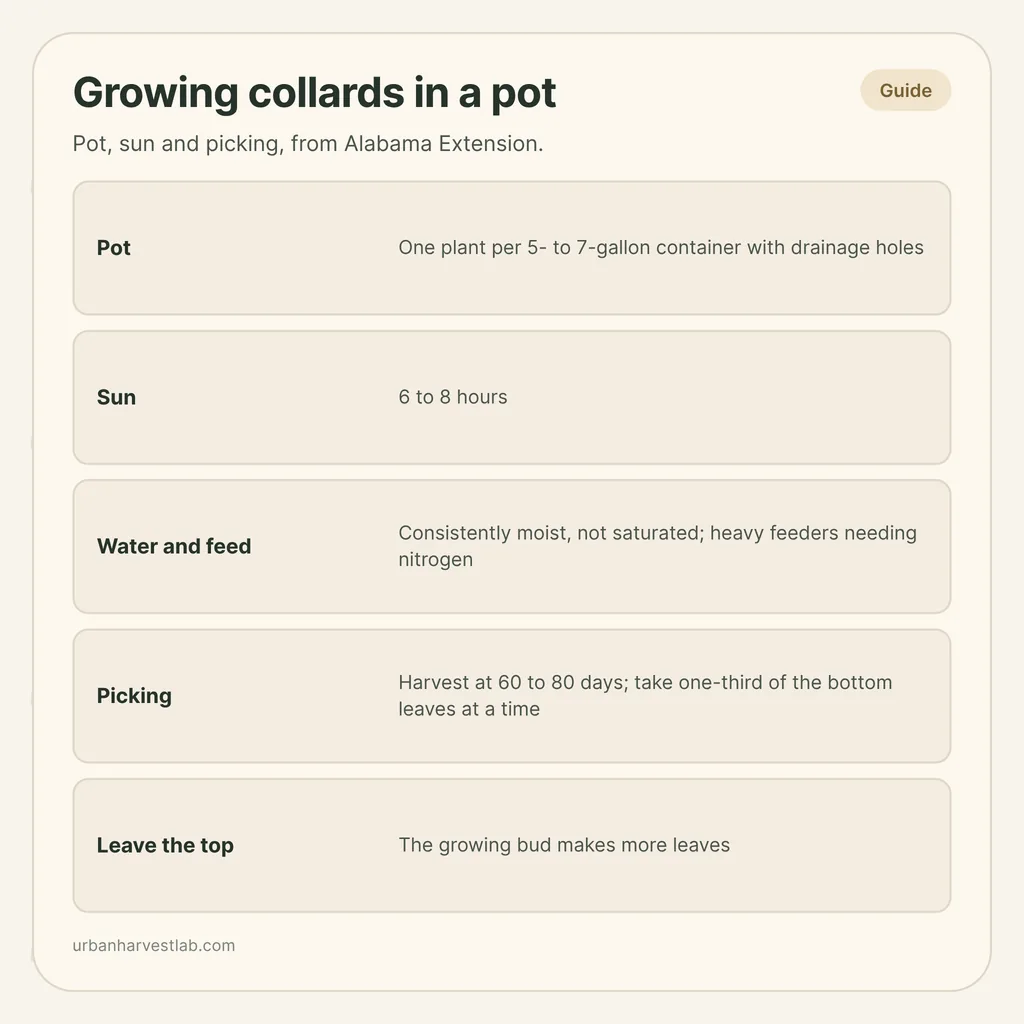
Give each collard plant its own 5- to 7-gallon pot with drainage holes, put it in 6 to 8 hours of sun, and pick the lowest leaves first. Those are Alabama Cooperative Extension’s figures, and they are all you need to start a single plant.
Collards are a non-heading cabbage relative, so you are growing leaves rather than waiting for one harvest. Mississippi State Extension says plainly that collards can be grown in containers, and notes that a pot is more manageable and needs much less weeding. For the other loose-leaf brassica, see kale in containers; the cabbage that forms a head is a different job, covered in cabbage in containers.
Pot size and mix
Alabama Extension spaces collards 12 inches apart in a row, or one plant per 5- to 7-gallon container. Arkansas Extension adds that the plants “become large” and wants at least 3 feet between rows in a garden. A five-gallon bucket with holes drilled in the base meets the lower end of that range.
Use potting mix, not garden soil. Alabama Extension says to use potting mix and make sure containers have drainage holes, and suggests self-watering containers as an alternative. If you are buying a bigger pot for this, browse 7-gallon grow pots on Amazon and check that the base has drainage holes before you fill it.
Sow or transplant
Alabama Extension starts seedlings 6 to 8 weeks before planting out and hardens them off for 1 week. Its planting windows are February to mid-March and mid-August to mid-September, which suit a mild Southern climate. In colder places, work from your own frost dates; finding your first and last frost dates shows how. Arkansas and Illinois Extension both describe two plantings: early spring for a summer harvest, and midsummer for a fall and early winter harvest.
Transplants save time. University of Kentucky Extension says leaves from transplants are ready for harvest in two to three weeks.
Water and feed
Illinois Extension says that if you maintain ample soil moisture during hot periods in the summer, collards produce an abundant harvest. Alabama Extension puts it as consistently moist but not saturated, and warns against wetting the leaves, which invites fungal disease. A pot loses water faster than a bed, so check the mix by touch; how often to water container vegetables covers the method.
Mississippi State calls collards relatively heavy feeders that need side-dressing with a nitrogen fertilizer. Alabama Extension applies an all-purpose 8-8-8 or 10-10-10 at planting, then side-dresses 3 to 4 weeks after planting and again after the first harvest, following label directions. The fertilizer schedule for container vegetables explains how to translate that to a pot.
Harvest from the bottom up
Alabama Extension harvests at 60 to 80 days, when outer leaves are 8 to 10 inches long, and removes only one-third of the bottom leaves at a time. Arkansas Extension gives roughly 60 days to a first harvest from seed. Pick clusters of lower leaves before they are full-sized, tough and woody, Illinois Extension advises.
Leave the top alone. Mississippi State describes harvesting the large lower leaves and leaving the young leaves and the growing bud to make more, and UF/IFAS says the plant continues to grow from the top of the centre stem. Arkansas Extension reports that maximum yields come from taking bottom leaves before they get too old.
On cutting, Arkansas Extension reports that bacterial soft rot enters through the broken areas where leaves were removed.
Heat and cold
The sources do not fully agree on heat, so here is what each says:
| Source | Heat | Cold |
|---|---|---|
| University of Maryland | More heat-tolerant than kale or turnip greens | Kale and turnip greens are more cold-tolerant than collards |
| Mississippi State | Do not tolerate high temperatures very well; spring plantings produce through summer if watered and fertilized | Cold intensifies flavour |
| UF/IFAS | Established plants last well into summer heat | Grow below freezing |
| Arkansas | Grow better in warm weather | Tolerate more late-fall cold than any other cabbage relative |
The practical reading: collards are among the sturdier brassicas for a hot balcony, but they are still a cool-season crop, and the best leaves come in spring and fall. In summer, keep the mix evenly moist. Illinois Extension and Arkansas Extension both say frost improves fall flavour. The University of Maryland suggests a protected location, floating row cover or a cold frame to extend the fall harvest. For a pot, the kale page covers sheltering containers in a freeze. Mississippi State names Vates as the preferred variety for overwintering.
Pests
Mississippi State lists aphids and leaf-eating worms as the major problems, and Kentucky says caterpillars cause the most harm. Illinois Extension names three cabbage-worm species and says they can ruin the crop if not controlled, and worse in fall plantings. Identification and control are in cabbage worms on kale, which applies to collards as well; for aphids on the undersides of leaves see cabbage aphids. Kentucky notes that aphids can often be washed from the harvested leaves.
Sources
- Alabama Cooperative Extension System: Grow More Collard Greens
- University of Arkansas Division of Agriculture: Collards (FSA6067)
- Illinois Extension: Collard
- University of Maryland Extension: Growing Leafy Greens in a Home Garden
- Mississippi State University Extension: Collards
- Mississippi State University Extension: Lettuce, collards thrive in cool-season gardens
- UF/IFAS Extension Hillsborough County: Growing Collard Greens in the Florida Vegetable Garden
- University of Kentucky Extension: Growing Your Own, Collards (NEP-223)
Around leafy brassicas in pots
The neighbouring pages for kale, cabbage, caterpillars and feeding.
Common questions
What size pot do collard greens need?
Alabama Extension advises one plant per 5- to 7-gallon container with drainage holes. Arkansas Extension notes that the plants "become large".
How do you harvest collards so they keep growing?
Pick the lowest, oldest leaves first and leave the growing bud at the top. Alabama Extension says to remove only one-third of the lower leaves at a time, and UF/IFAS notes the plant keeps growing from the top of the centre stem.
Can collards take summer heat in a pot?
Better than kale, according to the University of Maryland, and Mississippi State reports spring plantings producing right through summer if watered and fertilized. Mississippi State also says collards do not tolerate high temperatures very well, so expect the best leaves in cool weather and keep the mix evenly moist.
Does frost hurt collards?
Illinois Extension and Mississippi State both say cold improves the flavour, and UF/IFAS reports collards growing below freezing. The University of Maryland rates kale as more cold-tolerant than collards.
Related guides

How to grow kale in pots: cold, caterpillars and picking by the leaf
Kale suits containers: it is shallow-rooted enough for a modest pot, shrugs off frost, and gives leaf after leaf if you pick from the bottom.
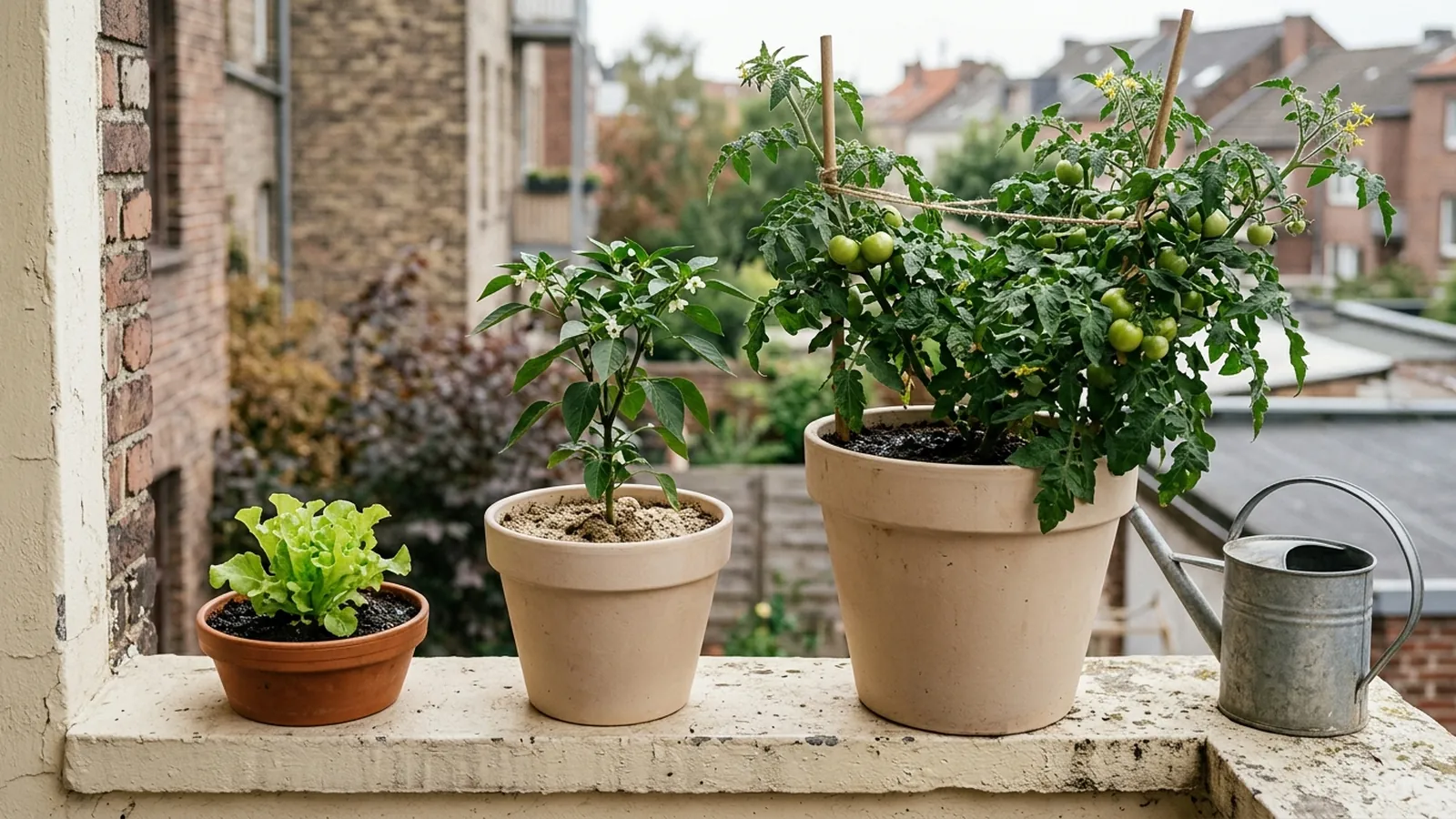
How often to water container vegetables: volume and crop stage set the interval
A pepper in a 2-gallon pot in May and the same pepper in the same pot in August are two different watering problems. Once you can see why, the question stops being how often and becomes how much mix you gave the plant, and what it is carrying right now.
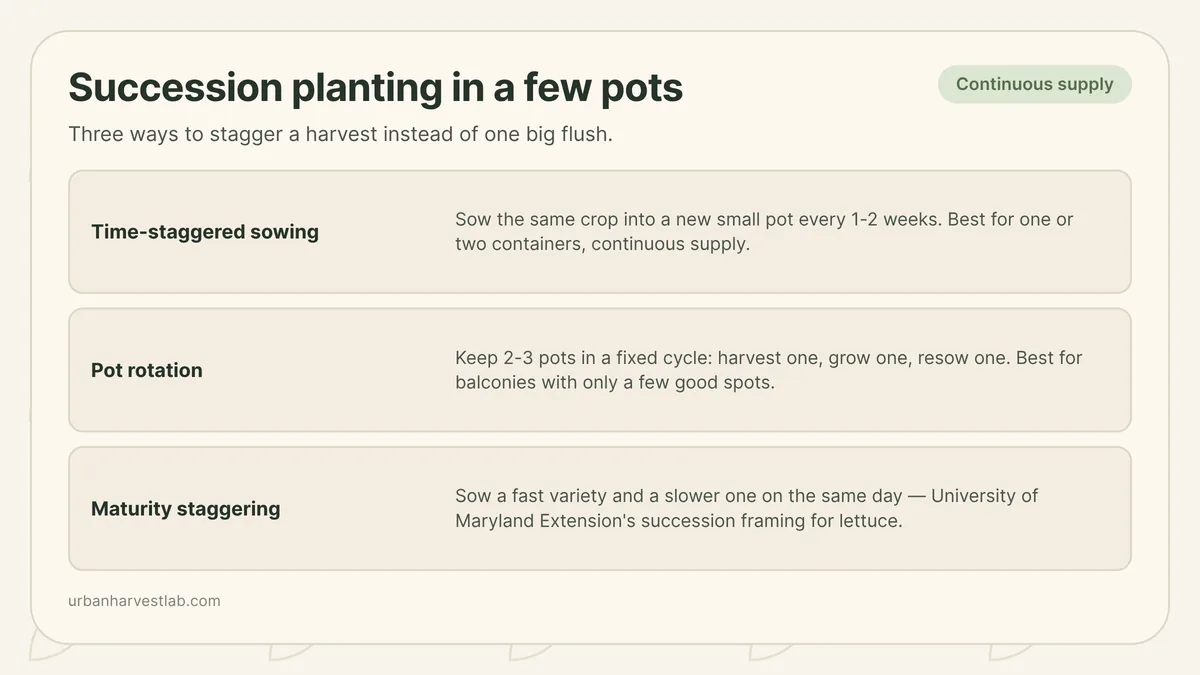
Succession planting in containers: how to stagger a harvest from a few pots
Succession planting in containers is a sowing rhythm: a few pots restarted on a schedule keep producing, where one large planting ripens together and then quits together.