Troubleshoot the system before you change the inputs.
Symptoms
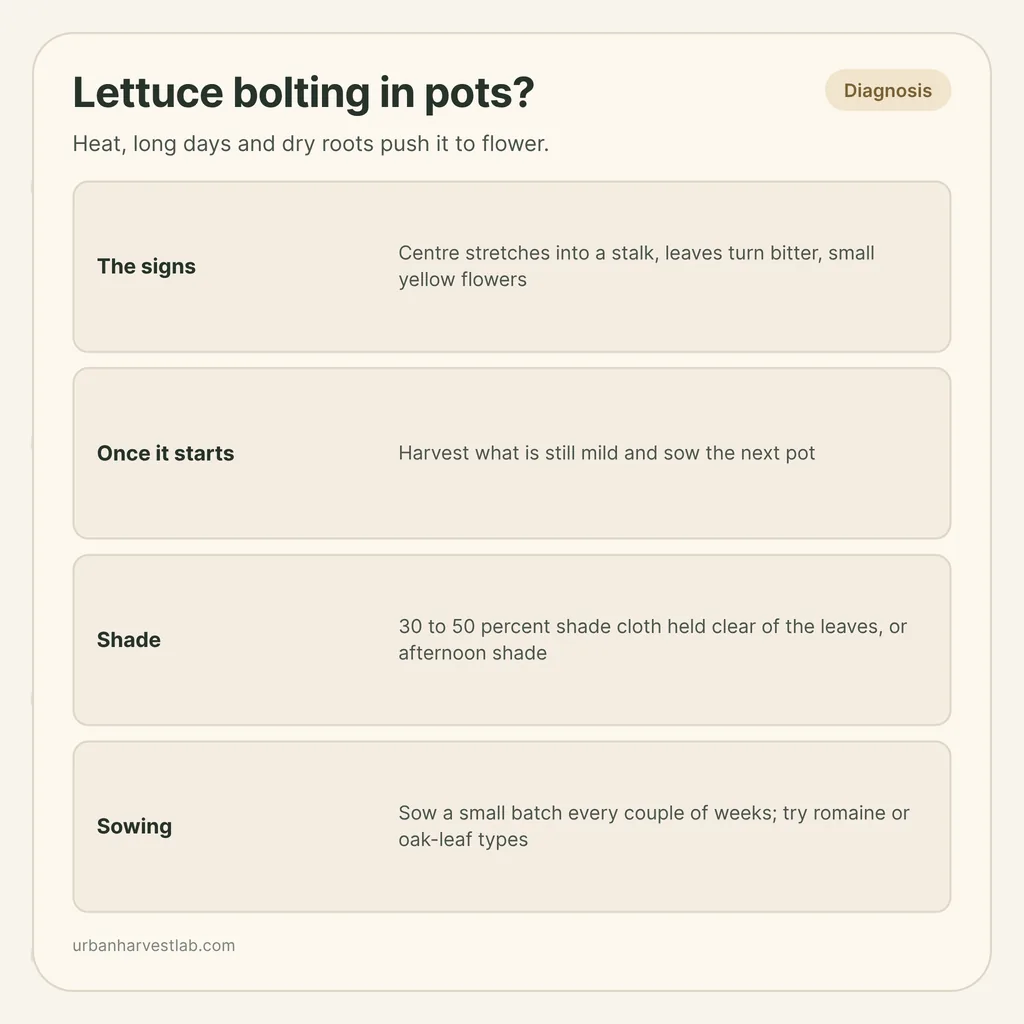
- The centre of the rosette stretches into a cone or stalk.
- Leaves along the stem become sparse and taste bitter.
- Small yellow flowers appear at the top.
- Bolting arrives in a warm spell, or a spell when the pot was allowed to dry out.
Possible causes
- Hot weather, especially warm nights.
- Long spring and summer days.
- Water stress, or a pot that heats and dries in full sun.
- A variety that bolts quickly, such as bibb or crisphead types.
Quick fixes
- Harvest the plant while it is still usable and resow.
- Move the pot to afternoon shade or hang 30 to 50 percent shade cloth clear of the leaves.
- Water evenly and mulch the surface.
- Switch to romaine, oak-leaf or named slow-bolt varieties.
Why potted lettuce bolts, and the lever for each cause
| Trigger | What you see | What changes it |
|---|---|---|
| Heat | Bolting in the first warm spell; hot pot wall on the sunny side | Move or shade the pot, grow a heat-tolerant type, sow earlier or later |
| Long days | Stalks even when temperatures are mild | Sow earlier in spring and harvest before the longest days |
| Dry roots | Wilting at midday, mix pulling from the pot edge | Water evenly, mulch, avoid black pots in direct sun |
| Late harvest | Spring plants left standing into heat and long days | Utah State Extension advises harvesting spring-planted lettuce as soon as possible; sow in small batches |
Lettuce in a pot bolts when heat, lengthening days and water stress tell it to flower, and a container in the sun delivers all three early. University of Maryland Extension puts it plainly: increasing day length and high summer temperatures usually cause seedstalk formation, “bolting”, and a bitter flavor. You cannot change the day length. You can change the date you sow, how hot the pot gets, how evenly it is watered, and which lettuce you grow.
If you grow lettuce hydroponically, the water temperature and light schedule are the levers, and hydroponic lettuce bolting covers them. What follows is for lettuce in potting mix.
How to tell it is bolting
The centre of the rosette lifts and stretches. Leaves spread out along a rising stem, and eventually a flower stalk appears. Utah State Extension describes bolting as the shift from leaf growth to flower production and notes that the start of a flower stalk can happen at any time during growth, so a plant can turn well before it looks tall.
The leaves turn bitter along the way. If the plant has only just started to stretch, cut the leaves now and use them. Once the stalk is up, the plant has stopped being a salad crop.
Why pots make it worse
Cornell describes lettuce as liking it cool, around 60 to 65 F (Clemson Cooperative Extension gives a slightly wider 55 to 65°F, as covered in salad greens in containers in fall). A pot on a balcony ledge rarely stays there in a warm spell. Cornell also lists moisture stress and high temperatures, particularly at night, as things that encourage bolting, and a small pot swings between hot and dry faster than a bed does.
Pot colour and position add to it. Dark walls in direct sun heat the root zone from the side; black pots and root heat has the data and the cheap fixes. Penn State Extension adds that a well-watered soil stays cooler than a dry one, and that black plastic mulch “cooks” the soil, so use straw, other organic matter or unprinted cardboard instead. The same advice appears in a lettuce-specific form from University of Maryland Extension: organic mulches conserve moisture and keep soil temperature even.
Lettuce also has shallow roots, so a wide, shallow pot suits it better than a deep, narrow one. Lettuce container size covers the dimensions.
The four levers
Sowing date
Utah State Extension notes that long days trigger bolting, so planting dates in spring matter, and it advises harvesting spring-planted crops as soon as possible to avoid excess heat, long days and the bolting that goes with them. In practice that means starting lettuce as early as the mix and weather allow, and treating the late-spring sowing as the one that will run out of time. University of Wisconsin Extension says lettuce can be sown outdoors as early as 4 to 6 weeks before the average last frost, or set out as transplants 2 to 4 weeks before it. To find your own date, first and last frost dates for a balcony shows how to work out the last frost you are sowing around. Penn State Extension makes the same point: bolting is commonly associated with hot weather, but it is triggered by changes in day length.
For late summer and autumn sowings, when days shorten, see salad greens in containers in fall.
Shade
University of Wisconsin Extension suggests growing summer lettuce in light shade. University of Maryland Extension says lettuce tolerates partial shade, which it defines as 4 to 6 hours of direct light a day, and that baby leaf lettuce can be grown entirely in indirect light in summer. It also suggests planting so that taller crops such as sweet corn, staked tomatoes or pole beans shade the lettuce during the hottest part of the day. Cornell suggests partial shade from taller plants, latticework or another screen.
On a balcony, that means putting the lettuce pot behind a tomato pot or trellis, or moving it to the side that loses sun after midday. If you use shade cloth, Penn State Extension recommends 30 to 50 percent for most vegetables and says the cloth should not touch the plants, because heat from the cloth can burn them. Hang it on a frame or hoops. If you need some, browse 30 to 50 percent shade cloth on Amazon. More placement ideas are in growing vegetables in shade on a balcony, and the wider heat plan is in protecting container plants in a heatwave.
Even water
Utah State Extension says transplants that are water-stressed before planting are more prone to bolting, and Cornell lists moisture stress among the causes. Keep the mix evenly moist rather than letting it dry to the point of wilting and then soaking it. University of Maryland Extension advises frequent, light watering for rapid growth and warns against over-watering, which invites root and leaf disease. Water in the morning, before the heat builds; Penn State Extension notes that watering early, before the onset of heat, protects plants. If you cannot tell whether the pot is too wet or too dry, overwatered vs underwatered separates the two.
Variety
University of Maryland Extension says bibb lettuce becomes bitter under high summer temperatures and lists oak-leaf types among the slow-bolting or heat-resistant choices. Cornell says romaine is more tolerant of warm weather and less likely to bolt than other types. University of Wisconsin Extension names Buttercrunch as a slow-bolting butterhead, Red Sails as one of the slowest-bolting red leaf lettuces, and Little Gem as a miniature butterhead suited to small spaces or containers. Seed packets that say “slow bolt” or “heat tolerant” are the ones to look for in warm climates.
Keep a pot of young plants coming
Because every planting will eventually bolt, the sensible plan is to sow small batches so something is at the tender stage at any time. University of Maryland Extension says lettuce is best planted in succession, or as different varieties that mature at different times, and University of Wisconsin Extension suggests sowing every couple of weeks. A second wide, shallow tray started two weeks after the first costs little. Succession planting in containers shows how to stagger pots without crowding the balcony.
If it has already bolted
Harvest the leaves that are still mild, pull the plant, and sow the next batch in fresh mix in a shadier spot. Herbs follow the same pattern; cilantro bolting is the closest comparison, though cilantro bolts for coriander seed and lettuce is simply finished.
Sources
- University of Maryland Extension: Growing lettuce in a home garden
- Utah State University Extension: Leafy greens, physiological problems
- Penn State Extension: Heat proofing your vegetable garden
- Clemson Cooperative Extension: Lettuce
- Cornell Cooperative Extension: Growing guide, lettuce
- University of Wisconsin Extension: Grow your own salad greens
Keep lettuce going in pots
Pot size, succession sowing and pot heat all change how long a container of lettuce lasts.
Common questions
Why is my lettuce growing tall and flowering in a pot?
It is bolting: the plant has switched from making leaves to making a flower stalk. Heat and long days trigger it, and Utah State Extension adds that stresses that slow vegetative growth commonly cause it. Pots in full sun heat and dry faster than garden soil, so they push lettuce there sooner.
Can I stop lettuce bolting once it starts?
No. Once the stalk forms the leaves turn bitter, which University of Maryland Extension links directly to bolting, so harvest what is still mild and sow the next pot.
Which lettuce bolts slowest in a container?
Cornell says romaine is more tolerant of warm weather and less likely to bolt than other types. University of Wisconsin Extension names Buttercrunch as a slow-bolting butterhead and Red Sails as one of the slowest-bolting red leaf lettuces. University of Maryland Extension recommends oak-leaf types for a longer season.
How much shade does lettuce need in summer?
University of Maryland Extension says lettuce tolerates partial shade, defined as 4 to 6 hours of direct light a day, and that baby leaf lettuce can grow entirely in indirect light in summer. Penn State Extension recommends 30 to 50 percent shade cloth for most vegetables.
Related guides
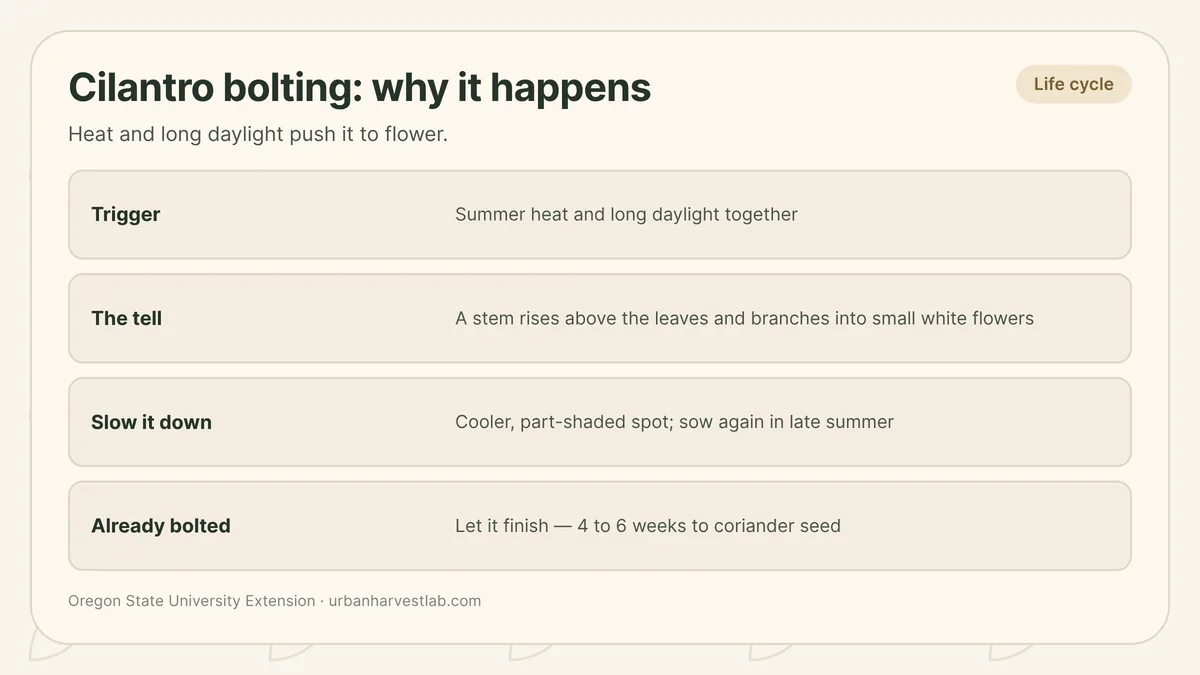
Cilantro bolting: why it happens and how to slow it down
Cilantro is an annual that bolts once heat and long daylight hours push it toward flowering, and cooler placement, sowing timing, and succession sowing are what actually slow it down.
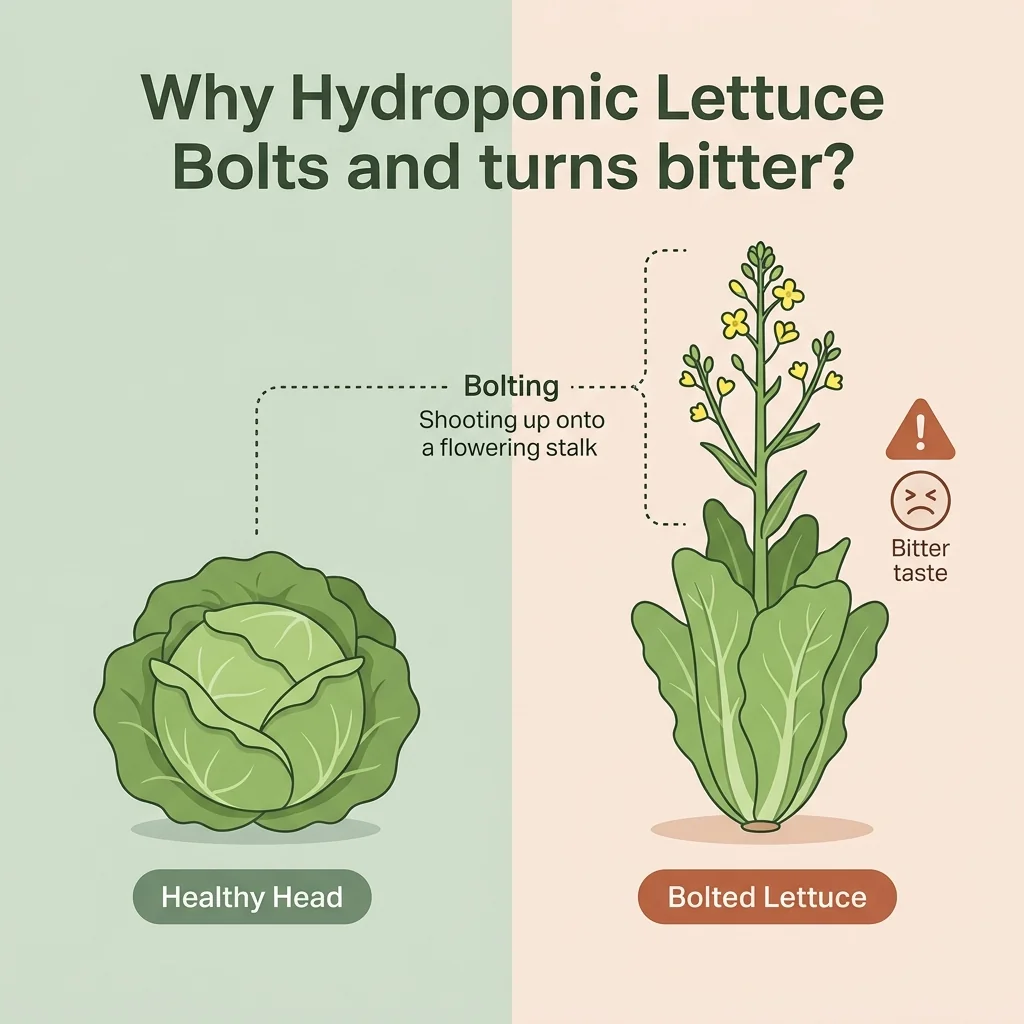
Why hydroponic lettuce bolts and turns bitter (and how to prevent it)
One day your hydroponic lettuce is a perfect, compact green rosette. The next, it has shot up like a pine tree, and a bite of the leaf leaves a horribly bitter taste in your mouth. Here is the science of lettuce bolting and how to stop it.
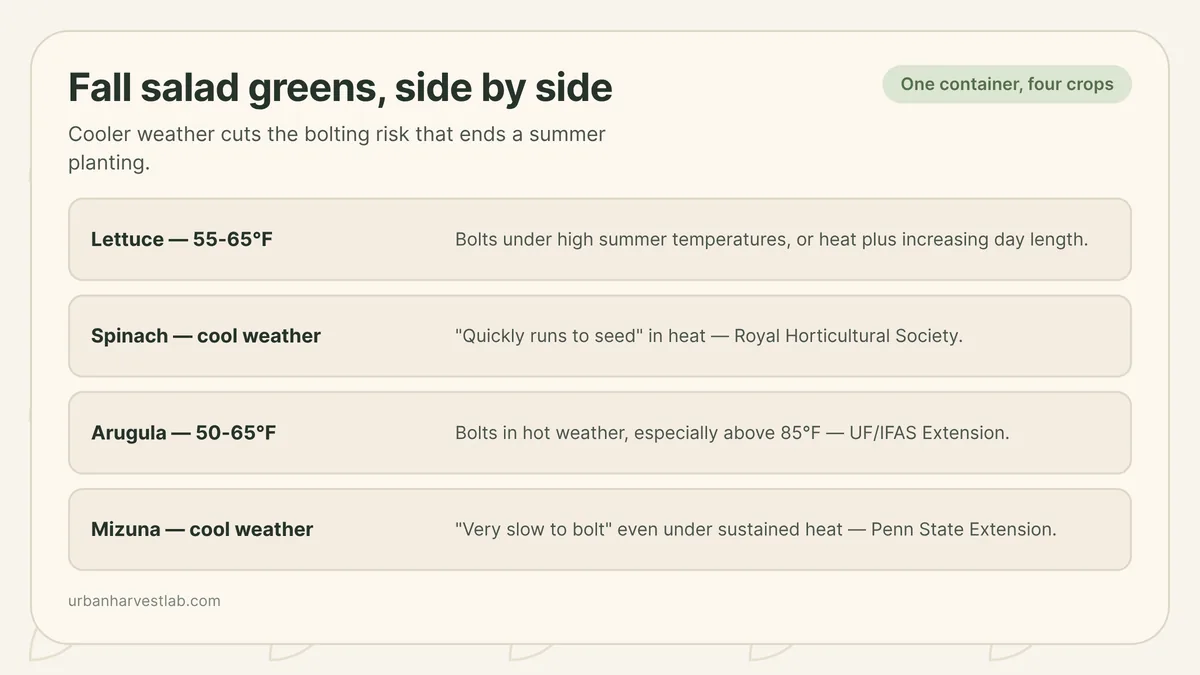
Growing salad greens in containers this fall
Lettuce, spinach, arugula, and mizuna all share the same summer problem and the same fall fix. Here is how to grow them together once the heat breaks.