Hardiness signal by distance from Lake Michigan (approximate)
| Area | 2023 USDA zone signal | What it means for a container |
|---|---|---|
| Lakefront and downtown (Loop, near-lake neighborhoods) | Zone 6b range — roughly -5°F to 0°F average winter minimum | Milder cold extreme, but a container still runs colder than the ground this reading is built from |
| Inland neighborhoods, mid-city | Transitional — likely between 6a and 5b depending on the block | Treat as the colder end of the range until you have local confirmation for your own address |
| Far inland and near O'Hare | Zone 5b range — roughly -15°F to -10°F average winter minimum | Matches the station data behind the temperature figures above; plan for the colder end |
Chicago gives a container garden two honest facts that do not fit on the same simple label. The outdoor growing season has a real, well-documented shape: a normal last spring freeze and a normal first fall freeze about six months apart. The winter cold a plant has to survive, on the other hand, is not one number for the whole city — it depends on whether a balcony sits near the lake or out toward the airport. Most “Chicago hardiness zone” answers online pick one of those two figures and present it as if it applied everywhere. How a hardiness zone and a frost date answer different questions covers that distinction in general; what follows applies it to Chicago specifically, instead of repeating the general explanation.
Quick answer for a Chicago balcony
The outdoor container season in Chicago normally runs from April 21 to October 19 — about six months, based on the 1991-2020 climate normal at O’Hare. The city’s 2023 USDA hardiness zone is not a single number: it reads 6b downtown and along the lake, and 5b at the airport and inland, a full zone and a half of difference driven by urban heat and the lake’s own thermal mass. A container on either side of that split runs colder than the zone number alone suggests, because a pot loses heat faster than the ground the zone is measured from. Wind at height, especially in the Loop’s building corridors, adds another layer of stress that a ground-level yard rarely experiences at the same zone.
The outdoor window: April 21 to October 19
The National Weather Service Chicago office (Romeoville/LOT) publishes normal freeze dates built from the 1991-2020 period at O’Hare, using a 32°F threshold. The normal last spring freeze falls on April 21; the normal first fall freeze falls on October 19. That is close to six months of outdoor growing time in an average year — enough for a full run of fruiting crops like tomatoes and peppers, with room at both ends for cool-season leafy crops before summer heat sets in and after it breaks.
“Normal” here means a 30-year average, not a promise for any given year. NWS Chicago’s own long-run records show real spread at both ends: the last spring freeze has occurred as early as March 19 (1925) and as late as May 25 (1992); the first fall freeze has arrived as early as September 22 (1995) and as late as November 24 (1931). A gardener who plants tender seedlings out the moment the calendar hits April 21 is following a good average, not a fixed date — the same caution that applies to any published frost normal. For the general method behind reading these figures and turning them into a working date for your own balcony, see the frost-date methodology page; the seed-starting calculator and the balcony vegetable garden calendar both use a last-frost date as their starting input, and April 21 is a reasonable Chicago default to enter into either.
Summer inside that window runs genuinely warm rather than extreme: per NOAA NCEI’s 1991-2020 normals for O’Hare, the July normal high is 84.5°F with a normal low of 66.4°F, and August is close behind. That is warm enough to carry fruiting crops through a full season without the sustained triple-digit stress that a desert-climate container garden has to manage. Winter outside the window is the opposite story — the same NOAA normals put O’Hare’s January range from an 18.8°F low to a 31.6°F high — which is why the window itself, not a mild-winter workaround, is the frame that matters here.
One city, two hardiness zones
This is the fact that most generic “Chicago gardening zone” content flattens into a single number, and it is worth stating plainly: the 2023 USDA Plant Hardiness Zone Map does not give Chicago one zone. ZIP 60601, in the Loop along the lakefront, reads zone 6b — an average annual minimum of roughly -5°F to 0°F. ZIP 60666, at O’Hare, reads zone 5b — roughly -15°F to -10°F. That is a full zone and a half of difference inside one metro area, and it exists because two separate effects push in the same direction: a dense urban core retains heat from pavement, buildings, and human activity long after an open field has released it, and Lake Michigan’s enormous thermal mass moderates the air right along the shoreline in both directions, warmer in winter and cooler in summer.
The temperature normals behind the frost dates and monthly figures above come from the O’Hare station specifically, because that is where NOAA NCEI and NWS Chicago collect their long-run data. O’Hare sits about 25 km northwest of the Loop, in the colder zone-5b band, not the milder 6b band most lakefront and downtown balconies actually experience. That is not a flaw in the data; it is simply what “the nearest full weather station” means for a city as spread out as Chicago, which is why a range, not a single confident zone, is what gets stated here.
The honest, useful version of “what zone am I in” is not a single number picked for convenience. It is: check how close your building sits to the lake and to the urban core, treat a downtown or lakefront address as closer to 6b, treat an inland or far-suburban address as closer to 5b, and when in doubt, plan for the colder end of that range rather than the warmer one. The table above gives a rough starting point; a soil thermometer and a season or two of your own observation will tell you more about your specific balcony than any citywide map can.
Why a container runs colder than the zone number suggests
Even after picking the right end of that 6b-to-5b range, one more gap remains. A USDA hardiness zone is built from air temperature at a weather station, measured over open ground with the surrounding earth’s own thermal mass underneath it. A container on a balcony has none of that mass. Exposed on every side above the rail, a pot’s growing mix can track close to air temperature during a hard cold snap, cooling and warming faster than garden soil at the same depth ever would. That is why a perennial rated hardy for zone 6b in the ground is not automatically hardy for zone 6b in an exposed pot on a balcony in the same neighborhood — the zone number describes the air a plant sits in, not the substrate it is actually rooted in.
This is the single most important adjustment for anyone gardening in containers in Chicago, whichever end of the zone split they live on. A thick-walled or grouped container, pushed against an exterior wall rather than left isolated on an open railing, holds heat noticeably better than a thin pot standing alone in the wind. Moving small pots into an unheated garage, stairwell, or against a heated wall for the coldest weeks does more for winter survival than any zone number implies on its own. The guide to overwintering rosemary and thyme in pots covers the specific watering and placement decisions that matter once a perennial is going to spend winter in a container rather than in the ground — read that before assuming a 6b reading settles the question.
Wind at height in the Loop and beyond
Chicago’s downtown skyline creates its own wind pattern, and it is not a minor detail for a high-floor balcony. Tall buildings funnel and accelerate airflow between them, producing gusts at height that a ground-level yard in the same zone rarely has to withstand. That matters twice over for a container garden: wind dries out an exposed pot faster than still air does, and it stresses tall or trellised plants more than their zone-based cold tolerance alone would suggest. A tomato or pepper that handles Chicago’s summer heat without trouble can still need a heavier pot, a lower center of gravity, or added anchoring if it is sitting on a high floor in or near the Loop. This site’s guide to windproofing a balcony garden covers container choice, plant habit, and windbreak options in more depth than fits here — treat it as the next step once a balcony’s wind exposure, not just its zone, is part of the plan.
What fits inside a six-month window
This is a climate hub, not a crop-by-crop catalog for Chicago, so the goal here is the shape of the decision rather than an exhaustive plant list. Inside a roughly six-month outdoor window, fruiting crops with a medium life cycle — tomatoes, peppers, bush beans — generally have enough time from a late-April start to a mid-October finish, especially in dwarf or compact varieties suited to containers. Leafy, fast crops such as lettuce and spinach fit naturally at either edge of the window, before summer heat pushes them to bolt and again once temperatures ease in September. Anything with a long enough life cycle to bump against either frost date — a full 100-plus-day crop started outdoors from seed, for instance — is the kind of plant that benefits most from the head start the seed-starting calculator and a controlled indoor sowing period can provide.
Watering demand shifts noticeably across that same window rather than staying constant. NOAA NCEI’s normal precipitation for O’Hare peaks in May at roughly 4.5 inches and stays fairly generous through summer, but a container’s own drying rate — driven by heat, sun exposure, and the wind discussed above — matters more day to day than the monthly rainfall total. Expect the heaviest watering demand during the hottest, sunniest stretch of July and August, and a much lighter one during the cooler weeks bracketing April and October. The balcony vegetable garden calendar builds a full season around gates like these rather than fixed calendar months, and it is the right next stop for turning Chicago’s window into a week-by-week plan.
Extending the season without extending the risk
Once October 19 passes as a normal, the conversation for anything still growing outdoors shifts from “protect it outside” to “decide whether it comes in.” Perennial herbs such as rosemary and thyme are the clearest candidates for the move indoors described above, rather than for winter left in place — that is a container-specific choice, not the same recommendation an in-ground zone-6 garden guide would give for an established, rooted perennial. Once a plant, or a fresh round of herbs, moves inside for the winter, the light it gets through a window drops sharply in both hours and intensity through a Chicago winter, which is the exact gap covered in growing herbs in winter with grow lights. Treat that page as the outdoor window’s natural sequel rather than a separate topic: the same six-month outdoor season implies roughly six months where a windowsill alone has to do more work than it can reliably manage.
Common mistakes reading Chicago’s season and zone data
- Quoting one zone number for the whole city. Chicago is not “zone 6” or “zone 5” as a single fact; it is a range that depends heavily on distance from the lake and from the urban core, and treating either end as universal misleads a reader on the other side of that split.
- Treating April 21 and October 19 as fixed dates rather than normals. Both are 30-year averages with a real historical spread of weeks on either side, not calendar guarantees for the current year.
- Assuming a container is as winter-hardy as garden soil in the same zone. A pot’s growing mix cools and warms far faster than the ground a USDA zone is measured from; this is the single biggest gap between “what the zone map says” and “what actually happens to a balcony perennial.”
- Ignoring wind as a separate factor from cold. A high-floor or Loop-adjacent balcony can face meaningfully stronger gusts than a ground-level yard in the same zone, which affects watering frequency and structural stress independently of temperature.
- Skipping the transition to indoor growing once the outdoor window closes. A windowsill alone rarely replaces the light an outdoor position provided during Chicago’s shorter, darker months; treating that gap as a light problem, not just a cold one, is what actually gets a herb collection through winter.
Deciding what to do when your own zone is uncertain
Somewhere between the Loop’s 6b reading and O’Hare’s 5b reading sits most of the metro area’s actual container gardens, and no citywide map will resolve that uncertainty down to a single address. The practical response is not to wait for a perfect answer; it is to make the more cautious assumption until local evidence says otherwise. For a perennial that would be expensive or disappointing to lose, plan around the colder end of the range — 5b-style caution — rather than the milder lakefront reading, unless the balcony’s own location and a season of observation say otherwise. For an annual crop that dies back at the end of the season regardless of zone, the frost-date window matters far more than the zone split does, and April 21 to October 19 is a reasonable planning default across the whole metro area. That asymmetry — zone uncertainty matters most for what survives winter, frost-date normals matter most for what grows and dies within one season — is the single most useful thing to carry out of a discrepancy that most Chicago gardening content rarely mentions at all.
Sources and further reading
Turn this into a working season plan
This hub sets Chicago's outdoor window and its zone caveat. These guides turn that into working dates, a sowing schedule, and season-specific container care.
Common questions
What USDA hardiness zone is Chicago actually in?
It depends on where in the metro area you are. The 2023 USDA Plant Hardiness Zone Map puts downtown Chicago and lakefront ZIP codes such as 60601 in zone 6b (roughly -5°F to 0°F average annual minimum), while the O'Hare area (ZIP 60666) reads zone 5b (roughly -15°F to -10°F) — a full zone and a half colder. There is no single correct answer for "Chicago's zone"; there is a range depending on how close you are to the lake and how much surrounding building mass moderates your specific block.
When is the last frost and first frost in Chicago?
The National Weather Service Chicago office gives a normal last spring freeze of April 21 and a normal first fall freeze of October 19, based on the 1991-2020 period at O'Hare. That is a 30-year average, not a guarantee: the last spring freeze on record has landed as early as March 19 and as late as May 25, and the first fall freeze has come as early as September 22 and held off until November 24 in other years. Treat the normal dates as a planning midpoint, not a fixed calendar entry.
If I live near the lake in zone 6b, can I leave a potted rosemary outside all winter?
Not automatically. Zone 6b describes the average coldest night for a plant rooted in the ground, and a container does not have the same insulation the surrounding earth gives a garden bed. An exposed pot can drop toward air temperature far faster than soil does, so a rosemary that would survive winter planted in a 6b garden can still freeze solid in an unprotected pot on a balcony in the same neighborhood. See this site's guide to overwintering rosemary and thyme in pots for what actually gets a potted perennial through a Chicago winter.
Does living downtown near the lake really change growing conditions, or is that overstated?
Urban heat retained by pavement and buildings, plus Lake Michigan's own thermal mass, are well-documented reasons a dense lakefront core runs measurably milder in winter than open, inland terrain nearby — enough to shift the USDA zone reading by a full band and a half between the Loop and O'Hare. That mostly affects how cold the coldest night gets, not the length of the frost-free season itself, since the frost dates here come from one station (O'Hare) that applies across the metro area. A downtown balcony likely has an easier winter for perennials; its outdoor sowing-and-harvest window is not necessarily longer.
What about wind on a high floor in the Loop?
Wind at height behaves differently than wind at street level, and Chicago's downtown towers are known for generating stronger, more channeled gusts between buildings than an open yard would see. That matters most for tall plantings, trellised crops, and anything in a narrow or lightweight pot. This site's guide to windproofing a balcony garden covers anchoring, container choice, and windbreaks in more depth than fits here.
Related guides
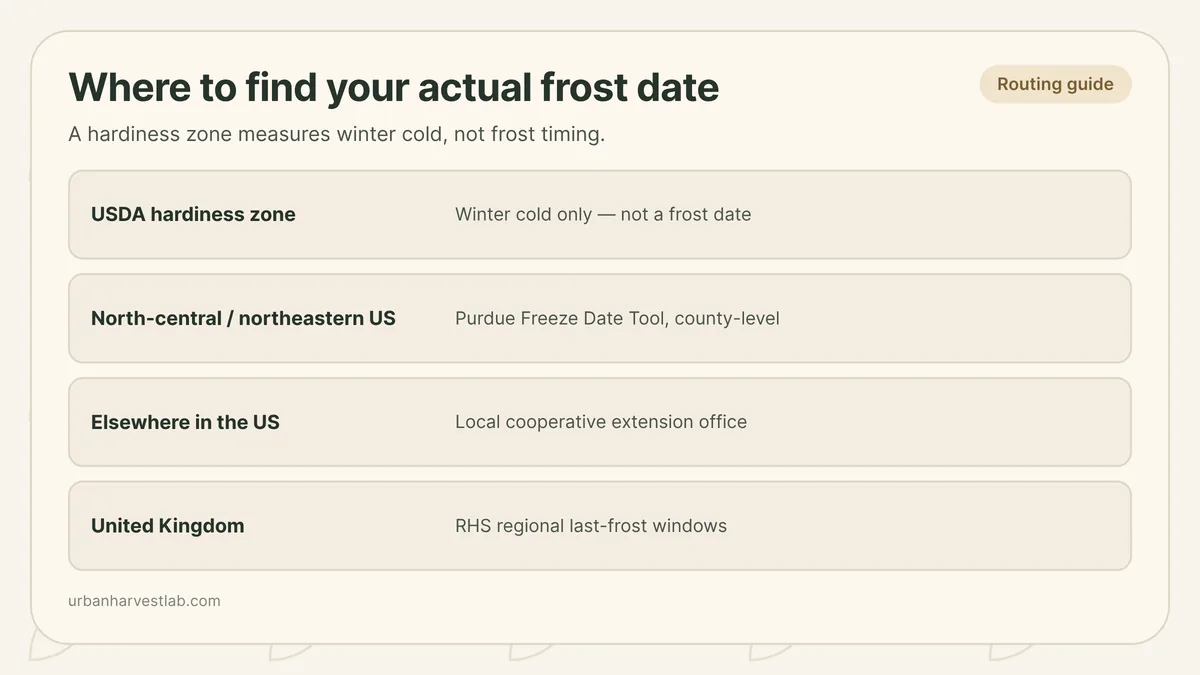
First and last frost dates for a balcony: start with your zone
Your hardiness zone tells you how cold winter gets, not when frost starts or ends. Look up the zone's temperature band, then use the tools built to answer the date question directly.
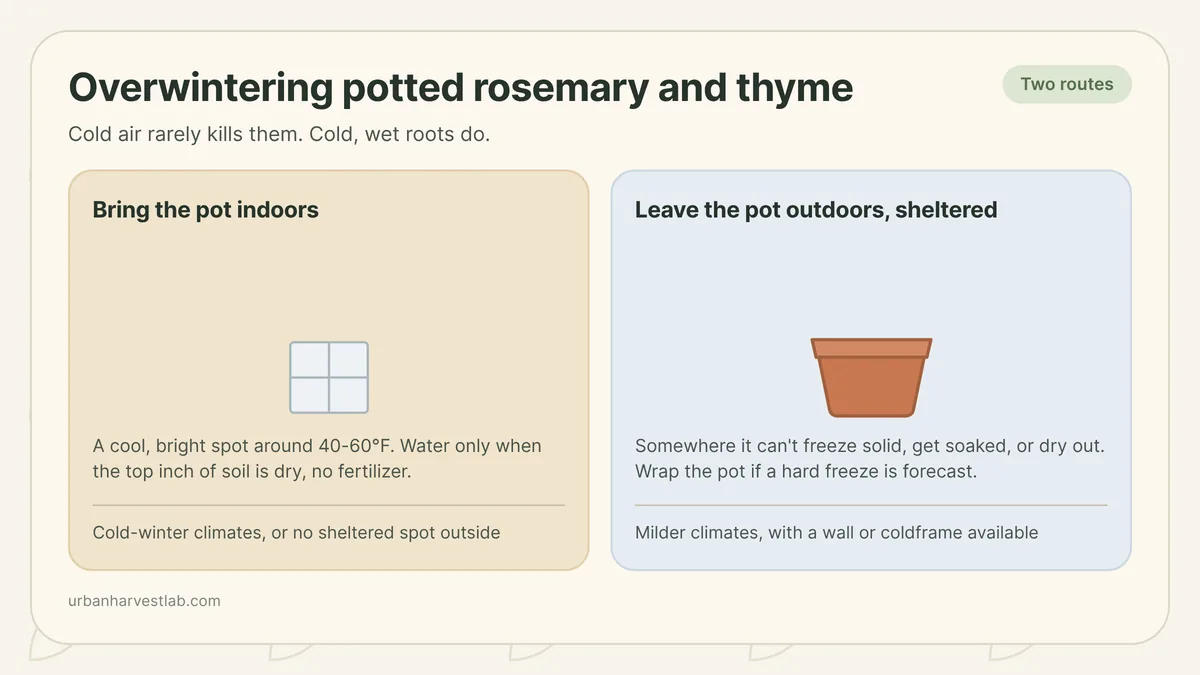
How to overwinter rosemary and thyme in pots
Winter kills more potted rosemary and thyme through mistimed watering and cold-wet roots than through cold air alone. Here is what to do indoors and out.
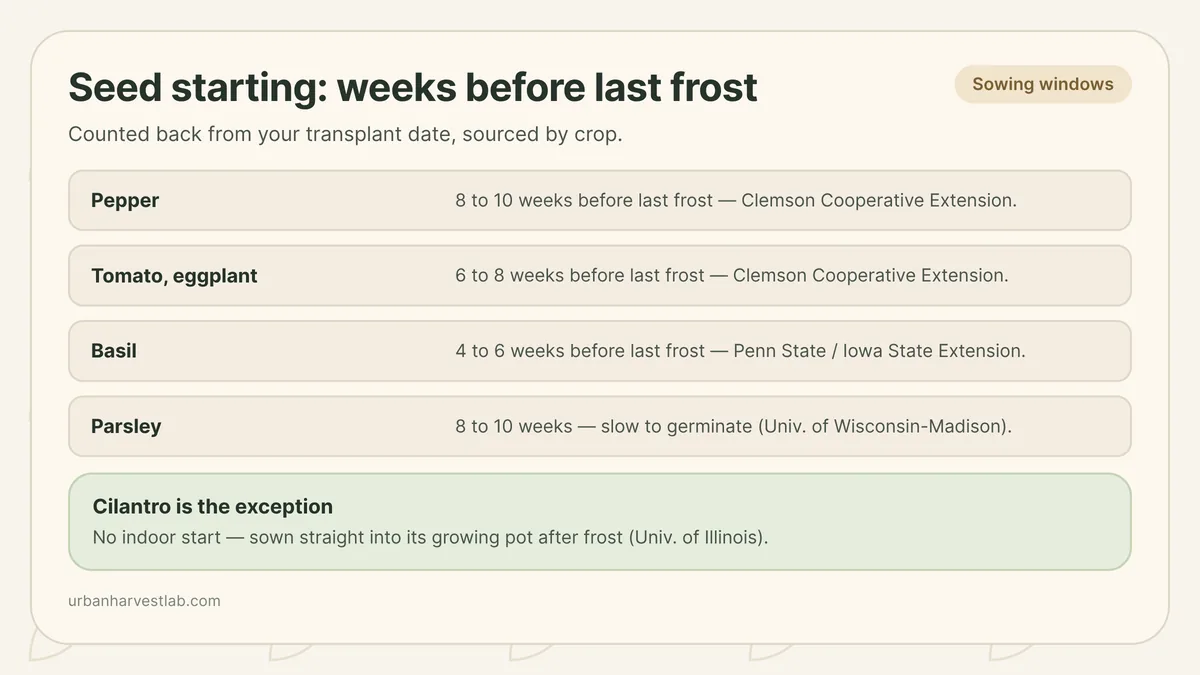
Seed starting calculator: sowing dates from your last frost date
A last frost date is only useful once you count backward from it. This works out that count crop by crop, instead of applying one week figure to everything in the seed drawer.