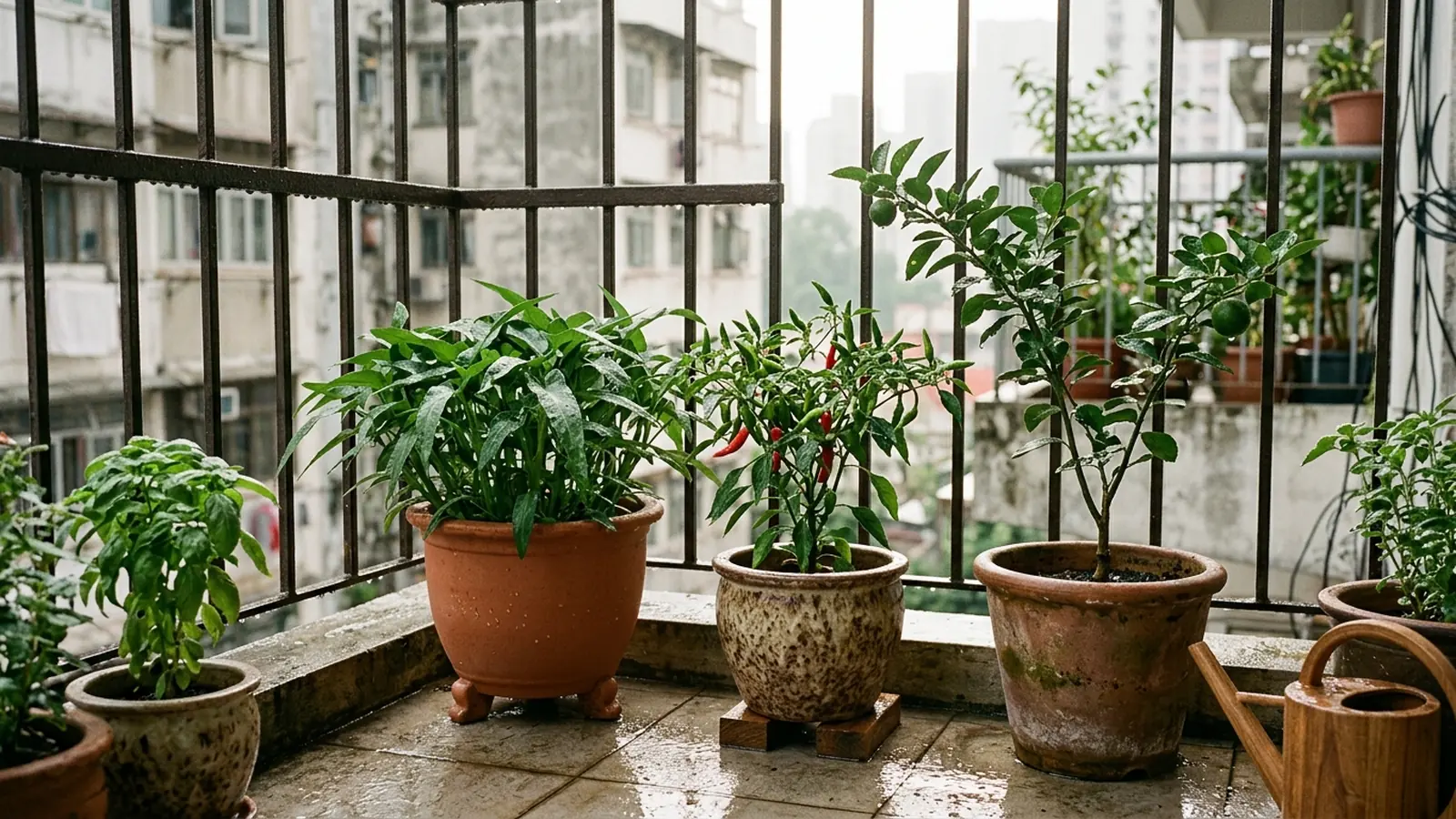
Miami's two real seasons for a container garden
| Season | Typical high | Monthly rainfall | What it means for containers |
|---|---|---|---|
| Dry season (Nov-Apr) | 76-84°F (24-29°C) | 1.8-3.5 in (46-90 mm) | Lowest drainage risk; the best window for cool-tolerant leafy crops and Mediterranean herbs |
| Wet season (May-Oct) | 86-91°F (30-33°C) | 6.3-10.5 in (161-267 mm) | Drainage and airflow matter more than watering; fungal pressure peaks |
| Rare cold snap (a few hours, some years) | Low-to-mid 40s°F (4-7°C) at the coldest extreme | Not a monthly pattern | A quick cover for sensitive perennials, not a seasonal plan |
A Miami container garden is not planned around a frost date, because there is not really one to plan around. NOAA station history for Miami International Airport shows no conventional frost or freeze window at all — the record low there is 30°F, and it has only been reached twice since the mid-1980s. That single fact changes the whole shape of the planning question. Instead of “when can I start,” the useful question in Miami is “what survives summer,” because the season that actually stresses a container here is the hot, wet stretch from roughly May through October, not a winter that barely qualifies as cold. Get the container’s drainage right for that wet season, and most of what makes Miami different falls into place.
This is a climate-first hub, not a plant-by-plant list. The goal here is to explain how Miami’s specific mix of heat, humidity, and rainfall changes the general logic of container gardening — pot choice, mix, watering habits, and disease risk — with individual crops mentioned only where they illustrate that logic, not as an exhaustive planting catalog.
The season Miami doesn’t have to plan around
Miami sits in USDA Plant Hardiness Zone 11a, with an extreme winter minimum of 40-45°F (4-7°C) at both the downtown ZIP code and the airport station area, according to the 2023 USDA Plant Hardiness Zone Map. That is a mild-winter zone by definition, but the more striking fact sits in the station’s own historical record rather than in the zone label: Miami International Airport has practically never recorded a true freeze. Its lowest temperature on record is 30°F, reached on two separate occasions — December 25, 1989, and January 22, 1985 — and freezing at 32°F or below has practically never occurred there in the modern record, per NOAA station history.
That is worth stating plainly because it is easy to misread as “no risk at all,” which is not quite right either. It means there is no normal frost date — no seasonal window a grower needs to track the way a Chicago or a Phoenix grower would. What it does not mean is that cold cannot happen; it means cold, when it happens, is a rare, short-lived event rather than a predictable annual season. The practical difference matters: a Miami grower does not need a frost-protection routine built into the yearly calendar, but does need to know what to do on the handful of nights a year that dip into the 40s°F, which is a very different problem from planning six months around a hard freeze.
Why summer, not winter, is the hard season
Most climate-first container guides for colder cities spend their effort on how to survive the cold months. Miami inverts that. Based on NOAA NCEI’s 1991-2020 monthly climate normals for the airport station, the coolest months — December through February — run a comfortable 76-78°F (25-26°C) for a daytime high, with lows in the 60s°F (16-17°C) and modest rainfall of 47-63 mm a month. Nothing about that stretch challenges a container the way winter does elsewhere.
Summer is where the real stress shows up, and it is not simple heat. Per the same NOAA NCEI normals, from June through September, average highs sit near 88-91°F (31-33°C) with lows barely dropping below the mid-70s°F overnight, so the potting mix gets little of the nighttime cooling a container in a more temperate climate would get. Layered on top of that heat is rain: the same four months bring 187 mm to 267 mm of precipitation each, roughly three to five times what the driest winter months deliver. September alone averages about 260 mm (10.2 in). That combination — sustained heat, warm nights, and heavy, frequent rain — is the actual problem this hub is built around, and it is a different problem from the dry, low-humidity heat that shapes container advice for a desert climate. Shade, grouping, and the rest of a general heat-load response still apply and are covered fully in how to protect container plants during a heatwave; in Miami, that heat response has to be paired with a rain response, not substituted for it.
The working calendar: dry season and wet season
Rather than four seasons, a Miami container garden really runs on two, and the comparison table above lays them out directly from the NOAA normals. The dry season, roughly November through April, is the easier stretch: lower rainfall, milder heat, and the best window for crops that would otherwise be considered cool-season elsewhere, plus subtropical herbs that do not love sustained humidity. The wet season, roughly May through October, reverses the priority list entirely — heat management and drainage take over as the main jobs, and watering becomes something to hold back on rather than increase.
April is worth calling out on its own: NOAA NCEI’s normal rainfall climbs to around 85 mm as the season turns, well above the dry-season baseline but still short of the full wet-season numbers that arrive by May. Treat it as a transition month rather than a firm boundary — the shift from “check for dryness” to “check for standing water” happens gradually, not on a fixed date.
Drainage is the central container decision here
In a climate with a real winter, the single most consequential container decision is often size, material, or insulation. In Miami, it is drainage — more so than in either a cold-winter or a dry-heat climate, because the risk a Miami container faces most often is not running dry, it is standing in water after a downpour. Do pots need drainage holes, and how to add one safely covers the full mechanics of why a pot needs a working hole and how to add one without cracking the container; the point specific to Miami is how much more often that mechanism gets tested here. A single wet-season storm can deliver more rain in an hour than a dry-season month delivers in total, and a container without generous, unblocked drainage has nowhere for that volume to go.
What that means for mix and elevation
Two adjustments follow directly from that risk. First, a potting mix that drains quickly and does not compact into a dense, water-holding mass matters more in Miami’s wet season than it would in a drier climate, where the same mix might simply dry out a little slower. Second, raising containers on feet or a stand — rather than letting the base sit flush against a patio floor or saucer — gives water somewhere to go immediately after a heavy rain instead of pooling directly against the drainage holes and slowing the exit it is trying to make. Neither change is exotic; both matter more here because the wet-season rain event that tests them is not occasional, it is a monthly pattern for roughly half the year.
Fungal pressure: containers under sustained humidity
Heat and standing moisture together are what fungal disease needs, and Miami’s wet season supplies both for months at a stretch rather than the odd humid week another climate might get. That is the mechanism behind three problems this site already covers in depth and that show up more readily in a Miami container than almost anywhere else in a temperate-climate guide: powdery mildew on container herbs, which spreads fastest where airflow is poor and humidity stays high; gray mold (botrytis) on herbs, which takes hold on damaged or crowded tissue in exactly the wet, still conditions a Miami balcony can hold through summer; and white mold on plant soil, a surface fungus that is usually cosmetic but that a consistently wet mix makes far more likely to appear in the first place.
None of those three diagnoses change because the container happens to be in Miami — the identification and the fix are the same wherever they show up. What changes is how often a Miami grower should expect to be checking for them. Spacing containers so air can move between them, avoiding overhead watering that wets the foliage on top of already-humid air, and not letting a pot sit permanently damp all do more preventive work in a Miami wet season than they would in a drier climate, where the same habits are more of a nice-to-have.
What actually grows well, by season
Because this is a climate hub rather than a plant list, the point here is the pattern, not a full catalog. In the dry season, crops that struggle with sustained humidity elsewhere — Mediterranean herbs like rosemary and oregano, along with quick leafy crops such as lettuce and radish — tend to do better in Miami’s mild, lower-rain winter than they would in Miami’s own summer, where the same crops are prone to rot or bolt under heat and wet stress. Tropical and subtropical herbs with more humidity tolerance, such as basil or chives, generally handle the wet season with more resilience, provided drainage and airflow are handled as described above.
Perennial subtropical crops in a large container — a dwarf citrus or a pepper plant, for example — benefit from the flip side of this climate: because there is no real winter to protect them from, they can stay outdoors year-round without the seasonal move-in, move-out routine a colder-climate container guide would otherwise require. Classic cool-season crops such as spinach or broccoli are the clearest mismatch for Miami: even the coolest local nights rarely drop enough to suit them, so they are realistically confined to a short dry-season window rather than a normal growing season.
The rare cold snap, and a brief note on storm season
Cold protection in Miami is a note, not a strategy. On the handful of nights a year — if any — that dip into the low-to-mid 40s°F, a lightweight cover or moving a sensitive potted perennial closer to a wall for the night is enough; there is no seasonal frost-protection plan to build the way there would be in a colder climate.
Miami also sits within a seasonal tropical storm track for part of the year. That is a wind and logistics question rather than a temperature one, and it deserves its own care rather than a borrowed cold-climate answer: if wind exposure is a concern for a balcony or rooftop setup, windproof balcony garden covers anchoring containers and choosing plants by growth habit, which is the more useful starting point than treating storm risk as an extension of the heat-and-rain planning covered here.
Common mistakes
- Waiting for a frost warning that a Miami station practically never issues, and treating the absence of a frost date as an absence of any seasonal planning at all.
- Keeping a summer watering schedule that ignores how much rain the mix is already receiving, which leads to a chronically saturated root zone rather than a healthy one.
- Choosing a container for its look rather than its drainage capacity, then discovering the shortfall only after the first heavy wet-season storm.
- Spacing containers tightly for a tidy appearance, which is exactly the crowded, still-air setup that lets powdery mildew and gray mold spread fastest.
- Assuming a subtropical perennial needs the same overwintering routine a colder-climate guide describes, when the actual Miami task is a single cover on a rare cold night, not a seasonal move indoors.
Sources and further reading
- NOAA NCEI: U.S. Climate Normals — 1991-2020 monthly normals, station USW00012839 (Miami International Airport), the source for every temperature and rainfall figure above.
- NOAA NCEI Access Data Service — the underlying station record used for the frost/freeze history, including the 30°F lows of 1989-12-25 and 1985-01-22.
- USDA Plant Hardiness Zone Map (2023) — ZIP codes 33130 (downtown Miami) and 33142 (airport area), both zone 11a.
Go deeper on Miami's real risks
Drainage, summer heat, and the fungal pressure that comes with sustained humidity each get their own full guide.
Common questions
Does Miami have a frost date to plan a container garden around?
No. NOAA station history for Miami International Airport shows no conventional frost or freeze window: the record low is 30°F, reached only on 1989-12-25 and 1985-01-22, and freezing (32°F) has practically never occurred there in the modern record. Treat it as a structural absence, not as missing data, and plan the calendar around summer heat and rain instead of a first or last frost date.
What is actually the hardest season for container plants in Miami?
Summer, not winter. From June through September, NOAA 1991-2020 normals put highs near 88-91°F (31-33°C) alongside 187-267 mm of rain a month. That combination of heat and sustained wet soil, not cold, is what stresses containers and drives fungal problems in Miami.
Should you water container plants less in a Miami summer?
Often yes, which runs against the usual summer instinct. Rain already delivers well over 150 mm a month from May through October, so a container on an automatic summer watering schedule is frequently adding water the plant does not need yet. Check the mix before watering rather than assuming summer means more.
What's the single biggest container mistake to avoid in Miami?
Using a pot without enough drainage capacity for heavy, sudden rain. A container that handles an ordinary watering can still sit with saturated mix for hours after a downpour if its holes are too few, too small, or blocked, and that standing water at the root zone is the most common preventable failure here.
Do container plants in Miami need any winter protection at all?
Almost never, and only as a one-off response, not a seasonal plan. On the rare night temperatures drop into the low-to-mid 40s°F, a quick cover or moving a sensitive pot in near a wall is enough. It is a response to an unusual night, not a frost-season routine like colder-climate guides describe.
Related guides
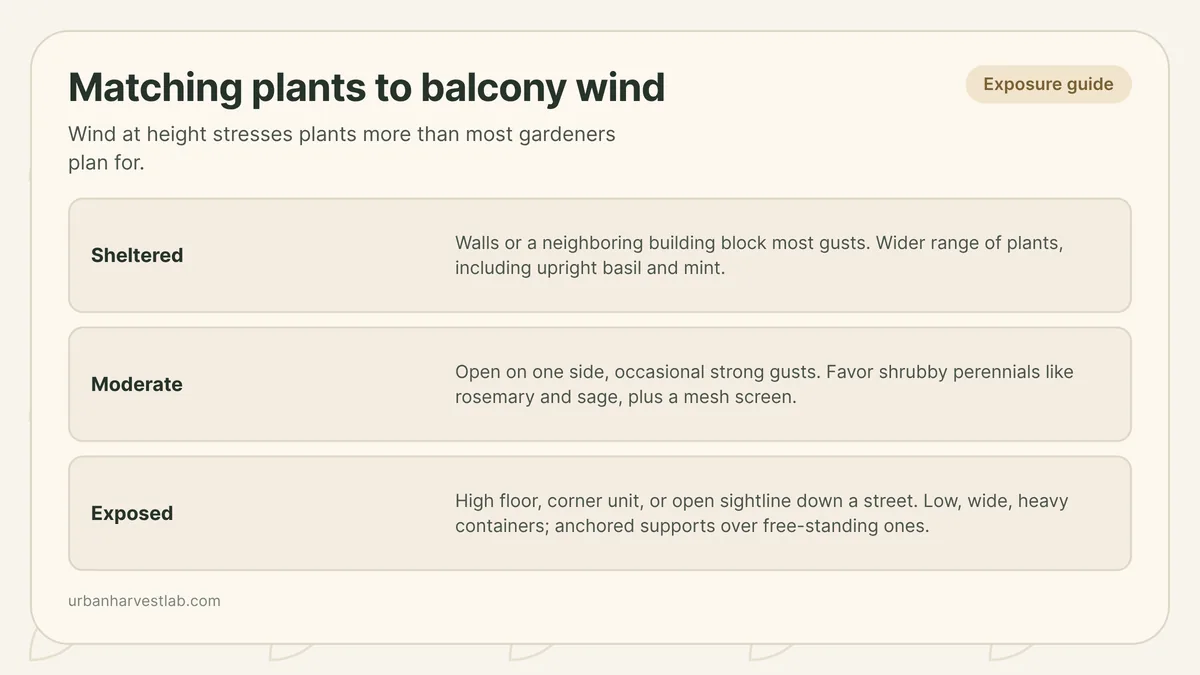
Windproof balcony garden: anchoring, plant choice, and windbreaks
A balcony catches wind differently than a yard does, and the fix is not one trick but three working together: heavier containers, plants suited to an upright or shrubby habit, and a windbreak that softens gusts instead of stopping them dead.

How to protect container plants during a heatwave
Watering more is only one piece of getting containers through a heatwave. This is the wider plan: cutting the heat load, grouping and staging pots, and reviving one that has already dried out.
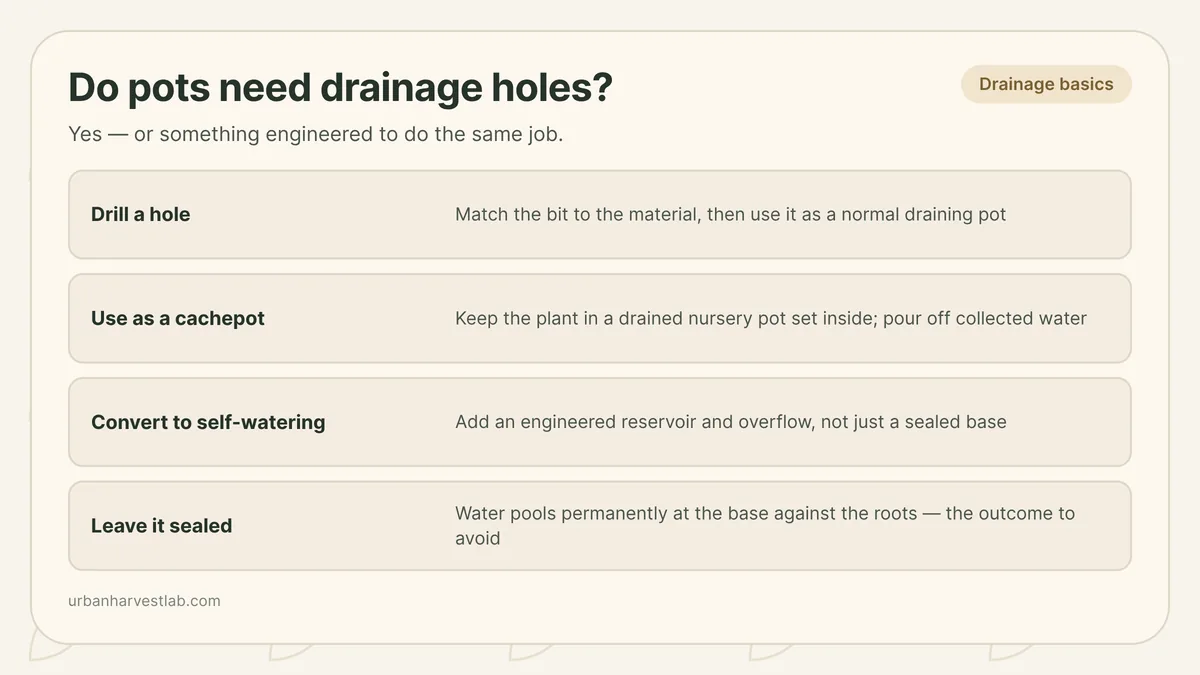
Do pots need drainage holes, and how to add one safely
A pot with no drainage hole is not a design quirk you can water around. Here is why that matters, how to drill one safely by material, and how to use a hole-less pot the right way instead.