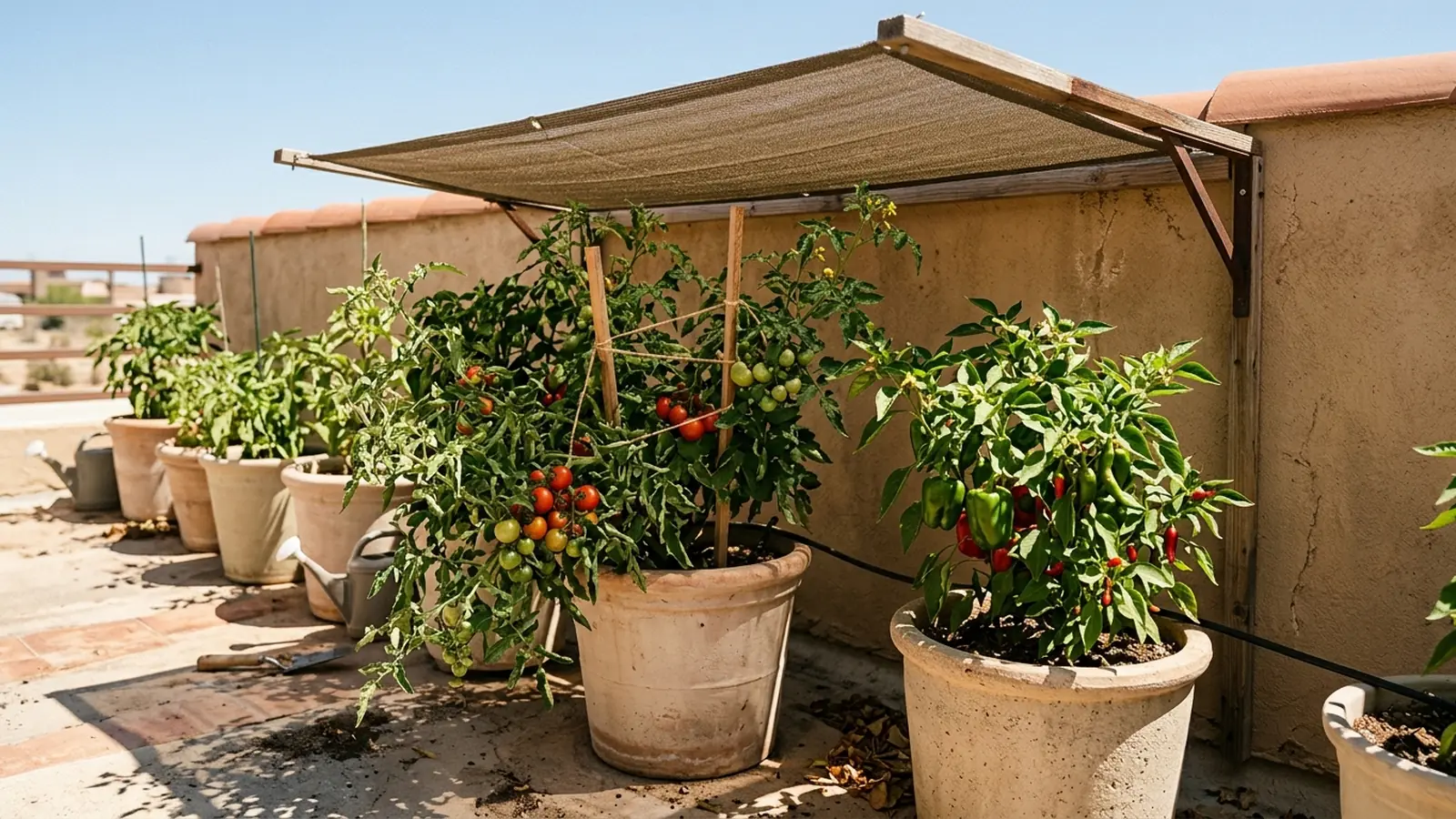
Container material and color vs. root-zone heat risk in Phoenix sun
| Container in full sun | Root-zone heat risk | What actually helps |
|---|---|---|
| Thin-walled dark plastic | Highest | Move to afternoon shade, or set inside a second, larger pot with an air gap between the walls |
| Thin-walled dark plastic, pot base and sides shaded, leaves in light | Moderate | Matches AZ1713's core recommendation directly; check the substrate by hand at midday |
| Light-colored or reflective plastic | Moderate | Meaningfully cooler than dark plastic; still benefits from afternoon shade in June-August |
| Unglazed terracotta | Moderate to high (dries fastest, but evaporates some heat away) | Pair with mulch and more frequent watering; still shade through peak summer |
| Thick-walled resin or large glazed ceramic | Lower | More material mass buffers daily swings; not immune once air temperatures hold above 100°F for weeks |
| Fabric grow bag | Moderate to high (breathable wall, but thin and exposed) | Shade the bag itself, not just the plant; check moisture at least daily in summer |
Phoenix container gardening does not run on one long growing season interrupted by a cold snap. It runs on two working windows separated by a stretch of summer that is too hot for most vegetables to grow at all. That structure changes almost every downstream decision — what to plant when, how to size and shade a container, and how much of the year is actually about survival rather than growth. Frost barely enters the picture: first and last frost dates for a balcony is worth a glance if you are new to the concept, but Phoenix sits in USDA zone 10a, and winter cold is not the constraint this hub is built around. Heat is, and a container concentrates that heat in a way an in-ground garden rarely has to deal with.
This hub goes further than a single hot spell. How to protect container plants during a heatwave already covers the emergency response for a short, sharp heat event — shade, grouping, staging, and a rescue soak for a pot that dried out. What follows here is the wider design question behind that: how a container garden in Phoenix is planned, planted, and kept alive across an entire climate built around extreme, structural heat, not just its worst weeks.
Start with two windows, not a frost date
University of Arizona Cooperative Extension’s AZ1005, “Vegetable Planting Calendar for Maricopa County” (Kai Umeda, revised 2018-09), states the region’s growing structure directly: “We have two optimal growing and planting seasons: one in the spring, the other in the fall.” For a Phoenix balcony or patio container garden, that translates into two practical windows.
The cool-season window runs roughly September through March. This is when cole crops, lettuce, garlic, and other cold-tolerant vegetables actually thrive in Phoenix, since daytime highs sit in a range most vegetables handle comfortably and the harsh summer heat is either behind you or still months away. AZ1005 also recommends starting some cool-season crops indoors as early as July, so they are ready to transplant into containers in August, just as the worst of summer heat begins to ease.
The warm-season window runs roughly February through May, for fruiting crops such as beans, corn, squash, and melons. University of Arizona Extension’s AZ1005 ties the start of this window to soil temperature rather than the calendar: sow once the substrate has warmed to around 60°F, and choose fast-maturing varieties that can complete their cycle before June’s heat becomes limiting. A warm-season crop that is still developing when summer arrives is a crop that stalls, not one that ripens late.
Neither window is defined by a frost date, because Phoenix rarely has one to organize around. That is a real structural difference from most of this site’s default assumptions, which lean on a spring last-frost and a fall first-frost to bracket the growing year. In Phoenix, the two seasons that matter are bounded by heat at both ends, not cold.
Summer is not a third season — it is maintenance
It is tempting to treat June, July, and August as simply “the third season” and try to keep planting through it. That is the single most common design mistake in a Phoenix container garden. Phoenix Sky Harbor’s official NCEI 1991-2020 climate normal records 111.3 days a year at or above 100°F, and 173.4 days a year at or above 90°F — the great majority of both concentrated in exactly this stretch, when average daily highs run 40 to 41°C (104 to 106°F). Two other commonly cited thresholds, 105°F and 110°F, do not have a published NCEI normal for this station. Rather than repeat a single hot year’s press figure as if it were a stable average, this leaves those two thresholds without a figure at all — Phoenix is simply that hot, often enough, without needing a specific day count to make the point.
Treat June through August as a maintenance window, not a planting window. The job during these months is keeping whatever survived the warm-season window alive — through shade, adjusted watering, and substrate protection — rather than starting anything new. AZ1005 does note that off-season growth is possible for some crops with added shade, extra humidity, or artificial heat management, but that is a deliberate exception for a grower set up to manage it, not the default plan for an ordinary balcony container. For most home container gardens, the realistic goal for summer is to come out the other side with the same plants you went in with, ready for the cool-season window that starts again in September.
The container’s real enemy is root-zone heat, not air temperature
Air temperature is not what actually limits a Phoenix container garden. Substrate temperature is, and the two are not the same thing. AZ1713, “Container Gardening In The Southwest Desert” (Kelly Murray Young, University of Arizona Cooperative Extension, 2016-09), confirms that small containers heat up and dry out faster than large ones, and that a container standing in full desert sun raises substrate and root temperatures well above the surrounding air.
This is the single distinguishing fact behind this hub, and the reason Phoenix needs its own container-gardening logic rather than a generic hot-climate guide. A container has no surrounding earth to buffer it the way an in-ground bed does. Its walls are exposed on every side to direct sun, reflected heat from pavement or a wall, and — depending on material and color — a considerable amount of extra absorbed heat on top of whatever the air itself is doing. Roots sitting a few inches inside a small pot in June are living in a different thermal environment than roots at the same depth in open ground a few feet away, even on the same afternoon.
That is also why container size functions as its own protective decision here, independent of the crop growing in it. A larger container holds more thermal mass, which buffers daily temperature swings the way a small one cannot. Sizing still needs to match the plant’s actual root system — oversizing a container for a shallow-rooted herb does not automatically fix heat if the walls themselves are thin and dark — but all else equal, a bigger pot runs a smaller risk of hitting a lethal root-zone temperature on a 110°F afternoon than a small one does.
Keep the pot in shade even when the leaves are not
AZ1713 makes a specific, almost counterintuitive recommendation worth calling out on its own: keep the container itself in shade while its leaves still get the light they need. In most climates, shading a plant means shading the whole thing, canopy included, and that is still the fallback if a full-plant shade cloth is what you have available. But in Phoenix, once root-zone heat is the limiting factor rather than leaf-level light, the more precise move is to block direct sun from reaching the pot’s walls specifically — with a shade cloth angled low, a second outer container, mulch, or simple placement against a shaded surface for part of the day — while the plant’s foliage keeps the sun exposure it needs to photosynthesize normally.
In practice this usually means one of a few concrete moves: nesting a dark container inside a larger, lighter-colored one with an air gap between them; wrapping the outside of an exposed pot in reflective material or a light-colored sleeve; or simply positioning containers so a wall, railing, or larger plant shades the pot’s body during the hottest hours without blocking the canopy above it. None of these are exotic techniques — they follow directly from treating the container wall as its own heat-exposed surface, separate from the plant growing inside it.
Water more, and more often, than anywhere else in this series
Phoenix is the most watering-intensive city in this site’s climate coverage, by a wide margin, and the numbers explain why. Per NOAA NCEI’s 1991-2020 normals, May and June average just 3.3 mm and 0.5 mm of precipitation respectively — essentially none — while daytime highs are already climbing toward 40°C. A small container loses moisture to evaporation and plant uptake at a rate that a monthly rainfall total measured in single-digit millimeters does nothing to offset. How often to water herbs in summer covers the root-zone check that applies everywhere this site operates — water from evidence in the mix, not a fixed schedule — but in Phoenix that check needs to run more often, and the interval it settles on will typically be shorter than it would be for the same pot in a milder climate. A small, sun-exposed container can realistically need checking more than once a day for a sustained stretch of summer.
Watering timing matters as much as frequency here. Morning watering gives roots and the surrounding substrate a buffer before the day’s heat peaks, rather than adding water into a substrate that is already hot from a full afternoon of sun. If a heatwave on top of the normal summer pattern is what you are dealing with right now, how to protect container plants during a heatwave walks through the staging response — shade, grouping, getting pots off hot pavement — in full.
Salt buildup: the slow damage tap water and fertilizer do together
A second, quieter risk in Phoenix containers builds up over weeks rather than hours. AZ1713 identifies desert tap water as carrying considerable dissolved salt on its own, and notes that regular fertilizer adds more. In an open garden bed, rainfall and natural drainage carry some of that salt load away over time. In a container that gets watered frequently with the same salty tap water and fed on a normal schedule, salts concentrate in the substrate instead, since there is far less volume for them to dilute into and far less natural flushing than an in-ground bed receives.
The visible result, per AZ1713, is salt burn: leaf edges turn brown, often with a yellow halo just inside the brown margin. It is easy to mistake for a watering problem or a nutrient deficiency, since the symptom shows up on the leaf rather than at the root. The source is worth naming directly because the instinctive fix — watering less, or cutting back on fertilizer — does not address the actual cause. AZ1713’s recommended fix is periodic leaching: a deep, thorough watering that runs well past the point of drainage from the bottom of the pot, done regularly enough to carry accumulated salts out of the substrate before they build to a damaging concentration. This is a routine maintenance task in Phoenix specifically, in the same way that checking the mix before watering is routine everywhere else — not a rescue measure reserved for a plant already showing symptoms.
Choosing a container built for Phoenix heat
Given root-zone heat and dry-down speed are the two forces doing most of the damage in a Phoenix container, material and color function as design variables here in a way they do not in a milder climate. The comparison above lays out the main combinations, but the underlying logic is simple: a thin, dark wall in full sun adds heat on top of whatever the air is already doing, while a lighter, thicker, or shaded wall removes that extra load.
This site’s existing container-material comparisons are directly relevant, applied through a Phoenix-specific lens. Plastic vs. terracotta pots for herbs and glazed vs. terracotta pots both cover how porosity changes dry-down speed in general; in Phoenix, faster dry-down from an unglazed terracotta wall is a real cost given how little humidity there is to offset it, and needs to be weighed against that material’s evaporative cooling effect rather than assumed to be purely a downside. Fabric pots vs. plastic matters here too: a fabric bag’s breathable wall dries out fast in low desert humidity, and its thin profile offers little of the thermal buffering a thick-walled resin or large glazed pot provides, so a shaded placement matters even more for a bag than for a rigid pot of the same size.
A few crops that fit the two-window system
This hub is not a city-by-crop catalog, and it is not meant to replace one. AZ1713 includes a full container-crop reference table, covering minimum container size, light requirement, spacing, and days to harvest for dozens of common vegetables, and that table is the better source to consult crop by crop. What is worth naming here is the pattern those crops follow: cool-season leafy crops and crucifers cluster into the September-to-March window, fast-maturing fruiting crops like beans and squash cluster into the February-to-May window, and a smaller group of heat-tolerant perennials in large, shaded containers can carry through the full year if the summer maintenance routine above is followed. Any crop that does not fit cleanly into one of those two annual windows, or that cannot finish a fruiting cycle before June arrives, is working against the climate rather than with it.
Common mistakes
- Treating summer as a third planting season. Nothing about the two-window structure supports starting new vegetables in June, July, or August in an ordinary container setup.
- Shading the plant but not the pot. Once root-zone heat is the limiting factor, a shaded canopy over an exposed, sun-baked container wall is only solving half the problem.
- Reaching for a smaller container to save space. In most climates this is a minor tradeoff. In Phoenix, a small container heats and dries fastest of all, which is the opposite of what the climate rewards.
- Responding to brown, yellow-haloed leaf edges by watering less. That pattern points to salt buildup, and the fix is a deep leaching watering, not a lighter one.
- Picking a dark, thin-walled pot for looks alone. Material and color carry real thermal consequences here that they do not carry in a milder climate.
Sources and further reading
- Kai Umeda, “Vegetable Planting Calendar for Maricopa County” (AZ1005), University of Arizona Cooperative Extension, revised 2018-09: az1005-2018.pdf
- Kelly Murray Young, “Container Gardening In The Southwest Desert” (AZ1713), University of Arizona Cooperative Extension, 2016-09: az1713-2016.pdf
- NOAA National Centers for Environmental Information, U.S. Climate Normals 1991-2020, Phoenix Sky Harbor International Airport station (USW00023183): ncei.noaa.gov/products/land-based-station/us-climate-normals
Go deeper on containers and heat
These guides cover the pot-material decision and the heatwave and watering specifics this hub builds on.
Common questions
When should I plant a vegetable garden in Phoenix containers?
Work from two windows, not one calendar. The cool-season window, roughly September through March, suits cole crops, lettuce, and garlic. The warm-season window, roughly February through May, suits beans, corn, squash, and melons, timed to finish before summer heat arrives. This split comes directly from University of Arizona Cooperative Extension's AZ1005, which states the county "has two optimal growing and planting seasons: one in the spring, the other in the fall."
Can you start new plants in a Phoenix container garden during summer?
Generally no, for most common vegetables. June through August is better treated as a maintenance window for crops already established, not a planting window — Phoenix Sky Harbor's 1991-2020 NCEI normal shows 111.3 days a year at or above 100°F, concentrated in exactly those months. AZ1005 notes it is possible to push some crops off-season with added shade, humidity, or artificial heat, but that is an exception, not the default plan for a balcony container.
Why does my Phoenix container dry out so much faster than the ground?
A container holds a small, exposed volume of substrate that heats and dries far faster than garden soil at the same depth, because it has no surrounding earth to buffer it. AZ1713 (University of Arizona Cooperative Extension) confirms that small containers in particular dry out and heat up faster than large ones, and that a pot standing in full desert sun can reach root-zone temperatures well above the surrounding air.
What causes brown leaf edges with a yellow halo on container plants in Phoenix?
That pattern matches the salt burn AZ1713 describes, caused by salts from desert tap water and fertilizer building up in the substrate faster than they leave it. The fix in the same source is a periodic deep leaching watering, run until water drains freely from the bottom, rather than reducing fertilizer.
Does the color or material of a pot really matter in Phoenix heat?
More than in almost any other climate this site covers. A dark, thin-walled container in full sun absorbs and conducts heat into the substrate faster than a light-colored or thicker-walled one, and AZ1713 specifically recommends keeping the container itself shaded even while the plant's leaves stay in the light — a distinction that only matters once container heat, not air temperature, becomes the limiting factor.
Related guides

How to protect container plants during a heatwave
Watering more is only one piece of getting containers through a heatwave. This is the wider plan: cutting the heat load, grouping and staging pots, and reviving one that has already dried out.
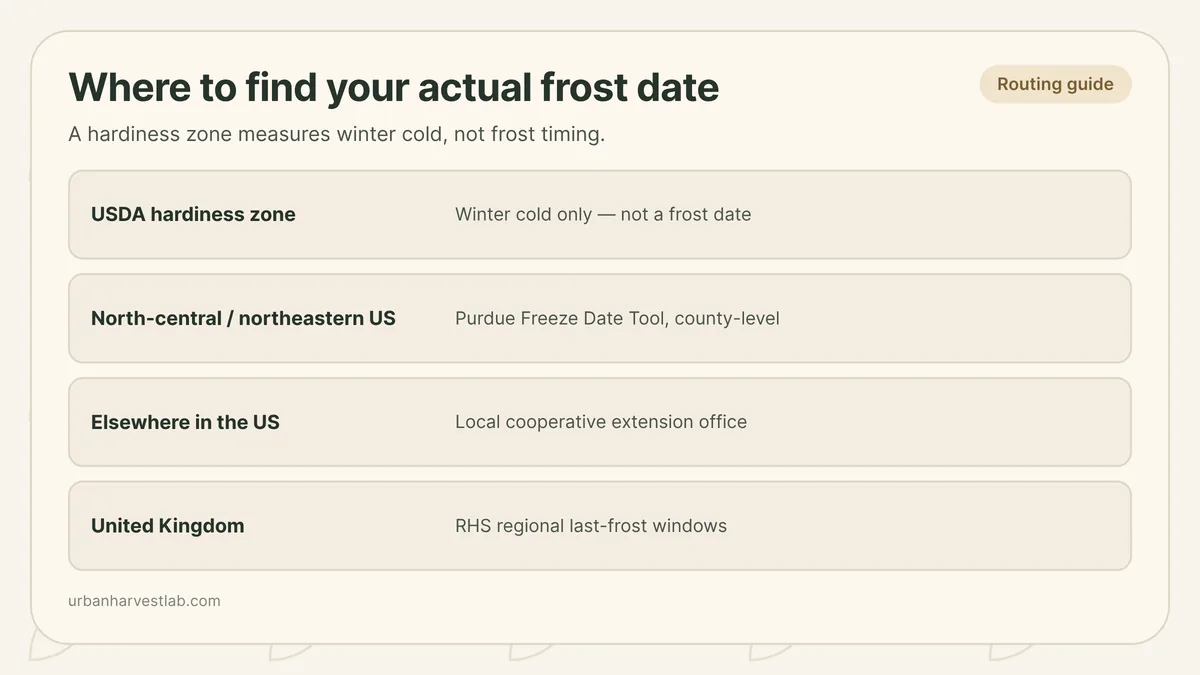
First and last frost dates for a balcony: start with your zone
Your hardiness zone tells you how cold winter gets, not when frost starts or ends. Look up the zone's temperature band, then use the tools built to answer the date question directly.
How often to water herbs in summer (heat-proof guide)
Summer heat can double how fast pots dry out. Here is how often to water each herb in hot weather, plus the shading and mulching tricks that keep pots alive in a heat wave.