How Many Hours Should Grow Lights Run for Herbs?
A longer light schedule is not always a better one. Herbs need enough daily light, but they also benefit from a stable dark period and realistic fixture placement.
An editorial grow lights hub covering photoperiod, fixture choice, coverage, distance, and troubleshooting for indoor herbs and seedlings.
A longer light schedule is not always a better one. Herbs need enough daily light, but they also benefit from a stable dark period and realistic fixture placement.
The best grow light for herbs is the one that matches your footprint, crop density, and tolerance for heat and visual clutter. This guide focuses on fit before hype.
Grow lights are one of the most misunderstood parts of small-space gardening because they are often sold through product language instead of plant language. Shoppers see wattage, spectrum, and marketing claims, but what actually matters is simpler: how much usable light reaches the crop over the day, and whether the fixture fits the real footprint.
Most home growers do not need a complicated lighting theory course. They need to know how long to run the fixture, how close to keep it, what type of fixture suits the shelf or counter, and how to recognize stress before it ruins the crop. Those are operational questions, and they are the ones this hub is built around.
Indoor crops underperform when the fixture shape and the growing footprint do not match. A square panel can be wasteful above a narrow shelf. A small clip-on lamp can be fine for two pots and completely inadequate for a crowded herb bench. Distance also matters. A decent fixture placed too high behaves like a weak one.
This is why runtime, distance, and fixture selection should never be treated as separate topics. They interact constantly.
Growers tend to make one of three mistakes:
A measured lighting setup feels boring, and that is usually a good sign. Plants grow evenly, the fixture stays manageable, and you do not need to keep guessing.
Start with the beginner guides if you are learning the relationship between runtime and canopy position. Move to setup guides when you need to buy or rearrange equipment. Use the troubleshooting section when herbs or seedlings are showing stretch, pale growth, or inconsistent development. Use the advanced section when you are ready to increase planting density or coordinate lighting with hydroponic systems.
The role of this hub is to make lighting decisions concrete enough that equipment recommendations remain grounded in crop outcomes, not just specification sheets.
These grouped sections keep the hub useful for beginners, active growers, and readers solving a specific problem.
Start with runtime, distance, and the basic relationship between fixture strength and crop response.
A longer light schedule is not always a better one. Herbs need enough daily light, but they also benefit from a stable dark period and realistic fixture placement.
Seedlings usually need grow lights much closer than beginners expect, but the exact distance depends on fixture strength, lens design, and plant response.
These pieces help you choose a fixture and place it sensibly inside a shelf, rack, or countertop setup.
The best grow light for herbs is the one that matches your footprint, crop density, and tolerance for heat and visual clutter. This guide focuses on fit before hype.
Countertop hydroponic systems can work very well for herbs, but only if you treat them as small growing systems rather than decorative appliances.
Use these when herbs stretch, pale out, or underperform under artificial light.
Yellow basil rarely has a single universal cause. The pattern of yellowing, the growing medium, and the recent care routine usually tell the story.
Slow hydroponic lettuce is usually a systems problem, not a mystery deficiency. The goal is to find the bottleneck without overcorrecting five variables at once.
Once the basics are stable, these guides help fine-tune crop density and equipment fit.
Most hydroponic problems are not mysterious. They come from concentration drift, pH drift, heat, or neglected maintenance. This guide covers the basics clearly.
The best grow light for herbs is the one that matches your footprint, crop density, and tolerance for heat and visual clutter. This guide focuses on fit before hype.
This hub keeps the full category inventory crawlable in one place, with the archive route available for a cleaner list view.
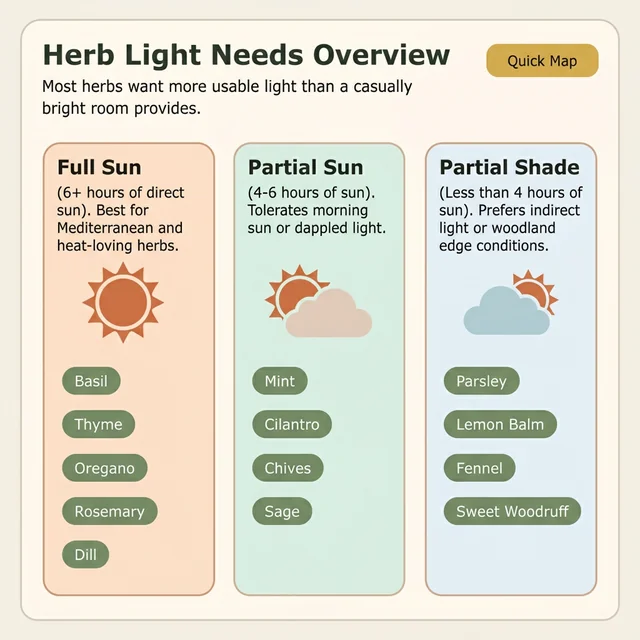
A practical guide to herb light needs for real homes, with clear rules for sunny windows, balconies, dimmer apartments, and beginner grow light setups.
The best grow light for herbs is the one that matches your footprint, crop density, and tolerance for heat and visual clutter. This guide focuses on fit before hype.
A longer light schedule is not always a better one. Herbs need enough daily light, but they also benefit from a stable dark period and realistic fixture placement.
Seedlings usually need grow lights much closer than beginners expect, but the exact distance depends on fixture strength, lens design, and plant response.