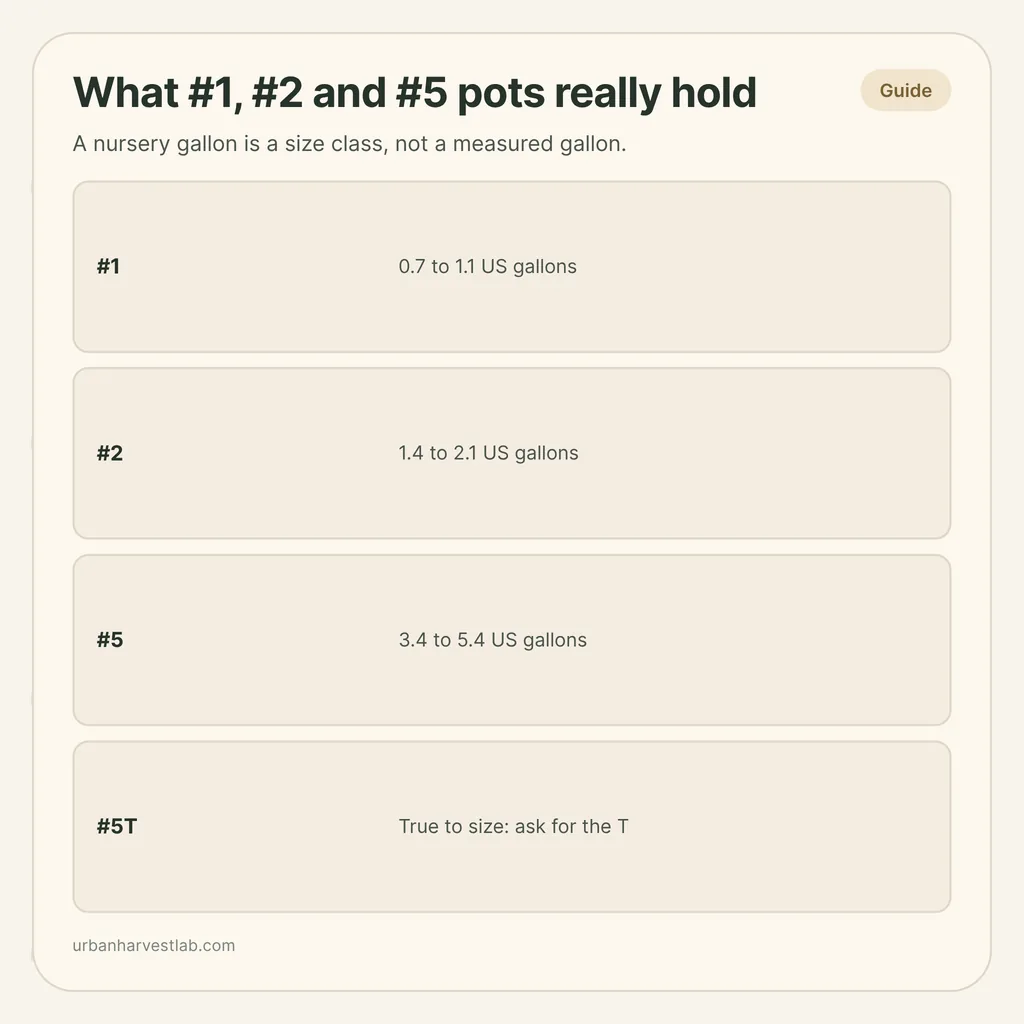
A nursery “gallon” is a size class, not a measured gallon. Under the American Standard for Nursery Stock, a #1 pot holds somewhere between 152 and 251 cubic inches, which is about 0.7 to 1.1 US gallons. Bigger classes drift further from their number, so a #5 can hold as little as 3.4 gallons. When a growing guide asks for a certain number of gallons, as the tomato pot size guide does, you need the pot’s actual volume, not the digit on its side.
What the number on a nursery pot means
The standard is published by AmericanHort, and its current edition is ANSI Z60.2-2025, a light revision of the Z60.1 text that many articles still cite. It requires that containers marketed with a “trade” or ”#” designation have volumes inside the ranges in its Table 1. It also says each class “includes a range of acceptable container volumes and is not limited to a single container volume.”
The ranges are built so that each one includes the volume of a container holding exactly that many gallons. A #5 range therefore contains 5 gallons, but it extends well below it. The standard also says that specifying only “quarts” or “gallons” is not in accordance with it.
The table below takes the standard’s cubic-inch and cubic-centimetre ranges and converts them. The conversion is ours: the standard states a gallon as 231 cubic inches and 3,785 cubic centimetres, and we divided. The litre figures are rounded to one decimal.
| Nursery class | Cubic inches (ANSI) | US gallons | Litres |
|---|---|---|---|
| #SP4 (four-inch, quart) | 31 to 63 | 0.13 to 0.27 | 0.5 to 1.0 |
| #1 | 152 to 251 | 0.7 to 1.1 | 2.5 to 4.1 |
| #2 | 320 to 474 | 1.4 to 2.1 | 5.2 to 7.8 |
| #3 | 628 to 742 | 2.7 to 3.2 | 10.3 to 12.2 |
| #5 | 785 to 1,242 | 3.4 to 5.4 | 12.9 to 20.4 |
| #7 | 1,337 to 1,790 | 5.8 to 7.7 | 21.9 to 29.3 |
| #10 | 2,080 to 2,646 | 9.0 to 11.5 | 34.1 to 43.4 |
| #15 | 2,768 to 3,696 | 12.0 to 16.0 | 45.4 to 60.6 |
Read the gallon column as a range, not a promise. The standard gives a band for each class rather than one volume, and it points users to the manufacturer’s volume specification for a particular pot.
True-to-size pots
If a buyer needs the pot to match its number exactly, the standard says the specifier must state that the containers are “true to size.” Such pots carry a T after the class, as in #5T or #10T. Without that letter, a pot sold as #5 only has to land somewhere in the 785 to 1,242 cubic-inch band.
The standard calls compliance voluntary. A garden-centre label may therefore say “5 gallon” without any promise attached, and a plain digit on a pot is a clue rather than a measurement. Where volume matters, measure the pot you have. When buying online, look for a listing that states the volume in gallons or litres rather than only a class number; browse nursery pots on Amazon and compare the stated volume with the table above.
Translating a growing guide into a pot
Extension guides state container needs in real gallons. North Carolina A&T recommends at least 5 gallons for tomato, pepper and eggplant, Texas A&M AgriLife Extension calls 5 gallons the most suitable size, and UGA Fulton County Extension puts an indeterminate tomato at 10. The full spread by plant is in what size pot for tomatoes and the pot size calculator.
Here is how the classes line up against those figures.
- Guide says 1 gallon: a #1 sits close, but its range tops out at 1.1 gallons. Volume does not tell you depth; for root crops such as carrots, check the pot’s depth too.
- Guide says 2 gallons: a #2 reaches 2.1 at best. A #3 is the safe pick, at 2.7 gallons or more.
- Guide says 5 gallons: a #5 may hold 3.4. Choose a #7 (5.8 gallons or more) or a #5T.
- Guide says 10 gallons: a #10 can hold 9.0, so a #15 or a #10T is the way to be sure.
Going up a class costs more soil and weight, and it is not an upgrade for every plant. Can a pot be too big for a plant covers when oversizing hurts.
Quart, four-inch and other small pots
The pots the trade calls four-inch or quart fall in the standard’s small-plant classes. The standard files them under #SP4, with #SP1 to #SP3 sitting below it, and gives one quart as 57.75 cubic inches, a quarter of a gallon. That is a starting size for a young plant, not a final container for a vegetable.
The standard also encourages anyone quoting inches to say whether the container is round or square, “to ensure adequate soil volume.” At the same height, a four-inch square pot holds more than a four-inch round one, so diameter alone does not fix volume.
A pot class does not tell you plant size
A #2 buys a pot of a certain volume, not a plant of a certain size. The standard says that where only a container class is specified, the specification is incomplete, and it provides no corresponding minimum plant size. Two #2 shrubs can differ a lot in height and root mass, so look at the plant and not just the label.
Measure what you actually have
Standards aside, the quickest check is water. Plug the drainage holes with tape, fill the pot to the level you would fill it with soil, and pour the water into a jug marked in litres or quarts. The American Standard for Nursery Stock gives a US gallon as 3,785 cubic centimetres, which is 3.785 litres, so a 15-litre result is just under 4 gallons.
That reading is the one to compare with a crop’s needs. If you are reusing nursery pots, how to clean pots before reusing and do pots need drainage holes cover the prep. A 5-gallon bucket is a known quantity, and growing vegetables in 5-gallon buckets covers what fits.
Sources
Pot size, once you can read the label
Pick a size by plant, check what a bucket holds, and see what tomatoes need in real gallons.
Common questions
How many gallons is a nursery #1 pot?
The American Standard for Nursery Stock sets the #1 class at 152 to 251 cubic inches, which works out to roughly 0.7 to 1.1 US gallons. The range is built to include a true gallon (231 cubic inches), but a pot in the class can hold less.
Is a #5 pot the same as a 5-gallon bucket?
No. The #5 class runs from 785 to 1,242 cubic inches, roughly 3.4 to 5.4 US gallons, and a pot marked #5 can sit anywhere in that range. Only a pot marked #5T (true to size) is meant to hold the full 5 gallons.
What is a nursery 4-inch or quart pot?
The standard treats the pots the trade calls four-inch or quart as class #SP4, and gives one quart as 57.75 cubic inches. That is a quarter of a US gallon, roughly 0.95 litres, so it is a seedling-stage size rather than a final container.
Which nursery pot should I buy for a plant that needs 5 gallons?
Go up a class to a #7, whose range of about 5.8 to 7.7 gallons sits entirely above 5, or buy a #5 marked T. If you already own a #5 of unknown volume, fill it with water and measure before you commit a tomato or pepper plant to it.
Related guides
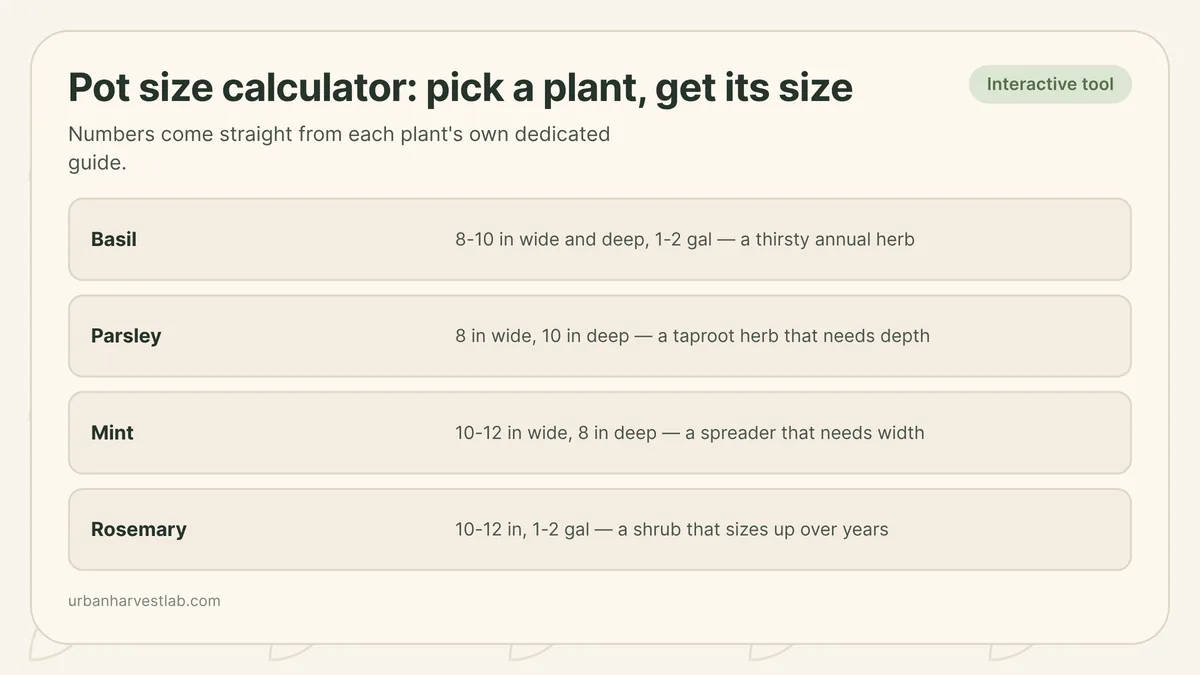
Pot size calculator: find the right container by plant and stage
A plant-and-stage picker that pulls its numbers straight from each herb's own dedicated pot-size guide, not a separate estimate.
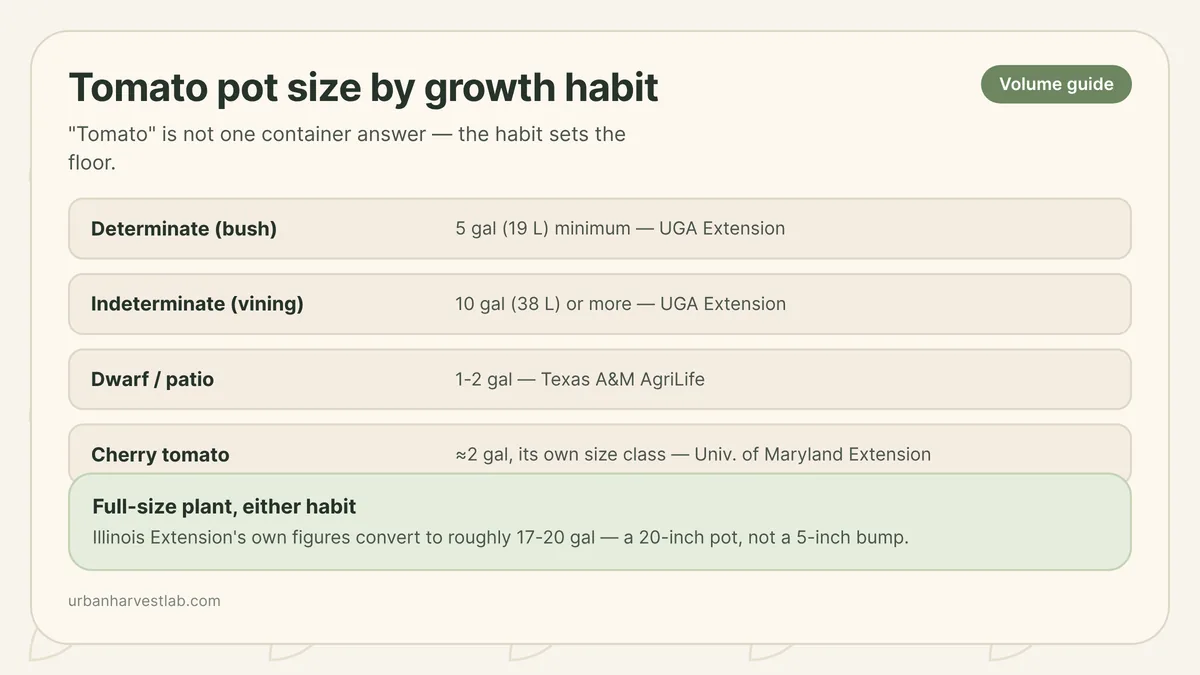
What size pot for tomatoes? Volume by growth habit
The right container for a tomato depends less on the fruit than on how the plant grows: determinate, indeterminate, or dwarf. Extension figures for the same word vary by more than three times.
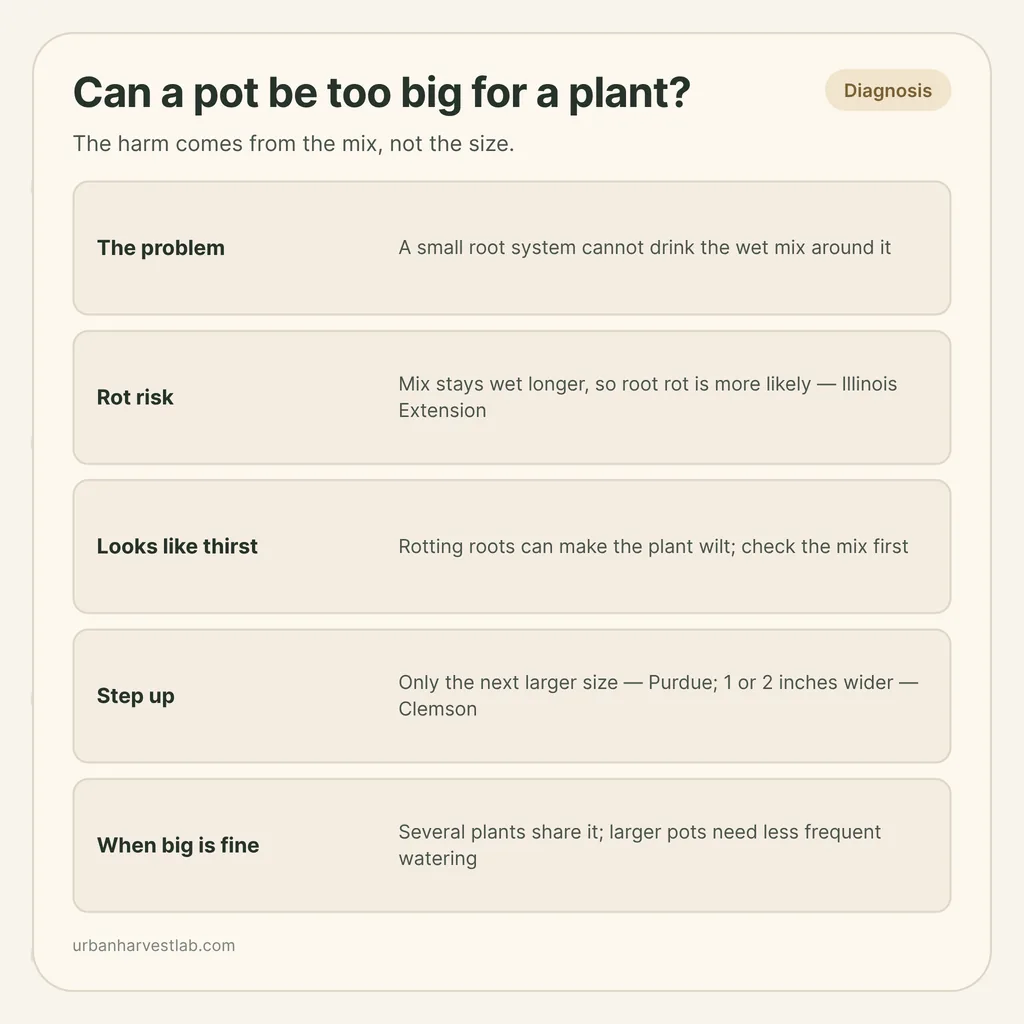
Can a pot be too big for a plant? When overpotting hurts
Yes, a pot can be too big, but the harm comes from wet mix around a small root system, not from size itself. Here is how to tell, and how to size up safely.