Is this pot too big? A quick decision guide
| Situation | Risk | What to do |
|---|---|---|
| One small plant, pot much wider than the rootball | High: wet mix the roots cannot use | Move to a pot 1 or 2 inches wider than the rootball, or water only when dry an inch or two down |
| Rootball fills the pot, many roots visible at the edge | Low: it is ready for more room | Step up one size (Purdue, Clemson) |
| Several plants sharing one large container | Lower: the plants share the space | Plant to the container's capacity and water by dryness |
| Plant is already as big as its spot can hold | Not a size problem | Refresh the mix in the same size pot (Purdue) |
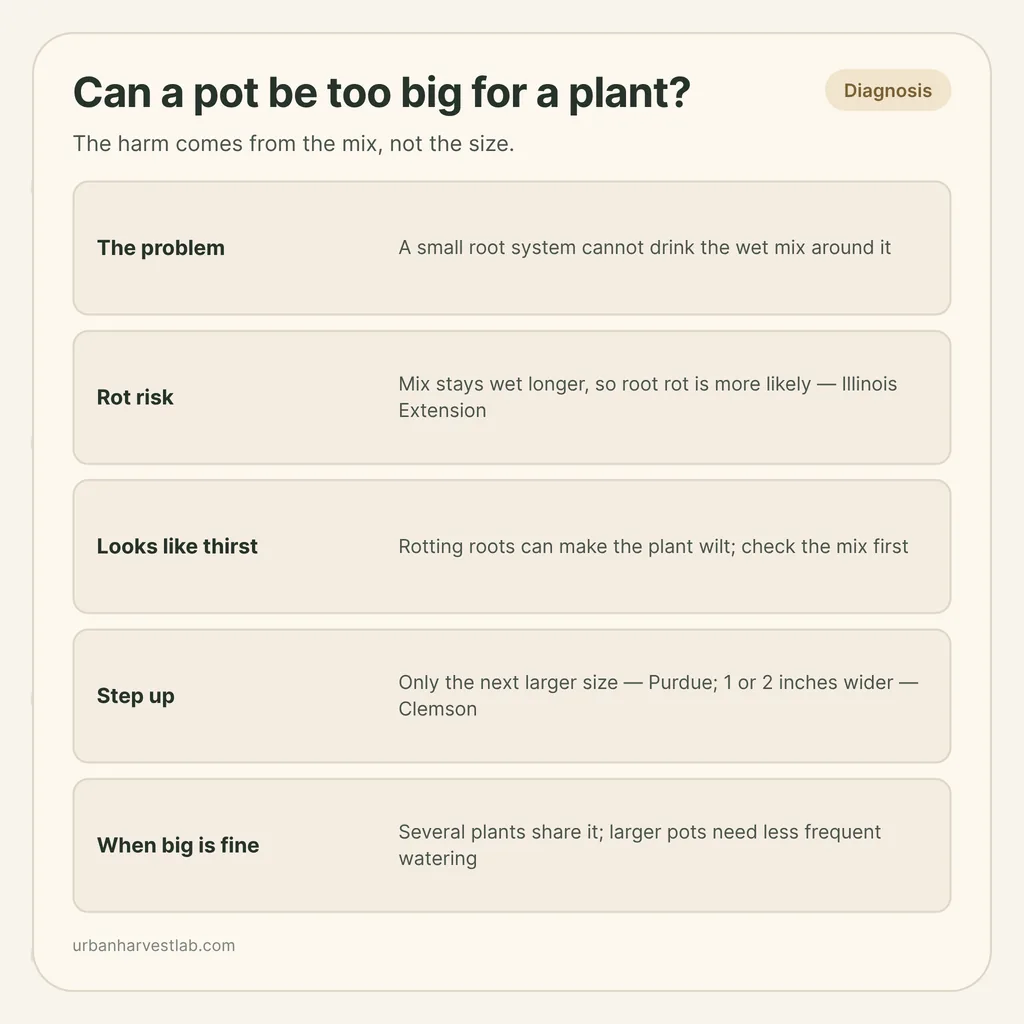
A pot can be too big for a plant, but the harm comes from the mix, not the size. A small root system can only drink from the soil right around it, so the rest stays wet. Purdue Extension says to choose a pot “of only the next larger size,” and Clemson HGIC says a pot 1 or 2 inches larger in diameter than the current one. If you are choosing a pot from scratch, the pot size calculator gives the right container by plant and stage.
What goes wrong in an oversized pot
Purdue Extension warns that the soil in pots that are too large “tends to stay excessively moist for too long and can lead to root rot.” Its container guide puts the problem as too much water and too little air. Roots need both, and a wet mass of mix pushes the air out.
The trap is how it looks. Once roots start to rot, Purdue says, the top of the plant may wilt and appear as if it needs more water. That misleads the owner into watering again, which makes the problem worse. A drooping plant in a big pot with damp mix is more likely drowning than thirsty. The overwatered vs. underwatered guide walks through telling the two apart.
Iowa State University Extension gives the working rule for any plant you suspect is too wet: water only when the soil is dry to the touch an inch or two down.
When a big pot is fine
Size is not the enemy. University of Illinois Extension notes that, given the same plants in the same place, larger pots need less frequent watering than smaller pots, and suggests a big pot if you will be away. The same page draws the line: if the pot is much too big for the plant or the number of plants, the soil tends to stay wet longer and root rot is more likely.
That wording matters. Two things change the picture:
- How many plants share the pot. Several plants fill a large container faster than one, so the mix gets used. The how many plants fit in one container page covers spacing.
- The crop’s mature size. It sets the final pot, not the starting one. The basil and tomato guides give those figures.
A single small plant dropped into a very large container is the risky case. It has the most unused wet mix and the least ability to use it.
How big a step up to take
Check first whether the plant needs more room at all. Purdue’s method: turn the pot over, ease the plant out and look at the soil ball. If many roots are visible at the outside, the plant will probably appreciate a larger pot. If roots are not visible, repotting is not needed.
If it does need more room, step up one size. Clemson HGIC says to select a pot that is 1 or 2 inches larger in diameter than the current pot. For herbs, the herb pot size guide lists the target for each plant, and repotting herbs without shock covers the move itself.
The opposite problem is real too. Purdue notes that a pot that is too small does not give the plant room to grow and dries out quickly. The signs of a root-bound herb show you when you have waited too long. Stepping up in modest stages avoids both.
Some plants do not need a bigger pot at all. Purdue says a plant that is already large for its surroundings would only continue to grow larger in a larger pot, and in that case repotting should only mean replanting in fresh soil in the same size pot.
A worked example
Say a herb has been growing in a 6-inch pot and the rootball is filling it. Clemson’s 1 or 2 inches means a 7-inch or 8-inch pot, not a 14-inch trough that looks generous. The roots then have fresh mix on every side to grow into.
Skipping the intermediate pot looks efficient, and it is what causes the trouble: a 6-inch rootball in a 14-inch pot leaves most of the mix untouched, and untouched mix stays wet. Before you water the new pot, push a finger an inch or two down. If the mix is damp there, wait. That check, from Iowa State, matters more in the first weeks than any schedule.
If your plant is already in a pot that is too big
You do not have to repot at once. Water by feel instead of by schedule, and make sure the mix can drain. Iowa State’s advice includes a drainage hole, and saucers, outer pots and sleeves that are not left holding water. The drainage holes guide covers adding one. Clay breathes more than plastic: Purdue says a plant in unglazed clay is less likely to suffer from too much water than one in glass or plastic, because water moves out and air moves in through the clay. The plastic vs. terracotta comparison has more on that choice.
If the plant is small and the mix stays soggy for days, moving it into a pot one size up from its rootball is the cleaner fix. Take the plant out, shake off the wet outer mix and repot in fresh mix.
Sources
- Repotting Houseplants Good Winter Activity, Purdue Consumer Horticulture
- Match Plant to Proper Container, Purdue Consumer Horticulture
- Transplanting and repotting indoor plants, Clemson Cooperative Extension HGIC
- Container size, University of Illinois Extension
- Why is my houseplant wilting?, Iowa State University Extension
Sizing and repotting
Pick the right size, recognise a crowded pot, and move up without shocking the plant.
Common questions
Can a pot be too big for a plant?
Yes. Purdue says the soil in pots that are too large tends to stay excessively moist for too long and can lead to root rot. University of Illinois Extension says the risk applies when a pot is much too big for the plant or the number of plants.
How much bigger should the next pot be?
Clemson HGIC says to select a pot that is 1 or 2 inches larger in diameter than the current pot. Purdue puts it as a pot of only the next larger size.
Why does my plant wilt in a big pot even though the soil is wet?
Purdue explains that once roots start to rot, the top of the plant may wilt and look as if it needs water, which misleads owners into watering more. Check the mix an inch or two down before adding any.
Is a bigger pot ever better?
Sometimes. University of Illinois Extension says larger pots need less frequent watering than smaller ones, and the risk applies when the pot is much too big for the plant or the number of plants. A single small plant in a huge pot is the risky case.
Related guides
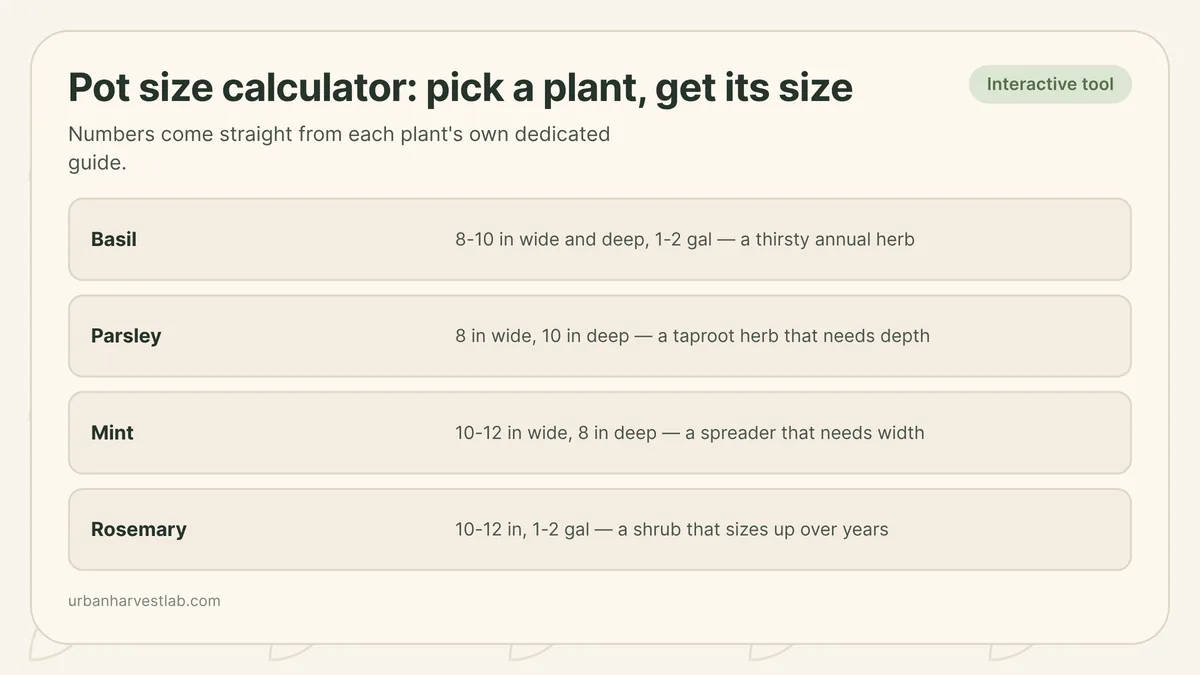
Pot size calculator: find the right container by plant and stage
A plant-and-stage picker that pulls its numbers straight from each herb's own dedicated pot-size guide, not a separate estimate.
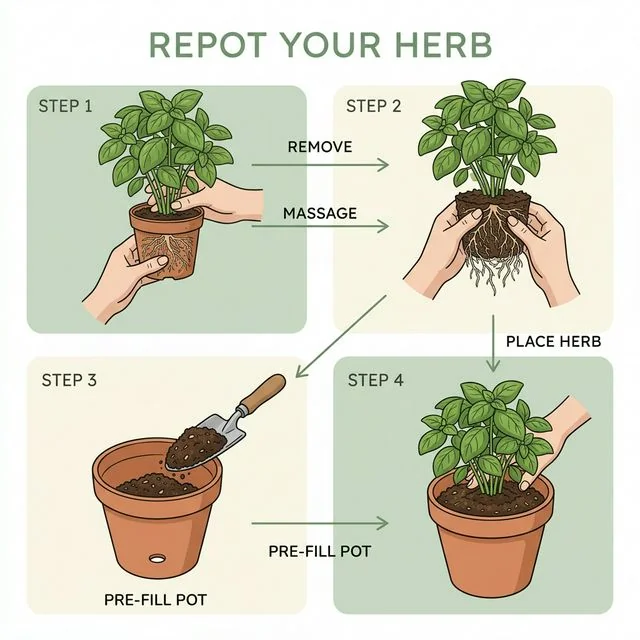
How to repot herbs without slowing growth
Moving an herb to a bigger pot should trigger a massive growth spurt. If your plants wilt and drop leaves after repotting, you are suffering from transplant shock. Here is how to upgrade your container without stressing the roots.
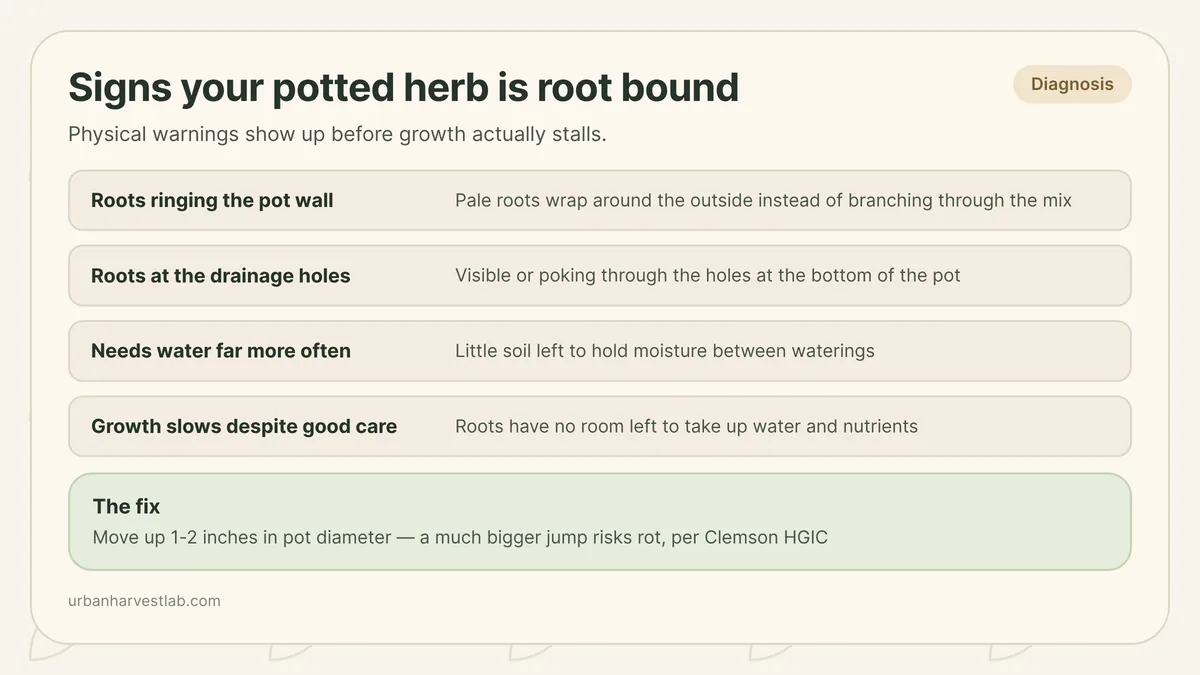
Signs your potted herb is root bound
A root bound herb gives off physical warnings before growth actually stalls. Here is what to look for, why the signs show up together, and how to repot without shocking the plant.