
What actually does well behind sealed glass
| Plant type | Fit for a sealed glass cabinet | What to watch for |
|---|---|---|
| Humidity-loving houseplants (ferns, calathea, fittonia) | Good — trapped moisture matches what they already prefer | Condensation on the glass; air the cabinet out occasionally to limit fungal issues |
| Cuttings and propagation | Good — steady humidity helps callus and root formation | No drainage inside most cabinets, so container choice matters more than usual |
| Basil, mint and other soft-leafed herbs | Mixed — tolerate humidity better than woody herbs but still want some air movement | Open the door daily rather than leaving it sealed around the clock |
| Rosemary, thyme, oregano and other Mediterranean herbs | Poor — these want dry, moving air, close to the opposite of a sealed cabinet | Root and stem rot are the likely outcome; better suited to an open shelf |
A glass-fronted display cabinet can work as a grow shelf, but the glass is doing more than making the setup look tidy. Sealing plants behind a door changes the heat, the humidity and, indirectly, the light they respond to best — and none of that shows up if you only think about which fixture to add. Before buying a light for one, it helps to know what the cabinet itself is already doing to the air inside it, which is a step ahead of the basic setup most grow-light guides start from.
Quick answer: what the glass actually changes
The seal is what changes everything. A closed door keeps potting mix and stray leaves out of sight and holds humidity around plants that struggle in normal room air — and the same seal holds heat in, unevenly, across a shelf that was built for dishware rather than plants. A light dropped into a cabinet built for ornaments behaves differently than the same light in open air, and the plants inside notice before you do.
Heat and humidity are the same problem, not two problems
A closed cabinet with a light running inside it warms up in a way an open shelf does not, because there is nowhere for the air the fixture heats to go. That matters for more than comfort: the study modelling four culinary herbs against daily light integral and mean daily temperature (Walters, Tarr and Lopez, PLoS One 2023, measured across 24-32 °C) found that a warmer microclimate moves the daily light total a plant uses best — and not in the same direction for every herb.
That is the problem with treating a sealed cabinet as just a rack with a door. A light target chosen for an open shelf — see DLI targets for herbs and leafy greens for the baseline most leafy herbs need — may not still be the right target once the door closes and heat starts collecting. The interior top of the cabinet is usually the warmest point, for the same reason it is on any enclosed shelf: warm air rises and has nowhere to escape, and a fixture mounted near that top shelf is heating the air it then sits in. Pots up there dry out faster than the same pots would on an open shelf, so a watering schedule set for the rest of the cabinet tends to run behind on the top row specifically — not because that row gets more light, but because it sits in the warmest, stillest air in the box. Grow light heat management covers what actually helps once a fixture is generating more heat than a small closed space can shed on its own — cracking the door periodically, leaving a genuine gap around the fixture, and checking the top shelf’s pots more often than the rest.
Mounting a light inside a cabinet that was not built for one
Mounting is the part a display cabinet fights hardest, and it has nothing to do with the light’s spectrum or wattage. Adhesive-backed strips and clip pads are the default fixing method for small grow lights, and they are a poor match for a cabinet that is going to run humid. Adhesive bonds weaken as moisture works into the join, and a light that seemed solidly stuck in a dry showroom can come loose weeks into regular watering and condensation. The shelves themselves are usually glass, which rules out most screw-in brackets and limits what a clip can safely grip without risking a crack.
The more reliable options grip the cabinet’s frame or an interior metal rail rather than the glass shelf itself — a small clip-on fixture like the ones covered in the buyer’s guide for clip-on grow lights tends to do better here than an adhesive strip, provided there is a frame edge or rail to clamp onto rather than bare glass. Running a cord and driver in a space that collects condensation is also an electrical question, not just a mounting one, and the safety basics for keeping a driver and cord away from moisture are worth reading before wiring anything into a cabinet — grow light safety covers that ground directly rather than repeating it here.
Depth versus light: the back of the shelf is not the front
Display cabinets are built to show objects from the front, which usually makes them deeper than an open plant shelf needs to be. That depth works against you once a light goes in. Output from any fixture falls off with distance and with the angle away from directly underneath it — the same falloff that the guide to lighting one shelf with one light or several covers for an open rack applies just as much inside a cabinet, and it is often worse, because the light usually mounts near the front or the top rather than centred over the whole depth of the shelf.
The practical result is that the usable growing area is smaller than the shelf’s footprint. A pot pushed to the back of a deep cabinet, behind the door hinge and away from the fixture, can sit in noticeably weaker light than one at the front even though both are technically “on the lit shelf.” Rotating pots toward the front on a schedule evens out the growth difference over time; it does not raise the light level at the back. The straightforward fix is to keep the growing pots in the band the fixture actually reaches — find it by taking a few readings across the shelf depth at pot height rather than assuming — mapping a canopy with a meter or a phone app covers how to take them and what the numbers mean — and use the back of the shelf for something that does not depend on strong light: a spare cutting, a slow-growing houseplant, or nothing at all.
Renting: what is genuinely reversible here
The no-drilling appeal of a freestanding cabinet is one of the reasons the format took off, and it holds up: a cabinet that already stands on its own legs does not require putting a hole in a wall the way a mounted grow light bar often does. Clip-on and magnetic fixtures extend that reversibility to the light itself, since neither needs an adhesive bond or a screw into the cabinet’s own glass. Guides to fitting grow lights into a small apartment generally lean on exactly this kind of fixture for the same reason.
Reversible does not mean weightless, though. A glass-fronted cabinet full of potted plants, wet soil and a light fixture is genuinely heavy furniture, and it is worth checking what floor and what shelf inside a rented flat is actually supporting that weight before assuming “no drilling” is the whole safety picture. A cabinet resting on a flimsy stand, or a light clamped to a shelf edge that is already close to its limit, is not a light-touch installation just because nothing went into the wall. An apartment herb setup built around low light instead is worth a look if the weight and humidity trade-offs of a full cabinet feel like more commitment than the space is worth.
What a sealed cabinet is actually good for
Treating this as a universal grow shelf is what the format punishes: humidity-loving houseplants and cuttings settle in well, while Mediterranean herbs fight the sealed air the whole time, as the comparison above lays out. For basil and mint, “opening the door regularly” means cracking it for a few minutes once or twice a day — soft, water-logged stems or a film of mould across the potting mix surface both point at the sealed air rather than at the light — though in a cabinet with no drainage they can equally mean the pot is holding water it cannot shed, so check the mix by weight before deciding which it is.
If the cabinet is not the right shape for what you are growing
None of that rules the format out — it rules out using it for everything. A four-tier open rack built specifically around lighting handles airflow and even light distribution in a way a repurposed display cabinet cannot, and it is the better starting point if herbs are the actual goal rather than houseplants. A small enclosed tent solves a related but different problem — growing herbs in a small grow tent covers how a tent’s controlled airflow compares to a sealed cabinet, and why the two are not interchangeable despite both being enclosed spaces with a light inside.
Common mistakes
A light comes loose one morning and hangs by its cord: adhesive bonds weaken as condensation works into the join, quietly over weeks rather than obviously on day one. Herbs that thrived on an open windowsill sulk behind the glass — the cause is the cabinet’s heat and humidity, not the fixture, because the light was chosen before anyone checked what the box does to the air. A back row stays thin despite good watering and a bright fixture: that is depth, not the plant, and a light near the front lights the front — that row needs a stronger light, a closer mount, or a plant that does not need much light to begin with.
The bottom line
A glass-fronted cabinet earns its popularity honestly for humidity-loving plants and propagation, and it earns its problems just as honestly once herbs that want dry air go inside it. The light matters less than the mounting, the depth, and the microclimate the door creates the moment it closes. Decide what you are actually growing first, then treat the cabinet as the enclosed, heat-retaining, humid space it is — not as a shelf that happens to have a door.
Sources
If a sealed cabinet is not the right shape for what you are growing
These cover the alternatives — an open rack built around lighting, a tent for a drier microclimate, and the electrical basics for a light near condensation.
Common questions
Can I put a grow light inside a glass display cabinet?
Yes, and it is one of the more workable versions of the trend, but the mounting is the hard part, not the light itself. The interior shelves are usually glass, which rules out most screws, and adhesive strips are unreliable once the cabinet's own humidity builds up behind the door. A small clip-on or magnetic fixture that grips the frame or an interior rail, rather than the glass shelf itself, tends to hold up better over months than anything stuck on with tape.
Is a glass display cabinet good for growing herbs?
It depends heavily on which herb. Humidity-loving foliage plants and cuttings generally do well behind sealed glass, because the trapped moisture matches what they already prefer. Mediterranean herbs such as rosemary, thyme and oregano are a worse fit: they evolved for dry, moving air, and a sealed cabinet gives them close to the opposite. Basil and mint sit in between and tolerate it better than the woody herbs, provided the door gets opened regularly.
Why is the back of my cabinet shelf growing slower than the front?
Almost certainly light falloff, not a plant problem. Light intensity drops with distance from the fixture and with the angle away from directly underneath it, and a deep cabinet puts the back row noticeably farther from a light mounted near the front or the top than the pots sitting right under it. Rotating pots toward the front on a schedule spreads the shortfall around; it does not raise the light level at the back.
Do I need to drill into a glass cabinet to add a grow light?
No, and most renters should avoid it even if the cabinet is theirs to keep. Clip-on fixtures that grip a frame edge, magnetic mounts on a metal rail, or a light hung from a temporary hook all avoid permanent fixings. The cabinet itself is still heavy furniture, though, so a reversible light mount does not make the whole setup light-touch — check what it is resting on before adding a light and a full shelf of wet pots to it.
Related guides
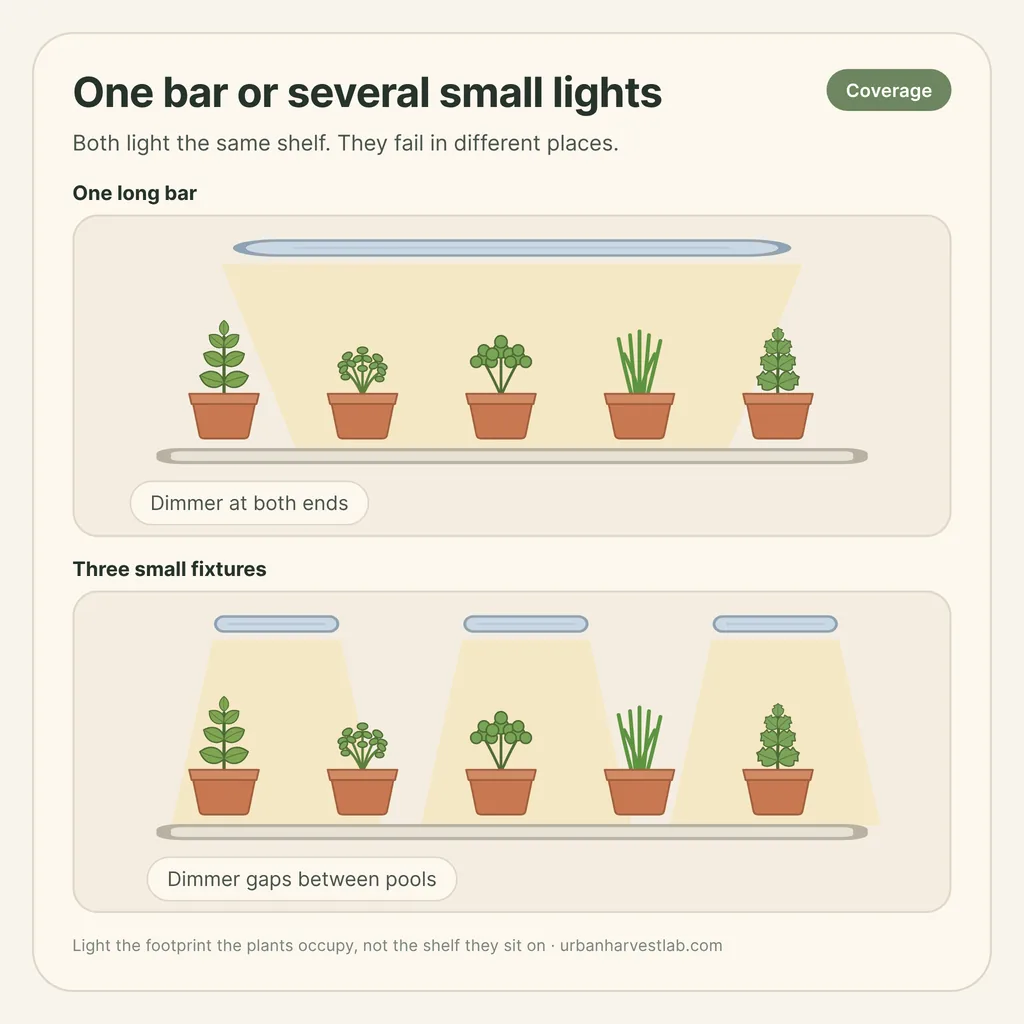
One grow light or several: how to decide
There is no fixed ratio of lights to shelf feet. The count follows from your plants' footprint and their light target, and it changes depending on whether they sit in a row or a cluster.
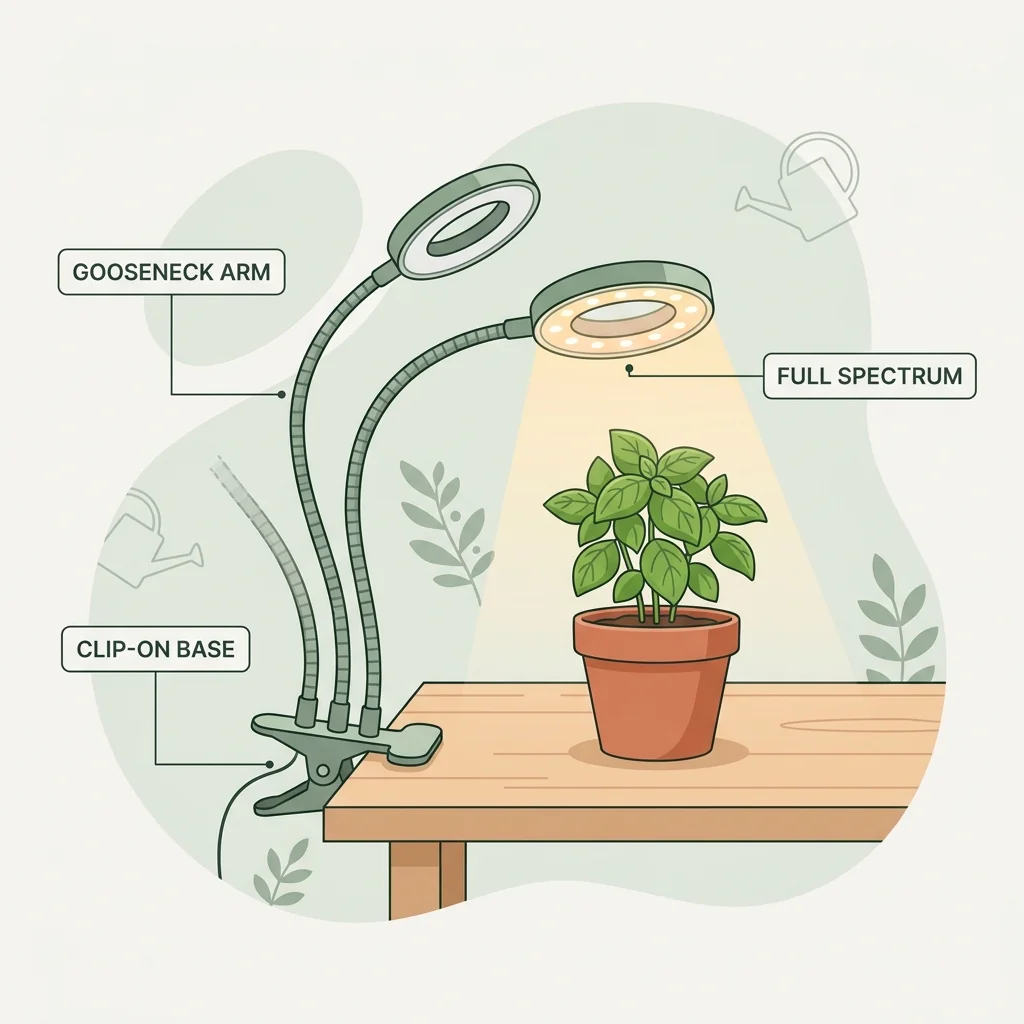
Best clip-on grow lights for herbs (buyer's guide)
You do not need to install massive ceiling-mounted grow panels or ugly industrial fixtures to keep your indoor herbs alive. With a flexible, clip-on gooseneck LED grow light, you can clamp a soft, full-spectrum light source directly onto your desk or windowsill in seconds. Here are our top-rated options.
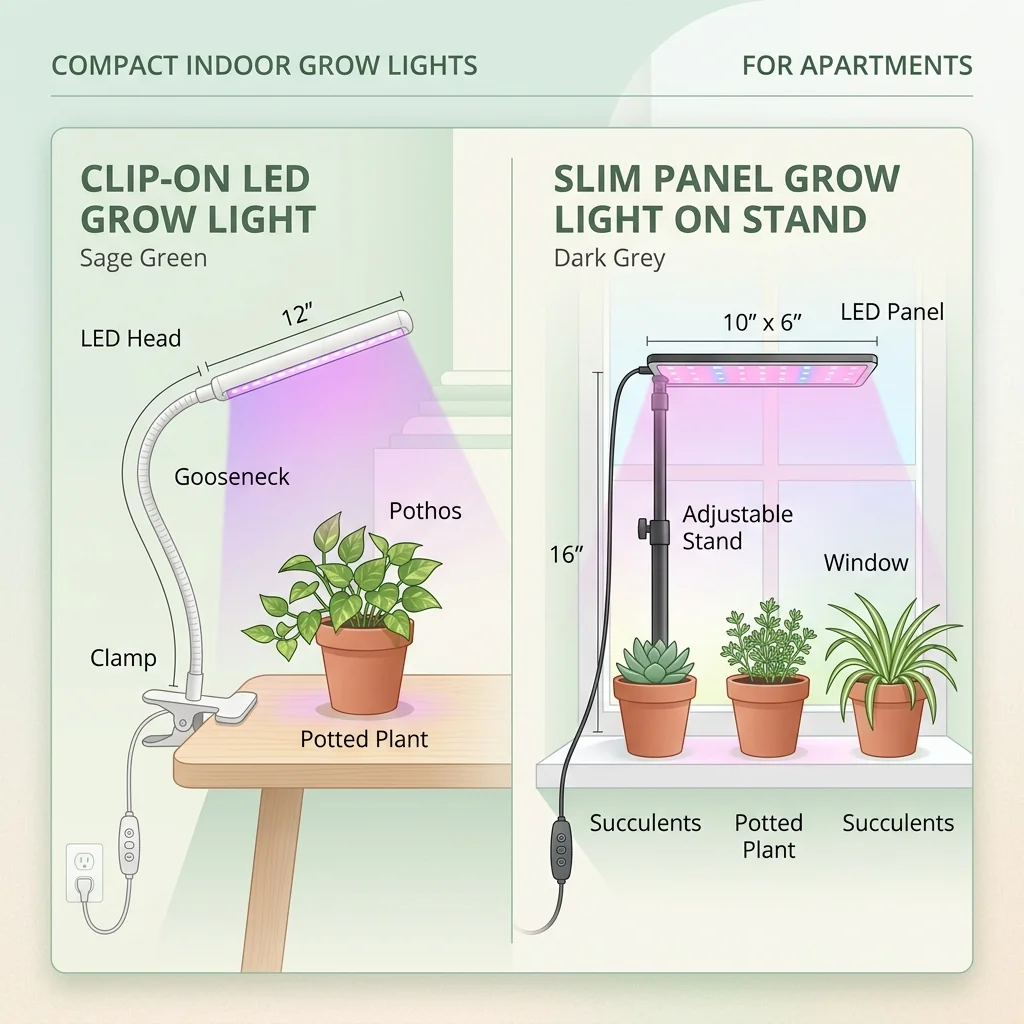
Best grow lights for apartments and windowsills
Apartments need grow lights that fit a small space and look acceptable in a living room. Here are the best compact LED types and what to check before buying.