
Starting hours by growth stage and room light, all inside the 12 to 16 hour extension range
| Growth stage | Room light without the fixture | Hours on | Dark period |
|---|---|---|---|
| Seedlings, just past germination | Winter or a dim room | 16 h | 8 h |
| Seedlings, just past germination | Average indoor room | 15 h | 9 h |
| Seedlings, just past germination | Bright room or sunny window | 14 h | 10 h |
| Established herbs and leafy greens | Winter or a dim room | 14 h | 10 h |
| Established herbs and leafy greens | Average indoor room | 13 h | 11 h |
| Established herbs and leafy greens | Bright room or sunny window | 12 h | 12 h |
A home herb or seedling schedule runs 12 to 16 hours of light a day, with the rest of the day dark, and the planner below turns a growth stage and a room’s brightness into an actual runtime, the clock times that go with it, and how long the dark period needs to be. Enter a start time and it fills in the rest — an on time, an off time, and the hours of darkness in between.
The range is not one fixed number chosen at random. Illinois Extension, Iowa State Extension and UMass Amherst all give the same range for herbs and seedlings after germination — how many hours grow lights should run for herbs walks through where that range comes from in more depth — and where a schedule actually sits inside it depends on how much work the fixture is doing on its own versus how much daylight the room already contributes. A weak clip light on a north-facing shelf in January and a strong LED bar over a bright kitchen counter in July are not running the same problem, even if both are lighting basil.
If a schedule is already in place and the plant still looks off, grow light mistakes that stress herbs more than they help walks through what tends to go wrong around a schedule once it exists — a missing dark period, a fixture hung too far from the leaves, hours added instead of the actual light level fixed. The step before all of that is choosing the schedule in the first place and turning it into an actual clock time, which is what the planner below does.
Plan your schedule
Choose a stage, describe the room, and set a start time. The result updates as any field changes.
Live planner
Pick the stage the plant is at and how bright the room is without the fixture, then set a lights-on time. The result is a runtime, an on/off clock, and the dark period that goes with it.
Recommended runtime
—
Set a start time to see the clock
- Lights off at
- —
- Dark period
- —
- Extension range
- 12–16 h
Choose a stage and room light to see the recommended hours.
Work it out without the widget
The arithmetic behind the planner fits on a sticky note. The hours below are starting points chosen inside the 12 to 16 hour range Illinois Extension, Iowa State Extension and UMass Amherst give; none of the three break that range down by room brightness. Pick an hours figure for the stage and room below, add it to a start time for the off time, and subtract it from 24 for the dark period.
| Growth stage | Room light without the fixture | Hours on | Dark period |
|---|---|---|---|
| Seedlings, just past germination | Winter or a dim room | 16 h | 8 h |
| Seedlings, just past germination | Average indoor room | 15 h | 9 h |
| Seedlings, just past germination | Bright room or sunny window | 14 h | 10 h |
| Established herbs and leafy greens | Winter or a dim room | 14 h | 10 h |
| Established herbs and leafy greens | Average indoor room | 13 h | 11 h |
| Established herbs and leafy greens | Bright room or sunny window | 12 h | 12 h |
A tray of seedlings under a modest clip light in a dim spare room in February sits at the top of that extension-sourced range: 16 hours on, 8 hours dark. Lights on at 6:00 a.m. means lights off at 10:00 p.m. An established basil plant on a bright counter in June can drop toward the bottom of the same range instead — 12 hours on, 12 off — because the room itself is supplying part of the light the fixture would otherwise have to provide alone. Copy the row that matches your setup onto a sticky note or a card by the shelf, and it holds up as a reference without needing a phone nearby.
Why stage and season move the number
Two things shift a schedule inside the 12 to 16 hour range, and neither is really about the date on the calendar.
The first is how much the fixture has to do without help. A room with real daylight, even indirect daylight through a window, is contributing something toward the plant’s day, so the fixture does not need to run as long to reach the same total. A shelf with no outside light at all is asking the fixture to do the whole job, which is why the dim-room rows above sit at the top of the range. This is the same reasoning behind daily light integral, the idea that a plant’s day is really intensity multiplied by duration rather than either one alone — a dim fixture run for a long time and a strong fixture run for a shorter time can end up delivering a similar total. PPFD and DLI for indoor herbs covers measuring what a shelf is actually delivering, which is the more direct way to check this than guessing from the room’s brightness.
The second is what the plant itself is doing. A tray of seedlings just past germination is building its first true leaves and tends to be grown under a smaller, weaker fixture than an established plant gets, which is part of why the seedling rows above run longer. Iowa State Extension notes that intense light is what prevents spindly, leggy seedlings in the first place, so a seedling stage under a modest light benefits from the extra hours more than a mature plant under a stronger one does. Once herbs are established and growing under a fixture sized properly for the shelf, the lower half of the range is usually enough.
None of this replaces getting the fixture’s placement right first. Running the recommended hours over a light that is too weak or hung too far from the leaves does not close that gap — grow light mistakes that stress herbs more than they help covers how chasing hours instead of fixing intensity is one of the more common ways a schedule goes wrong, and why a stretched, leggy plant usually needs the fixture moved closer rather than the timer extended, unless the shelf itself is running too warm — UMass Amherst names heat as the other cause of stretch, and grow light heat management covers checking that before touching the schedule. University of Minnesota Extension keeps seedling lights 4 to 6 inches above the canopy and raises the fixture as plants grow, and grow light distance for seedlings covers setting that clearance properly — a check worth doing before touching the schedule at all.
Keep the schedule actually running
A schedule chosen on paper only works if it happens the same way every day. A fixture switched on and off by hand drifts — the “on” time creeps later some mornings, the “off” time gets forgotten some nights, and the plant ends up with a day length that does not match the one that was planned. Best grow light timers compares the mechanical, digital, and smart-plug options that hold a chosen on and off time without needing anyone to remember.
Whatever timer is used, the schedule chosen above is the one to program in, and the dark period matters as much as the lit hours. A consistent block of darkness at roughly the same time each day is part of what the 12 to 16 hour figure describes, not an optional extra tacked on afterward.
Print or save the schedule
The Print this schedule button opens the browser’s normal print dialogue with the current recommendation showing, which is enough to tape a copy by the shelf or hand it to whoever waters the plants while the usual grower is away. Revisit the choice when the season changes or when seedlings become established plants, since both are exactly the inputs the planner asks for — a schedule set once in October is not necessarily the one a bright, established shelf needs by April.
Sources
- Illinois Extension: What’s Wrong With My Seedlings? Troubleshooting Seed Starting Problems
- Iowa State Extension: How to Successfully Start Seed Indoors
- UMass Amherst CAFE: Starting Seeds Indoors — Caring for Your Seedlings
- University of Minnesota Extension: Lighting for Indoor Plants and Starting Seeds
Once the schedule is set, also read
These guides cover where the range comes from, what to check if growth still looks wrong, and the timer that keeps the schedule running on its own.
Common questions
How many hours should a grow light run for herbs?
Extension guidance for herbs and seedlings after germination gives 12 to 16 hours of light a day, with a daily dark period on top of that. Where a schedule lands inside that range depends on how much work the fixture is doing versus how much natural light the room already contributes, and on whether the plant is a fresh seedling or already established.
Should the schedule change between winter and summer?
It can. A dim room in winter usually asks for the longer end of the range, since the fixture is supplying nearly all of the light on its own. A bright room or a sunny window in summer can often support the shorter end, because the room is contributing part of the total itself.
Does adding more hours fix stretched, leggy seedlings?
Not by itself. Stretching is usually a sign that the fixture sits too far from the leaves or is too weak for the distance it is hung at, not that the timer needs more hours. UMass Amherst puts temperature beside light in the same sentence: seedlings also stretch if the growing area is too warm, so check the shelf temperature before assuming the fixture is too high. Move the fixture closer, check its output, or cool the space down before extending the schedule.
What if the on and off times drift from day to day?
A day length that changes from one day to the next is harder on a plant than simply picking a point in the 12 to 16 hour range and holding it steady. A plug-in timer removes the drift that comes from a manually flipped switch.
Related guides

Grow light mistakes that stress herbs more than they help
Most grow light problems trace back to a handful of repeatable mistakes, not a mysterious plant failure — and most of them show up as a visible sign you can check today.
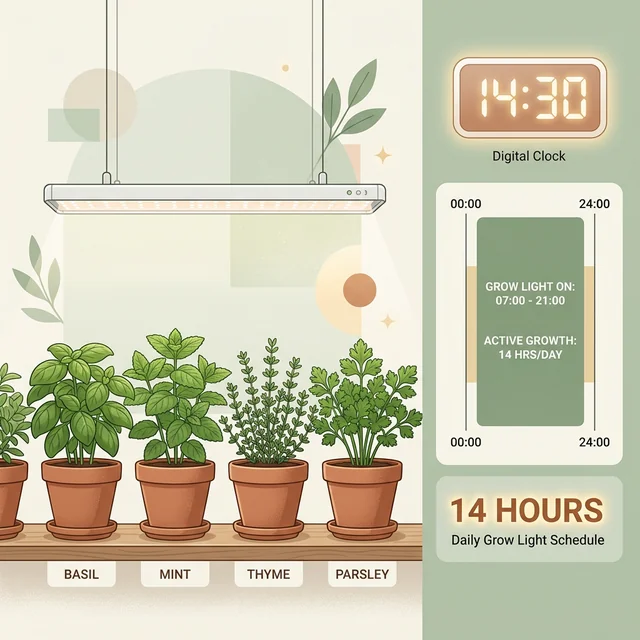
How many hours should grow lights run for herbs? 12-16
Most herb grow lights should run about 12 to 16 hours per day, but intensity, distance, and a stable dark period matter as much as the timer itself.

DLI targets for herbs and leafy greens: what to aim for
A single DLI number does not fit every herb. Here is the general target for leafy greens, and what published research on basil, sage, and mint actually measured.