
Most grow light problems trace back to a handful of repeatable mistakes: no dark period, a fixture hung too far from the leaves, and more hours added instead of the actual light level fixed. None of these produces one clean symptom. They show up as stretching, pale color, or a schedule that “should” be working but is not — which is exactly why they get misdiagnosed as a timer problem when the fixture or its placement is the real issue.
If you have not settled on a runtime yet, how many hours grow lights should run for herbs covers the 12 to 16 hour range most kitchen herbs run on, and where it comes from. This is the companion question: once a schedule is in place, what actually goes wrong around it, and what the plant looks like when it does.
Six mistakes and what they look like
| Mistake | What you’ll see | Fix |
|---|---|---|
| No dark period | No single tell — the schedule is simply outside published guidance | Give a consistent block of darkness every day |
| Fixture too far away | Tall, thin stems reaching toward the light | Move the fixture closer and measure at the canopy |
| Chasing hours over intensity | Two setups on the same hours, different results | Check daily light total, not just the clock |
| Inconsistent schedule | A day length that does not match what the timer was set to | Put the fixture on a timer |
| Fixture left at one height | Leaves crowding or scorching near the light | Raise the fixture as the canopy grows |
| Fading fixture assumed fine | Slower growth from a light that still turns on | Track hours against the fixture’s rated lifespan |
Running the light around the clock
Leaving a fixture on 24 hours a day is the single most common overcorrection, usually made by someone trying to compensate for a weak light by giving it more time. Illinois Extension puts seedlings at about 12 to 16 hours of light a day after germination, with darkness for the rest of it, and that is the range most home herb shelves run on too. Running a fixture around the clock is well outside that, and it is not what the extension guidance describes.
What matters is that the dark block lands at roughly the same time each day, not the exact clock hour. If the fixture currently runs nonstop, the fix is not a dramatic cut — pick a 12 to 16 hour window that matches your routine and add a timer so the dark period actually happens instead of depending on someone remembering to flip a switch.
Hanging the fixture too far away
This is the mistake with the clearest evidence behind it. Illinois Extension is explicit that seedlings stretch when the light sits too far from the canopy, producing a long, thin, weak stem as the plant reaches for more intensity than it is getting. Growers usually read that stretching as a hunger for more hours, when what the plant is actually short on is light density at the leaf surface. Distance is not the only cause. UMass Amherst puts temperature in the same sentence as light — seedlings also stretch if the room is too warm — so check the shelf temperature before assuming the fixture is too high; grow light heat management covers the warm-shelf case.
The exact clearance depends on the fixture’s output, optics, and heat, which is why a single inch number does not travel well between lights. Grow light distance for seedlings walks through setting it from the manufacturer’s own PPFD guidance and verifying it across the tray, rather than borrowing a distance that happened to work for a different fixture.
Chasing hours instead of fixing intensity
Daily light integral is the concept that explains why two growers can both run “14 hours” and get different plants. It folds intensity and duration into one number — the total light delivered over the day — and MSU Extension puts a useful minimum for leafy greens and herbs in controlled environments at around 12 mol·m⁻²·d⁻¹ or more. A dim fixture run for 16 hours can still land under that total, while a stronger one run for 10 can clear it easily.
Extending runtime on an underpowered light is a real strategy, and it can help, but only up to the point where the fixture’s own output becomes the limit. Past that point, more hours just spread the same weak light over a longer day. PPFD and DLI for indoor herbs covers how to measure what your shelf is actually delivering, and DLI targets for herbs and leafy greens has the working ranges to check it against.
Letting the schedule drift
A fixture switched on and off by hand drifts. Life gets in the way, the “on” time creeps later, the “off” time gets forgotten entirely some nights, and the plant ends up with an inconsistent day length instead of the stable one it was supposed to get. Growers rarely notice this happening in real time — it shows up later as uneven growth that does not match either the intended long or short schedule.
A timer removes the guesswork and makes the schedule something the plant can actually rely on. Best grow light timers covers the plug-in options that solve this without needing a smart-home setup.
Not raising the fixture as plants grow
Distance is not something you set once. As seedlings grow taller, the same fixture height that was generous on day one can become the “too close” problem by week three, especially under fixtures with strong, hot lenses. University of Minnesota Extension keeps lights 4 to 6 inches above seedlings and says to raise the fixture as they grow, which makes clearance something to recheck rather than set once.
This matters most in the seed-starting stage, when growth is fastest and the canopy position changes every few days. How to grow herbs indoors under a grow light covers how that stage differs from lighting an established herb shelf.
Trusting a fixture that still lights up
An LED fixture rarely fails outright — it fades. A fixture that still lights up is not necessarily still delivering the light it did when new, and it can be doing that for a long time before anyone notices, since it still turns on and still looks fine to the eye.
That makes an aging fixture a plausible explanation when a setup that used to work starts producing weaker growth for no obvious reason. How long do LED grow lights last? covers the L70 threshold and how to track a fixture’s hours against it.
Can plants get too much light?
It depends on the species and the temperature around it. Walters, Tarr and Lopez (2023) modelled four culinary herbs and found the best daily light total shifts with growing temperature — and shifts in opposite directions for different herbs, so there is no single ceiling; DLI targets for herbs and leafy greens carries the per-herb numbers and the temperatures they were measured at.
That spread is the real answer: some herbs have a point where more light stops helping and starts working against them, especially when the room is warm, while others simply had not hit that point at the highest levels tested. None of this points to a specific number of hours or a PPFD reading as universally “too much.” In an ordinary home setup, the more common problem is not the photons themselves but what tends to travel with a strong, close fixture — extra heat and faster drying of the growing medium. How much light do herbs need? sets the baseline worth checking first, and it is usually a more productive place to look than looking for a single ceiling. The study’s own conclusion is that no universal DLI recommendation holds across the four herbs it modelled.
Related Guides
- How many hours should grow lights run for herbs?
- Grow light distance for seedlings
- DLI targets for herbs and leafy greens
- Best grow light timers
Sources
- University of Minnesota Extension: Lighting for Indoor Plants and Starting Seeds
- Illinois Extension: What’s Wrong With My Seedlings? Troubleshooting Seed Starting Problems
- Walters, Tarr & Lopez (2023), “Modeling purple basil, sage, spearmint, and sweet basil responses to daily light integral and mean daily temperature,” PLoS One
- MSU Extension: Lighting Greenhouse Vegetables
If your schedule needs troubleshooting, also read
These guides connect timing mistakes to distance, intensity, and equipment decisions.
Common questions
Can plants get too much light?
It depends on the species and the temperature around it — the optimum moves with growing temperature and not in the same direction for every herb. In a home setup, the heat and dryness that come with a strong fixture are usually the bigger risk than the photons themselves.
Is it bad to leave a grow light on for 24 hours?
Herbs and seedlings are normally given a daily dark period. Illinois Extension's range for seedlings is 12 to 16 hours of light. Longer schedules exist in commercial protocols too - Utah State runs 18 hours on and 6 off for its microgreens protocol - but that schedule still switches the light off every day. Continuous light is not a schedule any of them describes.
Why do my seedlings look tall and thin under a grow light?
That pattern is usually too little light at the canopy — a fixture sitting too far away — though UMass Amherst notes a too-warm room produces the same stretch, so check both before changing the timer. Checking distance and intensity comes before adding more hours.
Should I add more hours if herbs are not growing well?
Not as a first move. More hours on a weak fixture can help a little, but intensity and distance usually matter more, and a longer schedule will not fix a coverage problem by itself.
Related guides
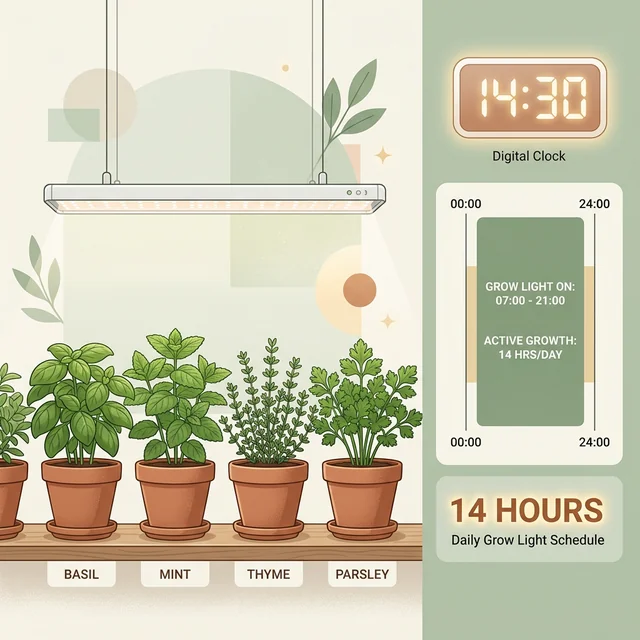
How many hours should grow lights run for herbs? 12-16
Most herb grow lights should run about 12 to 16 hours per day, but intensity, distance, and a stable dark period matter as much as the timer itself.

DLI targets for herbs and leafy greens: what to aim for
A single DLI number does not fit every herb. Here is the general target for leafy greens, and what published research on basil, sage, and mint actually measured.
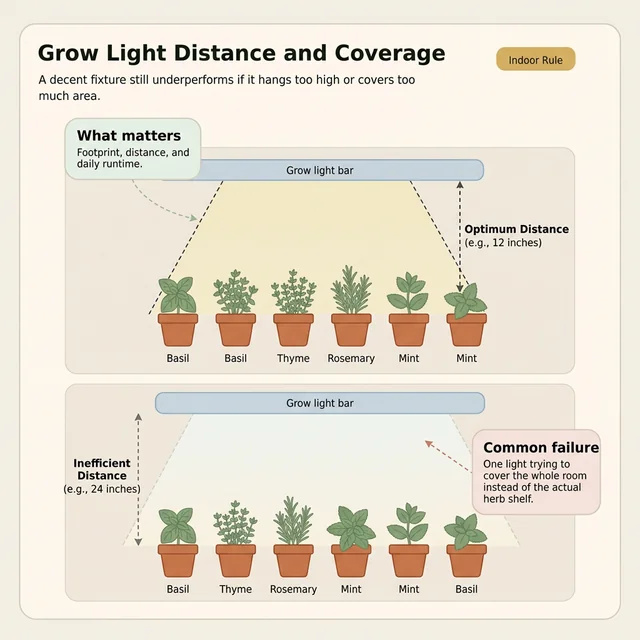
Grow light distance for seedlings: how close is too close?
Seedlings usually need grow lights much closer than beginners expect, but the exact distance depends on fixture strength, lens design, and plant response.