
What the coverage calculator needs, and where each number comes from
| Input | Where you get it | Why it matters |
|---|---|---|
| Measured PPFD | A light meter reading at canopy height, or a point read off the fixture's photometric chart | Feeds both the DLI conversion and the footprint math |
| Hours run per day | Your timer setting | Converts a snapshot reading into a daily total |
| Grid readings across the shelf | A center-plus-corners PAR grid you take yourself | Shows what fraction of the shelf actually clears your target |
| Target DLI | Crop-specific guidance for the herb on that shelf | The bar the footprint is measured against |
A grow light’s coverage area is not a number you can look up — it depends on that fixture’s optics and how high you mount it, so the only reliable way to know your footprint is to measure it. A meter reading at canopy height, or a point taken from the fixture’s own photometric chart, tells you what your shelf actually gets. A watts-per-area figure printed on a listing tells you nothing about it, because two fixtures can share a wattage and still throw completely different patterns.
The measurement itself is a short procedure, and PPFD and DLI for indoor herbs walks through it step by step: warm the fixture, then take a grid of readings across the canopy rather than trusting one bright spot in the middle. Once you have that grid, turning it into a coverage footprint is arithmetic — which is what the calculator below does.
Why coverage is not a lookup number
Two identical-wattage fixtures can cover very different amounts of shelf. Beam angle is the reason: a narrow-optic LED concentrates its photons into a tight, intense column, while a wider lens spreads the same photon output over more area at lower intensity per square foot. A single-point reading taken directly under either one misrepresents what the rest of the canopy is getting.
Mounting height compounds this. Move the exact same fixture six inches higher and its footprint widens while its intensity at any one point drops — the two move in opposite directions, so “coverage” and “intensity” cannot both be maximized by adjusting height in only one way. A manufacturer’s photometric chart captures one specific combination of optics and height; move away from that height and the chart is describing a fixture that is no longer yours.
None of this shows up in a wattage figure. “Equivalent watts” marketing compares a bulb to an old incandescent, not to another grow light, and input wattage on its own says nothing about how the light was focused before it left the fixture. If a listing’s only coverage claim is a watts-per-square-foot number, treat it as decoration rather than a fact you can plan a shelf around.
Set a target before you measure
Coverage only means something relative to a target. Michigan State University Extension puts the general floor for leafy herbs and greens grown in a controlled environment at 12 mol·m⁻²·d⁻¹ or more, with quality reduced measurably below 10 — which is why the worked example below checks a shelf against 10 mol/m²/d, the point where MSU says quality starts to suffer, rather than treating it as a goal. DLI targets for herbs and leafy greens is where to find the number specific to the crop actually growing on the shelf — bring that figure back here rather than guessing one. Without a target, “does this fixture cover the shelf” has no answer; a corner reading is neither strong nor weak until it is compared against something.
Turn your reading into a footprint
Live estimate
Enter your own PAR-grid readings — a light meter or the fixture's photometric chart, not a watts figure — to see what fraction of the shelf actually clears your target.
Usable footprint
—
— of the measured shelf clears your target
- DLI at weakest point
- —
- Gap to target
- —
The first half of the calculator is a unit conversion: your weakest measured PPFD, multiplied by the hours the light actually runs, becomes a daily total you can compare against a target DLI. The second half is footprint math, not fixture physics — it takes the fraction of your own grid points that cleared the target and applies that fraction to the shelf area you measured, so a corner that fails does not get silently averaged away by a bright center reading.
Do the math yourself
The calculator is not doing anything you cannot check on paper. The DLI half of that is Purdue Extension’s conversion, PPFD × hours × 0.0036 — see the DLI calculator for where that factor comes from and how it scales down from the full 24-hour figure.
Say a meter reads 260 µmol/m²/s at the weakest corner of a shelf, the timer runs 14 hours a day, and the crop’s floor is 10 mol/m²/d:
260 × 14 × 0.0036 = 13.1 mol/m²/d
That corner clears the target by about 3 mol/m²/d. Now suppose the same shelf measures 24 in by 12 in (2 sq ft), and a five-point grid — center plus four corners, the minimum the method in PPFD and DLI for indoor herbs builds on by adding the midpoint of each edge — put four of the five points at or above target:
2 sq ft × (4 ÷ 5) = 1.6 sq ft usable, or 80% of the shelf
The remaining 20% is not a rounding error; it is one corner that needs attention, whether that means moving a pot toward the center, lowering the fixture slightly, or adding a second light over that spot. A weaker grid changes what to do next, not just the percentage: if only three of the five points had cleared target instead of four, the same arithmetic gives 2 sq ft × (3 ÷ 5) = 1.2 sq ft usable, or 60%, and at that point the failing area is no longer a single corner — it is most of one side of the shelf, and where those two points sit tells you what to do next. Two adjacent corners failing together suggests a mounting-height or tilt problem worth correcting before adding hardware, while corners on opposite sides failing points to a beam that does not reach the shelf’s long axis at all, which a second fixture addresses more reliably than raising the first, since raising it widens the footprint at the cost of intensity everywhere.
What a photometric chart can and cannot tell you
A manufacturer’s own coverage chart is the one legitimate substitute for measuring a shelf yourself, because it was produced with a meter under that exact model. It stops being reliable the moment your setup differs from the one it was tested under: a different mounting height, a reflective panel added behind the shelf, or simply a fixture that has been running for a couple of years.
That last point matters more than it sounds. ENERGY STAR’s luminaire lumen-maintenance standard defines L70 as the point at which an LED has dropped to 70% of its original output, and sets that threshold at 25,000 hours for an indoor luminaire — a fixture does not fail outright, it fades, so “it still turns on” is not the same claim as “it still delivers what the box promised.” A photometric chart printed at the factory describes day one. A shelf that was adequately lit a year ago is worth remeasuring rather than assumed.
How many fixtures you need is a different question
Once you know the footprint one fixture actually delivers at your target, deciding whether that is enough for the whole shelf — or whether a second fixture would help more than repositioning the first — is a layout decision, not a coverage calculation. One grow light or several covers how a single bar and a cluster of small fixtures fail in different ways and how to choose between them once the footprint numbers are in hand.
Height is a related but separate question from footprint. If the issue is how close a fixture should sit above young seedlings rather than how wide its coverage runs, grow light distance for seedlings covers that measurement instead. And if the real question driving all of this is which fixture to buy in the first place, best grow lights for herbs and best grow lights for apartments and windowsills go through what to check in a manufacturer’s published output before it reaches your shelf. A model’s advertised wattage is not part of that check — see how many watts a grow light actually needs for why the number on the box is the wrong place to start.
Common mistakes measuring coverage
- Reading only the center. The brightest point on a shelf is rarely the one that determines whether the whole canopy is adequately lit; the weakest point is.
- Treating one shelf’s numbers as portable. A footprint measured at 12 inches does not describe the same fixture mounted at 18 inches, and a chart made for an empty shelf does not describe one crowded with taller plants.
- Skipping the recheck after raising the fixture. Coverage changes every time mounting height changes, not just once at setup.
- Converting lux to PPFD with one fixed multiplier. Lux versus PPFD covers the rough, white-LED-only estimate and why it breaks down for other spectra — a phone app is a comparison tool between points on the same shelf, not a universal converter.
- Ignoring window light next to the shelf. A canopy that sits beside a window is getting a second, changing light source; measure with the grow light off and on separately rather than reading a mixed total.
Illinois Extension attributes long, thin, weak stems to a fixture that sits too far from the canopy, while UMass Extension puts a too-warm room beside low light as a second cause of the same stretch. A leggy plant at the dim corner of a shelf is worth checking against the grid reading before assuming the fixture is the problem — see grow light heat management for the temperature half of that diagnosis.
Sources
- Purdue Extension HO-238-W — Measuring Daily Light Integral in a Greenhouse
- Michigan State University Extension — Daily light integral defined
- MSU Extension — Lighting Greenhouse Vegetables
- Illinois Extension — What’s wrong with my seedlings? Troubleshooting seed starting problems
- UMass Amherst Center for Agriculture — Starting Seeds Indoors: Caring for Your Seedlings
- ENERGY STAR Program Requirements for Luminaires
Turn a measured reading into a plan
Once you know your shelf's real footprint, use these to set the target, check the fixture, and decide on a layout.
Common questions
How much area does a grow light cover?
It depends on that specific fixture's optics and how high you mount it, so a single watts-per-area figure cannot describe every model. Measure canopy-height PPFD across the shelf with a light meter, or use the coverage point the manufacturer measured for that model at that height, then compare the weakest reading against your target.
Can I estimate coverage from a grow light's wattage?
Not reliably. Input wattage says nothing about how the light was focused before it left the fixture, so a watts-per-square-foot figure does not travel between models. Measure the delivered PPFD instead of the power draw.
What is the fastest way to check if my grow light covers the whole shelf?
Take a PPFD reading at the center and at each corner of the canopy, at the height the leaves actually sit. If the weakest of those readings still clears your target PPFD or DLI, the fixture is covering the shelf; if it does not, that corner needs a second fixture, a move closer to the center, or a lower mounting height.
Does a manufacturer's coverage chart replace my own measurement?
It is a legitimate starting point, since it was measured for that exact model, but only at the height and position it was tested under. Raise or lower the fixture, add a reflective side panel, or let plants grow taller, and the chart no longer describes your shelf. Recheck with your own reading whenever the setup changes.
Related guides

DLI calculator: convert PPFD and hours into daily light integral
Daily light integral is PPFD multiplied by the hours a light runs, converted from a per-second rate into a per-day total. Enter both below to get the number, then check it against a target.
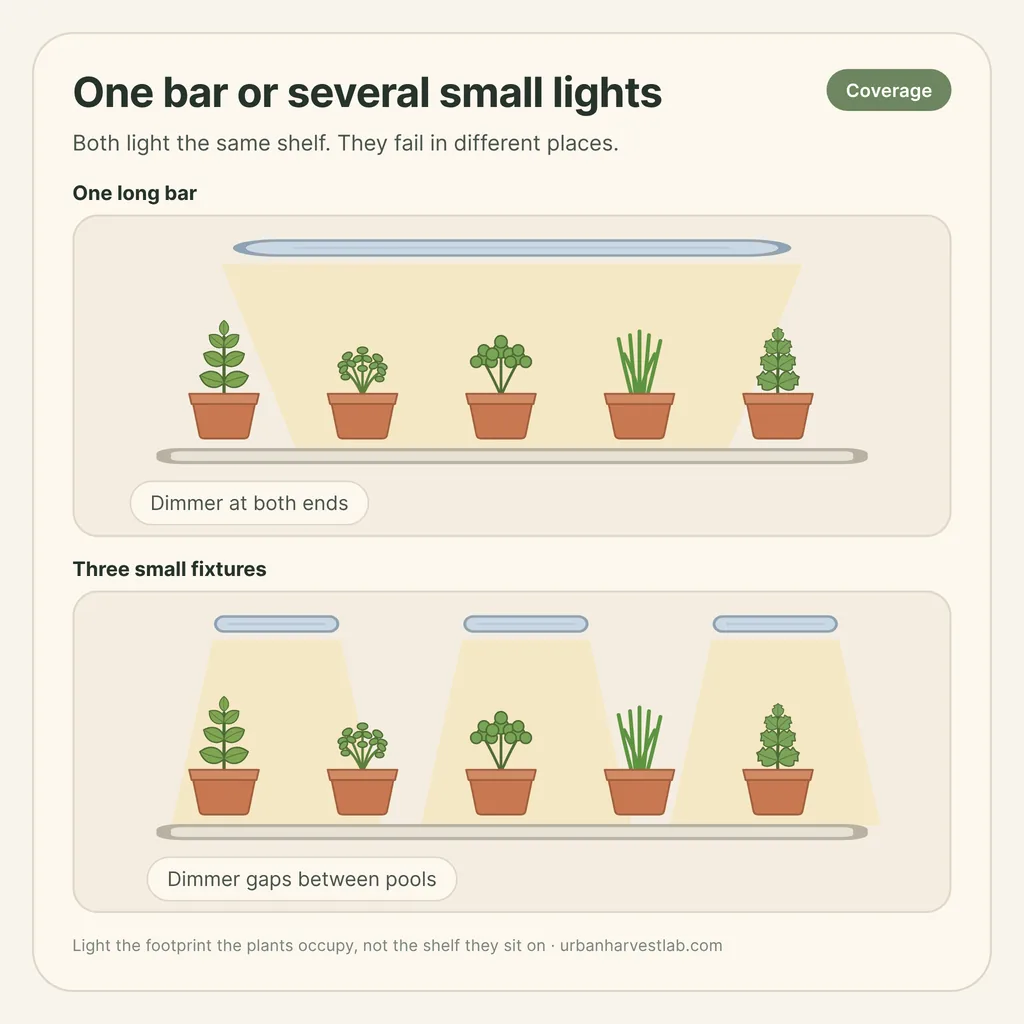
One grow light or several: how to decide
There is no fixed ratio of lights to shelf feet. The count follows from your plants' footprint and their light target, and it changes depending on whether they sit in a row or a cluster.

Lux to PPFD: what a light meter reading actually tells your plants
Lux measures what a human eye sees; PPFD measures what a plant can use. The gap between the two explains why a bright reading does not guarantee strong growth.