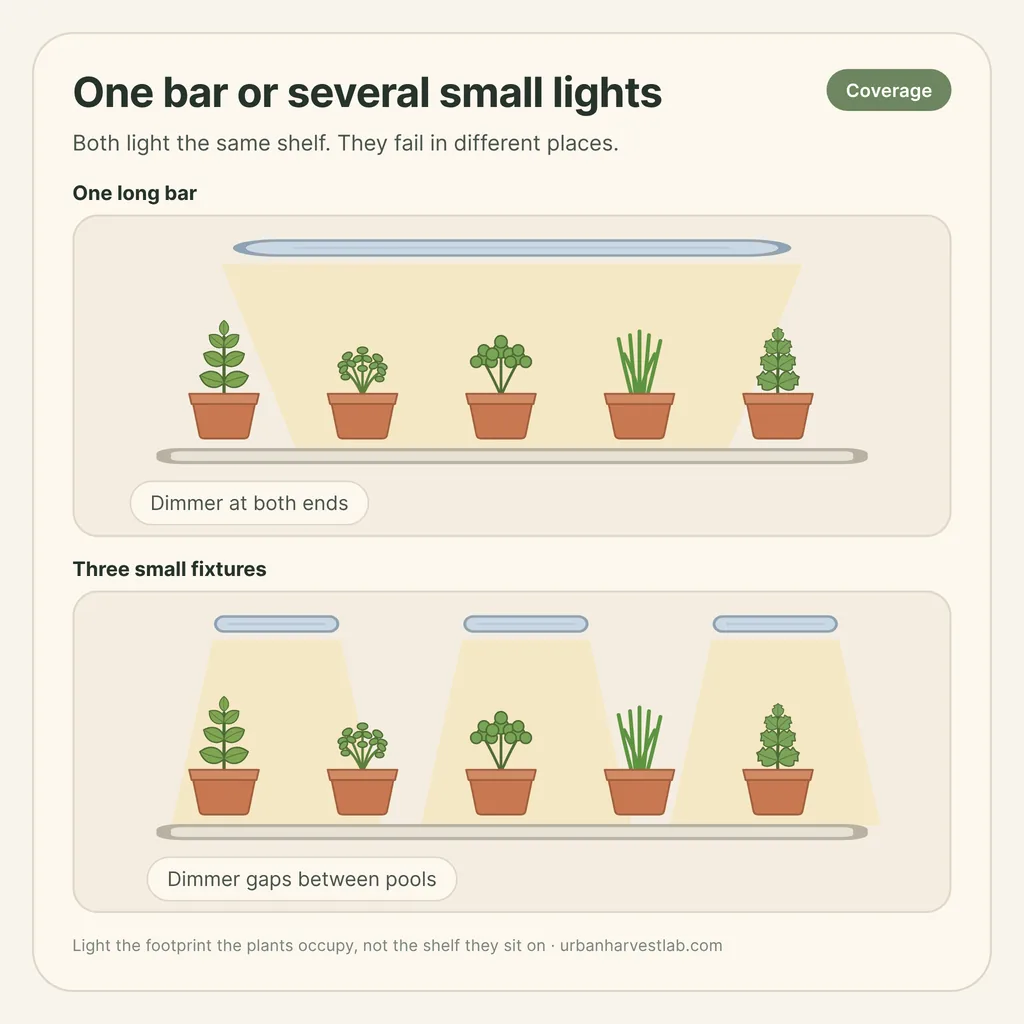
One fixture or several: how each one fails
| Setup | Light pattern | Fits best when |
|---|---|---|
| One long bar or panel | Even light along its length, weaker at both ends | Plants sit in a single row, like a windowsill line of pots |
| Several small clip or puck lights | Bright pools directly under each fixture, dimmer light in between | Plants are scattered or clustered rather than lined up |
| One bar plus a clip for an outlier pot | Fixes one weak spot without changing the rest of the layout | Most plants sit in a row, but one pot sits off to the side |
The right number of grow lights is not a fixed ratio to shelf length — it is whatever combination puts your target light level across the area your plants actually occupy. A single bar can do that for a tidy row of pots and fail badly for a scattered cluster; three small clip lights can do the opposite. The count follows from the layout and the light, not from a rule that says one fixture per so many pots.
Before working out how many fixtures to buy, it helps to know what level you are aiming for in the first place — how much light do herbs need? sets that baseline. With that target set, the question is whether one fixture or several actually deliver it across the pots.
Light the plants, not the shelf
The most common mistake is buying for the furniture. A grower measures the shelf, buys a light rated for “shelves up to that size,” and mounts it — without checking that the plants themselves occupy anything close to that footprint. Four pots clustered at one end of a long shelf do not benefit from a fixture built to spread light evenly across the whole length; most of that light lands on bare wood.
The genuine rule of thumb, and about the only one that survives contact with a real shelf, is to measure the space the pots occupy right now, not the space available. If the plants are going to spread out later, plan for that later footprint when the time comes rather than lighting empty shelf today on the assumption that it will fill in eventually.
Even coverage versus total output
Once the footprint is settled, the real decision is between two different kinds of failure, not between “strong” and “weak” lighting.
A single long bar or panel mounted above a row of pots tends to distribute light fairly evenly along its length. Photometric output from a linear or rectangular source is more consistent across the middle of its run than a small point source can manage. The trade is at the ends: intensity typically tapers off toward both tips, so a pot pushed right to the edge of the fixture’s run receives less light than one sitting in the middle, even though both are on the same shelf under the same light.
Several small clip or puck lights behave differently. Each one creates its own pool of strong, concentrated light directly beneath it, with the light level dropping fast just outside that pool. Cover a shelf with three or four of these and you get bright spots with genuinely dim gaps between them, unless the fixtures are close enough together that the pools overlap.
Which failure mode matters depends entirely on how the plants are arranged. A single row of pots along a windowsill is a good match for one bar: the even middle covers most of the plants, and you can shift the one or two end pots toward the center if they start lagging. A cluster of pots at different depths and angles, on the other hand, is often served better by two or three small lights positioned over the actual plants than by one fixture trying to reach all of them evenly.
Why the edges lose out
The physics behind this is straightforward. Light intensity from any real source falls off with distance, and with the angle away from directly underneath it. A pot at the end of a bar gets light that travelled further and landed flatter. Neither wattage nor “full spectrum” marketing changes that geometry.
Illinois Extension’s seedling troubleshooting guidance ties this directly to what a grower can actually see: seedlings stretch into a long, thin, weak stem specifically when a fixture sits too far away from the canopy. The plants at the dim edge of a shelf are experiencing a milder version of exactly that same mechanism — not a different problem, just a smaller dose of the same one. Growers who rotate pots on a schedule are, in effect, correcting for this by moving each plant through the strong and weak zones in turn rather than leaving one pot permanently in the shadow. Rotation spreads the shortfall around; it does not remove it. For how close a fixture needs to sit above seedlings, see the grow light distance guide.
The method, not a number
Coverage depends on a fixture’s optics and its mounting height, so a “one light covers this much space” figure is a manufacturer measurement for one specific fixture, not a constant you can look up. Two fixtures with identical wattage can throw very different patterns depending on the lens and reflector behind the diodes. The useful process instead runs in three steps.
First, measure the area the plants occupy, not the shelf. Second, set the light target for the crop — DLI targets for herbs and leafy greens gives the baseline most leafy herbs need, along with the caveat that a handful of species reward more. Third, check whether a candidate fixture actually reaches that target across the whole footprint, either from the manufacturer’s own photometric chart at your mounting height or by measuring the installed shelf directly, as covered in PPFD and DLI for indoor herbs.
That third step is the one people skip, and it is the one that actually answers “how many.” Michigan State University Extension’s definition of daily light integral is a useful reminder here: DLI is the total light delivered over a full day, which means running a light longer multiplies whatever intensity is present at that moment. It does not raise a genuinely low reading into an adequate one — extra hours cannot fix a spot the fixture fails to reach properly. If a corner of the shelf is short on intensity, either move a plant, add a fixture over that spot, or reposition the one you have. Adding hours to the timer is not a substitute.
If you do not have a PAR meter, a phone lux app is a workable stand-in for comparison purposes only, and only under a white LED fixture. Lux versus PPFD covers the rough estimate — about 15 times the illuminance in kilolux gives a PPFD figure, from an unreviewed bioRxiv preprint rather than a peer-reviewed source — and why it falls apart for anything other than white LED. Used across several points on the same shelf under the same light, it is enough to tell you that one end reads noticeably dimmer than the other, which is exactly the information this decision needs.
The trade that has nothing to do with photons
Optics are not the only variable, and for a lot of apartments they are not even the deciding one. Several small fixtures mean several power bricks, several cords, and either several timers or a splitter to keep them synchronized, versus one plug and one switch for a bar — see grow light safety for cord routing and strip loads near a sink or damp windowsill. That difference alone is a legitimate reason to pick one stronger fixture over three small ones in a small flat, and a reliable timer matters more once several fixtures are involved, since a schedule that drifts out of sync between lights is harder to notice than one that drifts on a single switch.
Matching the fixture to the shape you actually have
Once you know whether you are lighting a row or a cluster, fixture selection becomes a narrower question than “which grow light is best.” A shelf of pots lined up along a windowsill is the case a bar or small panel was built for, and the buyer’s guide for apartments and windowsills walks through what to check before choosing one. A single pot, or two pots that are not in line with each other, tends to suit a clip-on fixture that can be aimed independently rather than a fixture built to spread light along a line it does not need to cover.
If the edges of a bar-lit row are the specific weak point, a light-colored or reflective surface behind the shelf can recover some of what the fixture’s own optics lose at the tips. It is a smaller fix than repositioning a plant or adding a second fixture, and it comes with its own limits — creasing, dust, and hot spots all reduce what it actually gives back.
Common mistakes
The recurring error is buying to match the shelf’s dimensions rather than the plants’ footprint, which leaves a fixture lighting bare surface while the pots at one end sit outside its effective run. A close second is assuming that more fixtures automatically means more usable light, without checking whether their pools of coverage actually overlap where the plants are — three small lights spaced too far apart can leave a shelf with worse gaps than one bar would have.
The bottom line
Decide row versus cluster first, then check the fixture’s own coverage data or measure the shelf before assuming the count you bought is the count you needed.
Sources
Turn coverage into a working setup
Once you know how many lights the layout calls for, use these guides to set the target, measure it, and pick a fixture that fits.
Common questions
How many grow lights do I need for a shelf of herbs?
There is no fixed number that applies to every shelf. It depends on the area your plants actually occupy, the light level that crop needs, and what a specific fixture delivers at your mounting height — which is a manufacturer measurement, not a rule of thumb. Measure the area, set a light target, then check the fixture's own photometric data or measure the installed shelf yourself.
Is one long light bar better than several small clip lights?
Neither is better in general; they fail in different ways. A single bar or panel usually spreads light evenly along its length but tapers off at both ends, so plants in a straight row do well while the pots right at the tips lose out. Several small clip lights create separate bright pools with dimmer gaps between them, which suits a scattered cluster of pots better than a tidy row.
Can I check my grow light setup with just a phone?
A phone lux app can flag relative differences, such as a dim corner next to a bright one, for white LED fixtures specifically, using a rough, unreviewed estimate (a bioRxiv preprint, not peer-reviewed) that PPFD works out to about 15 times the illuminance in kilolux. That factor does not hold for other light types, and it is an estimate rather than a measurement, so treat it as a sanity check rather than a final answer.
Why do plants at the end of my shelf grow slower than the ones in the middle?
They are almost certainly receiving less light. Output from a point or short source falls off with distance and with the angle away from directly underneath it, so the ends of a shelf under one bar, or the gaps between several small fixtures, can sit well below the level the brightest spot receives. Rotating pots evens out the difference in growth over time; it does not raise the light level itself.
Related guides
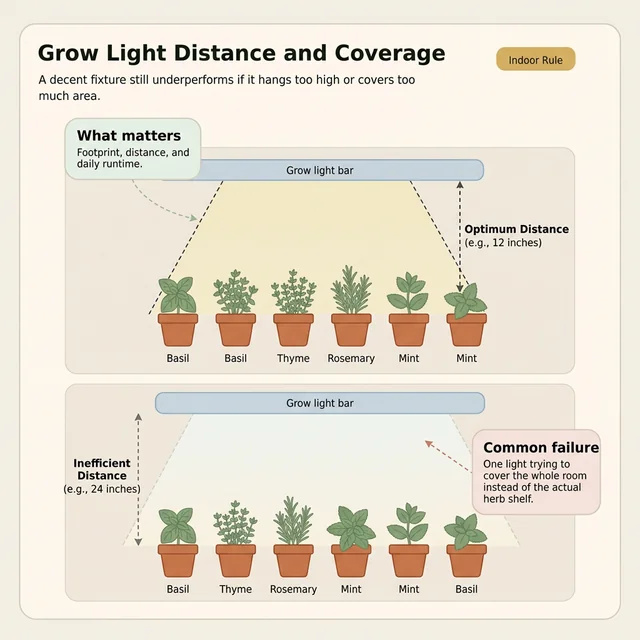
Grow light distance for seedlings: how close is too close?
Seedlings usually need grow lights much closer than beginners expect, but the exact distance depends on fixture strength, lens design, and plant response.
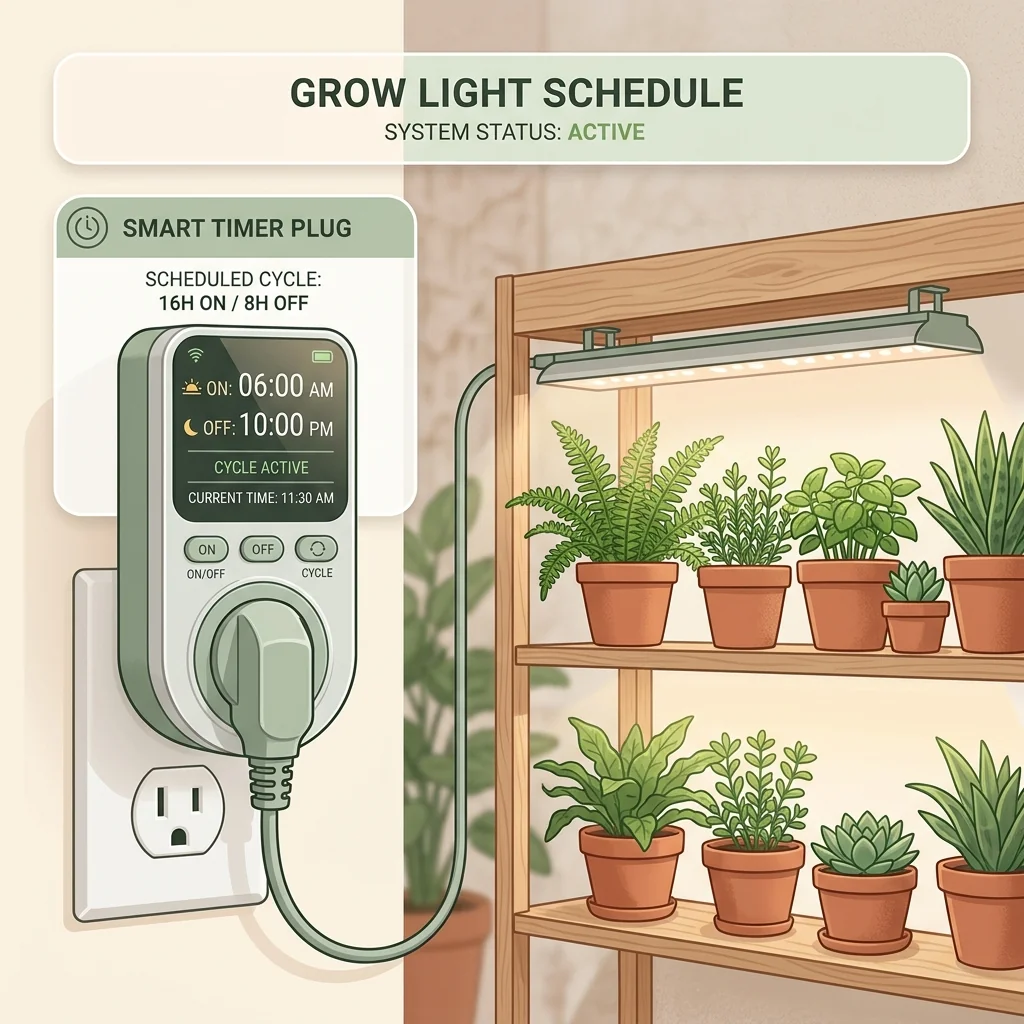
Best grow light timers (buyer's guide)
Consistency is everything in indoor horticulture. If you forget to turn your grow lights on, your plants will starve. If you leave them on too long, your greens will stress and bolt. Automating your photoperiod with a reliable outlet timer is the single easiest upgrade you can make. Here are our top picks.
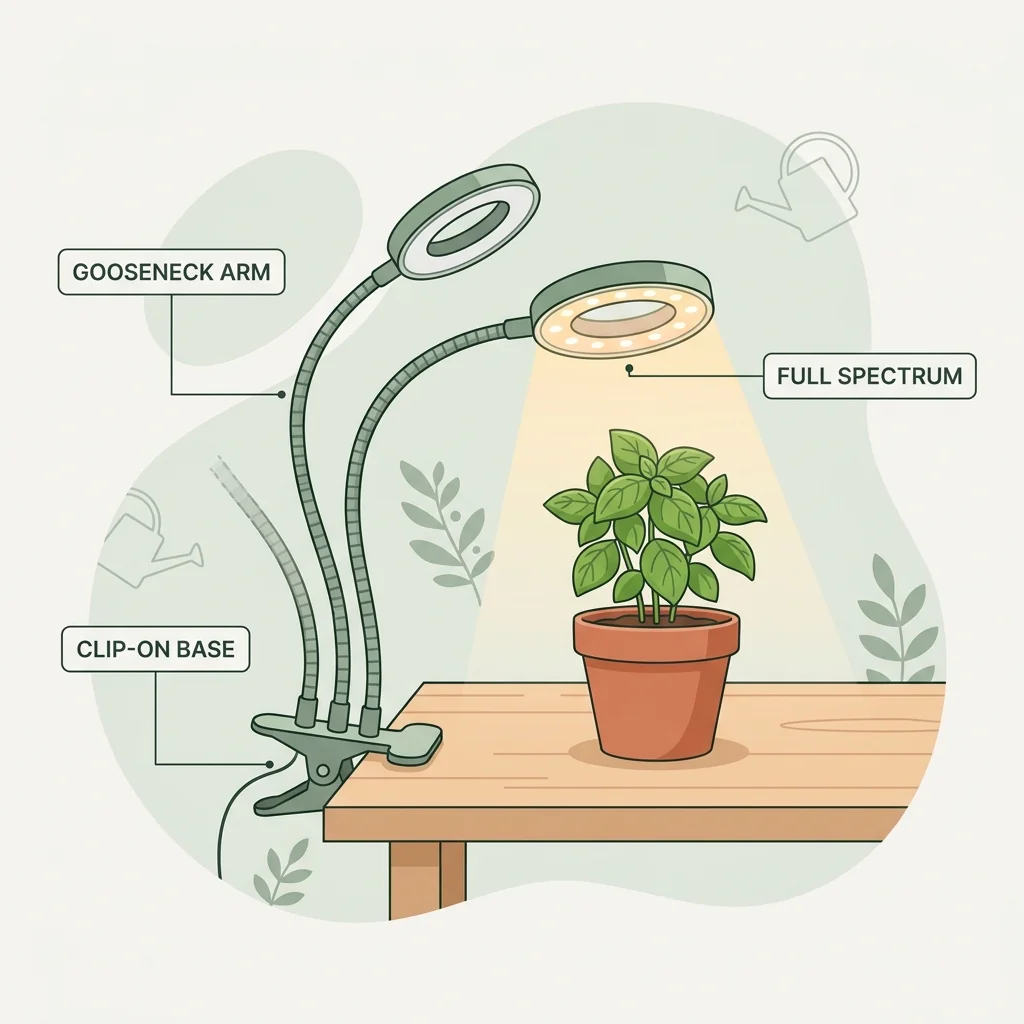
Best clip-on grow lights for herbs (buyer's guide)
You do not need to install massive ceiling-mounted grow panels or ugly industrial fixtures to keep your indoor herbs alive. With a flexible, clip-on gooseneck LED grow light, you can clamp a soft, full-spectrum light source directly onto your desk or windowsill in seconds. Here are our top-rated options.