
Switch when the plant is carrying flowers and fruit, not on a date, and expect the change to be a step up in nitrogen and potassium rather than a jump in phosphorus. Ohio State Extension tells tomato growers to count flower trusses with open flowers; UF/IFAS counts fruit clusters. Neither programme moves to a different kind of feed at a single “flip to bloom” moment, and neither raises phosphorus at all.
That matters because bottles sold as “grow” and “bloom” suggest a switch at the first flower. For a tomato or pepper the university programmes are staged by how much fruit the plant is carrying, and the early stages are deliberately weak. The hydroponic tomatoes guide and the peppers guide cover the crops themselves; the question here is only when and what to change in the reservoir.
What the two programmes switch on
Ohio State’s fact sheet defines stages by trusses: Stage 1 runs “from cotyledon emergence up to second truss with open flowers”, Stage 2 from the third open truss to the fifth, and Stage 3 begins beyond the fifth. Its recipe, developed by Dr. Merle Jensen at the University of Arizona, is the three-stage column set below. UF/IFAS gives a five-stage programme tied to clusters, from transplant to first cluster through to fifth cluster until the end of the crop.
| Nutrient (ppm) | Ohio State, Stage 1 / 2 / 3 | UF/IFAS, Stage 1 / 2 / 3 / 4 / 5 |
|---|---|---|
| Nitrogen | 90 / 120 / 190 | 70 / 80 / 100 / 120 / 150 |
| Phosphorus | 47 / 47 / 47 | 50 / 50 / 50 / 50 / 50 |
| Potassium | 144 / 350 / 350 | 120 / 120 / 150 / 150 / 200 |
| Calcium | 144 / 160 / 200 | 150 / 150 / 150 / 150 / 150 |
| Magnesium | 60 / 60 / 60 | 40 / 40 / 40 / 50 / 50 |
Read across, the pattern is the same even though the numbers differ. Nitrogen climbs by roughly a factor of two. Potassium rises, sharply in Ohio State’s recipe. Phosphorus does not move. Ohio State’s reasons for the climb are specific: nitrogen “to promote plant growth and development”, calcium largely “to prevent blossom end rot” and potassium “to promote fruit sugar loading and general fruit quality”. UF/IFAS adds that demand rises “especially after several clusters of fruit have been set on the plant”.
Ohio State puts the early-stage solution at an EC of about 2.0 dS/m and the mature stage closer to 2.4. The two recipes are written for commercial greenhouses and differ in absolute strength, so pick one programme and stay with it rather than averaging them.
Why the early stage stays weak
Both sources are blunt about the cost of feeding hard too soon. Ohio State: too much nitrogen makes plants overly vegetative, with thick stems, curled leaves and, “most importantly”, reduced flowering. It shows a truss that carried two fruit where six to eight would be expected. UF/IFAS holds nitrogen at 60 to 70 ppm early in the season to prevent bullish growth, which it links to cracked stems, misshapen fruit, blossom-end rot and cat-facing.
So a seedling or young plant on a strong “grow” formula is not being given a head start. If a plant is lush, dark and leafy with few flowers, the first thing to check is whether the reservoir is richer in nitrogen than the stage calls for. Our nutrient deficiency chart helps tell excess from shortage when leaves look off.
Potassium: the other half of the change
Potassium is the nutrient that does most of the rising, and UF/IFAS flags the risk in doing it carelessly: high potassium “can interfere with the plant’s capability to absorb Ca and Mg”, leading to magnesium deficiency on lower leaves and blossom-end rot. Its stated focus for the whole programme is that “the major elements to manage are N and K”. Step potassium up when fruit is set, not before, and keep calcium adequate; Ohio State raises it, and UF/IFAS holds it at 150 ppm.
Working out your switch point
- Count trusses or clusters. Mark the stem each time a truss opens. Moving from Ohio State’s Stage 1 to Stage 2 happens at the third open truss; Stage 3 beyond the fifth. UF/IFAS steps up at each cluster boundary.
- Step, do not leap. Both programmes rise in stages. A single jump from stage-one strength to the top is the opposite of how either is built.
- Check pH after each change. UF/IFAS gives a final solution pH of 5.8 to 6.2.
- Change the reservoir with the stage. If you only top up, the concentration you mixed weeks ago is still what the plant gets. When to change hydroponic nutrient solution covers top-off versus a full reset, and the mix calculator converts target ppm into millilitres per litre.
If you only have a bottled feed
Ohio State notes that off-the-shelf fertilisers for phased tomato solutions are typically not available and must be prepared by the grower, who mixes individual salts. If that is out of reach, its practical fallback is to use half the strength of the Stage 3 recipe for Stage 1 plants and three-quarter strength for Stage 2, which it calls “not optimal” but better than doing nothing about early nitrogen.
With bottles, compare the N-P-K analysis on the label with the stage you are in. UF/IFAS lists premixed examples from 4-18-38 to 7-17-37 (N-P2O5-K2O), and its worked programme using a 4-18-38 premix holds that single bag constant across all five stages; what rises is the separate calcium nitrate stock. That is the direct answer to “do I need a second bottle”: the UF/IFAS example changes the separate calcium nitrate stock, not the base. Which products suit your water and system is a separate question, covered in best hydroponic nutrients and the general mixing steps in how to mix hydroponic nutrients.
Peppers
UF/IFAS describes its tomato table as “a suitable base when determining a nutrient solution plan for cucumbers and peppers”, adding that cucumbers need more nitrogen early in the season. The sources here do not give a separate pepper schedule by cluster. The practical reading is to apply the same staging, with the same weak start, at the lower overall concentration peppers want; the EC target is on the peppers page.
What a feed change cannot fix
Nutrients are only one input. Light for fruiting plants is covered in grow lights for fruiting plants indoors, and hand pollination is covered on the tomato page.
Sources
Feeding fruiting crops
The crop guides and mixing tools that sit around the growth-to-bloom decision.
Common questions
When should I switch to bloom nutrients in hydroponics?
Time it by the plant, not the calendar. Ohio State Extension counts flower trusses with open flowers: the first stage runs up to the second open truss, the second from the third to the fifth, and the mature stage starts beyond the fifth. UF/IFAS counts fruit clusters instead and steps up after the first, second, third and fifth.
What actually changes in a bloom feed?
In both programmes nitrogen and potassium go up as the plant carries more fruit and phosphorus stays flat from transplant to the end of the crop; Ohio State also raises calcium (144 to 200 ppm), while UF/IFAS holds calcium at 150 ppm throughout. Ohio State's three-stage recipe goes from 144 to 350 ppm potassium and 90 to 190 ppm nitrate nitrogen; UF/IFAS goes from 120 to 200 ppm potassium and 70 to 150 ppm nitrogen.
Does feeding more nitrogen make fruiting plants bigger?
Early on it does the opposite of what you want. Ohio State Extension reports that too much nitrogen gives overly vegetative plants with thick stems, curled leaves and reduced flowering, and UF/IFAS reports bullish growth and misshapen fruit. Both keep nitrogen low until fruit is setting.
Do peppers need a different bloom feed from tomatoes?
UF/IFAS calls its tomato programme a suitable base for peppers and cucumbers, with the note that cucumbers need more nitrogen early. Peppers are grown at a lower EC than tomatoes (see the peppers guide for the target), so use the same staging idea at a gentler strength.
Related guides

Hydroponic peppers indoors: EC, pH, and how they differ from tomatoes
Peppers are the hydroponic fruiting crop that forgives a mixing mistake tomatoes would not. That does not make them a light or pollination shortcut.
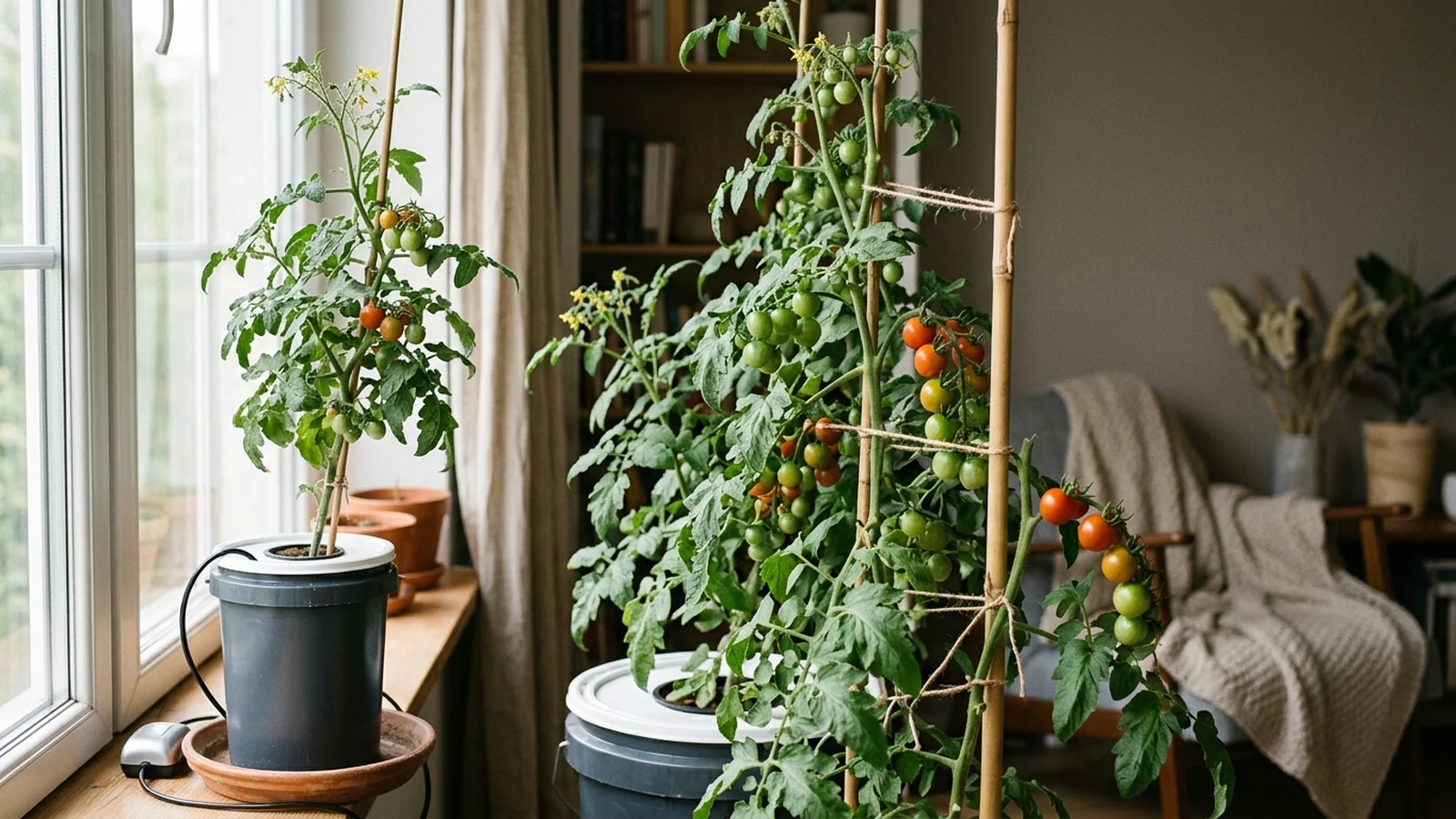
Growing hydroponic tomatoes indoors: system, EC, and light
Tomatoes are the first fruiting crop most hydroponic growers try indoors, and the jump from lettuce is bigger than it looks. Here is the system, the EC program, and what to expect.
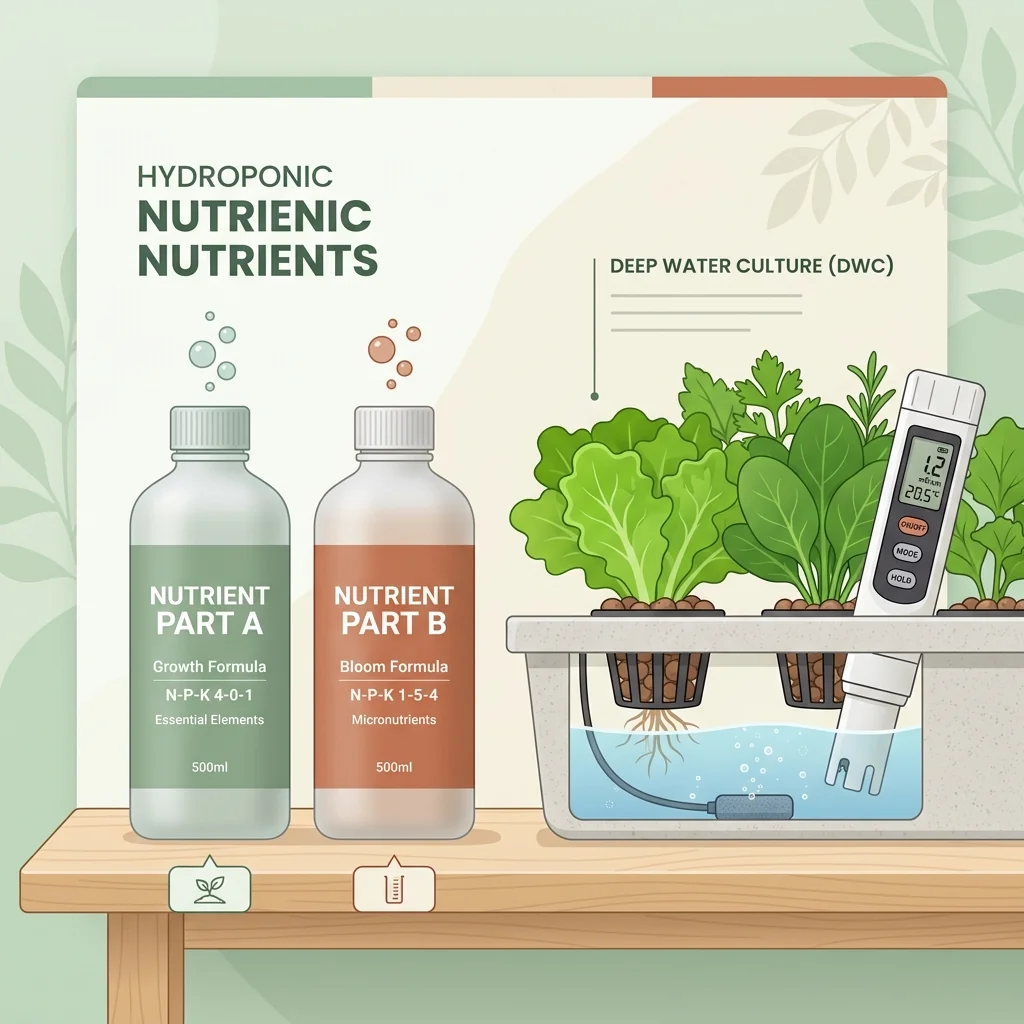
Best hydroponic nutrients for herbs and greens
Leafy greens and herbs do not need exotic nutrients, just a complete, balanced formula with the right micronutrients. Here is what to look for and which type to pick.