
Hydroponic watercress: working targets from the University of Hawaii
| Variable | Target | Notes |
|---|---|---|
| EC | 1.5-2.0 mS | Seeded non-circulating method; the long trials ran at 1.0-1.8 mS |
| pH | 5.0-7.0 | Described as an acceptable range; pH drifted upward as the solution aged |
| Solution temperature | 18 C or cooler in the trials | Deep (30 cm) tanks kept midsummer solution at or under 18 C |
| Seed to first cut | 4-6 weeks | Germination in about 3 days; ratoon cut 3-4 weeks later |
| Solution change | After every second crop | About every 2 months in the Hawaii trials |
Watercress grows well in a still, deep tank of nutrient solution if you keep it cool: the University of Hawaii’s method holds EC at 1.5 to 2.0 mS with an acceptable pH of 5.0 to 7.0, and gets a first cut 4 to 6 weeks after seeding. The two things that go wrong are warm water and a solution left unchanged too long. A third matters for what you eat: the CDC links raw watercress from the wrong source to a liver parasite.
These numbers come from University of Hawaii work by horticulturist Bernie Kratky, done in a cool highland climate. They are starting points for a home tank, not a guarantee, so measure your own solution. If EC and pH are new, hydroponic nutrient basics explains the meters and the logic first.
Why watercress suits a still tank
Watercress is normally an aquatic crop. The University of Hawaii notes that open-field watercress there is grown in shallow beds with clean water flowing continuously, a system that needs about 58,000 litres of water per kilogram of crop. In its non-circulating trials the best treatment used about 0.1% as much water. That is the argument for a simple floating-board tank at home: the roots already expect to sit wet, and you skip the pump.
The Hawaii setup is close to the Kratky method:
- A tank at least 5.5 inches (about 14 cm) deep, per the University of Hawaii; deeper is preferred.
- Floating extruded polystyrene boards holding 2-inch net pots of peat-perlite mix, with the lower 1.5 inches of each pot in the solution, as the Hawaii guide describes.
- Seeds sown on the surface of the medium and left uncovered, about 10 to 20 per pot.
- Net pots on a staggered 8 x 12 inch grid, about 1.5 pots per square foot.
The University of Hawaii reports seeds usually germinate within 3 days, and the plants then grow 4 to 6 weeks without attention. The tank should be topped up with water before you cut, because the level falls as the crop drinks. Hawaii also started a trial from cuttings: 40 stems, 30 cm long, per tank. Whichever route you take, the CDC section below should guide where those stems come from.
EC and pH
The University of Hawaii tells advanced growers to maintain a solution strength of 1.5 to 2.0 mS, and says pH 5.0 to 7.0 is acceptable. Its longer shading and solution-change trials ran slightly lower, between EC 1.0 and 1.8 mS. That is a wide pH window next to the 5.5 to 6.5 the University of Missouri gives as a rule of thumb for most crops, so aim for the middle of it and watch the trend rather than a single reading. In the Hawaii analysis, pH rose as the solution aged, along with boron, magnesium and sodium, while nitrate, phosphorus and calcium fell.
For comparison with other crops, see the EC chart by crop. If your tap water is hard, its dissolved minerals raise the starting EC before any fertiliser goes in; hard water in hydroponics shows how to account for it. Hawaii makes the same point for a still tank: good water quality is required, because salts may concentrate as the solution is consumed and this could retard growth.
Keep it cool
Watercress prefers cooler temperatures, the University of Hawaii says, and growing it at lower, warmer elevations in summer gave variable results. In field beds, production and quality fell in warm months (22 to 33 C air) compared with cooler ones (18 to 27 C), even though the flowing water stayed at 20 to 25 C.
Depth is the tool the Hawaii team used. Their tanks were about 30 cm deep (University of Hawaii) to encourage uniform and cool solution temperatures, and the solution did not exceed 18 C in midsummer. A shallow tray on a sunny sill will not behave that way. A deep, covered, opaque tank in a cool room is the nearest home equivalent. The reasoning in hydroponic water temperature for lettuce applies here too, with this crop sitting at the cool end.
Tipburn, brown dead leaf edges, appeared in unshaded plants in the Hawaii trials. University of Hawaii found that shade cloth blocking 57% or 71% of light significantly reduced it. Indoors, the equivalent step is to ease light intensity or raise the lamp if edges brown, before touching the nutrients.
Cutting and re-cutting
Cut with scissors in the morning or evening, and leave a stubble about 1.5 inches high. The stems regrow from the root mass, and the University of Hawaii says a ratoon crop may be harvested after another 3 to 4 weeks. In the longer trials the Hawaii team cut about monthly. After each cut, add fertiliser in proportion to the water you topped up.
When to change the solution
Leaving a still tank alone is tempting, but the data argue against it. In the University of Hawaii trials, changing the solution every 2 months raised yield by 25% over changing it every 4 months and by 68% over every 6 months. A tank left unchanged gave 33% less over six harvests. The university’s recommendation is to change it after every second crop. For the general reasoning on topping up versus a full reset, see when to change hydroponic nutrient solution.
Because the tank is still, it can also breed mosquitoes. The University of Hawaii lists salt-tolerant fish, approved Bti products or labelled pesticides for its outdoor tanks; indoors, a lid that keeps mosquitoes off the water is the simpler barrier.
Food safety: watercress is not lettuce
The CDC says people can get Fasciola, a liver fluke, by eating raw watercress or other freshwater plants contaminated by larvae, and that drinking contaminated water is another route. Its advice is to avoid eating raw watercress and other freshwater plants, especially from areas where livestock graze, in places where the infection occurs.
That warning concerns wild and pasture-fed water, which is a reason to grow from packet seed or bought stems and to keep stream-gathered cuttings out of your tank. A sealed tank filled from the tap is a different situation from a pasture ditch. Rinse every cut under running water, as the FDA advises for all produce including home-grown, and remember that, per the FDA, washing can reduce bacteria that may be present but will not eliminate it. Rinsing is general produce hygiene against bacteria, not a fluke treatment; for Fasciola, the protection is clean water and clean starting material, and CDC notes that washing produce in contaminated water is itself a route.
Watercress also overlaps with the seedling crop. Cress grown as a tray microgreen is a different product with different timings; cress microgreens covers that. For a comparable leafy crop in a reservoir, see hydroponic arugula.
Sources
- University of Hawaii CTAHR: Growing Watercress from Seed by a Non-Circulating Hydroponic Method (Kratky)
- University of Hawaii: Shading and Periodic Replacement of Nutrient Solution Improve Production of Hydroponically-grown Watercress (Kratky, Maehira and Cupples, 2002)
- CDC: Clinical Overview of Fasciola
- CDC: About Fasciola
- U.S. FDA: Selecting and Serving Produce Safely
If you are growing watercress, also read
These guides cover EC and pH basics, other crops in the same range, and the passive tank method watercress suits.
Common questions
What EC and pH should hydroponic watercress have?
The University of Hawaii's method for seeded watercress in a non-circulating tank holds the solution at EC 1.5 to 2.0 mS and calls pH 5.0 to 7.0 acceptable. Its trial tanks actually ran between EC 1.0 and 1.8 mS. Start near the low end and top up with plain water as the tank drops.
How long does hydroponic watercress take to harvest?
In the University of Hawaii method, seeds germinate within 3 days and the plants grow for 4 to 6 weeks before the first cut. Leave a stubble about 1.5 inches high and a second cut can follow 3 to 4 weeks later.
Does watercress need running water?
Field watercress is grown in continuously flowing water, but University of Hawaii trials grew it in still, non-circulating tanks and used only about 0.1% as much water as flowing beds. The catch is that the still solution must be changed every second crop.
Is it safe to eat hydroponic watercress raw?
The CDC ties liver fluke (Fasciola) infection to eating raw watercress and other freshwater plants, especially from livestock grazing areas. Grow from packet seed in clean water rather than gathering cuttings from a stream, and rinse the cut leaves under running water, as the FDA advises for all produce. That rinse is hygiene against bacteria, not a fluke control; against Fasciola the protection is clean water and clean starting material.
Related guides
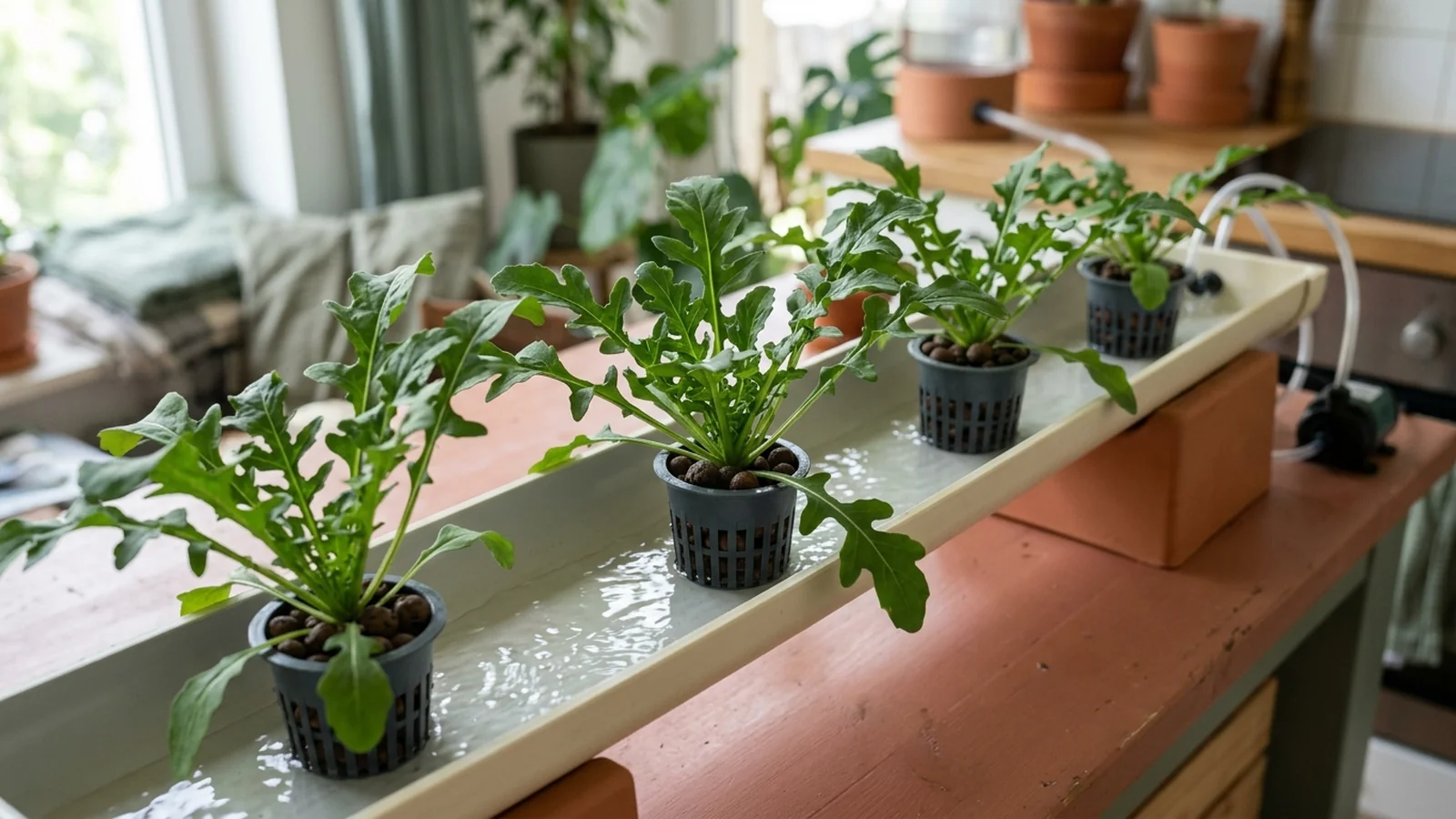
Hydroponic arugula: EC, pH, and how it differs from microgreens
Arugula has no dedicated hydroponic EC or pH figure in the extension research, and it is one of the few crops grown here as both a full hydroponic leafy green and a fast microgreen.
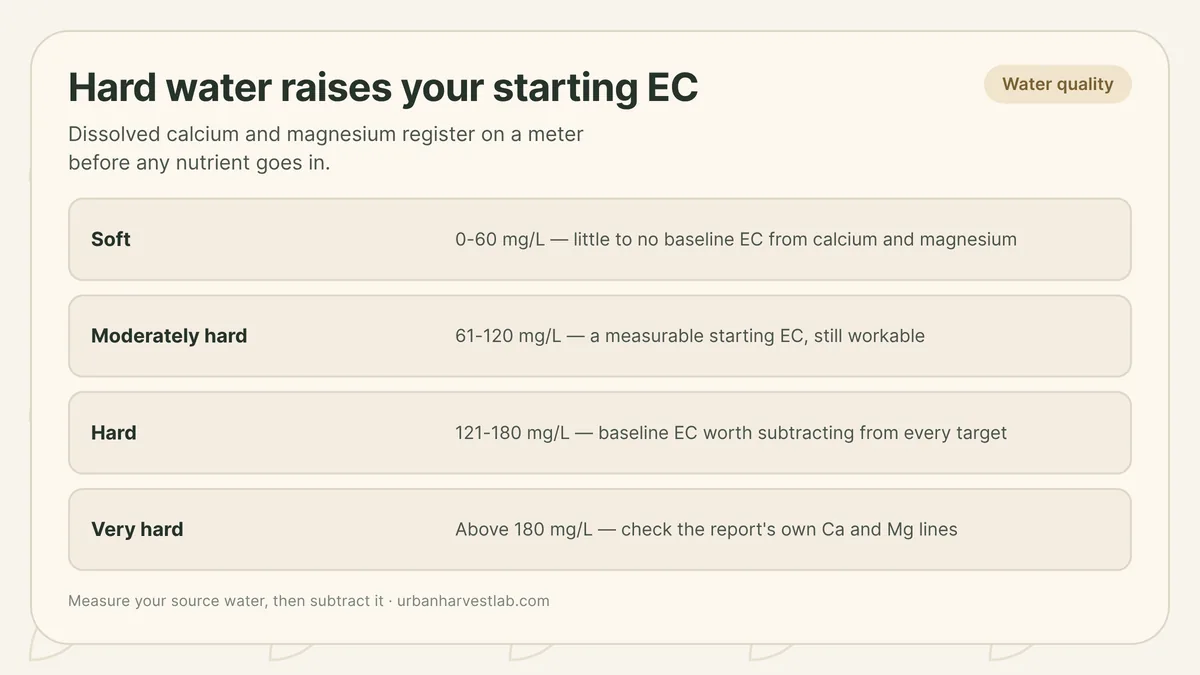
Hard water in hydroponics: how it raises your starting EC
Tap water carrying dissolved calcium and magnesium does not start at zero EC. Here is how much that shifts your baseline, and how to mix around it.
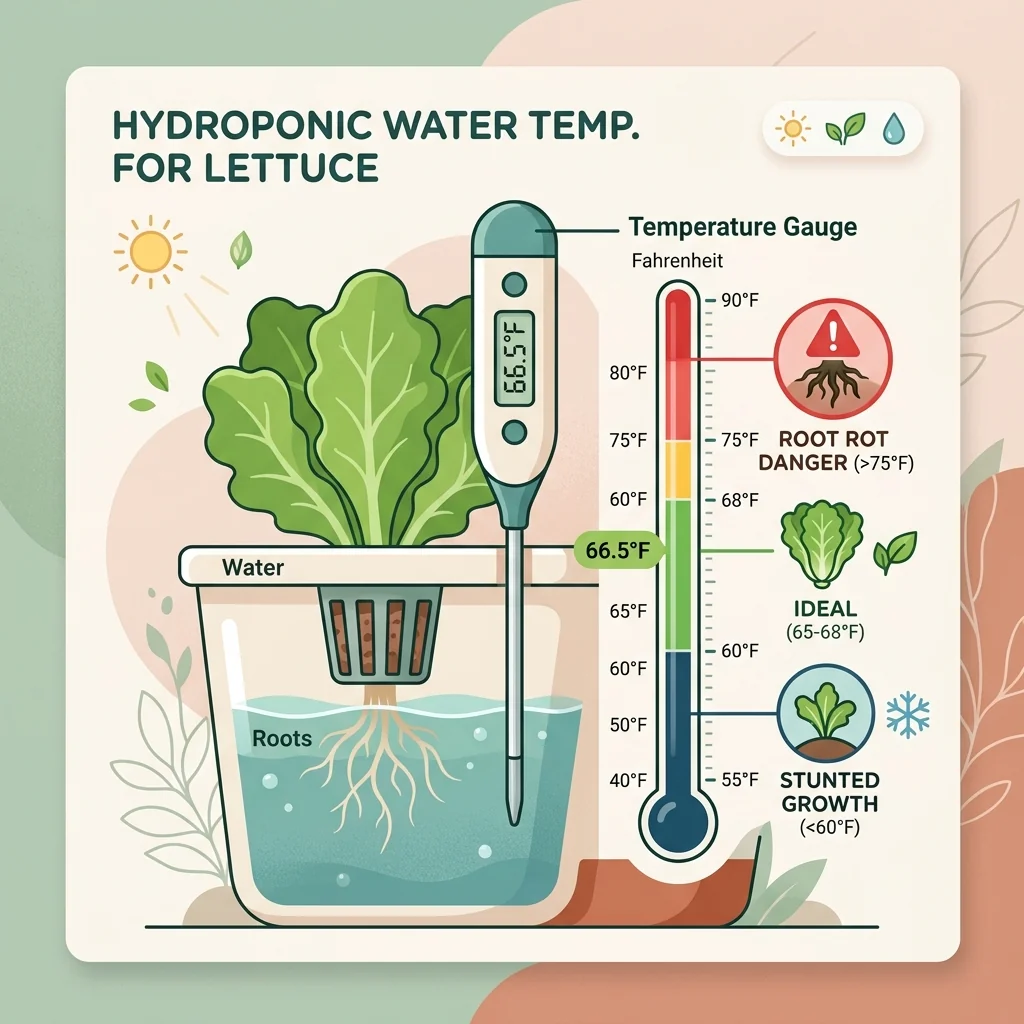
Hydroponic water temperature for lettuce: why 68°F is magic
You can have perfect pH, perfect nutrients, and a massive air pump. But if your hydroponic reservoir is sitting at 80°F, your lettuce is actively suffocating. Here is why water temperature dictates everything in hydroponics.