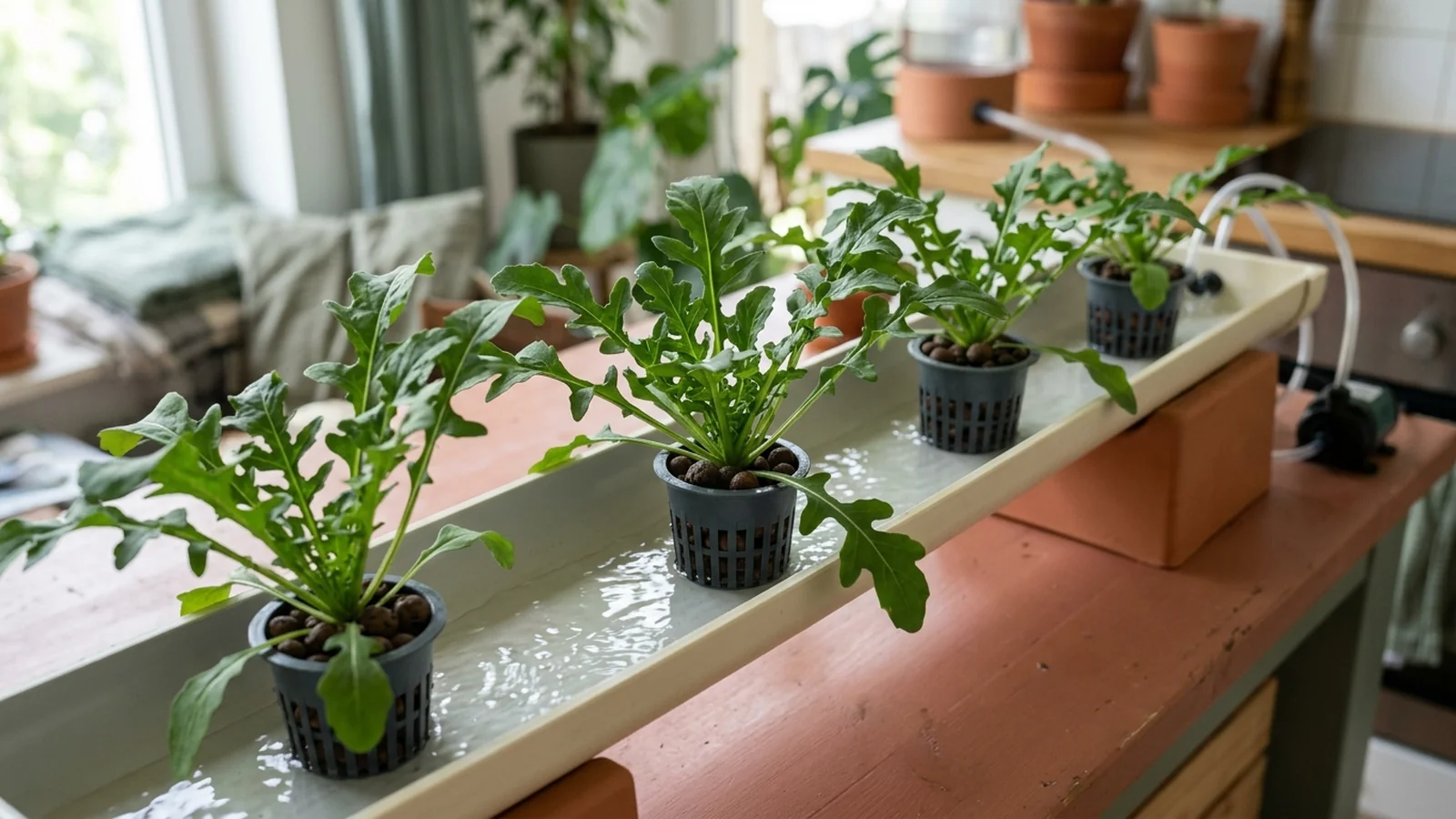
Hydroponic arugula: working targets
| Variable | Target | Notes |
|---|---|---|
| EC | 1.2-2.0 mS/cm | Virginia Tech's general leafy-green range for DWC; Oklahoma State's 27-crop table has no line for arugula |
| pH | 5.5-6.2 | Same source, same caveat |
| Water temperature | 65-80°F (18-27°C) | UF/IFAS range; Oklahoma State's optimum sits at 72-75°F (22-24°C) |
| System fit | NFT, DWC, or Kratky | University of Minnesota names arugula suited to NFT specifically |
Hydroponic arugula grows as a fast, peppery leafy green in NFT, DWC, or Kratky systems, but no university extension table reviewed here gives it its own EC or pH figure the way it does for lettuce or basil. The closest sourced target is a general leafy-green range: EC 1.2 to 2.0 mS/cm and pH 5.5 to 6.2, treated as a proxy rather than a number measured on arugula itself. If EC and pH are new terms, start with hydroponic nutrient, EC, and pH basics before dialling in a reservoir.
Hydroponic arugula vs. arugula microgreens
Arugula is one of the few crops on this site grown both ways, and the two products share nothing but a seed packet.
| Hydroponic arugula (full leaf) | Arugula microgreens | |
|---|---|---|
| System | NFT, DWC, or Kratky reservoir | Shallow tray, no reservoir |
| Days to harvest | Several weeks, on the order of a lettuce cycle | 6-8 days, per Utah State University Extension |
| Seeding | Transplanted seedlings or net-pot starts | 10 g of seed per 1020 tray, per Utah State University Extension |
| Covered growth | Not applicable | 1-2 days, per Utah State University Extension |
| What you harvest | Full rosette leaves, cut repeatedly | Seedling stems and first leaves, cut once |
Utah State University Extension’s tray protocol calls for 10 grams of seed per standard 1020 tray, with only 1 to 2 days of covered growth before the lights come on, tied with kale, radish and rutabaga for the shortest covered time in that table. Penn State Extension’s own trial, averaged across multiple two-week cycles in a greenhouse with no supplemental light, measured 148 grams of arugula microgreens per standard 10-row tray. None of those figures apply to a plant grown to full size in an NFT channel or a DWC bucket; the seeding rate, tray, and harvest window all belong to the tray method. For the seeding density across other microgreen crops, see the microgreens seed density chart; for how covered time compares crop to crop, see the blackout period chart.
What EC and pH to use for hydroponic arugula
Oklahoma State University Extension’s 27-crop table is the most detailed per-crop EC and pH reference available from a US extension service, and it does not include arugula. Neither does UF/IFAS Extension’s lettuce guide, Penn State Extension’s nutrient-solution pages, the University of Kentucky’s lettuce production guide, or Virginia Cooperative Extension’s deep water culture publication. University of Minnesota Extension names arugula among the leafy greens that grow well in NFT, but gives no number to go with the name.
The closest sourced anchor is Virginia Cooperative Extension’s general range for leafy greens in deep water culture: EC 1.2 to 2.0 mS/cm, pH 5.5 to 6.2. That is not an arugula-specific figure, and it does not match the lower EC figure published on the hydroponic EC chart by crop and the lettuce EC and pH chart, both of which give leafy greens 0.8 to 1.2 mS/cm. That lower figure is not supported by any of the primary sources checked here: Oklahoma State’s table gives lettuce 1.2 to 1.8, UF/IFAS gives 1.4 to 1.8 for lettuce, and Kentucky’s example recipe sits around 1.5. Start near the low end of Virginia Tech’s range for young transplants, and build up as the rosette fills in, the same approach growers use for lettuce.
Cilantro and mint land in the same gap. Neither has a published hydroponic EC or pH figure either, so hydroponic cilantro and hydroponic mint route to the same kind of proxy range rather than a crop-specific number. Parsley is the exception among the four: Oklahoma State does publish a parsley figure, a notably stronger 1.8 to 2.2 mS/cm.
Water temperature and oxygen
The temperature figures available here come from lettuce research, but they describe the reservoir rather than the plant. As a habit comparison rather than a measured claim, arugula shares the same cool-season, fast-growing pattern. UF/IFAS Extension gives 65 to 80°F (18 to 27°C) as the workable range for a small hydroponic system, and Oklahoma State University Extension calls 72 to 75°F (22 to 24°C) optimal — warmer than many home growers assume is safe.
Warmer water holds less dissolved oxygen, so aeration matters more as the reservoir warms. In NFT, the University of Kentucky notes the continuous thin film of solution supplies enough oxygen on its own. Deep water culture needs help: an air pump and air stones, per the University of Kentucky and Virginia Cooperative Extension, to reach a 6 to 8 ppm target. In a passive setup like Kratky, University of Minnesota Extension’s rule of thumb is to keep roughly half the root mass submerged and the rest exposed to the air gap above the water line.
Choosing a system: NFT, DWC, or Kratky
University of Minnesota Extension lists arugula by name among the leafy greens that perform well in NFT, alongside lettuce, kale, spinach, and mustard greens. Deep water culture and Kratky setups work too, since both already grow lettuce and other quick leafy crops at a similar EC and pH. For a side-by-side of how the three systems differ in setup and upkeep, see NFT vs DWC vs Kratky; for the passive, no-pump version specifically, the Kratky method for beginners covers the reservoir mechanics.
University of Minnesota Extension says a container as simple as a 5-gallon bucket or a food-safe plastic storage bin works, sized to the canopy of the mature plant. The University of Kentucky budgets more than 4 litres (more than 1 gallon) of solution per plant in deep water culture, again measured for lettuce; see hydroponic reservoir size for sizing a container to a specific number of plants. For spacing, the University of Kentucky’s planting densities — measured for lettuce, not arugula — run 3 to 4 plants per square foot in deep water culture, about 2 per square foot in NFT, and 1 to 2 per square foot on drip.
How long hydroponic arugula takes to reach harvest
Kentucky, Cornell, UNH and UF/IFAS each publish a days-to-harvest figure for hydroponic lettuce, but none of them covers arugula grown to full leaf size. Lettuce is the closest analog with an actual number: the University of Kentucky gives 21 to 35 days after transplant, at 100 to 210 grams a head, and University of Minnesota Extension puts the whole crop, seed to harvest, at 6 to 7 weeks. Arugula is not lettuce — it does not form a head — but in a reservoir system it runs on the same order of magnitude: several weeks, not days.
That distinction matters next to the other number that does exist for this crop. Arugula grown as a microgreen — seed to harvest in a shallow tray, no reservoir at all — takes 6 to 8 days, per Utah State University Extension. The two figures describe different products from the same seed packet, not two measurements of the same thing.
Harvesting arugula, and troubleshooting problems
University of Minnesota Extension notes that most herbs and leaf lettuce can be harvested multiple times, with growers typically taking 3 to 5 cuts from the same plants before restarting from seed; a head-forming crop, by contrast, is a single harvest. Arugula does not form a head, so it fits the repeat-harvest pattern: cut outer leaves with clean scissors and let the center keep producing rather than pulling the whole plant. Washing and short-term storage follow the same steps used for hydroponic lettuce — rinse, dry, and refrigerate soon after cutting.
Slimy, discoloured roots in a warm reservoir usually point to root rot rather than the harmless staining some nutrient formulas cause. Check the reservoir temperature and aeration first, and see root rot prevention before changing the nutrient mix. If growth stalls or leaves turn pale without any root symptoms, check EC and pH before adjusting light or temperature; arugula reacts to a drifting reservoir the same way any leafy green does.
Sources
- Virginia Cooperative Extension SPES-464 — Hydroponic Production of Edible Crops: Deep Water Culture (DWC) Systems
- Oklahoma State University Extension HLA-6722 — Electrical Conductivity and pH Guide for Hydroponics
- UF/IFAS Extension HS1422 — Growing Lettuce in Small Hydroponic Systems
- University of Minnesota Extension — Small-scale hydroponics
- University of Kentucky CCD-CP-63 — Hydroponic Lettuce Production in Controlled Environments
- Utah State University Extension — Grow Your Own Microgreens
- Penn State Extension — Growing Microgreens
- Penn State Extension — Hydroponics Systems and Principles of Plant Nutrition
- Cornell University CEA Program — Hydroponic Lettuce Handbook
- University of New Hampshire Extension — Hydroponics at Home
If you are growing hydroponic arugula, also read
These guides cover the EC and pH basics, how arugula compares to other hydroponic crops, and its microgreens counterpart.
Common questions
What EC and pH does hydroponic arugula need?
Oklahoma State University Extension's 27-crop EC and pH table does not list arugula, and neither do the UF/IFAS, Penn State, Kentucky or Virginia Tech hydroponic guides. The closest sourced range is Virginia Tech's general target for leafy greens in deep water culture: EC 1.2 to 2.0 mS/cm and pH 5.5 to 6.2. Treat that as a leafy-green proxy, not a number measured on arugula itself, and start near the low end.
How long does hydroponic arugula take to grow?
Kentucky, Cornell, UNH and UF/IFAS each publish a days-to-harvest figure for hydroponic lettuce (commonly 21 to 35 days after transplant, per the University of Kentucky), but none of them covers arugula grown to full leaf size. Arugula runs on a similar multi-week cycle to other fast leafy greens, not the six to eight day cycle used for arugula microgreens.
Is hydroponic arugula the same as arugula microgreens?
No. Hydroponic arugula is grown in a reservoir-based system such as NFT, DWC, or Kratky, to a full rosette of leaves over several weeks. Arugula microgreens are grown in a shallow tray with no reservoir, harvested at 6 to 8 days per Utah State University Extension, with only 1 to 2 days of covered growth beforehand.
Which hydroponic system works best for arugula?
University of Minnesota Extension names arugula among the leafy greens that perform well in NFT. Deep water culture and Kratky setups suit it too, since both already grow lettuce and other fast leafy greens at a similar EC and pH.
Related guides
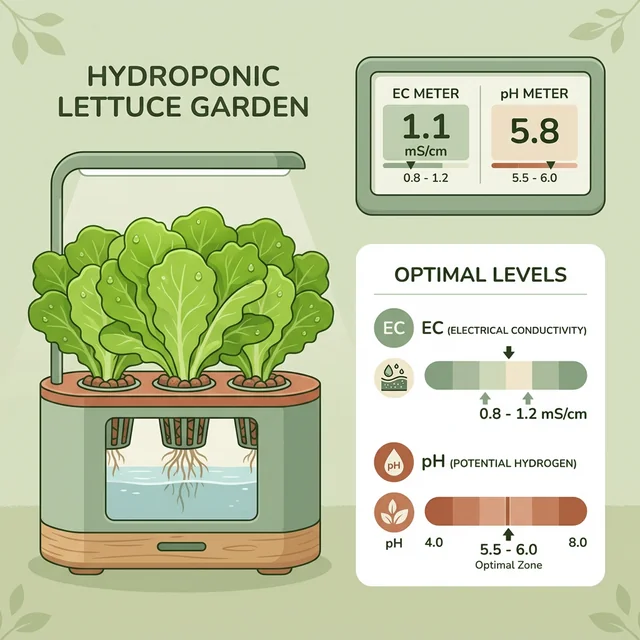
Hydroponic lettuce EC & pH chart: 0.8-1.2 and 5.5-6.0
Lettuce is the easiest crop to grow hydroponically, but it requires specific water chemistry. Use this beginner-friendly EC and pH guide to prevent tip burn and slow growth.
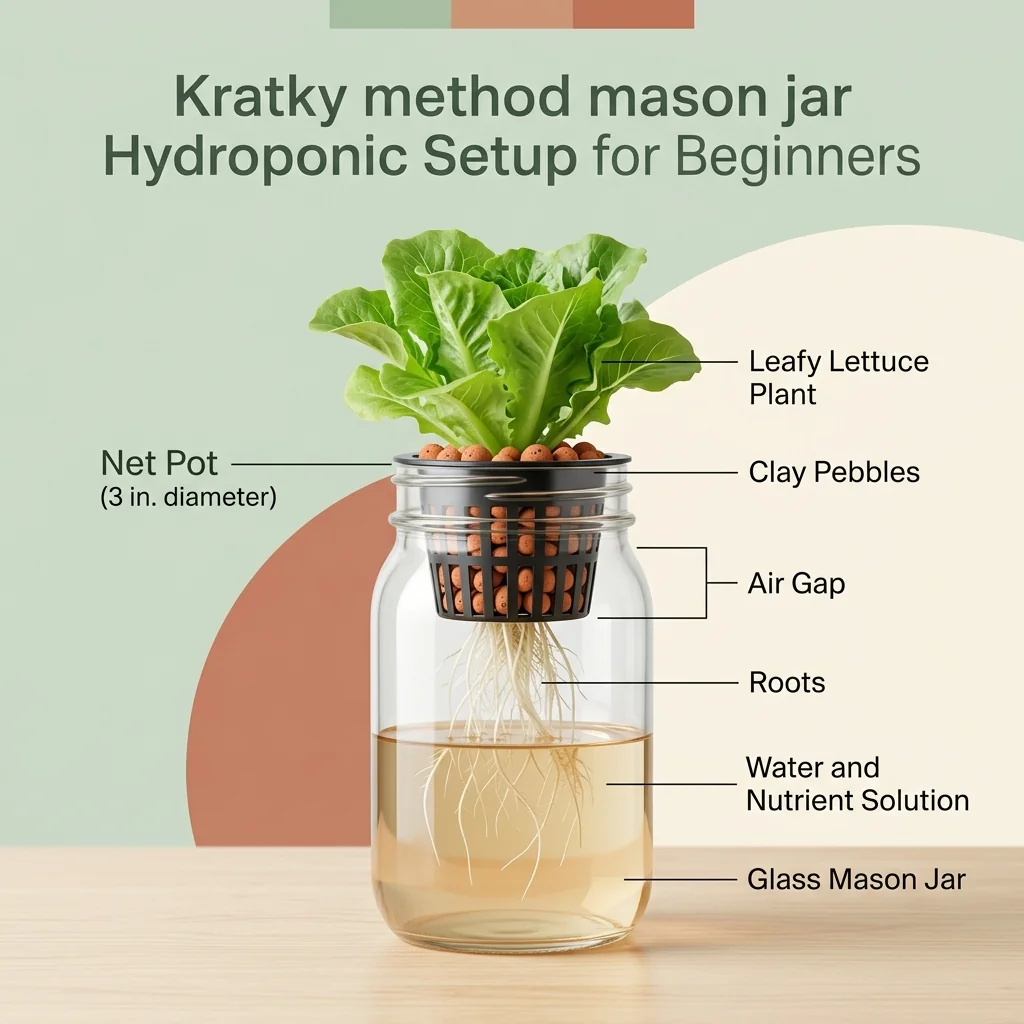
The Kratky method: passive hydroponics for beginners
The Kratky method is the simplest way into hydroponics: a container of nutrient solution, a net pot, and no pump or power. Here is how it works and its limits.
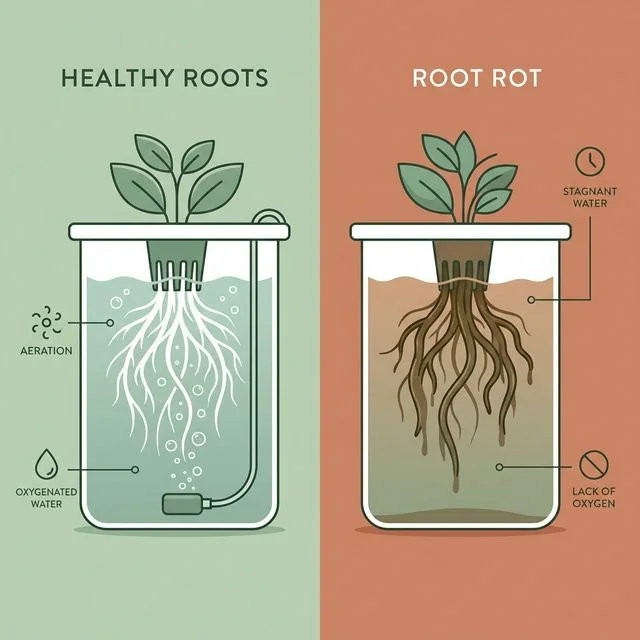
Hydroponic root rot: how to spot it early and stop it
Brown, slimy or swampy-smelling roots mean root rot. Catch it early and fix the conditions behind it — warm water, low oxygen and stagnant flow.