Net pot and container sizes in university hydroponic guides
| Crop and system | Container described | Source |
|---|---|---|
| Lettuce, 5-gallon bucket Kratky | 2-inch net pots in 2-inch lid holes, 3 per bucket | University of Hawaii CTAHR |
| Lettuce, bucket with cups and cubes | 2-inch net cups, rockwool or foam grow cubes, water about halfway up the cup | UF/IFAS Extension |
| Lettuce, polystyrene panel over a tray | 2-inch net pot per hole | University of Hawaii CTAHR |
| Lettuce, commercial-size tank | Tapered 5 x 5 cm or 3.8 cm diameter x 7.6 cm deep net pots | University of Hawaii CTAHR |
| Lettuce, tote with styrofoam sheet | Net pots 2.3 x 2.3 x 2.1 inches, spaced 8 x 6 inches | Purdue Extension |
| Tomato, suspended pot | 70 ml tapered net pots (3.8 cm x 7.5 cm) or 10 cm square pots holding 700 ml | University of Hawaii CTAHR |
| Cucumber, trash-container tank | One tapered tube, 3.8 cm x 21 cm, per 100 to 130 litre container | University of Hawaii CTAHR |
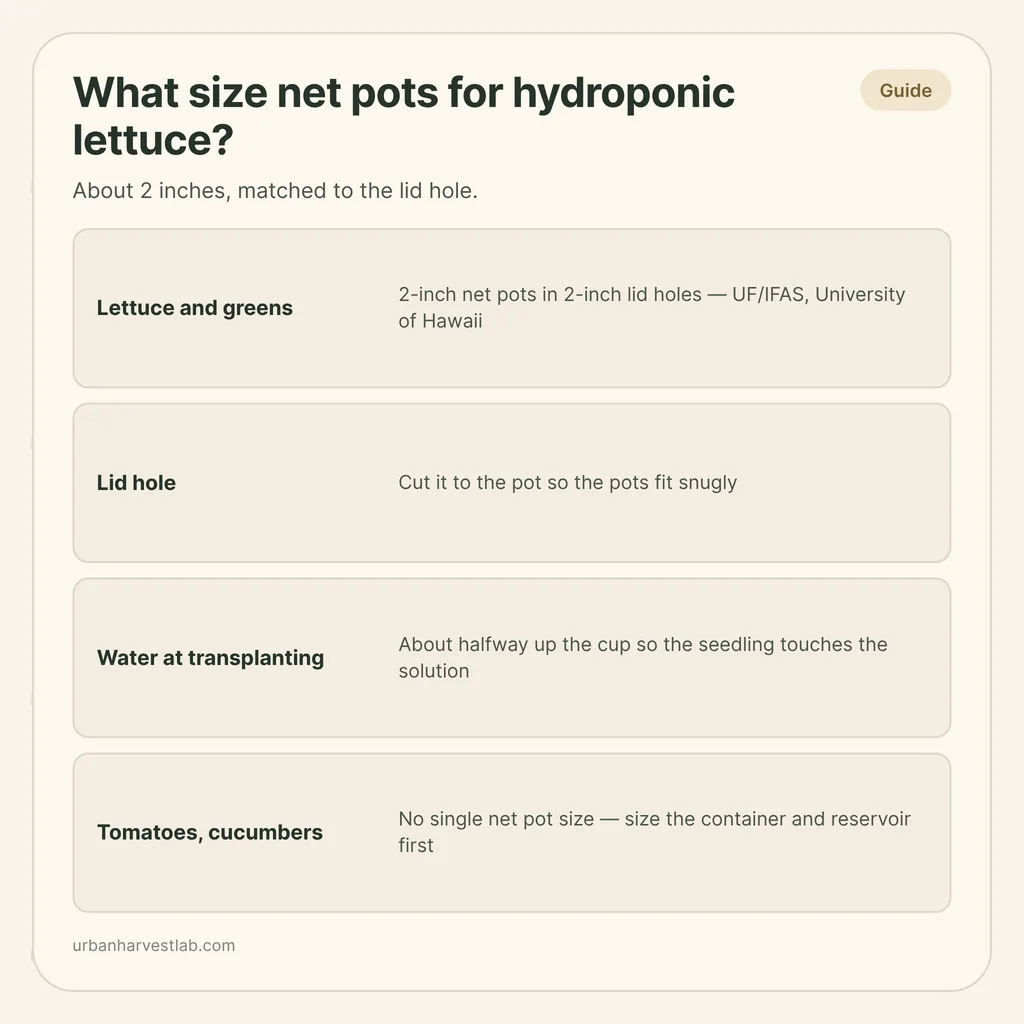
For lettuce and leafy greens, a net pot of about 2 inches (5 cm) is what university growing guides use, set in a lid hole cut to the same size. University of Florida and University of Hawaii extension guides both specify 2-inch pots for lettuce, and Hawaii also lists tapered pots 1.5 inches (3.8 cm) across. For tomatoes and cucumbers the university work described below uses different containers, with no single net pot size you can read off a chart.
Why the pot matters less than people think
A net pot is a slotted cup that holds the seedling and a little medium above the water. It does not set the size of the root system. In the Hawaii suspended-pot method, the pots are tapered and slotted so roots can emerge, and the roots hang into the solution below. A leafy plant’s roots soon leave the cup through the slits and spend the rest of the crop in the reservoir. What you are choosing is a snug fit in the lid and enough room for the seedling’s cube.
That also explains why the pot is rarely where a problem starts. If lettuce is stalling, root and reservoir checks come first.
Lettuce and leafy greens: what the guides use
The numbers cluster tightly. University of Hawaii’s bucket guide drills three holes in the lid with a 2-inch hole saw “so the net pots fit snugly.” UF/IFAS Extension’s lettuce guide lists “2-inch net cups” with rockwool or foam grow cubes, and its video places those cups in a lid drilled with a 2-inch hole saw. Hawaii’s tray-and-panel design also puts each seedling in a 2-inch net pot.
Hawaii’s commercial-size tank design is a little smaller or squarer: tapered 5 cm by 5 cm pots, or 3.8 cm diameter by 7.6 cm deep pots, with leafy and semi-head lettuce spaced 20 by 30 cm. Purdue’s lettuce trial used net pots measuring 2.3 by 2.3 by 2.1 inches in a styrofoam sheet, spaced 8 by 6 inches.
Across the Hawaii, Florida and Purdue guides the lettuce pots run from 1.5 to 2.3 inches, with the 2-inch cup in the middle. The spacing between holes is a separate decision; transplant spacing for lettuce covers it.
Match the lid hole to the pot
Cut the hole after you have the pots in hand, and size it to the pot, as Hawaii’s 2-inch hole saw does for 2-inch pots. Hawaii’s paper on three non-circulating methods for lettuce also recommends tapered pots with slits, so roots can leave from the sides as well as the base.
Water level at the start
At transplanting, the University of Florida video shows the water about halfway up the net cup, so the seedling stays in contact with the solution. Hawaii’s guidance for a pot in a bottle neck is an immersion of the lower 3 cm. The level then falls as the plant drinks. In a Kratky jar, University of Minnesota Extension advises that only about half of the root biomass should touch the water once roots outgrow the pot, which is what keeps the roots oxygenated. In a pumped DWC system the air stone handles oxygen and the water level is managed differently.
Tomatoes, cucumbers and other big plants
Here the evidence changes shape. The University of Hawaii work on tomatoes did not settle on a net pot size. ‘Big Beef’ tomatoes yielded 2.68 kg per plant in 0.35 litre aluminium beverage cans. Tomatoes in 70 ml net pots gave similar yields in one trial and lower yields in another. Plants in 10 cm square pots holding 700 ml of perlite, resting on a nursery tray, yielded significantly higher than the cans in two trials. Hawaii’s explanation: the tray raises the pot, which exposes more root to moist air and gives roots a surface to form on and anchor.
Cucumbers in the same Hawaii paper went in a single tapered forestry tube, 3.8 cm by 21 cm per the University of Hawaii, with extra holes drilled in the sides, in a 3.8 cm lid hole on a 100 to 130 litre container.
What this means for you:
- The Hawaii tomato and cucumber work started plants in small tapered containers and then relied on a large tank, a pot on a raised tray or a long tube. The 2-inch lettuce cup is not a template for those crops.
- Plan the whole container, support and reservoir together. The hydroponic reservoir size calculator is the place to start, and the indoor tomato guide covers the rest of that system.
- None of these trials gives a single net pot size for fruiting crops, so treat any per-crop inch chart you find as a seller’s convention rather than a tested figure.
Medium inside the pot
The pot holds medium, and the medium decides how the cup behaves. A rockwool or foam grow cube suits seedlings, which is what the University of Florida guide uses. UF/IFAS rates expanded clay low in water-holding capacity. Rockwool vs clay vs coco vs foam compares them, so the comparison is not repeated here. Hawaii’s guidance for peat-perlite mixes is to tap the medium to settle it but not pack it so tightly that you restrict air.
A short way to decide
- Leafy greens or herbs in a bucket, tote or jar lid: buy 2-inch net pots and cut 2-inch holes.
- Panel, tower or kit built around a particular pot: use that pot, because the holes are cut for it.
- Tomato, cucumber, pepper: size the container, support and reservoir first. Do not size from the net pot.
Sources
- University of Hawaii CTAHR, Growing lettuce in a 5 gallon bucket (Kratky)
- University of Hawaii CTAHR, Small-scale lettuce production with hydroponics or aquaponics (SA-2)
- University of Hawaii CTAHR, A suspended pot, non-circulating hydroponic method (Kratky, 2004)
- University of Hawaii CTAHR, Non-circulating hydroponic methods for growing tomatoes (Kratky et al., 2005)
- UF/IFAS Extension, “Set it and forget it” hydroponic lettuce (HS1488)
- Purdue Extension, Heating requirements for winter hydroponic lettuce production (HO-308-W)
- University of Hawaii CTAHR, Three non-circulating hydroponic methods for growing lettuce
- University of Hawaii CTAHR, Hydroponic vegetable production (VC-1)
- University of Minnesota Extension, Small-scale hydroponics
Pick the pot with the rest of the system
The pot is one decision among medium, container and method.
Common questions
What size net pots should I use for hydroponic lettuce?
Two inches is the size the University of Florida (IFAS) and the University of Hawaii use in their lettuce guides, set in a 2-inch hole. Hawaii also describes tapered net pots 1.5 inches (3.8 cm) across and 3 inches (7.5 cm) long, and 2 inch (5 cm) square ones.
Does the net pot have to match the hole in the lid?
Yes. Hawaii's bucket guide has you cut the hole with a 2-inch hole saw so the pots fit snugly, and the University of Florida video does the same with 2-inch cups in 2-inch holes.
How high should the water be in the net pot?
At transplanting, the University of Florida video shows the water about halfway up the cup so seedlings stay in contact with the solution, and Hawaii immerses the lower 3 cm of a 7.5 cm pot. Later the level falls and the roots carry on.
What net pot size for tomatoes and cucumbers?
University of Hawaii trials do not give one standard net pot size for them. Hawaii grew tomatoes in 70 ml net pots with mixed results and did better in 700 ml pots, and grew cucumbers from a single 3.8 cm by 21 cm tube in a 100 to 130 litre container.
Related guides

Rockwool vs clay pebbles vs coco vs foam: which hydroponic medium fits
The four media most home growers choose between behave very differently: one needs a pH soak, one drains in seconds, one carries salt, one falls apart. Here is which fits which system.
Hydroponic reservoir size: how many litres you actually need
Reservoir size is a function of plant count, system type, and one sourced rule for deep water culture: more than 4 litres per plant. Here is how to size yours.
Growing hydroponic tomatoes indoors: system, EC, and light
Tomatoes are the first fruiting crop most hydroponic growers try indoors, and the jump from lettuce is bigger than it looks. Here is the system, the EC program, and what to expect.