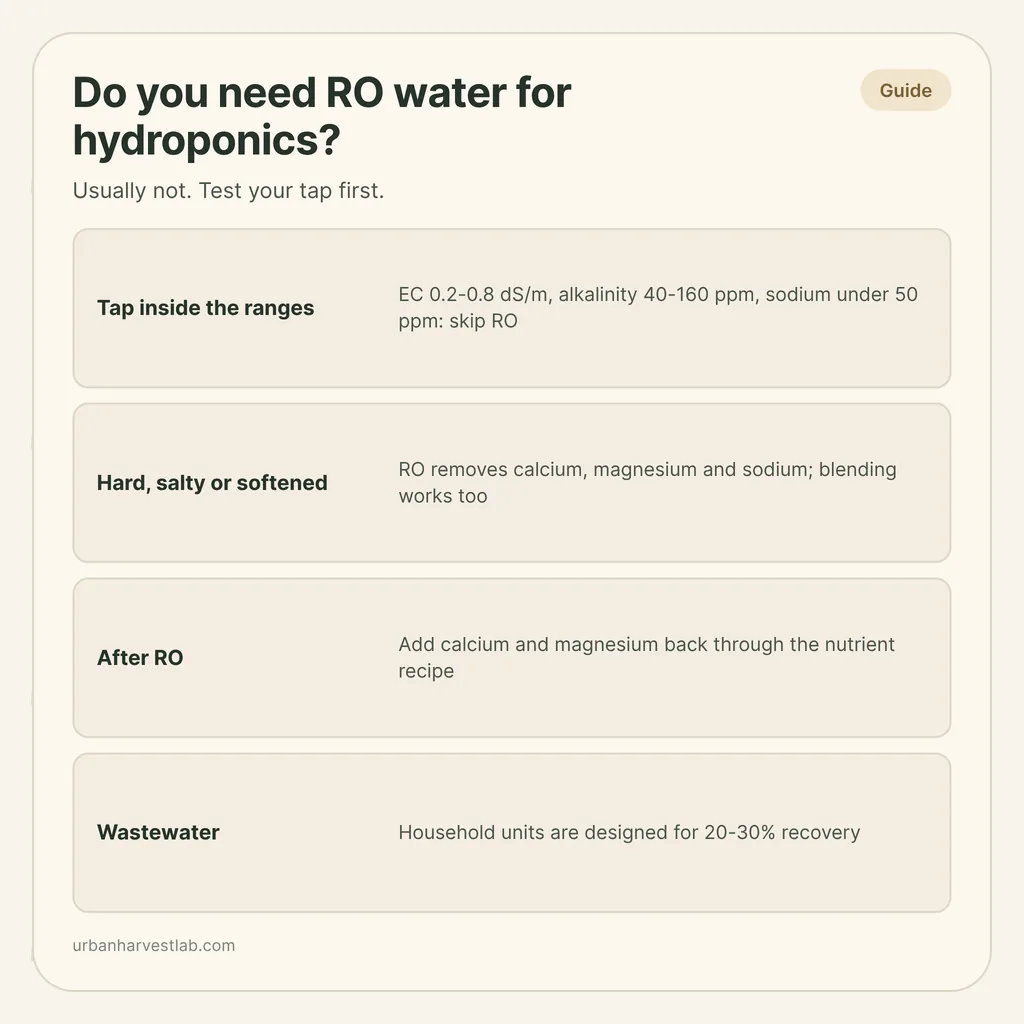
You probably do not need RO water. Test your tap first: if its EC, alkalinity and sodium sit inside the extension ranges below, fill the reservoir straight from the tap. Reverse osmosis earns its place when the test shows very hard, salty or softened water, and it comes with two costs: you must put calcium and magnesium back, and most of the water that enters the unit goes down the drain.
The decision rests on numbers you can get cheaply, which is why the first step is the one in hydroponic nutrient, EC and pH basics: read what your water already contains before anything is mixed into it.
What RO actually does to your water
Reverse osmosis pushes water through a membrane that holds back dissolved ions. University of Nebraska-Lincoln Extension lists calcium, magnesium, sodium, potassium, sulfate, nitrate and chloride among the ions household RO units remove. The same publication says dissolved gases such as hydrogen sulfide pass through, and that the carbon filters packed with household units, not the membrane, are what take out chlorine.
Removal is a percentage, not a wipe. In Nebraska Extension’s example, a membrane with 85 percent rejection takes 40 mg/L of nitrate down to 6 mg/L, not to zero. So RO water is very low in minerals, not guaranteed blank, and your EC meter is the way to see what your unit delivers.
When tap water is fine
University of Missouri Extension puts the optimum source-water EC for hydroponics at 0.2 to 0.8 dS/m, alkalinity at 40 to 160 ppm calcium carbonate equivalent, and flags sodium above 50 ppm, calcium above 150 ppm and magnesium above 75 ppm as problem levels. Tap water inside those bands is a workable base. It also brings some calcium and magnesium for free.
Chlorine alone is not a reason to buy RO. Municipal residuals sit far below the levels extension sources flag; chlorine and chloramine in hydroponics has the numbers. Plain hardness is also manageable without RO: hard water in hydroponics shows how to subtract the starting EC from your target, and tap water alkalinity and pH drift covers a tap that keeps pushing pH back up.
When RO is worth the trouble
| Your test shows | What it means | Reasonable move |
|---|---|---|
| Source EC near or above 0.8 dS/m | Little headroom before the fertilizer goes in | Blend tap with RO, or use RO alone |
| Sodium above 50 ppm, or a water softener on the supply | University of Minnesota Extension warns softened water can start a system with excess salt | RO removes sodium; use unsoftened water if you can |
| Calcium above 150 ppm or magnesium above 75 ppm | Outside the Missouri range | Blend with RO |
| Alkalinity far above 160 ppm | Each pH correction needs more acid | RO lowers it; see the alkalinity page first |
| EC, alkalinity and sodium inside the ranges | Tap is a usable base | Skip RO |
Cornell University’s commercial lettuce operation runs its ponds on RO water, which suits a greenhouse that wants a known zero baseline. That is a design choice for scale. A balcony DWC bucket does not have to copy it.
Blending instead of going all-in
You do not have to choose between pure tap and pure RO. Cornell notes that EC creeping up can be lowered by adding pure water, such as RO water, and that you should subtract the base EC of your source water from the sensor reading. Mixing RO into a hard tap supply works on the same principle: the more RO in the mix, the lower the starting EC and the smaller the calcium, magnesium and sodium load.
As a rough estimate the blend’s EC falls in proportion to the share of RO water, but ions do not always behave that neatly, so measure each batch with a meter you have calibrated (choosing a pH and EC meter). Record the blend ratio and the reading, then repeat it.
What to add back after RO
RO water is low in everything, including the calcium and magnesium plants need in quantity. Your nutrient solution has to carry them. Cornell’s RO-based lettuce recipe shows how: Stock A holds calcium nitrate and Stock B holds magnesium sulfate, and the two stocks are added separately to the RO water because, Cornell notes, keeping them apart prevents chemical reactions that would make some of the nutrients precipitate and drop out of solution. The result is mixed to an EC of 1.2 dS/m.
In practice, read your fertilizer label for calcium and magnesium before you commit to RO. If the label lists neither element, you need a separate supplement; follow its label dose, then check EC and watch new growth. The mixing order and separation rules are in how to mix hydroponic nutrients. One more consequence: very low-alkalinity water gives a solution with little pH buffer, so pH can move quickly. University of Missouri Extension says below 40 ppm alkalinity the pH swings and needs constant monitoring.
The wastewater bill
Nebraska Extension says most household RO systems are designed with a 20 to 30 percent recovery rate. A system fed 100 gallons a day at 20 percent recovery yields 20 gallons of treated water and sends 80 down the drain. Output is also lower from cold supply water: Nebraska reports a 1 to 2 percent drop in treated water for every degree below 77°F. Treated output of a household membrane runs 10 to 35 gallons per day.
By arithmetic, recovery of 20 to 30 percent means each gallon of RO water costs roughly 3.3 to 5 gallons of tap water, with 2.3 to 4 of them wasted. Applying Nebraska’s recovery range, filling a 20-litre reservoir takes about 67 to 100 litres of feed water, and 47 to 80 litres go to the drain. Nebraska also notes that the waste stream adds load to a septic system. A small DIY reservoir changes weekly or fortnightly adds up slowly, but the ratio is why blending, which uses a fraction of the RO, makes sense for a hard supply.
If you decide against RO
University of Minnesota Extension notes that RO water can be bought refillable at grocery stores for about 39 cents per gallon, a US figure that may have moved since; for a small reservoir that can be cheaper than installing a unit. Lower-cost routes exist for a middling supply: blend, subtract the baseline EC, or choose a recipe and EC target that account for it. For plants other than hydroponic crops, is tap water bad for plants covers the wider question. If you do buy a unit, test the water it delivers, change its filters on schedule because the membrane is readily fouled, and keep running the pH and EC checks you would use on any reservoir.
Sources
Know your source water
The tap-water measurements that decide whether RO is worth it.
Common questions
Do I need RO water for hydroponics?
Usually not. If a water test puts your tap water inside University of Missouri Extension's source-water ranges (EC 0.2 to 0.8 dS/m, alkalinity 40 to 160 ppm, sodium under 50 ppm), use it as it is. RO is for water that falls outside them, especially softened or very hard water.
Do I need to add calcium and magnesium to RO water?
The nutrient solution has to supply them, because Nebraska Extension lists calcium and magnesium among the ions RO removes. Cornell's RO-based lettuce recipe gets calcium from calcium nitrate and magnesium from magnesium sulfate. Check that your fertilizer lists both.
How much water does reverse osmosis waste?
Nebraska Extension says most household RO systems are designed for 20-30% recovery. At those figures, producing 1 gallon of RO water sends roughly 2.3 to 4 gallons down the drain.
Can I mix RO water with tap water?
Yes. Blending lowers the starting EC and the calcium, magnesium and sodium load of a hard or salty tap supply. Measure the blend with your EC meter instead of trusting the ratio.
Related guides
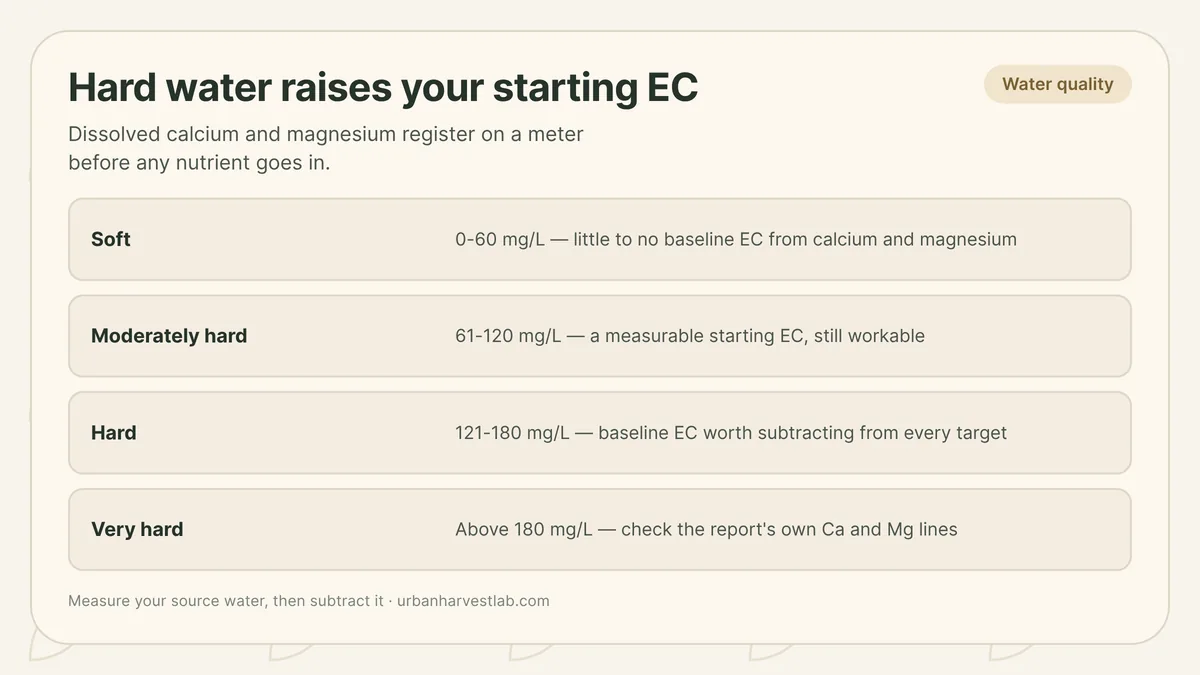
Hard water in hydroponics: how it raises your starting EC
Tap water carrying dissolved calcium and magnesium does not start at zero EC. Here is how much that shifts your baseline, and how to mix around it.
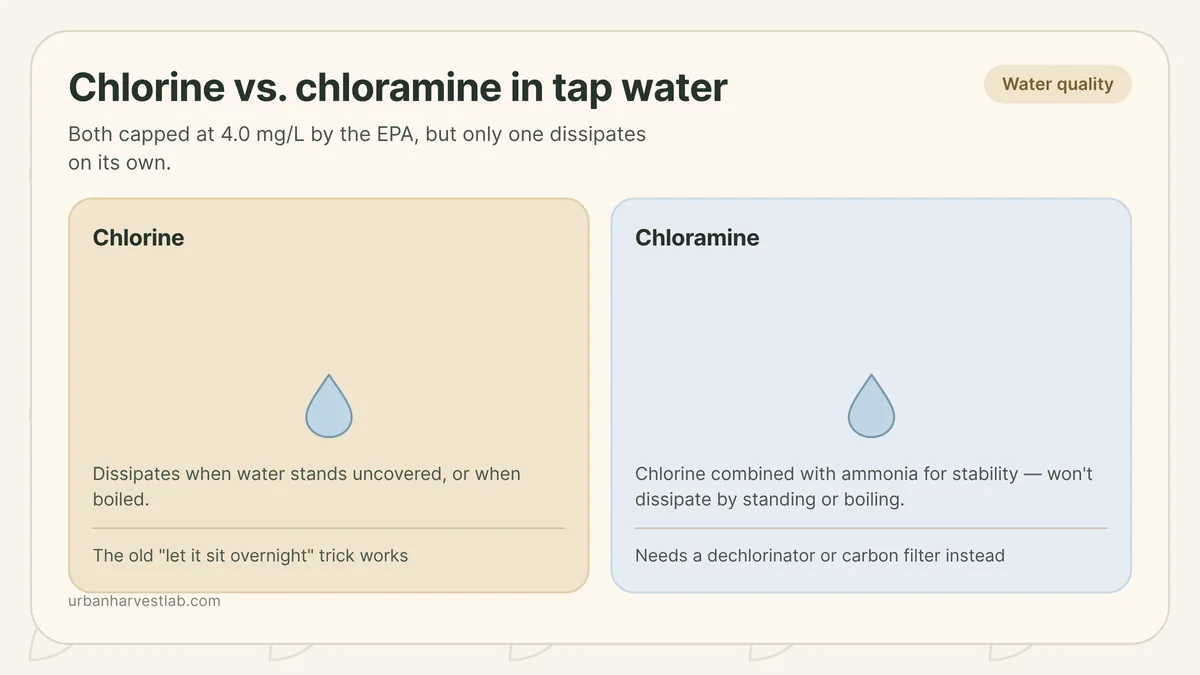
Chlorine and chloramine in hydroponics: do you need to dechlorinate?
Tap water usually carries some chlorine or chloramine. Here is how much is actually in it, why the two disinfectants behave differently, and when dechlorinating is worth the extra step.

Tap water alkalinity: why hydroponic pH keeps drifting back up
Dosing pH down and watching the reading climb back up within a day usually means the water itself is buffered against the change. Here is what alkalinity measures, the range that keeps a reservoir stable, and how it differs from hardness.