
A tray of microgreens costs whatever you pay for the seed you sow, the growing medium you fill it with, and the electricity your light draws — divide that total by the grams you actually harvest and you have a cost per 100 g to weigh against what you pay at the store. There is no single figure that applies to every kitchen, because seed price, substrate price, and electricity rate differ by country, by supplier, and by setup. Whether growing beats buying comes down to those three costs measured against your own shelf price, and crop choice is the single biggest lever, because both yield and cycle length move with it.
If you have not grown a tray yet, the beginner microgreens method covers sowing, blackout, and watering. The calculator below needs four things you already have on hand: the price and weight of your seed packet, what one tray fill of medium costs, the wattage of your light, and the per-kWh rate on your electricity bill.
Calculate your own cost per tray
Live estimate
Nothing here is prefilled from a market price — seed, substrate, and electricity rates vary too much for a default to mean anything. Enter your own numbers.
Cost per tray
—
Fill in every field, including your harvest weight, to see cost per 100 g
- Seed
- —
- Substrate
- —
- Light
- —
- Energy used
- —
The default 14 hours of light and a 14-day cycle are starting points, not answers. UC Master Gardener Program of Sonoma County gives 12-16 hours under lights once sprouts appear, and Penn State Extension’s own yield trial ran a two-week cycle — change either field to match your own timer and your own crop.
Work the arithmetic by hand
The calculator is doing three additions and one division, and you can check it on paper. Say a tray uses 12 g of radish seed at €0.02 a gram, a growing medium that cost €0.60 for that single fill, and a 30 W light run 14 hours a day for a 14-day cycle — the same length as Penn State Extension’s own yield trial — at €0.25 per kWh. The prices are round numbers chosen to make the arithmetic clear, not a quote for any specific seed or substrate.
Seed: 12 g × €0.02/g = €0.24
Light: 30 W ÷ 1,000 × 14 h × 14 days = 5.88 kWh, then 5.88 kWh × €0.25 = €1.47
Add substrate directly: €0.24 + €0.60 + €1.47 = €2.31 for the tray.
If that tray harvests 136 g — the average Penn State Extension measured across seventeen microgreens varieties in a greenhouse trial — the cost per 100 g works out to €2.31 ÷ 136 g × 100 = €1.70. Swap in your own seed price, substrate price, electricity rate, and harvest weight, and the same three additions give you your own number.
The three costs a tray actually carries
Seed
Seed cost is price per gram times grams sown, and both halves vary. Penn State Extension recommends 10 to 15 g of seed for a standard 12 x 20 in ten-row tray, or 6 to 8 large seeds and 10 to 12 small seeds per square inch relayed from Johnny’s Selected Seeds. Utah State University Extension publishes a separate per-crop table in grams, for a different tray — the 1020, at 10 x 20 in — where arugula needs only 10 g and pea needs 150 g for the same size tray. The two tables do not swap directly because the trays are not the same area; the seed density calculator rescales grams by tray area and by your seed’s own seeds-per-gram count, which is the more reliable way to find the grams field above.
Buying seed sold specifically for sprouts and microgreens costs more per gram than garden seed, but Penn State Extension notes it is processed under food-safety standards that garden seed is not, which matters more than the price difference. What you need to grow microgreens covers the rest of the shopping list.
Substrate
Growing medium is a single-use cost in most home setups. Illinois Extension’s instruction, once a tray is fully harvested, is to compost the remaining stems and medium rather than reuse it, and Purdue Extension notes that reused substrate carries a higher mold risk. That makes substrate cost per tray a straightforward number: whatever a single fill of your tray costs, whether that is a scoop of seed-starting mix, a length of hemp or coir grow mat, or a paper towel over a shallow dish.
Light
The light line reuses the same arithmetic as grow light electricity cost: watts divided by 1,000, times hours per day, times days, times your price per kilowatt-hour. The only difference here is the day count — Penn State Extension and Purdue Extension both put a microgreens cycle at 7 to 21 days rather than a full month, so the days field is your grow cycle length, not a billing period. That range moves a lot by crop: Utah State University Extension’s per-crop days-to-harvest table runs from 6 to 8 days for arugula up to 21 to 28 days for cilantro, and the timeline planner covers the full spread crop by crop.
A bright window instead of a grow light removes this line from the budget entirely. UC Master Gardener Program of Sonoma County notes that once sprouts appear, 6 to 8 hours of natural light is enough; microgreens light requirements and a simple setup covers when a windowsill is enough and when it is not.
How much a tray actually yields
Cost per tray only becomes cost per 100 g once you know the harvest weight, and that number moves more than most people expect. Penn State Extension measured yield per standard 10-row tray, averaged over 14 to 28 crop cycles in 2016-17, in a greenhouse with no supplemental light, at a 10-15 g seeding rate over a two-week cycle, across seventeen varieties:
| Variety | Yield per tray |
|---|---|
| Mustard (Red Rain) | 201 g |
| Average across all seventeen | 136 g |
| Cilantro | 47 g |
Cilantro at 47 g against mustard at 201 g is a fourfold spread on the same tray, the same seeding rate, and the same trial. Those figures are greenhouse measurements, not a promise for a windowsill running shorter days or a cooler room, so treat them as a starting estimate rather than your own scale. Microgreens tray sizes and yield covers the full seventeen-variety table and how yield changes again once the tray itself is a different size. Weighing your own harvest and typing it into the field above beats any published average, because it is the number for your tray, your crop, and your room.
Is growing microgreens actually worth it compared to buying them
That depends on the number you just calculated, not on a fixed market figure. Utah State University Extension, Penn State Extension, and UC ANR publish detailed growing methods but no cost figure at all. Purdue Extension is the exception: it states that growing microgreens at home runs “around $1.00 per ounce,” close to $3.50 per 100 g. That is a 2022 US figure from a Master Gardener article with no method, no input breakdown, and no stated seed, substrate, or electricity assumptions behind it — a landmark to note, not a number to build a budget from, and not directly comparable to a euro figure from your own worked example above.
The real comparison is between your own cost per 100 g and what you already pay for a clamshell of microgreens at your grocery store or greengrocer. Run your own numbers through the calculator, then hold that figure up against the price on the shelf. The trays worth growing are the ones where your calculated cost per 100 g comes in under the shelf price you looked up. Buying wins for an occasional garnish, or for a crop with a low measured yield such as cilantro, where the numbers stack against it twice over: Utah State University Extension gives cilantro 21 to 28 days to harvest against 8 to 12 days for the brassicas, so the same 30 W light runs roughly twice as long, and that larger light line still gets divided into cilantro’s smaller 47 g harvest rather than a brassica’s.
Lower the cost per tray
Three levers move the number, and they match the three inputs.
Seed price per gram drops with a larger bag, because packaging and shipping are a smaller share of a bigger order. It does not change what a single tray needs — that is a function of tray area and seed size, not price — so a cheaper price per gram lowers cost per tray without changing the grow.
Substrate cost is fixed by what you fill the tray with. A scoop of seed-starting mix, a cut length of hemp or coir grow mat, and a paper towel over a shallow dish all differ in cost per fill — divide what your pack cost by the number of tray fills it gives you, and that per-fill price is what goes into the substrate field. This is the cost line most worth shopping around on, since it recurs every single tray.
Light cost drops fastest by removing the light altogether. A bright windowsill grows a usable tray for most crops, and where a fixture is still worth running, cutting hours to the low end of the sourced range rather than the high end, and running it only across the days it is actually needed, both reduce the watt-hours in the formula without changing the tray’s timing in any way that matters to the plant.
Sources
- Penn State Extension: Growing Microgreens — the 10 to 15 g per 12 x 20 in tray seeding rate, the 6 to 8 / 10 to 12 seeds per square inch target, and the measured per-variety yield data from the 2016-17 greenhouse trial.
- Penn State Extension: The ABCs of Microgreens — the note that sprout and microgreen seed is processed under food-safety standards that garden seed is not.
- Purdue Extension: Grow Microgreens at Home — the “$1.00 per ounce” home-growing cost figure, and the note on substrate reuse and mold risk.
- Utah State University Extension: Grow Your Own Microgreens — per-crop seeding rates in grams for a 1020 tray, and per-crop days to harvest.
- Illinois Extension: Growing Microgreens — the instruction to compost a fully harvested tray’s stems and medium rather than reuse it.
- UC Master Gardener Program of Sonoma County: Growing Microgreens — natural and under-light hours once sprouts appear.
Build the rest of the budget
Work out the numbers that feed into a tray's real cost — how much seed to weigh out, what a tray yields, and the electricity math itself.
Common questions
Is growing microgreens at home actually cheaper than buying them?
It depends on your own seed price, substrate cost, and electricity rate, plus how many grams a tray yields for you. Add seed cost to substrate cost to light cost, divide by your harvest weight, and compare that per-100-gram figure to what you already pay at the store. Purdue Extension states a home-grown figure of about $1.00 per ounce, close to $3.50 per 100 grams, from 2022, with no cost breakdown behind it, so use your own numbers rather than that one.
How much does the light add to the cost of a tray?
Multiply the actual wall watts of the light by the hours it runs each day and the number of days in the grow cycle, divide by 1,000 for kilowatt-hours, then multiply by your electricity price per kilowatt-hour. A 30-watt light run 14 hours a day for a 14-day cycle uses about 5.9 kWh, close to €1.50 at €0.25 per kWh. Growing on a bright windowsill instead removes this cost.
What harvest weight should I put in the calculator?
Weigh your own cut and use that. If you have not grown a tray yet, Penn State Extension's measured average of 136 grams per standard tray is a placeholder to start from, but individual crops ranged from 47 grams for cilantro to 201 grams for mustard in that same trial, so swap in your own scale reading the moment you have one.
Does buying seed in bulk lower the cost per tray?
Yes. Seed cost is price per gram times grams sown, and a larger bag typically lowers the per-gram price. Substrate and light cost do not change with bag size, so a cheaper seed price is the most direct way to bring the total down without changing how the tray is grown.
Related guides
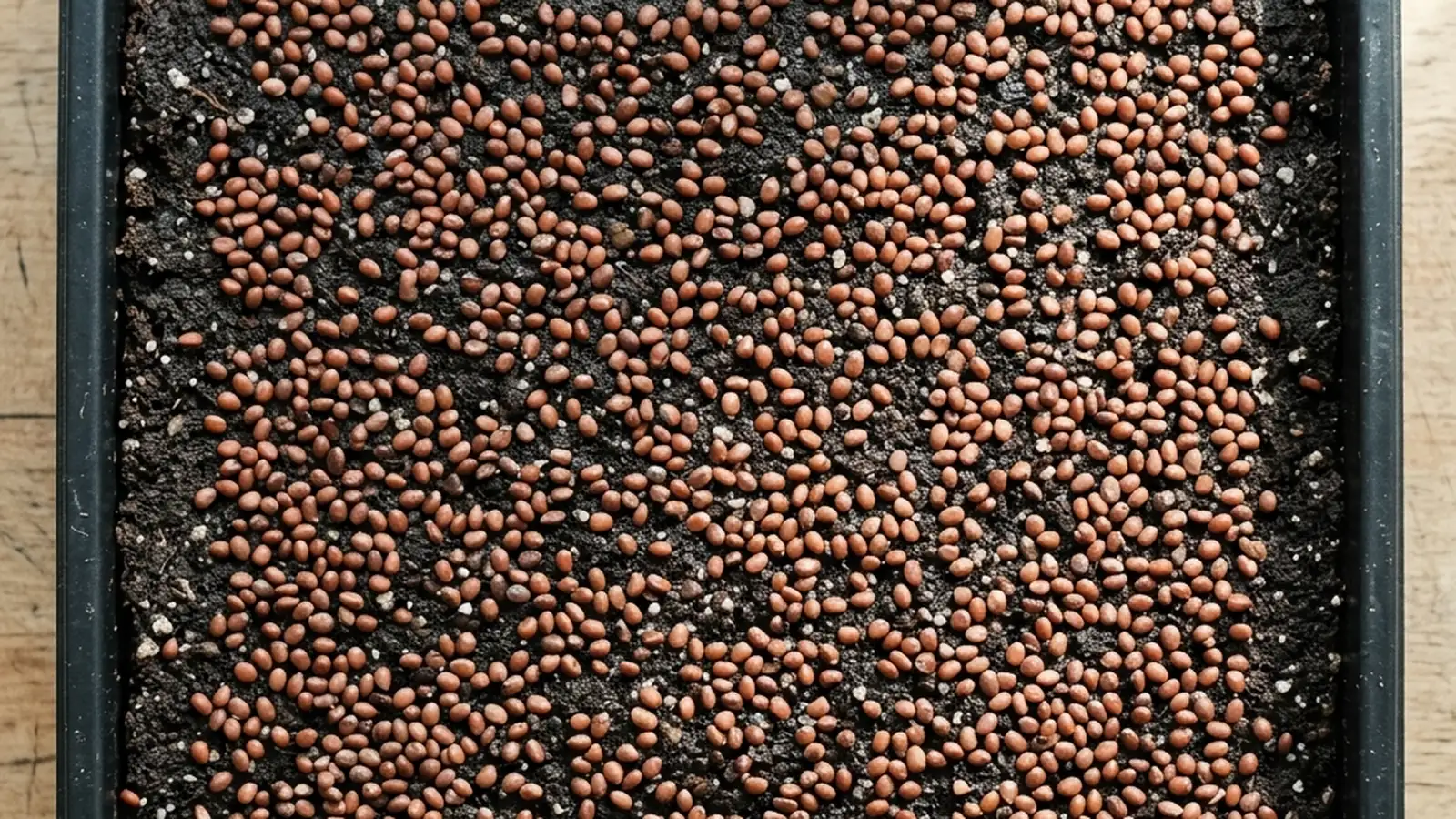
Microgreens seed density: how to work out grams per tray
Seed density is the one variable that decides whether a tray comes up as an even carpet or a patchy, mould-prone mat. Here is how to calculate it from your own seed.
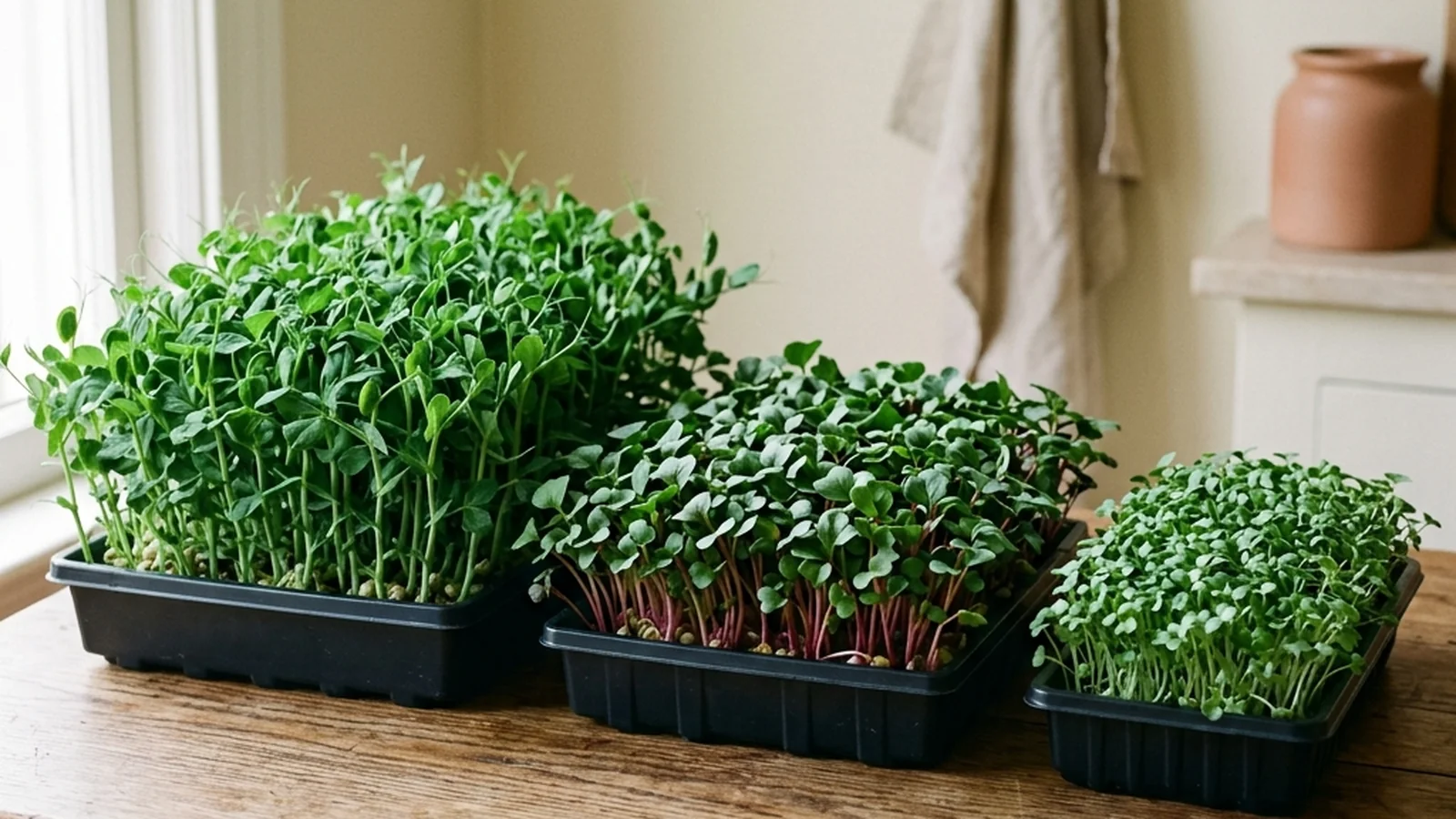
How much microgreens yield per tray, by crop and tray size
One tray of microgreens can weigh anywhere from 47 to 201 grams at harvest depending on the crop, and the tray size behind that figure matters as much as the crop itself.
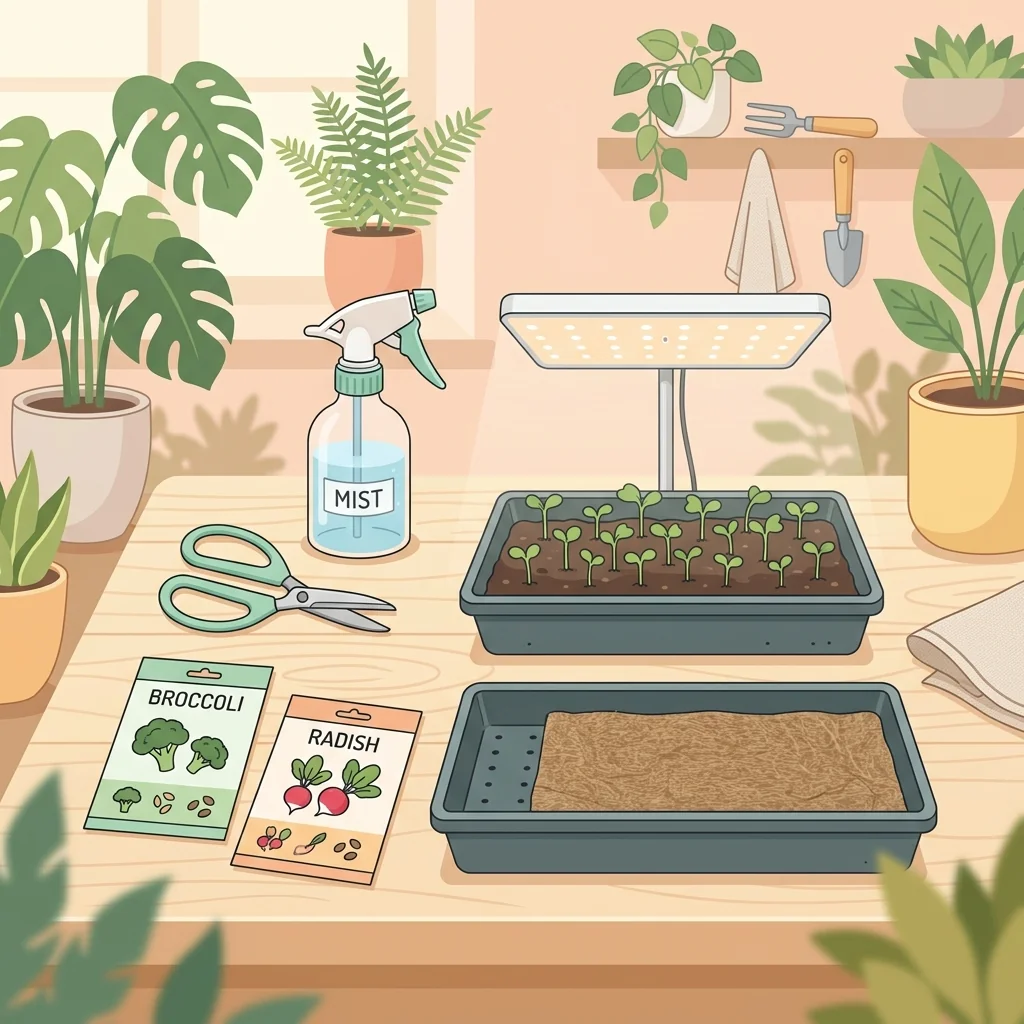
What do you need to grow microgreens? A short list
The microgreens supply list is short: tray, medium, seeds, spray bottle, light, scissors. Here is exactly what to get for your first setup and what not to waste money on.