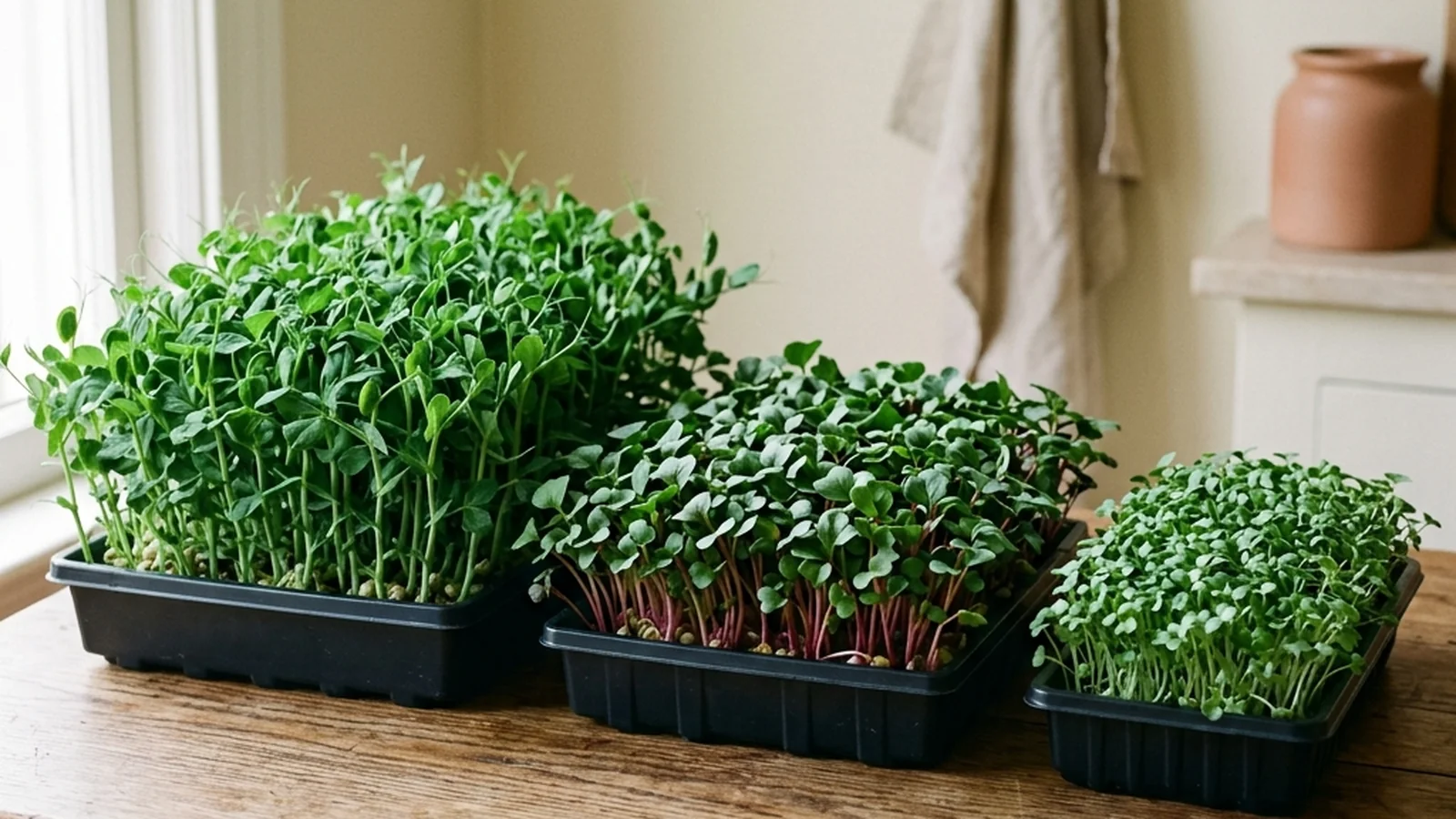
One tray of microgreens typically yields somewhere between 50 and 200 grams of cut greens, and which end of that range you land on depends far more on the crop than on anything you did wrong. Penn State Extension’s measured trial across seventeen varieties found cilantro at 47 grams and mustard at 201 grams from the same tray, the same seeding rate, and the same two-week cycle — averaging 136 grams overall. The tray behind that figure matters too: it is a 12 x 20 inch, 240 square inch tray, and a gram figure measured on it does not carry over to a smaller or larger one without rescaling.
If you have not sown a tray yet, how to grow microgreens at home covers the method this yield sits at the end of.
How much one tray of microgreens actually yields
Of Penn State, Utah State, Illinois and Purdue Extension, only Penn State actually weighed the harvest rather than estimating it: a trial run across fourteen to twenty-eight crop cycles in 2016 and 2017, in a greenhouse with no supplemental light, using a 10 to 15 gram seeding rate on a standard 12 x 20 inch, ten-row tray, and a two-week grow cycle. Every crop went through the same conditions, the same tray, and the same seeding rate, which is what makes the comparison between crops meaningful rather than a mix of different growers’ guesses.
Averaged across all seventeen varieties, Penn State’s trial measured 0.30 lb, or 136 grams, per tray. By variety, from highest to lowest:
| Crop | Yield per tray (g) | Yield per tray (oz) |
|---|---|---|
| Mustard (Red Rain) | 201 | 7.1 |
| Hon tsai tai | 181 | 6.4 |
| Mizuna | 177 | 6.2 |
| Pac choi | 170 | 6.0 |
| Basil | 165 | 5.8 |
| Persian cress | 164 | 5.8 |
| Kale (Russian) | 155 | 5.5 |
| Arugula | 148 | 5.2 |
| Kohlrabi (purple) | 126 | 4.4 |
| Radish (Daikon) | 122 | 4.3 |
| Chinese cabbage | 120 | 4.2 |
| Kale (Toscano) | 118 | 4.2 |
| Tatsoi | 115 | 4.1 |
| Shungiku | 114 | 4.0 |
| Red cabbage | 106 | 3.7 |
| Ruby red chard | 71 | 2.5 |
| Cilantro | 47 | 1.7 |
| Average (all 17) | 136 | 4.8 |
These are measured averages from one greenhouse trial, not a promise for a kitchen counter under a grow light. Read them as Penn State’s benchmark for what a tray of each crop produced under those specific conditions, and expect your own tray to land somewhere near it rather than exactly on it.
Pea shoots, sunflower and broccoli are common tray crops, and none of them are among Penn State’s seventeen. Utah State University Extension, UC ANR and University of Tennessee Extension were checked and none of them publish a measured yield for pea shoots, sunflower or broccoli either. Plan a pea shoot tray against pea shoots’ own timeline rather than by weight, and do the same with sunflower’s grow log; broccoli’s schedule is worth planning by count for the same reason.
Why cilantro yields a quarter of what mustard does
The fourfold spread between mustard’s 201 grams and cilantro’s 47 is not a seeding-rate effect — Penn State’s trial held the seeding rate at 10 to 15 grams across the whole comparison, so every crop started from a similar sowing density. What is left to explain the gap is how much leaf and stem mass each crop actually builds in the same two weeks, on the same tray.
Timing is part of the answer, and it is worth naming directly rather than treating cilantro’s low figure as simply a smaller crop. Utah State University Extension’s own days-to-harvest table gives cilantro 21 to 28 days — nearly double the two-week cycle Penn State used for the whole trial. A crop that normally needs three to four weeks, cut at two, is going to weigh less than one that is naturally ready in that window. Basil sits at a similar disadvantage: Utah State puts it at 12 to 16 days, longer than most of the brassicas in the table, and it still measured a respectable 165 grams — so the relationship is not a strict rule, but it is a real factor for the two slowest crops in the comparison.
A gram figure means nothing without the tray it was measured on
Penn State’s gram figures are pinned to one tray: 12 x 20 inches, 240 square inches. Utah State University Extension publishes its own per-crop seeding rates for a different tray, the 1020, at 10 x 20 inches — 200 square inches. Neither a seeding-rate figure nor a yield figure moves cleanly between the two without rescaling by area, and the same caution applies to any tray you actually own, including a small windowsill flat.
Illinois Extension states the rescaling method plainly for exactly this reason: measure your container’s area as a percentage of the reference tray, and scale the figure by that percentage. Applied to Penn State’s yield table, here is what mustard and cilantro would be expected to weigh on three common tray sizes:
| Tray | Area | Mustard (scaled) | Cilantro (scaled) |
|---|---|---|---|
| Windowsill tray, 6 x 12 in | 72 in² | 60 g | 14 g |
| Half tray, 10 x 10 in | 100 in² | 84 g | 20 g |
| Standard tray, 10 x 20 in | 200 in² | 168 g | 39 g |
| Penn State’s tray, 12 x 20 in | 240 in² | 201 g | 47 g |
A windowsill tray of mustard tops out around 60 grams — not because mustard suddenly performs worse, but because it is a third of the area. Comparing that to Penn State’s 201-gram figure without accounting for the tray would look like a failed crop when it is really an unscaled expectation. The seeding-rate side of this same problem — how many grams of seed to sow for a given tray — is worked out in microgreens seed density, which uses the same area-scaling logic in the other direction.
Estimate your tray’s expected yield, and log what you actually cut
The table above only covers Penn State’s exact tray size. The calculator below scales any of its seventeen measured crops to your own tray’s dimensions, and lets you save your own harvest weight so you can compare a real cut against the benchmark and against your own past trays.
Live estimate
Enter your tray's dimensions and pick your crop from Penn State's seventeen measured varieties — the estimate does not cover crops Penn State did not weigh, such as pea shoots or sunflower. Add your own harvest weight once you have cut a tray to see how it compares, and save it to build a log across multiple grows.
Tray area
—
- Penn State's benchmark for this tray
- —
- Your yield density
- —
- Your tray vs the benchmark
- —
Enter a tray length and width to begin.
Your log
Saving an entry keeps a running record in your own browser, on this device. Nothing is uploaded and no account is needed.
No trays logged yet.
| Date | Crop | Tray area | Harvest weight | Density | vs benchmark |
|---|
The arithmetic behind the estimate is simple enough to redo with a calculator if the widget will not load: divide Penn State’s gram figure for your crop by 240 square inches, then multiply by your own tray’s area to scale it. To read your own results the same way, divide your harvest weight by your tray’s area, then compare that density to the scaled benchmark rather than comparing raw weights from two different tray sizes.
What else moves the final weight
Tray size and crop choice explain most of the difference between a heavy tray and a light one, but three other factors shift the number too.
Seeding rate. Penn State’s trial fixed its seeding rate at 10 to 15 grams per tray, which is why the seventeen-crop spread above is not a sowing-density effect. Sow more thinly than that and a crop tends to yield less, not because the plants individually shrink but because there are fewer of them to cut. Microgreens seed density works out the sowing side of that trade-off for any tray and any seed.
How long the crop grows before you cut it. A tray cut a day or two early weighs less than the same tray left to its normal harvest window, and the reverse is not free either — broccoli’s grow log walks a fast brassica’s day-by-day timeline, and the same logic scales to slower crops like basil and cilantro above. Purdue Extension notes that microgreens grow more bitter the longer they sit, naming sunflower as the crop where that trade-off shows up fastest, so a heavier tray is not always a better one to eat.
Equipment. A shallow, food-safe tray and a growing medium that drains without waterlogging are what the yield above assumes you are working with; what you need to grow microgreens covers the short list of supplies that keeps a tray from underperforming for reasons that have nothing to do with the crop.
Reading your own log instead of chasing a published number
Penn State’s table is the best measured reference this cluster has, and it is still one greenhouse, one trial, one set of conditions. Your own tray, on your own shelf, under your own light, will not match it exactly — and it does not need to. What is useful is a comparison against your own past results: a tray that comes in noticeably lighter than your last one under the same crop and tray size is telling you something changed, whether that is seeding rate, light, or how long you let it grow before cutting.
That is the point of saving entries rather than only reading the live estimate once. A log of three or four trays of the same crop gives you a baseline that is more relevant to your setup than any extension trial, because it was actually grown in it.
If you want to know whether the weight you are cutting is worth the seed, medium, and electricity going into it, cost per tray works out that side of the arithmetic once you have a yield figure to plug in.
Sources
- Penn State Extension, Growing Microgreens — the measured yield trial (2016-17, fourteen to twenty-eight crop cycles, greenhouse, no supplemental light, 10-15 g seeding rate, two-week cycle) and the per-variety yield table for seventeen crops.
- Utah State University Extension, Grow Your Own Microgreens — per-crop days-to-harvest figures, including cilantro’s 21-28 days and basil’s 12-16 days.
- Illinois Extension, Growing Microgreens — the instruction to rescale a seeding or yield figure by measuring a container’s area as a percentage of the reference tray.
- Purdue Extension, Grow Microgreens at Home — microgreens growing more bitter the longer they are left to grow, naming sunflower as the fastest to turn.
Sowing, cost and timing decisions behind the number
Yield sits between how densely you sow, what the tray costs to run, and how long you let the crop grow.
Common questions
How much does one tray of microgreens yield?
Penn State Extension measured seventeen varieties on a standard 12 x 20 inch tray and found yields from 47 grams for cilantro up to 201 grams for mustard, averaging 136 grams across all seventeen. That trial ran a two-week grow cycle in a greenhouse with no supplemental light and a 10 to 15 gram seeding rate, so treat it as a measured benchmark rather than a promise for a windowsill tray.
Does a bigger tray produce more microgreens?
Yes, in proportion to its area, not automatically by more per square inch. Penn State's yield figures are measured on a 240 square inch tray; scale a crop's gram figure by your own tray's area relative to that 240 to get an expected weight, rather than assuming a 10 x 20 inch tray yields the same as a 12 x 20 inch one.
Why did my cilantro tray yield so little compared to other crops?
Cilantro measured lowest in Penn State's trial at 47 grams per tray, roughly a quarter of mustard's 201 grams, on the same seeding rate and the same two-week cycle. Utah State University Extension's own days-to-harvest table gives cilantro 21 to 28 days, nearly double the two-week window Penn State used, so part of that low figure may reflect an early cut rather than a genuinely small crop.
What is a realistic weight to expect from a home microgreens tray?
Penn State's measured average across seventeen varieties was 136 grams, about 4.8 ounces, per 12 x 20 inch tray under greenhouse conditions. A smaller tray or a slower-growing crop weighs proportionally less. A yield estimator scales any of Penn State's seventeen measured crops to your own tray dimensions; it does not cover crops Penn State did not weigh, such as pea shoots and sunflower.
Related guides

Microgreens cost per tray: seed, substrate, and light
Seed, substrate, and light are the only three costs a tray of microgreens has. Enter your own prices below and see what your tray costs per 100 g, not a stranger's estimate.
Microgreens seed density: how to work out grams per tray
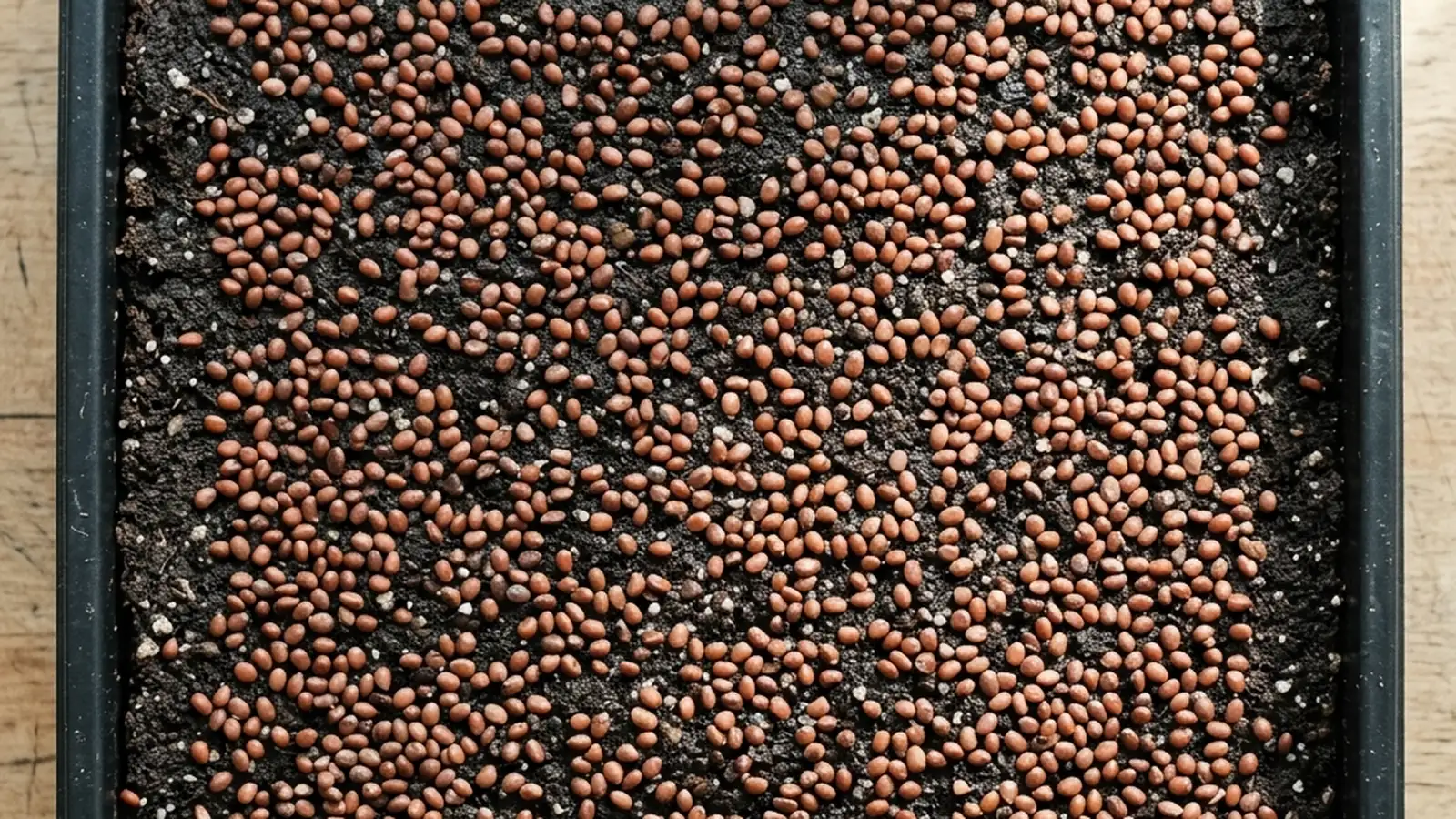
Seed density is the one variable that decides whether a tray comes up as an even carpet or a patchy, mould-prone mat. Here is how to calculate it from your own seed.
What do you need to grow microgreens? A short list
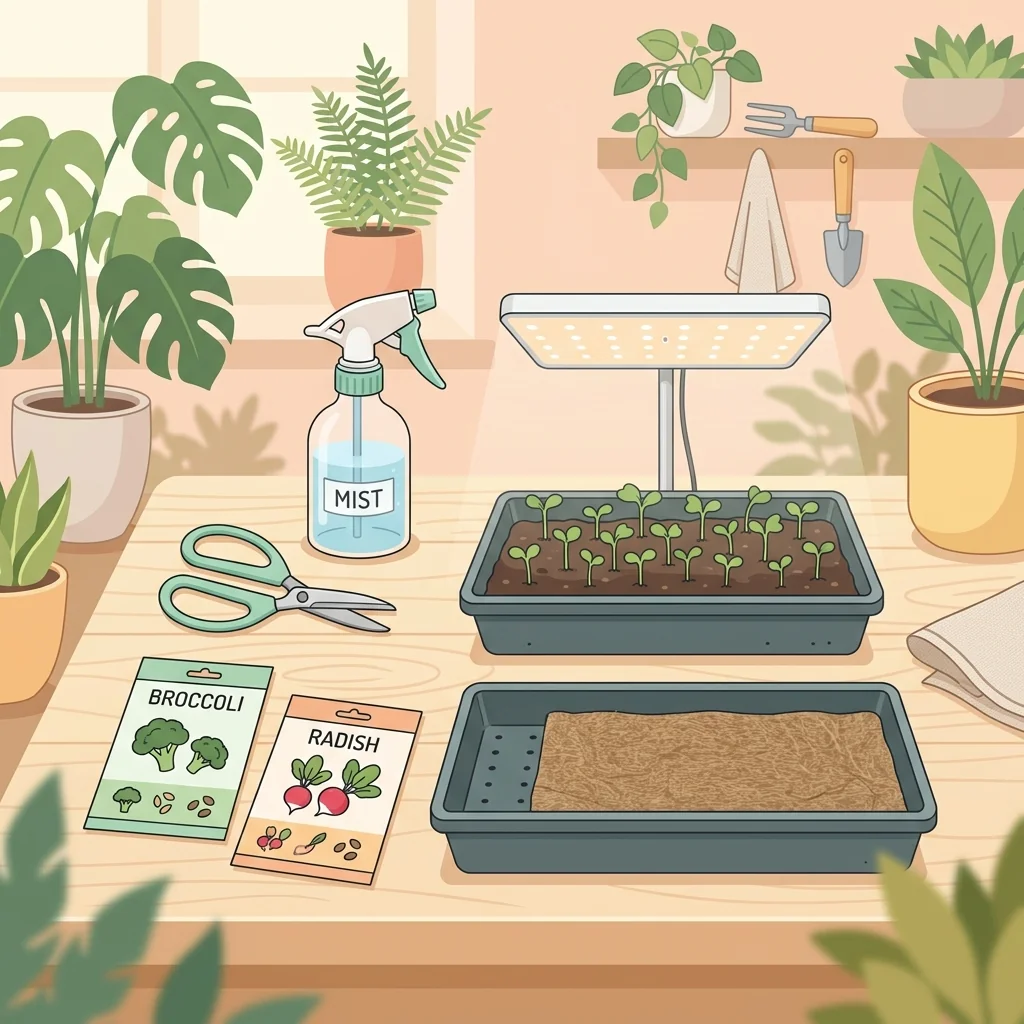
The microgreens supply list is short: tray, medium, seeds, spray bottle, light, scissors. Here is exactly what to get for your first setup and what not to waste money on.