
Enter the crop you are sowing and the date you are sowing it, and the calculator below works out when blackout ends, when the tray goes under light, and the window it should be ready to cut. Every date comes from Utah State University Extension’s published covered-time and days-to-harvest figures for eleven varieties, so the schedule is specific to the crop rather than a generic “about two weeks” guess. If you have not sown a tray yet, the beginner microgreens method covers the sowing and watering steps this calendar assumes are already done.
Why one crop’s calendar does not fit another
A radish tray and a cilantro tray sown on the same morning are nowhere near the same tray three weeks later. Penn State Extension’s general figure for seed to harvest is 7 to 21 days, and that fifteen-day spread is not noise — it is different crops finishing at genuinely different speeds. Purdue Extension and Illinois Extension both publish the same 7 to 21 day window independently, and the University of Tennessee gives 10 to 14 days as a tighter “under optimal conditions” estimate, so the wide range is the best-agreed figure in the group, not a shrug.
What moves inside that range, crop by crop, is what a single “microgreens take about two weeks” answer hides. Utah State University Extension is the source that breaks it out by variety, publishing both a covered (blackout) time and a total days-to-harvest figure for each one. Those two numbers are what the calendar below runs on: covered time sets when the tray comes into light, and total days-to-harvest sets the far end of the schedule. The stretch in between — light on, cutting still to come — is just the remainder.
Build the calendar
Live estimate
Pick the crop you are sowing and the date, and the calculator works out the blackout end, the light-stage start, and the harvest window from Utah State University Extension's published figures. Print the result for a tray label or a wall calendar.
Your tray's schedule
- Soak seed
- —
- Sow
- —
- Blackout ends, light begins
- —
- Harvest window
- —
Choose a crop and a sow date to see the calculation.
The arithmetic behind it is worth knowing even if the widget is not loading: blackout ends on the sow date plus the crop’s covered-time range, and the harvest window opens and closes on the sow date plus the low and high ends of the crop’s total days-to-harvest. The light stage is whatever days sit between those two — for radish, sown day zero, the cover typically comes off day 1 or 2, and the tray sits under light for roughly a week before the harvest window opens on day 8 and closes on day 12.
The full schedule, by crop
These are Utah State University Extension’s published figures for each variety, the numbers the calculator above runs on:
| Crop | Presoak | Covered (blackout) | Total days to harvest |
|---|---|---|---|
| Arugula | none | 1-2 days | 6-8 days |
| Basil | none (mucilaginous seed) | 4-7 days | 12-16 days |
| Broccoli | none | 2-4 days | 8-12 days |
| Cilantro | none | 7-14 days | 21-28 days |
| Kale | none | 1-2 days | 8-12 days |
| Mesclun mix | none | 3-5 days | 12-14 days |
| Pea | 6 hours | 3 days | 8-10 days |
| Radish (Champion and Purple) | none | 1-2 days | 8-12 days |
| Rutabaga | none | 1-2 days | 8-12 days |
| Sunflower | 12 hours | 3 days | 9-10 days |
Utah State tested two radish cultivars, Champion and Purple, and both land on the same 1 to 2 day covered time and 8 to 12 day total, so one row covers both. Cilantro and basil sit at the opposite end from the fast brassicas: cilantro’s 7 to 14 day blackout is itself longer than most crops’ entire schedule, and its 21 to 28 day total is roughly two and a half times radish’s. For the seed-handling reasons cilantro and basil are slow and awkward to sow, see cilantro microgreens and basil microgreens.
Mustard is not part of this table. Penn State Extension groups mustard with the fast brassicas at 7 to 8 days overall, but Utah State does not publish a covered time or a days-to-harvest figure for it specifically, so it is left out of the calculator. For mustard’s own schedule, see mustard microgreens.
Where Utah State and Penn State disagree
Penn State Extension’s fast-brassica group — broccoli, radish, arugula, kale and mustard together — is given a single figure of 7 to 8 days. Utah State’s per-crop numbers only partly match that: arugula’s 6 to 8 days sits right on top of it, but broccoli, radish and kale all run to 8 to 12 days on Utah State’s protocol, several days past Penn State’s group figure. Both numbers are worth having rather than one replacing the other. Penn State’s is a fast general estimate for the group; Utah State’s is measured per crop and runs longer for three of the four brassicas it shares with that group. If a broccoli or kale tray is not ready at day 8, that is consistent with Utah State’s own figure, not necessarily a slow tray.
The soak, and the one crop where sources disagree about it
Only two crops in Utah State’s table call for a presoak: pea at 6 hours and sunflower at 12 hours. Both are large, hard seeds, and a general rule published by the UC Master Gardener Program of Sonoma County puts the presoak window for large or hard-cased seed at 6 to 12 hours, which both figures sit inside. Soak the evening before and count the following morning as the sow date; that is day zero for the calculator above.
Cilantro is the one crop worth a second look. Utah State’s protocol sows it dry, with no presoak, and that stands as published — but cilantro’s seed is a hard, split schizocarp, which is exactly the seed shape the UC Master Gardener Program of Sonoma County’s general large-seed soaking rule is written for. The two do not agree, and neither cancels the other out: sow cilantro dry if following Utah State’s schedule, and expect that a soaked batch is testing something the published protocol does not cover. Soaking microgreen seeds goes through which crops call for it and for how long.
Reading the calculated date instead of just cutting on it
A calculated harvest window is the crop’s own range, not a fixed appointment. Utah State University Extension’s days-to-harvest come from its own protocol: an 18-hour photoperiod with the tray held at 74 °F for germination and 72 °F under lights, a longer day than the 12 to 16 hours the UC Master Gardener Program of Sonoma County gives for a home fixture. Room temperature, how fresh the seed lot is, and how much light the tray actually gets during its light stage all move the real date within that window, and sometimes past its far edge — the UC Master Gardener Program of Sonoma County frames a home windowsill crop at 2 to 3 weeks to 2 to 3 inches tall, which is closer to what a cooler, dimmer setup should expect. Penn State Extension’s growing range runs 60-70 °F for air; a tray sitting at the cool end of that range is not behaving unusually, it is behaving like a slightly cooler version of the same crop.
That is also why the calendar gives a range rather than a single day for both ends. Illinois Extension’s method skips the calendar entirely and goes by what the tray is doing instead: rather than a fixed blackout duration, the cover comes off once the seedlings have rooted into the medium and started pushing it up on their own. That cue-based approach and the day-count approach are not rivals — the calendar tells you roughly when to expect the cue, and the cue confirms whether the tray is on schedule or running long. Blackout time by crop goes further into how the published blackout methods differ from each other and how to judge a tray that is not behaving like the table.
Once a tray is inside its harvest window, the decision that matters is height and leaf stage, not the date on the calendar. Purdue Extension puts most crops at 2 to 4 inches tall with true leaves just emerging, and names pea shoots as the exception, cut taller with two or more sets of true leaves. Harvesting and storing microgreens covers the cut itself and what to do with the tray afterward.
What the calendar does not replace
The calendar predicts dates from a published average; it does not show the crop-specific handling — soak timing, hull removal, a second cut — that a day-by-day breakdown covers. Radish microgreens, sunflower microgreens, pea shoots and broccoli microgreens each go through one crop’s schedule day by day, built from the same published figures.
Copy the four dates onto a tray label or a wall calendar once the calculator fills them in.
Sources
- Utah State University Extension, Grow Your Own Microgreens — the per-crop covered time, days-to-harvest, and soak figures for eleven varieties.
- Penn State Extension, Growing Microgreens — the 7 to 21 day general range for seed to harvest.
- Penn State Extension, The ABCs of Microgreens — the 7 to 8 day fast-brassica group figure and harvest size and stage.
- Purdue Extension, Grow Microgreens at Home — the corroborating 7 to 21 day range and the 2 to 4 inch harvest-size rule with its exceptions.
- Illinois Extension, Growing Microgreens — the 1 to 3 week range and the cue-based, no-fixed-duration blackout method.
- University of Tennessee Extension, Regulatory Considerations for Marketing Sprouts, Microgreens and Baby Greens — the 10 to 14 day optimal-conditions estimate.
- UC Master Gardener Program of Sonoma County, Growing Microgreens — the 6 to 12 hour general soak rule for large or hard-cased seed, the 12 to 16 hour home light-fixture timer figure, and the 2 to 3 week home-windowsill expectation.
- UC ANR Coastal Gardener, Your Indoor Winter Garden: Fresh Microgreens for Gloomy Days — the two-stage blackout method referenced in the FAQ.
Get the tray to the sow date
The calendar assumes a tray that is already sown correctly and stays on schedule. These cover the steps either side of it.
Common questions
How long is the blackout period for microgreens?
It depends on the crop. Utah State University Extension publishes 1 to 2 days for arugula, kale, radish and rutabaga, 2 to 4 for broccoli, 3 for pea and sunflower, 3 to 5 for a mesclun mix, 4 to 7 for basil, and 7 to 14 for cilantro. Treat the shorter end as the earliest you would check and the longer end as normal; UC ANR's Coastal Gardener guide runs a separate two-stage method that keeps the fast brassicas covered a little longer, and the blackout time by crop page compares the two.
How many days from sowing to harvest do microgreens take?
Penn State Extension gives 7 to 21 days as the general range across species, and Utah State University Extension's per-crop figures mostly sit inside it: arugula 6 to 8 days, pea 8 to 10, sunflower 9 to 10, broccoli, kale, radish and rutabaga 8 to 12, a mesclun mix 12 to 14, basil 12 to 16, and cilantro 21 to 28. Total days already include the covered stage, not additional time after it.
Do I need to soak the seed before I set a sow date?
Only for two crops in Utah State University Extension's table: pea, at 6 hours, and sunflower, at 12 hours. Soak the evening before and treat the following morning as day zero. Every other variety in that table, including cilantro despite its hard seed coat, is sown dry on that protocol.
Does a calculated harvest date mean the tray is definitely ready that day?
No. It is the window Utah State University Extension's figures put the crop in, not a guarantee for your room. Cooler air, an old seed lot, or lower light all push the true date later, and a dim windowsill can run well past the window — the UC Master Gardener Program of Sonoma County frames a home windowsill crop at 2 to 3 weeks. Judge the tray itself close to the calculated date rather than cutting on the date alone.
Related guides
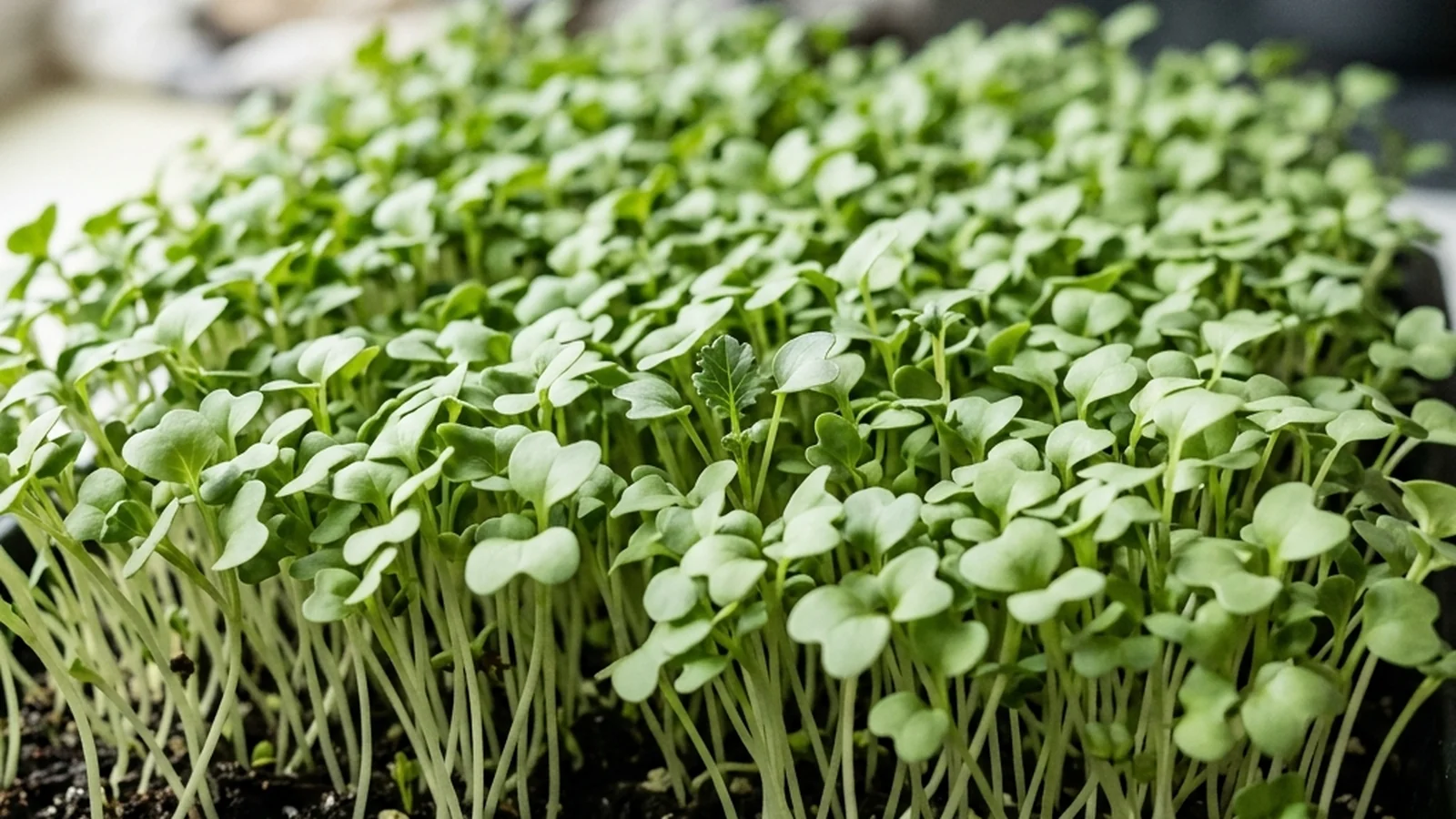
Broccoli microgreens grow log: a day-by-day timeline
Broccoli microgreens follow the same fast brassica schedule as radish, but the reason people search for them is different. Here is the typical timeline, and what the nutrition claims actually support.
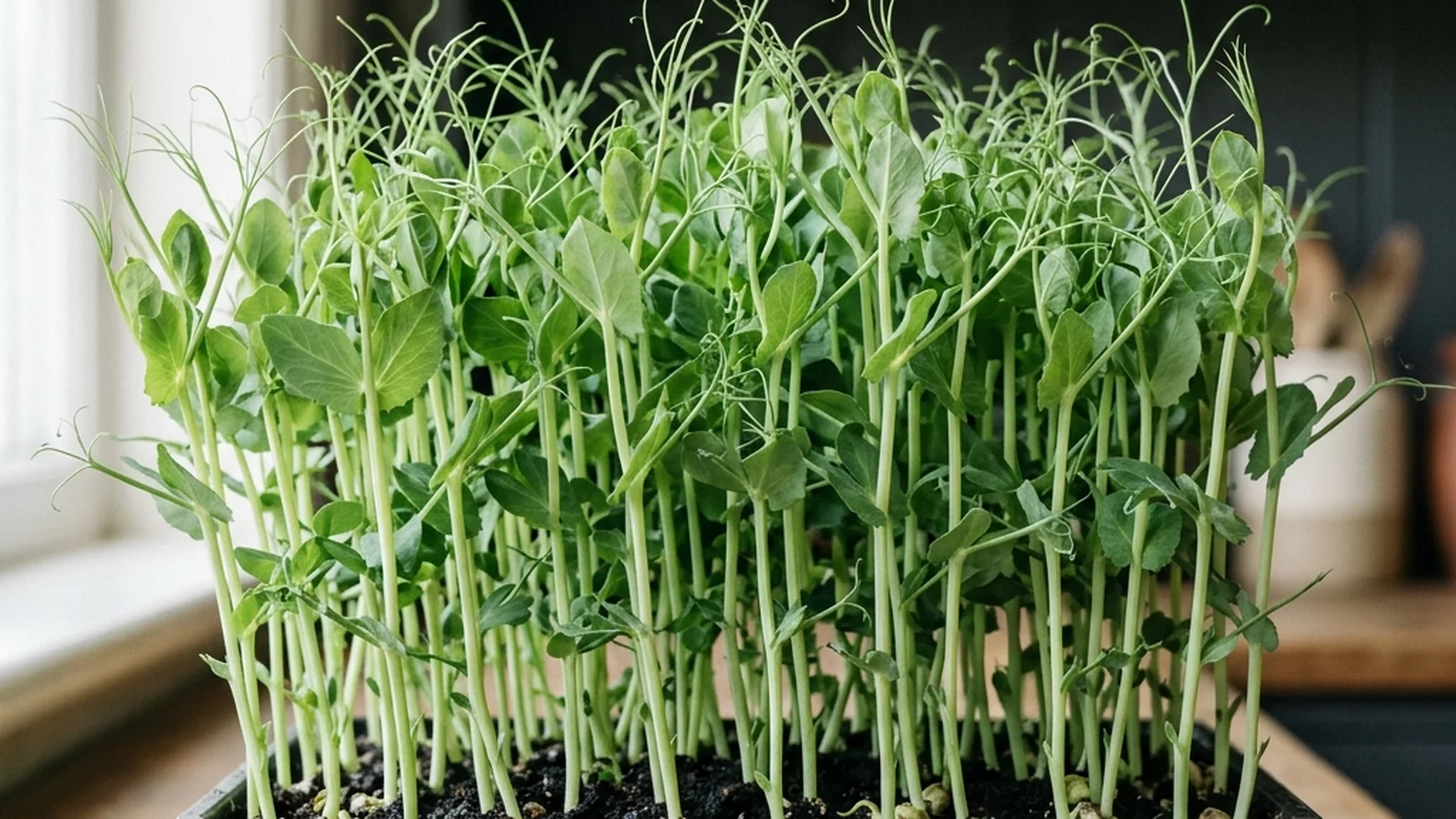
Pea shoots grow log: the timeline and the regrow cut
Pea shoots are the one microgreen documented to regrow. Here is the realistic day-by-day timeline, the long soak they need, and exactly where to make the cut.
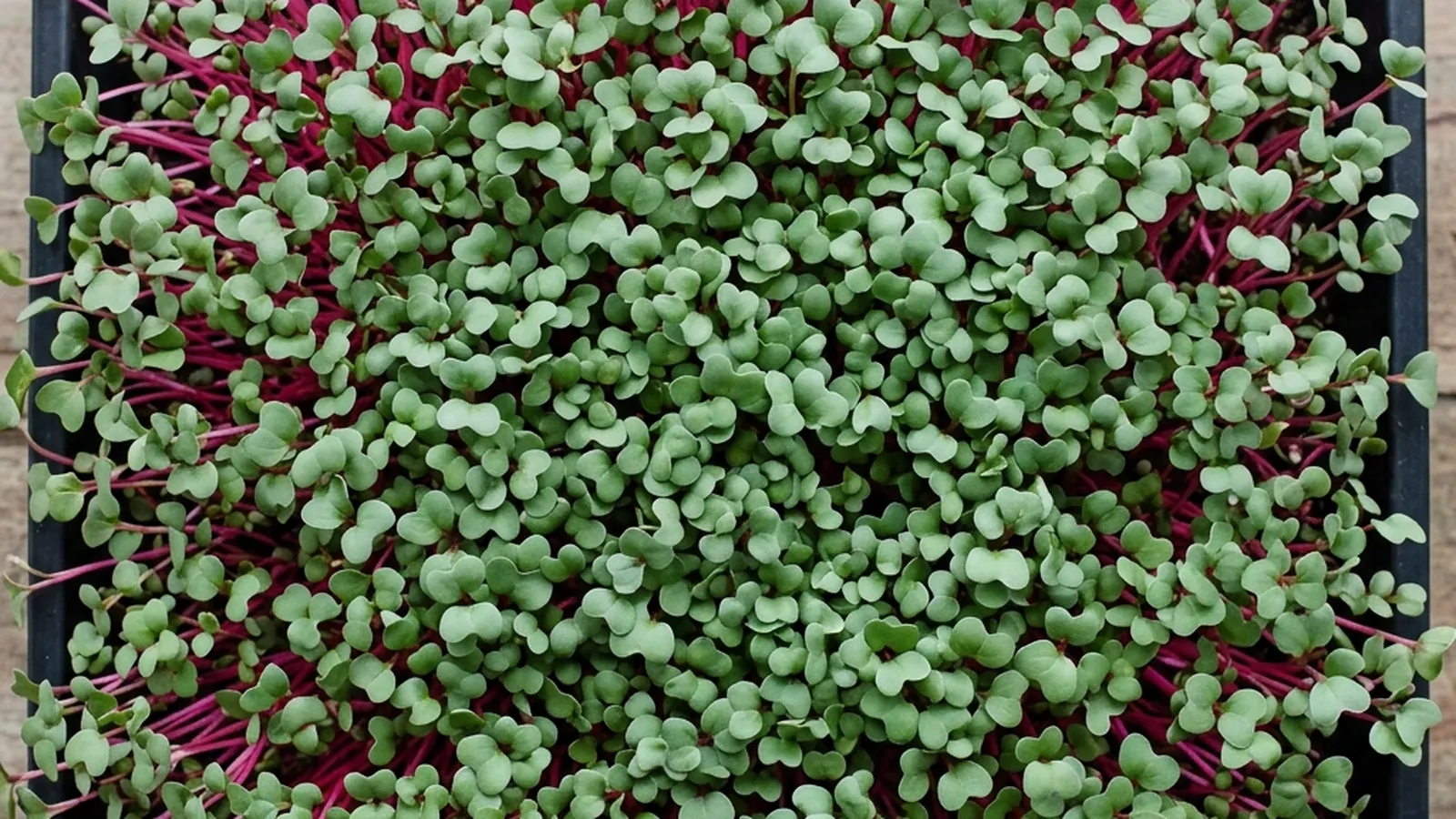
Radish microgreens grow log: a day-by-day timeline
Radish is one of the fastest common microgreens, which is why it works as the benchmark crop for beginners. Here is the realistic week it takes, stage by stage.