Yes, you can grow different microgreens in one tray, as long as they germinate and grow at the same pace. Penn State Extension says to generally choose one type per tray, and allows more than one type in a tray when their growth rates are similar. Speed is the whole decision. Everything else about a shared tray follows from whether the crops are ready to uncover and cut on the same day.
If you are still choosing crops, best microgreens for beginners covers the forgiving ones.
Why speed decides it
Penn State’s reason for one crop per tray is blunt: “different microgreen types have different germination and growth rates.” A tray gets one watering routine and, unless you split it, one cover and one harvest day. A slow crop under the same cover as a fast one is either uncovered too early or keeps its neighbour in the dark.
Penn State’s other warning is about density. Where mixes are used, it says it is very important to balance the seed density and to make sure the seeds of different species or cultivars will germinate and grow at the same time. It does not give a ratio for splitting a tray.
Which crops line up
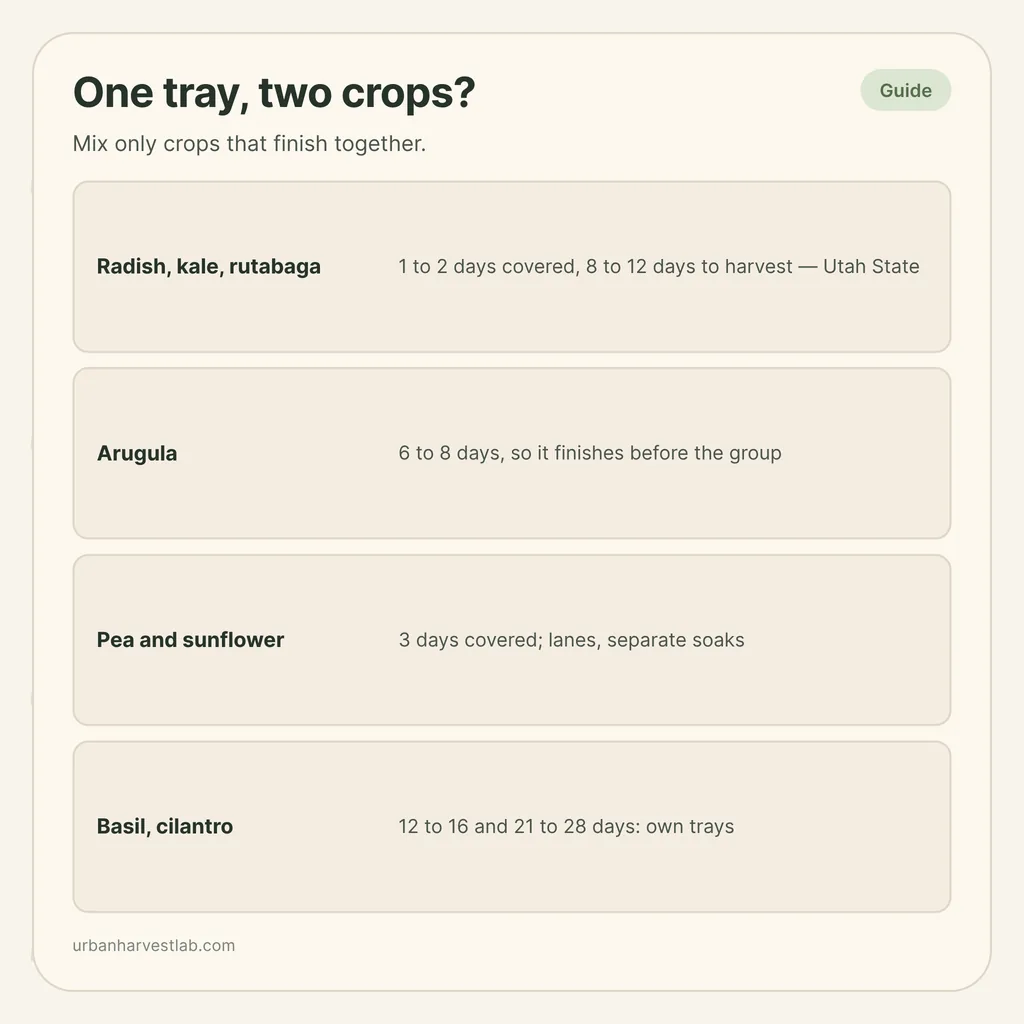
Utah State University Extension publishes a covered time and a days-to-harvest figure for each crop it lists. Grouping those figures by finish date gives the table below.
| Group | Crops | Utah State covered time | Utah State days to harvest | Share a tray? |
|---|---|---|---|---|
| Radish and kale group | Radish, kale, rutabaga (broccoli covered 2 to 4 days) | 1 to 2 days | 8 to 12 | Yes, with each other |
| Arugula | Arugula | 1 to 2 days | 6 to 8 | Alone |
| Pea and sunflower | Pea, sunflower | 3 days | 8 to 10 (pea), 9 to 10 (sunflower) | With each other, in lanes; separate soaks |
| Mesclun mix | Mesclun greens mix | 3 to 5 days | 12 to 14 | Alone |
| Slow herbs | Basil; cilantro | 4 to 7 days; 7 to 14 days | 12 to 16; 21 to 28 | Alone |
The growing timeline planner has the full per-crop schedule.
Radish and kale group. Radish, kale, rutabaga and broccoli share the same 8 to 12 day band at Utah State. Radish, kale and rutabaga also share a 1 to 2 day cover, with broccoli at 2 to 4. These are the natural partners, and Penn State groups the brassicas, arugula among them, as a very short cycle crop of 7 to 8 days at most. The two sources differ by a few days, so take the dates from your own tray rather than either number. Blackout time by crop explains how to decide when to lift the cover.
Arugula is the awkward fast one. At 6 to 8 days in Utah State’s table, it finishes before the 8 to 12 day group. Utah State’s seed rate for it is 10 g, against 28 g for kale and 42 g for radish, so sowing it at their rate would overseed it badly.
Pea and sunflower. Both are covered for 3 days and harvested in 8 to 10 and 9 to 10 days. The catch is the soak: Utah State soaks pea for 6 hours and sunflower for 12, and both are sown far heavier than the brassicas (150 g and 48 g). They suit a shared tray better with each other than with a brassica, as long as you keep the soaks separate. Purdue Extension adds the catch that day counts hide: pea shoots are cut much taller, with two or more sets of true leaves, while most crops, sunflower included, are cut at 2 to 4 inches with true leaves just emerging. A pea and sunflower tray only works in lanes you cut on different days. See soaking microgreen seeds.
Leave out the slow ones. Utah State lists basil at 4 to 7 days covered and 12 to 16 to harvest, and cilantro at 7 to 14 days covered and 21 to 28 to harvest. Put cilantro in with radish and the radish is past its 8 to 12 days long before the cilantro is ready. Basil microgreens and cilantro microgreens cover each in its own tray.
How to sow a shared tray
Penn State gives no split for a shared tray, so the arithmetic below is simply area scaling of Utah State’s single-crop rates. It is an approach, not a published ratio.
- Pick two crops from the same group in the table. Radish and kale, or pea and sunflower.
- Divide the tray into lanes, not a scatter. Two halves let you cut or uncover each crop on its own day if they drift apart, which a random mix cannot do.
- Scale each rate to its share of the tray. If radish takes half of a 1020 tray, sow half of its 42 g, which is 21 g, and give the other half half of kale’s 28 g, which is 14 g. For other tray sizes, the seed density chart shows how to convert by area.
- Water and light the whole tray the same way. One tray means one routine, which is why the timing has to match.
- Cut by lane. Utah State says plants are ready to harvest as soon as you begin to see the first true leaves, or sooner. Judge each lane on its own; if one lags, cut the other and leave the rest.
If one lane is clearly behind the other by the time the first true leaves show, pair them differently next time or split them into two trays. The growing timeline planner gives dates by crop for staggering trays instead.
Ready-made mixes and mixing after the cut
Penn State notes that seed is also available in ready-made mixtures like spicy and mild mixes, and that you can make mixes yourself. Illinois Extension gives a volume rate for these blends: half a tablespoon to a tablespoon of mild or spicy brassica mix per standard 10 x 20 in flat, and it says to sow lighter if you plan to grow on to first true leaf. The seed density chart covers converting to other trays. Utah State lists a mesclun greens mix at 28 g per 1020 tray, 3 to 5 days covered and 12 to 14 days to harvest, with a mild, slightly sweet flavor. That is slower than its separate radish and kale rows at 8 to 12, so a blend sold to you may contain a slower component. Utah State does not say what is in its mix, so follow the supplier’s timing for a blend, and expect to wait longer than for a radish or kale tray.
The simpler route is the one Penn State also offers: “If you are creating a microgreens mixture, you can combine different types after harvesting.” Grow each crop in its own tray on its own schedule, then toss them together. It costs a few extra trays and nothing else, and it removes every timing compromise above. Penn State also describes a class tray on a seeding mat in a vented clamshell that was seeded with a mix of microgreens with similar growth rates and sold without cutting, which is the shared-tray case done on purpose.
For tray count and how much a tray returns, see microgreens yield per tray.
Sources
- Penn State Extension: Growing Microgreens — one type per tray, similar growth rates, mixing after harvest, ready-made mixes.
- Penn State Extension: The ABCs of Microgreens — balancing seed density in mixes, and the 7 to 8 day brassica group.
- Utah State University Extension: Grow Your Own Microgreens — seeding rate, presoak, covered time and days to harvest by crop, including the mesclun mix.
- Illinois Extension: Growing Microgreens — volume seeding rate for mild and spicy brassica mixes.
- Purdue Extension: Grow Microgreens at Home — harvest size, with pea shoots cut taller.
Plan the tray before you sow it
Timing, seed density and crop choice decide whether a shared tray works.
Common questions
Can you grow different microgreens in one tray?
Yes, when the crops grow at similar speeds. Penn State Extension says to generally pick one type per tray, but that more than one type with similar growth rates can share a tray. Utah State University Extension puts radish, kale, broccoli and rutabaga at 8 to 12 days to harvest, which makes them workable partners.
Which microgreens can be grown together?
In Utah State University Extension's table, radish, kale and rutabaga all take 1 to 2 days covered and 8 to 12 days to harvest, and broccoli takes 2 to 4 days covered and the same 8 to 12 days. Pea (8 to 10 days) and sunflower (9 to 10 days) both take 3 days covered, but the table soaks them for different times, 6 hours and 12 hours. Purdue Extension adds that pea shoots are cut much taller, with two or more sets of true leaves, while most crops are cut at 2 to 4 inches, so a pea and sunflower tray needs lanes cut on different days.
Which microgreens should not share a tray?
Crops far apart on the Utah State University Extension table: cilantro takes 7 to 14 days covered and 21 to 28 days to harvest, basil 4 to 7 days covered and 12 to 16 days, against 8 to 12 days for most of the fast brassicas. A sharing tray would be cut, covered or uncovered at the wrong time for one of them.
Are ready-made microgreen mixes grown in one tray?
Penn State Extension notes that seed is sold in ready-made mixtures such as spicy and mild mixes. Utah State University Extension lists a mesclun greens mix at 28 g per 1020 tray, 3 to 5 days covered and 12 to 14 days to harvest, slower than its brassica rows, so read your blend's own timing rather than assuming the brassica one.
Related guides

Soaking microgreen seeds: which crops need it, and for how long
Soaking is not a step every crop needs. Two extension sources cover it — one general rule and one per-crop protocol — and they agree with each other.

Microgreens growing timeline: sow, blackout and harvest dates by crop
A tray's calendar depends on the crop in it. Enter a sow date and a variety below and get the blackout, light and harvest dates worked out for you, plus the numbers behind them.
How much microgreens yield per tray, by crop and tray size
One tray of microgreens can weigh anywhere from 47 to 201 grams at harvest depending on the crop, and the tray size behind that figure matters as much as the crop itself.