
Cilantro microgreens are slow, and the seed behind them is not really a seed at all. What goes into the tray is a dry fruit that splits into two seeds, and that single fact explains most of what makes a cilantro tray look different from a fast, tidy brassica tray. Cilantro sits at the slow end of the microgreens timeline, its emergence is naturally uneven and clumpy, and neither of those things means the tray has failed. Get the expectations right and cilantro is a manageable, flavorful crop. Expect it to behave like radish or broccoli and it will look like a disappointment for reasons that have nothing to do with anything you did wrong.
Why cilantro seed comes up clumpy and uneven
This is the detail that surprises a lot of first-time growers. What you buy and sow as “cilantro seed” is not a single seed at all — it is a dry fruit known botanically as a schizocarp, and inside that fruit are two seeds joined together. When the fruit splits, the two halves are not perfectly synchronized, and the fruit itself is a less uniform, less freely-flowing object to scatter than a small round brassica seed.
The practical consequence shows up at the tray level. Instead of a dense, even carpet of cotyledons coming up together, a cilantro tray tends to show clusters and gaps, with some fruits splitting and sprouting ahead of others nearby. That unevenness is a structural feature of the seed, not a symptom of bad technique, bad seed, or a bad batch. If you compare a cilantro tray to a fast, tightly synchronized brassica tray and expect the same look, cilantro will read as a failure when it is actually behaving as this kind of seed does.
That same unevenness is why cilantro is a harder tray to read while you are still learning what healthy growth looks like day to day, and it is part of why the beginner-friendly crop guide leans toward faster, more uniform crops. Cilantro tastes strongly of the fresh herb once it is cut, and that flavor is worth the wait — it is one of the more distinctive crops in the cluster in the kitchen — but it works better as a second or third tray than a first one.
Where cilantro sits in the timeline
Utah State University Extension puts cilantro at 21 to 28 days — the slowest crop in its table by a wide margin, and past the end of the 7 to 21 day general range Penn State Extension gives for microgreens overall. For comparison, the same Utah State table finishes arugula in 6 to 8 days and radish in 8 to 12, and Penn State’s fast brassica group — broccoli, radish, arugula, kale, mustard — is ready in 7 to 8 days. So a cilantro tray occupies its space for roughly three to four times as long as the crop most beginner guides use as the default example. Plan the tray around weeks rather than around a brassica-length schedule.
Penn State Extension’s greenhouse trial measured cilantro at 47 g per 10-row tray — the lowest of the seventeen varieties in that trial, against a 136 g average and 201 g for the top variety. Those are greenhouse figures from a 10 to 15 g seeding rate over two-week cycles with no supplemental light, not a windowsill promise, but the trade is real either way: cilantro asks for three to four weeks of shelf space and returns the least weight of anything Penn State weighed.
Penn State Extension gives 60-75 °F for soil temperature at germination and 60-70 °F for air temperature, and those apply to cilantro as they do to any other crop here. Nothing about cilantro moves those numbers; what moves is how many days the tray spends inside them, which is why a cool room costs a cilantro grower a week where it costs a radish grower a day.
A cilantro tray against a radish tray, three weeks apart
Sow both on the same day and a radish tray is already off the shelf while a cilantro tray is only past its clumpy start, with two more weeks still ahead of it. The practical differences line up cleanly against each other:
| Trait | Cilantro | Radish, same tray, same day | Source |
|---|---|---|---|
| Speed | 21-28 days (Utah State’s slowest listed crop) | 7-8 days (Penn State’s fast brassica group) | Utah State / Penn State Extension |
| Measured yield, 10-row tray | 47 g (lowest of 17; 136 g trial average) | 122 g (Daikon) | Penn State Extension |
| Seeding rate, 1020 tray | 28 g | 42 g | Utah State University Extension |
Penn State’s measured yield is keyed to its own 12 x 20 in. (240 in²) 10-row tray; Utah State’s seeding rate is keyed to a 1020 tray (200 in², 10 x 20 in.). The two trays are not the same footprint, so treat the yield row and the seeding-rate row as separate facts about separate trays rather than as one ratio.
None of this makes cilantro a bad crop. It makes it one where the yield and the wait are the trade you accept going in, not a surprise waiting at harvest.
Soaking cilantro seed
Cilantro is the one crop the two extension sources handle differently: Utah State University Extension sows it dry, while UC Master Gardener Sonoma’s rule for large, hard-cased seed points to a 6 to 12 hour presoak. The seed soaking guide works through why both positions are defensible and which one to follow. Sown dry — which is what Utah State’s protocol does — the fruit takes up water slowly through its wall, which is part of why cilantro emerges as unevenly as it does; a soak is an attempt to shorten exactly that.
Utah State University Extension sows cilantro at 28 g per 1020 tray, the same rate it gives basil, broccoli and kale — see the seed density chart for how that rescales to a different tray size.
Watering and mold risk over a longer tray
A slow crop spends more days sitting in warm, moist growing medium than a fast one does, and that extra time is exactly the kind of condition that favors mold and damping-off organisms if watering is not handled deliberately. Water from the bottom rather than misting the canopy once seedlings are up — see how to bottom water microgreens for the mechanics if you have only top-watered before. Bottom watering keeps the surface and the developing cotyledons drier for longer, which matters more on a crop that sits in moist medium for three or four weeks than on one that clears out in a week.
Because cilantro’s emergence is naturally uneven, it is also easy to misjudge what you are looking at when something white or fuzzy shows up between clumps. Mold vs. root hairs walks through the checks — location, uniformity, odor — that separate normal root hair growth from a tray that has actually gone wrong, and that distinction is more useful on a clumpy cilantro bed than on a uniform brassica one where any white growth stands out immediately. If a tray genuinely does show a collapsing, discolored patch rather than harmless root hairs, damping-off in microgreens covers what that looks like and what to do about it.
Blackout for a slow crop
Cilantro spends longer under cover than almost anything else in the cluster. Utah State University Extension covers it for 7 to 14 days after sowing — the longest per-crop figure in its table — well past the 2 to 3 day stage-one window UC ANR Coastal Gardener gives as a general rule for microgreens overall. That gap fits everything else about this crop: a schizocarp taking up water slowly through a tough wall needs more time in the dark before it is ready for light, not less. Pulling the cover on a cilantro tray by the same calendar you would use for a fast brassica risks doing it too early. See microgreens blackout period by crop for how that stage is timed more generally.
Harvest window
University of Tennessee Extension puts harvest at 1 to 4 inches tall, cut once one or two true leaves have formed; Penn State Extension and UC Sonoma phrase the same window as 2 to 4 inches with true leaves just emerging, and cilantro follows that same benchmark along with most other crops. Cilantro’s uneven germination means that window will not be reached uniformly across the tray — some clumps will hit it before others. Rather than waiting for every last patch to catch up, cut the tray once the majority of the bed has reached that size range, the same way you would treat any tray with some natural spread in maturity.
Cilantro microgreens and the mature herb
Anyone searching for cilantro microgreens is often also growing, or planning to grow, cilantro as a full herb plant. The two are related but not interchangeable projects: a microgreens tray is cut within a few weeks at the cotyledon-and-first-true-leaf stage, while a mature cilantro plant is grown on for a full harvest of leaf over a longer season and has its own watering needs as an established plant. If you are also keeping cilantro growing to maturity, how often to water cilantro covers that separate question for the adult plant, rather than the tray-stage watering discussed here.
Common mistakes with cilantro microgreens
- Expecting a dense, even carpet like a brassica tray and treating normal clumpy emergence as a failed batch.
- Looking for a precise cilantro soak time and applying an invented number instead of one of the two published positions.
- Judging the whole tray by its slowest patch and leaving it in far longer than the majority of the bed needs.
- Watering from the top out of habit on a tray that is already going to sit in moist medium longer than most crops.
- Mistaking normal root hair growth in the uneven gaps between clumps for mold.
Sources
- Utah State University Extension: Grow Your Own Microgreens — the 21-28 day cilantro figure, the per-crop presoak protocol, the 7-14 day covered time, and the 28 g seeding rate.
- Penn State Extension: The ABCs of Microgreens
- Penn State Extension: Growing Microgreens — the 47 g measured yield and the 136 g trial average.
- Penn State Extension: A Step-By-Step Guide for Growing Microgreens at Home
- UC Master Gardener Program of Sonoma County: Growing Microgreens
- UC ANR Coastal Gardener: Your Indoor Winter Garden: Fresh Microgreens for Gloomy Days
- University of Tennessee Extension W1261: Regulatory Considerations for Marketing Sprouts, Microgreens and Baby Greens
Handle the slow, uneven trays in the cluster
Cilantro's slow pace and clumpy emergence are not unique problems. Soaking method, blackout timing, and mold diagnosis all solve pieces of it.
Common questions
Why is my cilantro microgreens tray so uneven and clumpy?
That is normal for this crop rather than a sign of a failed tray. What you sow as a single cilantro "seed" is actually a dry fruit called a schizocarp, and it contains two seeds fused together. When it splits, the two halves do not germinate in perfect unison, and the fruit itself does not distribute as evenly as a small, round brassica seed does. The result is a bed that looks clumpy and staggered rather than uniform, even under good conditions.
How long do cilantro microgreens take to grow?
Utah State University Extension gives 21 to 28 days for cilantro, the slowest crop in its table and past the end of Penn State Extension's general 7 to 21 day microgreens window. That is three to four weeks against a week for radish. Temperature and light shift it in either direction, so treat it as the scale of the wait rather than a harvest date to book.
Should I soak cilantro seed before sowing?
The two sources point different ways. Utah State University Extension lists cilantro among the varieties it sows dry, while UC Master Gardener Sonoma's general rule — a 6-12 hour presoak for large or hard-cased seed — fits a fruit with a wall this tough. Neither publishes a cilantro-specific number of hours. Follow Utah State's protocol end to end and sow dry, or work from the general rule and give it a 6-to-12-hour soak; both are defensible. The seed soaking guide covers both positions and the mechanics.
Is cilantro a good first microgreen to grow?
Probably not. Cilantro is genuinely useful once you have a tray you like, since it tastes strongly of the fresh herb, but the combination of a slow timeline and uneven, clumpy emergence makes it harder to read than a fast, uniform brassica tray. Most people get more out of starting with an easier crop and moving to cilantro once basic watering and airflow habits are comfortable.
Related guides
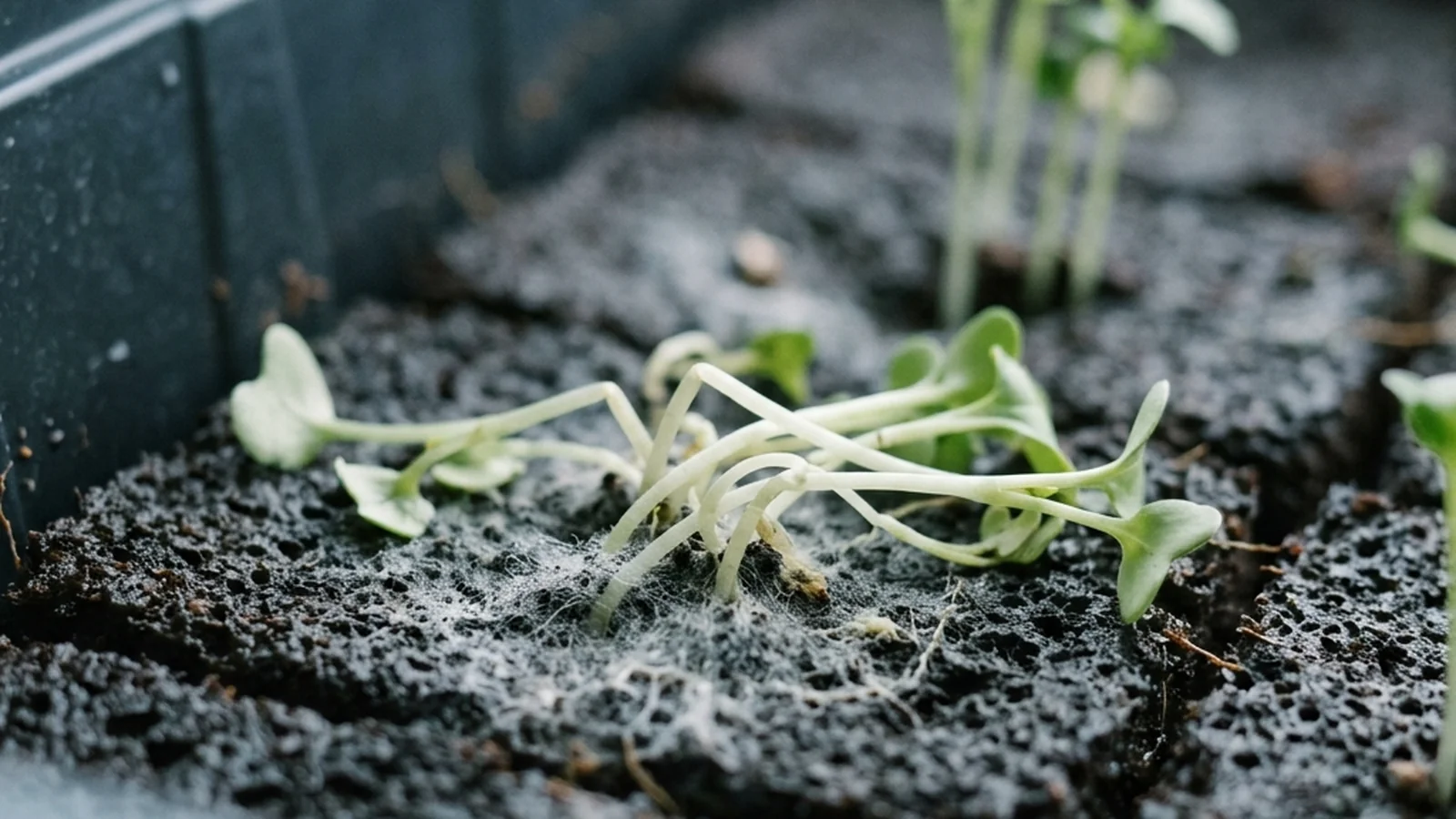
Damping-off in microgreens: symptoms and control
Damping-off attacks the seedling itself, not the tray surface. Here is how to recognize pre- and post-emergence stages and control outbreaks with sanitation, not fungicide.
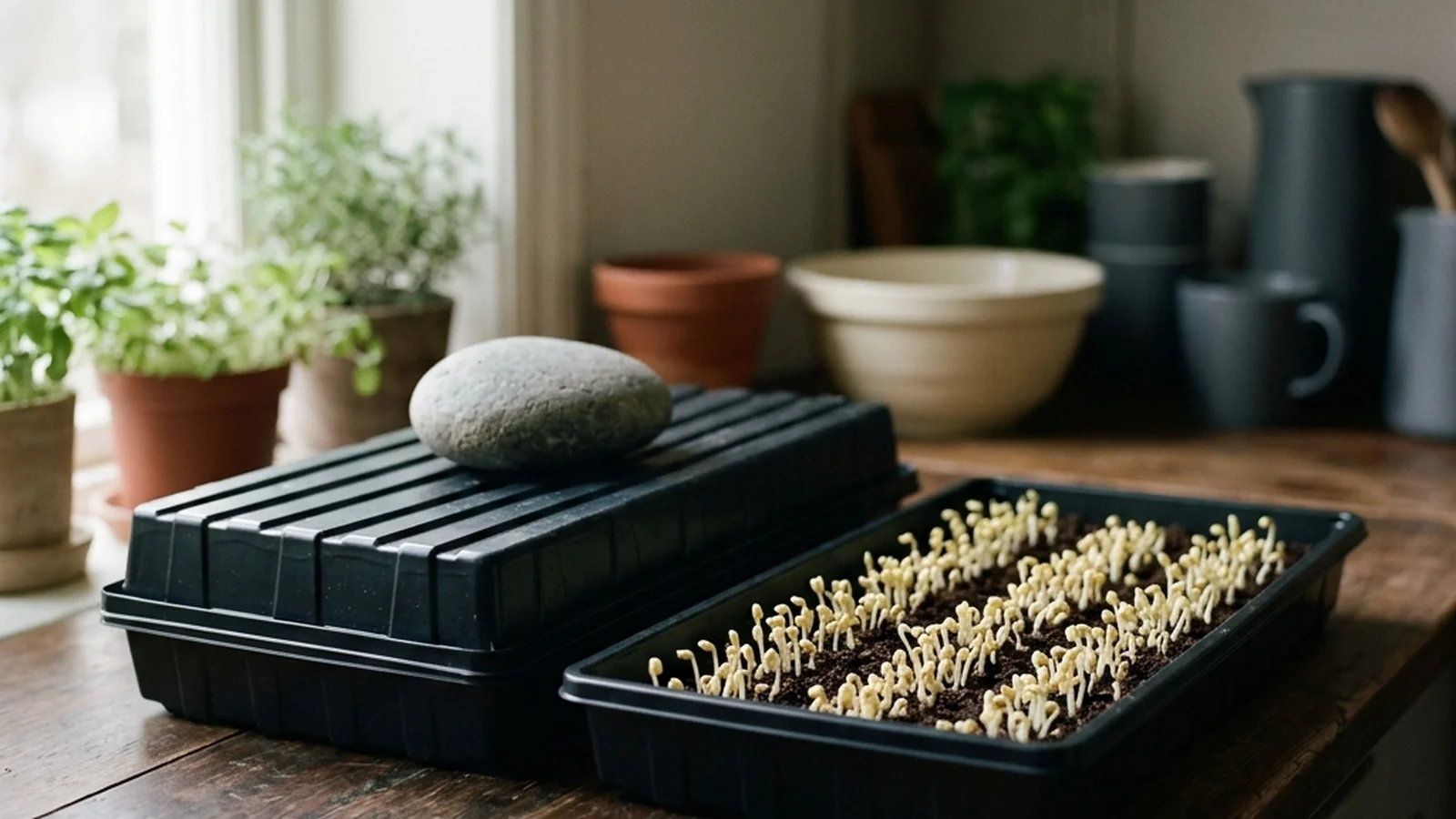
Microgreens blackout time by crop: what varies and why
Blackout time varies by crop — Utah State's table runs from 1-2 days for arugula to 7-14 for cilantro. Here is how that compares to the documented blackout methods, and how to judge readiness by the tray instead of the calendar.
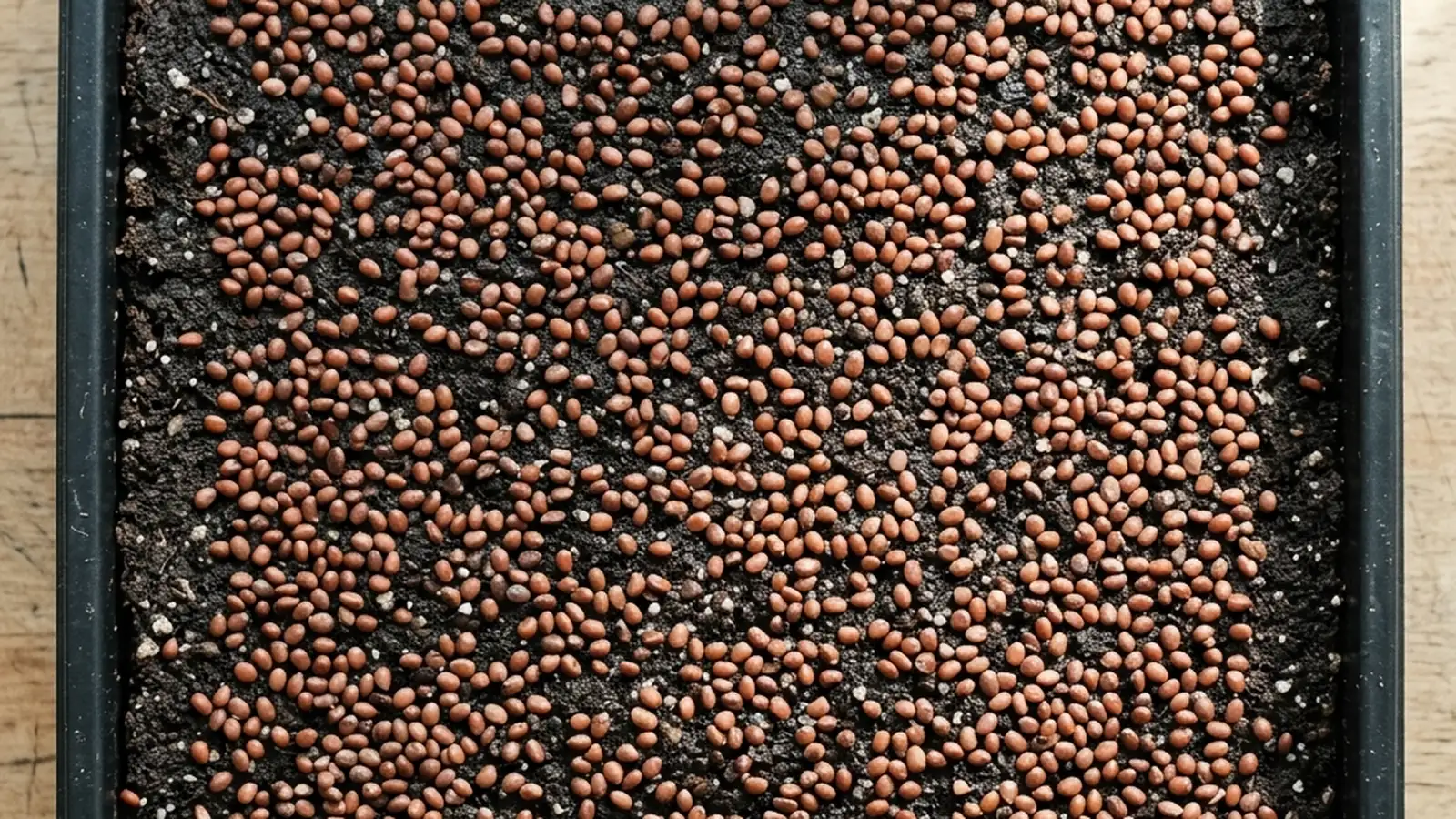
Microgreens seed density: how to work out grams per tray
Seed density is the one variable that decides whether a tray comes up as an even carpet or a patchy, mould-prone mat. Here is how to calculate it from your own seed.