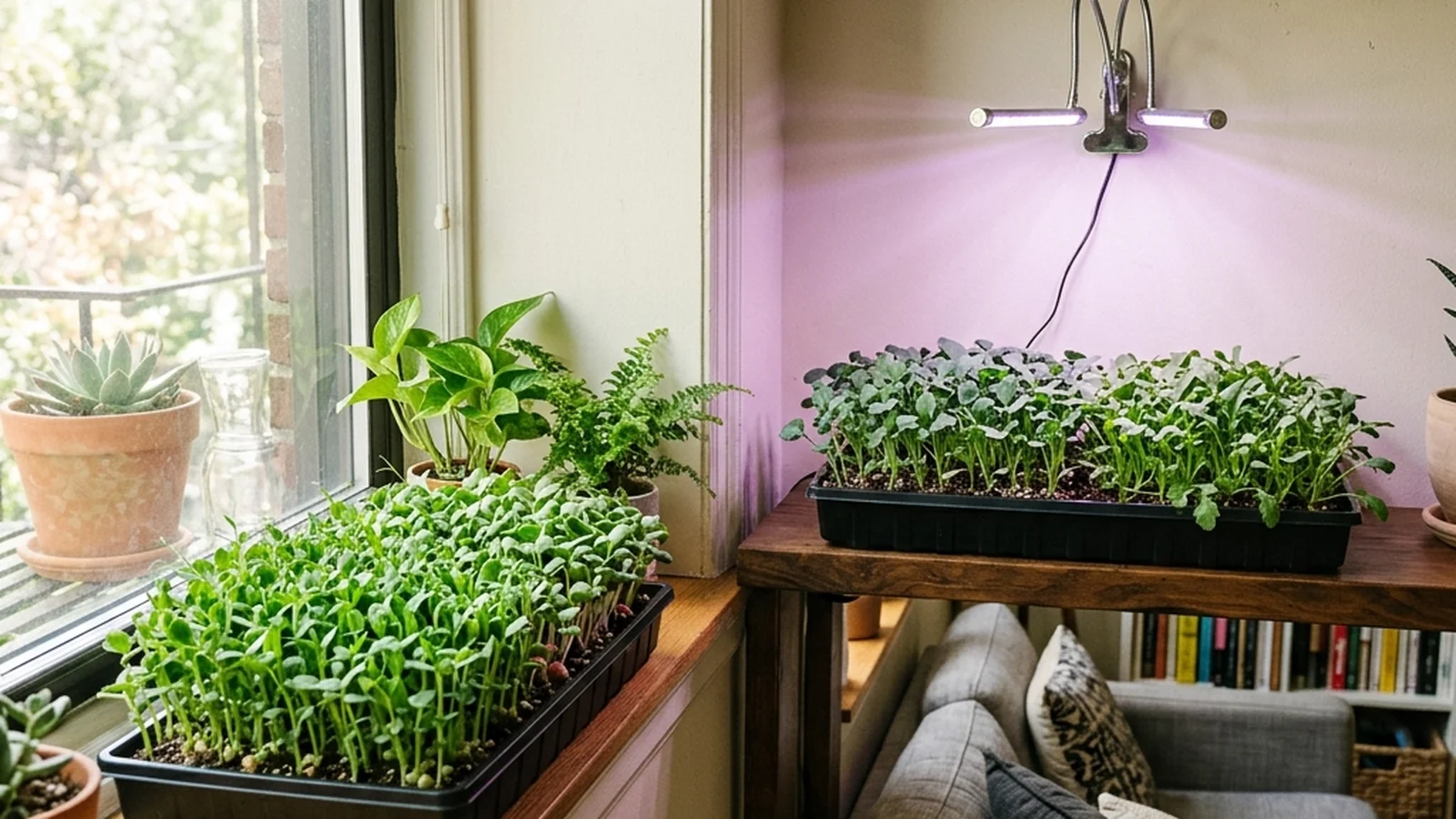
Window versus grow light, by scenario
| Scenario | Window alone | Grow light |
|---|---|---|
| Bright south-facing or unobstructed east/west window | Usually enough | Optional, mainly for convenience |
| North-facing or heavily shaded window | Often not enough | Worth adding |
| Short winter days at higher latitudes | Borderline, varies by location | Worth adding for consistency |
| Tall, fast-stretching crops (sunflower, pea shoots) | Needs a strong window plus daily rotation | Makes it easier to keep the tray short and even |
Most microgreens grow well on a bright, unobstructed windowsill — a grow light is worth adding when the window faces north, is heavily shaded, or the days have got short. The full growing method, including sowing and harvest timing, is in how to grow microgreens at home; the question here is only the light decision.
Why microgreens are the crop where a window most often works
Microgreens are harvested early, at the cotyledon stage or once the first true leaves have just emerged. University of Tennessee Extension puts that at 1 to 4 inches tall; Penn State Extension gives a seed-to-harvest range of 7 to 21 days depending on the crop and the environment. Because you are cutting the plant that young, a large share of its growth is fueled by energy already stored in the seed, not by weeks of photosynthesis under strong light. That is a fundamentally lighter demand than a tomato seedling you are growing on for months, or a mature herb you expect to keep cropping indefinitely.
This is the reason a windowsill has a real shot with microgreens where it would struggle with other indoor crops: you are not asking the window to power sustained leafy growth, only to get a seedling through a week or two of life before it is cut.
What a window actually needs to deliver
The UC Master Gardener Program of Sonoma County gives 6 to 8 hours of natural light a day once sprouts appear, which is what grows a tray short, dense, and green rather than pale and stretched. Under a fixture the same guidance runs a longer photoperiod. A bright window that gets several hours of direct or strong indirect light for a good part of the day can supply this. What matters is consistency and exposure, not a single bright afternoon — an unobstructed, well-lit window that the tray can sit in for most of the daylight hours is doing the job a light fixture would otherwise do.
Rotate the tray once a day. Seedlings lean toward the strongest light source, and a window is a light source on one side only, so without rotation the tray grows unevenly — lush and upright near the glass, thinner and paler toward the back.
You can judge a window before you sow anything in front of it. Over one clear day, note when direct sun first reaches the sill and when it leaves; that span, not how bright the room feels, is what the tray gets. Then look at what sits between the glass and the sky — an awning, a balcony above, a hedge, a neighbouring wall — because anything blocking the upper part of the view cuts the strongest light of the day rather than the weakest. Check the glass itself too: an insect screen, a net curtain, or a heavily tinted pane all take a share before the light reaches the sill. A window that gives a few unobstructed hours in the middle of the day is a better bet than one that stays dimly bright from morning to evening.
When a window stops being enough
A window is more likely to fall short when:
- It faces north, or sits behind heavy shading — a fence, an awning, trees, or a neighboring building that cuts direct light for most of the day.
- The season has turned. Short winter days are a photoperiod-and-intensity problem, not a technique problem: a tray sown in December can come out lankier than the same seed did in June from the same sill, no matter how carefully you sow or water. A tray that struggles in winter is not a sign you did something wrong.
- The crop stretches hard for light. Taller, quicker-growing crops have more stem to lean and more incentive to reach for a single light source. Sunflower microgreens and pea shoots are two crops worth watching closely in a window, since their height makes weak light show up sooner and more visibly than it would on a low, flat tray of radish.
None of this means a window is unreliable across the board. It means the same window’s performance is not fixed — it depends on orientation, obstruction, season, and which crop you sowed.
Reading the signal: normal pallor versus a real problem
Right after the tray comes out of blackout, pale, slightly stretched seedlings are expected. Whether that pallor is normal or not is its own diagnosis, covered in microgreens turning yellow; what matters here is only what it tells you about the window. Give the tray light and watch. If it greens up — stems stop elongating, colour shifts toward green — the window was fine. If it stays pale while it keeps getting the same light, the window is the limit.
| Sign | What it usually means | What to do |
|---|---|---|
| Pale colour that does not correct once the tray is in the light | The window is not delivering enough light | Move to a stronger window, or consider a grow light |
| Long, thin stems leaning hard toward the glass | Seedlings reaching for a single light source | Rotate the tray daily; if it continues, the light is too weak |
| One side of the tray lush, the other side leggy | Uneven light reaching the tray | Rotate more often, or turn the tray around midway through the day |
If you decide you do need a light
Once a window has shown you it is not enough — through a shaded exposure, a winter slump, or a crop that will not stop stretching — the next step is a fixture, not a diagnosis. Microgreens light setup covers that part: how far above the tray to mount a small LED, how many hours to run it on a timer, and what a workable setup looks like day to day.
Common mistakes when relying on a window
- Confusing initial post-blackout pallor with a light problem, and reaching for a grow light before giving the seedlings a chance to green up on their own.
- Not rotating the tray, which turns an adequate window into an uneven one simply because the seedlings only ever lean one way.
- Deciding the window is fine because the room feels bright, instead of letting one tray settle it over a week. A window can look plenty bright to a person and still be behind what a stretching, light-hungry crop needs.
- Assuming winter performance predicts the rest of the year, or the reverse — assuming a strong summer window will hold up once the days shorten.
- Trying to fix stretching with more water or fertilizer. Legginess in an otherwise healthy tray is a light issue, not a feeding issue.
The bottom line
A window is a legitimate light source for microgreens, not a compromise you settle for until you can afford a fixture. It works because of how this crop is harvested, not in spite of it. Where it falls short — poor exposure, winter light, or a tray of a crop that stretches hard — the fix is not a better window routine but a small grow light, and that setup is covered separately once you know you need it.
Sources
- University of California ANR, Coastal Gardener — “Your Indoor Winter Garden: Fresh Microgreens for Gloomy Days”
- UC Master Gardener Program of Sonoma County — “Growing Microgreens”
- Penn State Extension — “Growing Microgreens”
- University of Tennessee Extension W1261 — “Regulatory Considerations for Marketing Sprouts, Microgreens and Baby Greens”
Deciding between a window and a grow light?
These guides cover the growing method, the easiest crops to start with, and what a grow light setup actually looks like once you decide you need one.
Common questions
Can microgreens grow without a grow light?
In many cases, yes. The UC Master Gardener Program of Sonoma County gives 6 to 8 hours of natural light a day once sprouts appear, and a bright, unobstructed window can supply that. The exceptions are north-facing or heavily shaded windows and the short days of winter, where a window struggles to deliver enough hours of usable light. Under a fixture the photoperiod runs longer.
How do I know if my microgreens need more light than a window gives?
Watch what happens after the normal pale phase right out of blackout. Give the tray light and watch for green-up, meaning stems stop elongating and colour shifts toward green. If instead the seedlings stay pale, keep stretching, or lean hard toward the glass while getting the same light, the window is not enough and it is time to consider a grow light.
Do microgreens need as much light as other seedlings or houseplants?
No, and that is the core reason a window works as often as it does for this crop. Microgreens are cut at the cotyledon or first-true-leaf stage, so most of their growth is fueled by energy stored in the seed rather than by weeks of photosynthesis, which is a much lighter demand than mature plants place on a window.
Which microgreens struggle most on a windowsill?
Taller, faster-stretching crops tend to show weak light first, because they have more stem to lean with. Sunflower and pea shoots are two examples worth watching closely in a window; see the individual grow logs for what their growth looks like day by day.
Related guides
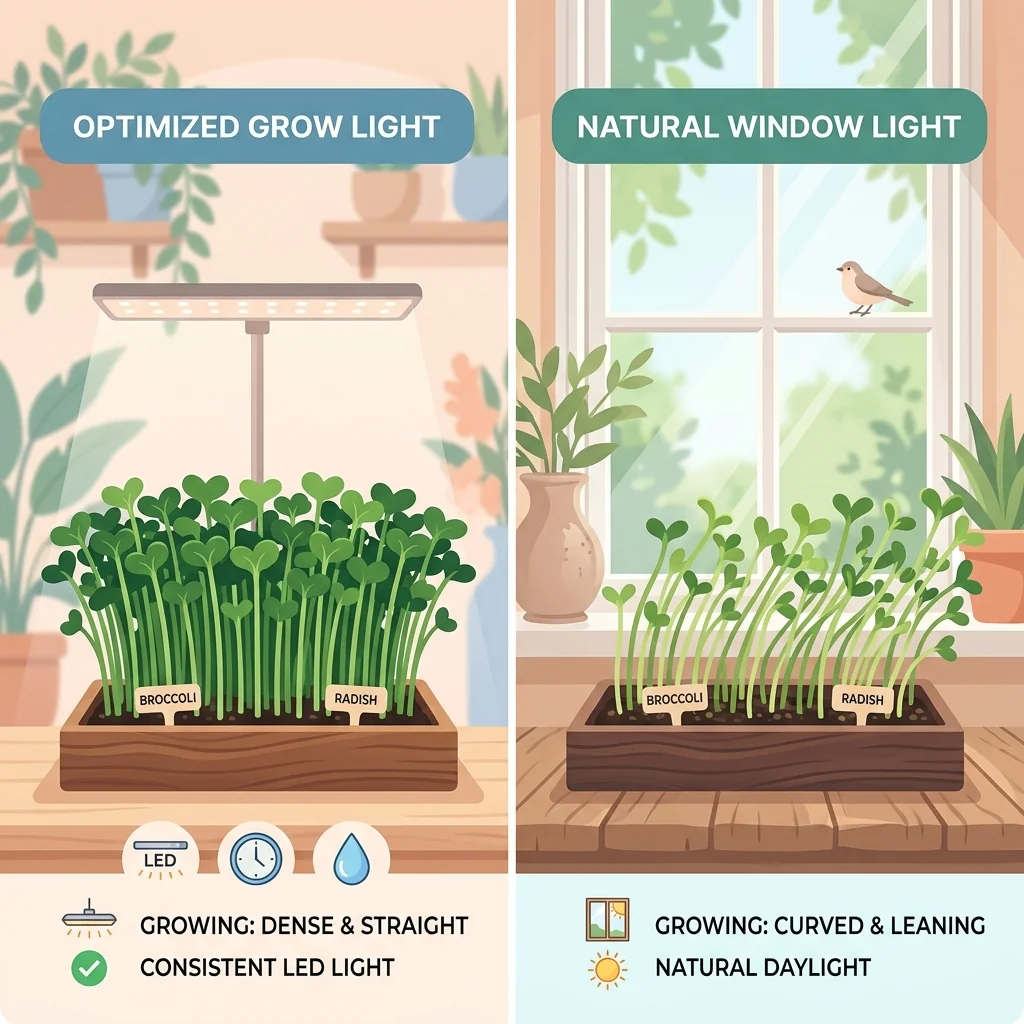
Microgreens light requirements and a simple setup
Microgreens are kept dark to germinate, then need good light to stay short and green. Here is how much light they need and the simplest windowsill or LED setup.
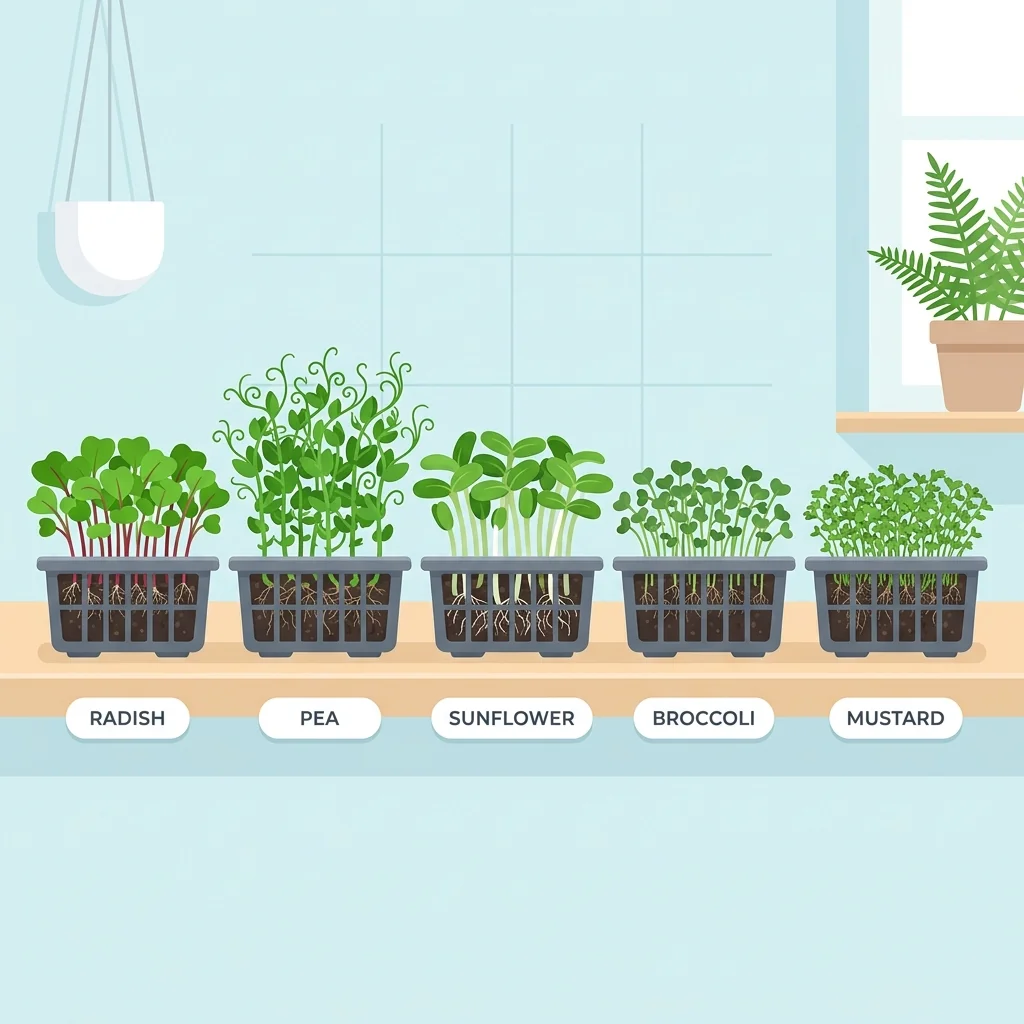
Best microgreens for beginners (fast and forgiving)
Start with microgreens that germinate fast and forgive mistakes. Radish, peas, sunflower, broccoli, and mustard are the easiest first trays, ready in about a week.
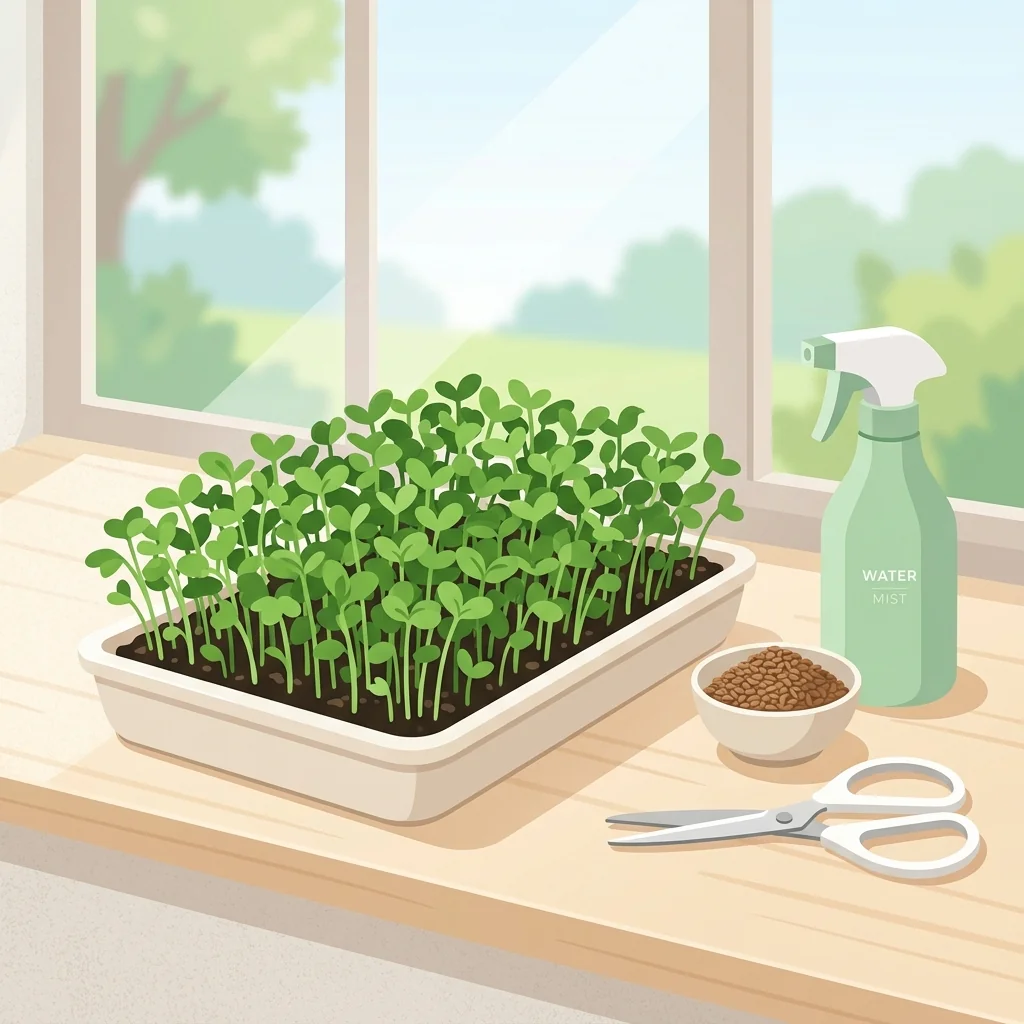
How to grow microgreens at home: a beginner's guide
Microgreens are the fastest crop you can grow indoors. This beginner guide walks through sowing, watering, light, and harvesting your first tray in about ten days.