
Mustard microgreens finish in about a week and carry real heat — that heat, not the speed, is the reason to grow them. The tray behaves like any other fast brassica for the first week, then delivers a flavour sharper than most beginners expect from something the size of a garnish. Sown at broccoli density, a full tray is more mustard than most kitchens want.
If you have not grown a tray of any kind yet, the beginner microgreens method covers the general four-step process. The detail below is mustard-specific: what the heat is like and how to size a sowing around it, how fast the tray moves, and why the small seed is handled differently from a large one.
The pungency question
Mustard’s flavor is the reason people grow it, and also the reason a lot of first trays get over-sown. It carries a mild-to-sharp heat rather than a simple bitterness, closer in character to a spicy salad green than to a peppery seasoning.
The practical response is proportion, not avoidance. Mustard works best mixed into a blend with milder crops, or sown thinly and used the way you would use a fresh herb rather than a base green. Sowing a full tray of mustard the way you would sow a full tray of broccoli is the single most common reason people end up with more heat than they wanted.
That has a direct consequence for how you plan a rotation. If you run several trays, mustard is the one to sow in a partial tray, or to share a tray with a milder crop sown alongside it, rather than to dedicate a full tray to. A week’s worth of mustard for one household is closer to a handful than to a full cut, and mustard that sits in the fridge waiting to be used up is mustard losing the quality the storage data says it can hold.
Penn State’s measured yields back up the same point from another angle. In a two-week-cycle trial run in a greenhouse with no supplemental light, at a 10-15 g seeding rate and averaged over 14 to 28 crop cycles, the Red Rain mustard variety returned 201 g per tray — the highest of the seventeen varieties Penn State measured, well ahead of Daikon radish’s 122 g on the same tray and seeding rate. So the crop that fills a tray hardest is also the one you want least of — which is the argument for a half tray rather than a full one.
If a batch does come out sharper than you wanted, it is still usable — the fix is dilution rather than the compost. Fold it through a larger volume of a neutral green, put it under something fatty like avocado or a dressed grain, or use it cooked, where brassica heat softens the way it does in any mustard green. What does not work is treating it as a base salad and hoping it reads milder in quantity.
A week from sowing, and a short time under cover
Penn State Extension’s ABCs of Microgreens puts mustard in the fast brassica group alongside broccoli, radish, arugula, and kale, all typically ready in 7 to 8 days. Penn State’s separate step-by-step guide photographs mustard and peas with the blackout cover coming off by day 3, so the covered stage on this crop is short.
Both figures assume the same environment: Penn State gives soil temperature in the 60-75°F range and air temperature around 60-70°F. A cooler room slows every stage after sowing; nothing about mustard changes that general rule.
Sowing mustard: skip the presoak
Mustard seed is small, and small seed does not get the same treatment as a large one. Utah State’s protocol sows every crop in its table dry apart from pea and sunflower, and mustard, though not listed, is small brassica seed in the same class. Sow it dry, directly onto moist growing medium, and let it take up water from the surface it is resting on rather than from a soak beforehand.
This is worth stating plainly because it is easy to over-generalize a presoak habit from one crop to the next — see how soaking works across different microgreen seeds if you are sowing several trays side by side and want to know which ones actually call for it.
Mustard is absent from Utah State’s gram table as well as its soak table, so sow it by seed size rather than by a crop row: Illinois Extension and Penn State Extension both put small seed at 10 to 12 seeds per square inch, and Illinois gives half a tablespoon to a tablespoon of small brassica seed per standard 10 x 20 in. flat. Run your own tray and seed lot through the seed density calculator to turn “sow it thinly” into a number for your tray.
A day-by-day look at mustard’s timeline
| Day | Stage | What’s happening | What to do |
|---|---|---|---|
| 0 | Sow | Dry mustard seed spread on moist medium, no presoak | Mist the surface; cover the tray |
| 1-2 | Germination, covered | Seed coats split; short roots anchor into the medium | Keep the cover on; maintain surface moisture |
| ~3 | Cover comes off | Photographed sequence shows the blackout cover removed around this point | Move the tray to light |
| 3-6 | Greening and stretching | Cotyledons unfold and green; stems lengthen under light | Switch from misting to bottom watering so leaves stay dry; UC Master Gardener Sonoma gives 6-8 hours of natural light, or 12-16 hours under a fixture |
| 6-7 | True leaves forming | Cotyledons full; first true leaves visible | Keep bottom watering; hold off cutting until the size cue below is met |
| 7-8 | Harvest | Tray reaches roughly 2-4 in.; true leaves just emerging between the cotyledons | Cut at the base once true leaves are just emerging |
The day-3 uncovering comes from one photographed grow, so treat it as a documented example rather than a schedule your tray must match. For why the covered stage exists at all and how long other crops spend under it, see blackout period by crop — mustard sits at the shorter end of that pattern.
Harvest and how mustard holds up afterward
Cut mustard at the base, just above the growing medium, once it reaches roughly 2 to 4 inches with the true leaves just emerging between the cotyledons — the same cue most microgreens use, pea shoots being the documented exception. Mustard is also the crop the storage research was actually run on: the study that measured packaged mustard microgreens found good sensory quality held for 14 days at 5°C. Warmer storage cuts that back sharply, and the full temperature curve, along with washing timing and packaging comparisons across crops, is in how to harvest and store microgreens. The practical point for mustard is that the drop-off with temperature is steep, so the coldest shelf in the fridge is worth more than an approximate one.
Radish, broccoli, or mustard: which heat level do you want
All three finish in roughly the same week, so timing is not the differentiator — flavour is. Radish gives a mild, slightly peppery bite, which is why it works well as a first tray; broccoli is closer to neutral and functions as a base green in almost anything. Mustard is the one grown specifically for heat. If you want the same day-by-day format applied to radish, that grow log is built the same way and makes a useful side-by-side comparison once you have run a tray of each.
Common mistakes with mustard microgreens
- Sowing a full tray of mustard the way you would sow a mellow crop like broccoli, then being surprised by how sharp the harvest tastes.
- Harvesting by day count instead of by the tray: use the size and true-leaf cue described above, not a fixed number of days.
- Sowing mustard densely without adequate airflow once the cover comes off; dense, humid trays are a mold and damping-off risk regardless of crop — see damping-off in microgreens if a tray is collapsing rather than just growing slowly.
Sources
- Penn State Extension: The ABCs of Microgreens — fast brassica group timing (7-8 days), including mustard.
- Penn State Extension: A Step-By-Step Guide for Growing Microgreens at Home — the mustard-and-pea photo sequence showing the blackout cover off by day 3.
- Penn State Extension: Growing Microgreens — soil and air temperature ranges, harvest height and true-leaf timing, and the measured yield-per-tray table.
- UC Master Gardener Program of Sonoma County: Growing Microgreens — presoak duration for large seed and light hours once sprouts appear.
- Utah State University Extension: Grow Your Own Microgreens — per-crop soak table; mustard is absent from it.
- Illinois Extension: Growing Microgreens — small-seed sowing rate by volume and by seed count.
- Purdue Extension: Grow Microgreens at Home — small-seed count per square inch and the general home refrigerator shelf-life figure.
- Kou et al., “Effect of Storage Temperature on Storage Life and Sensory Attributes of Packaged Mustard Microgreens” — the shelf-life-by-temperature dataset.
Get the tray right before mustard adds its own variables
Mustard behaves like a fast brassica for setup and light, but its seed size and its flavor curve are its own. These cover the parts mustard shares with the other fast brassicas.
Common questions
Do mustard microgreens need to be soaked before sowing?
No. Utah State University Extension's per-crop table soaks only pea and sunflower and sows every other variety dry; mustard is not listed on that table, but it is small brassica seed in the same class. The 6 to 12 hour presoak UC Master Gardener Sonoma gives applies to larger seed with a hard coat. Mustard seed is small enough that it germinates reliably without one, so it is sown dry, directly onto moist growing medium.
How long do mustard microgreens take to grow?
Mustard is part of Penn State Extension's fast brassica group, typically ready in about 7 to 8 days at a soil temperature of 60-75°F and air temperature of 60-70°F. Penn State's step-by-step guide photographs the blackout cover coming off by day 3 for mustard and peas, so the covered stage is short.
Why do mustard microgreens taste so much stronger than broccoli or radish?
Mustard carries a mild-to-sharp brassica heat that is characteristic of the crop, not a sign anything went wrong. Sow it thinly and use it the way you would a fresh herb.
How long do mustard microgreens keep in the fridge?
Purdue Extension's general home figure is about a week, stored unwashed in the refrigerator and washed right before eating. Mustard is the crop with the best-measured curve: Kou et al. found packaged mustard microgreens held good sensory quality for 14 days at 5°C, but that is a controlled packaging study, not an ordinary fridge shelf. The full temperature curve is in how to harvest and store microgreens.
Related guides
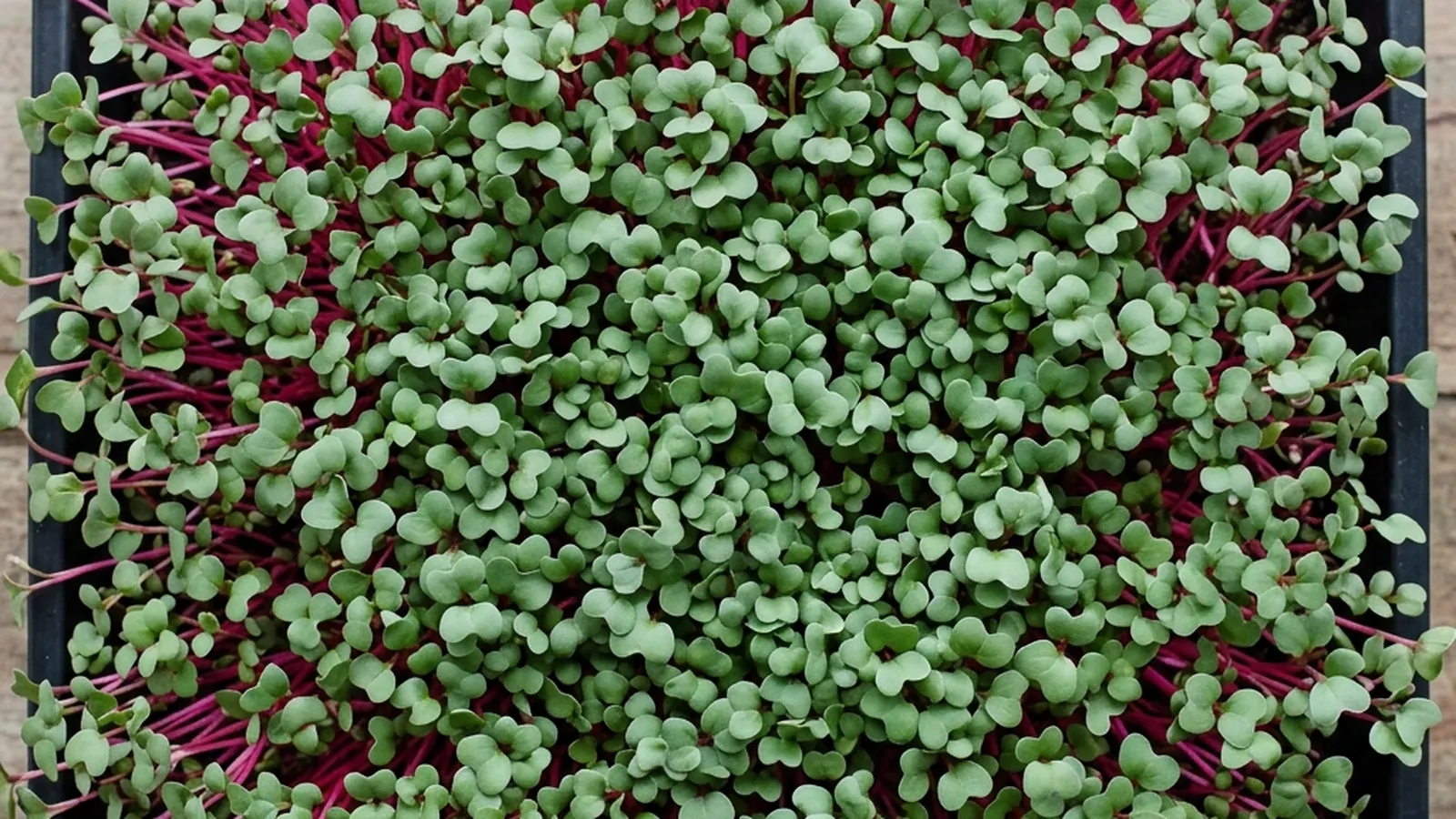
Radish microgreens grow log: a day-by-day timeline
Radish is one of the fastest common microgreens, which is why it works as the benchmark crop for beginners. Here is the realistic week it takes, stage by stage.
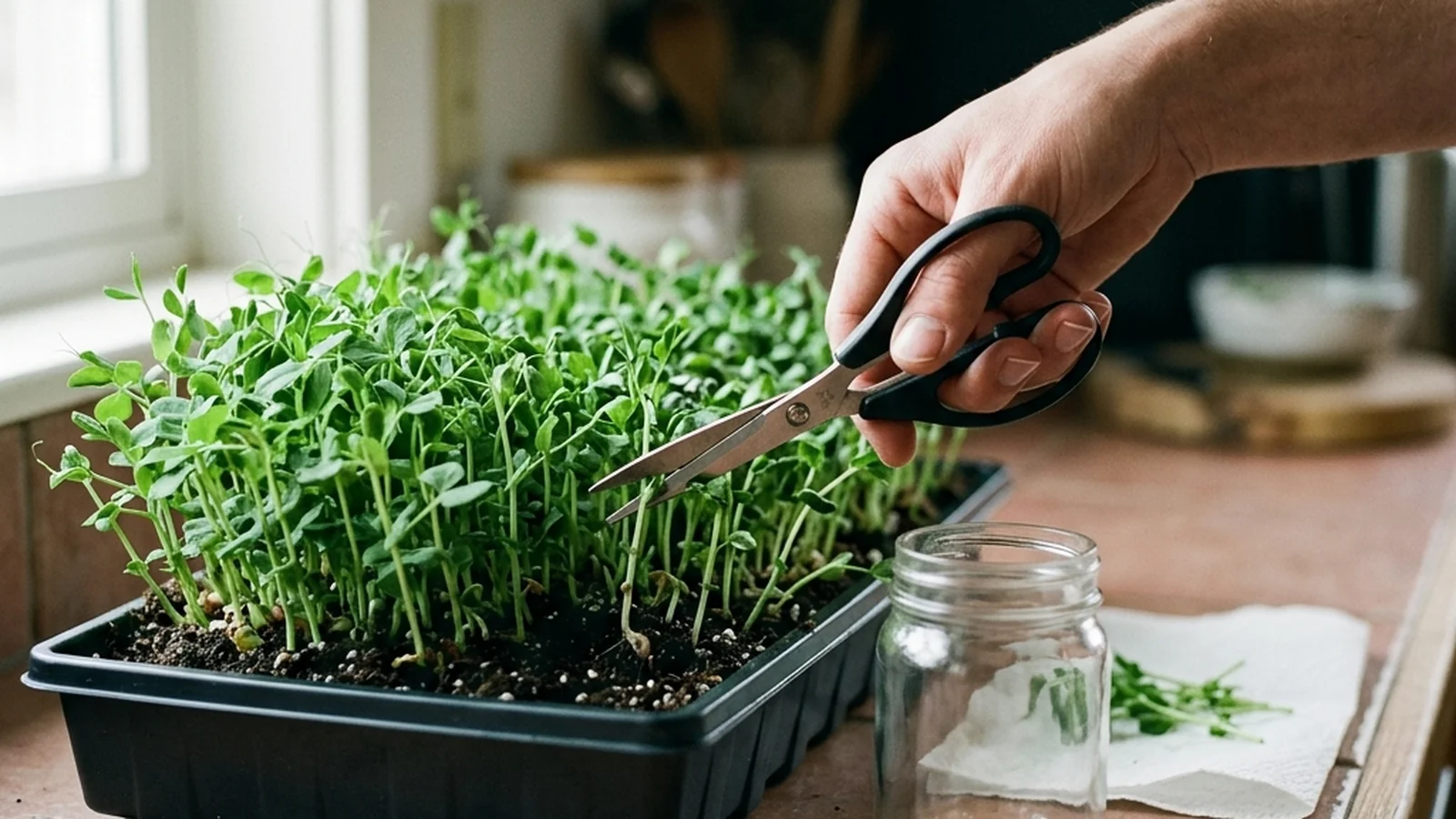
How to harvest and store microgreens safely
The cut and the fridge decide how long a tray lasts. Here is when to harvest, why you should not wash before storing, and what the shelf-life data actually shows.
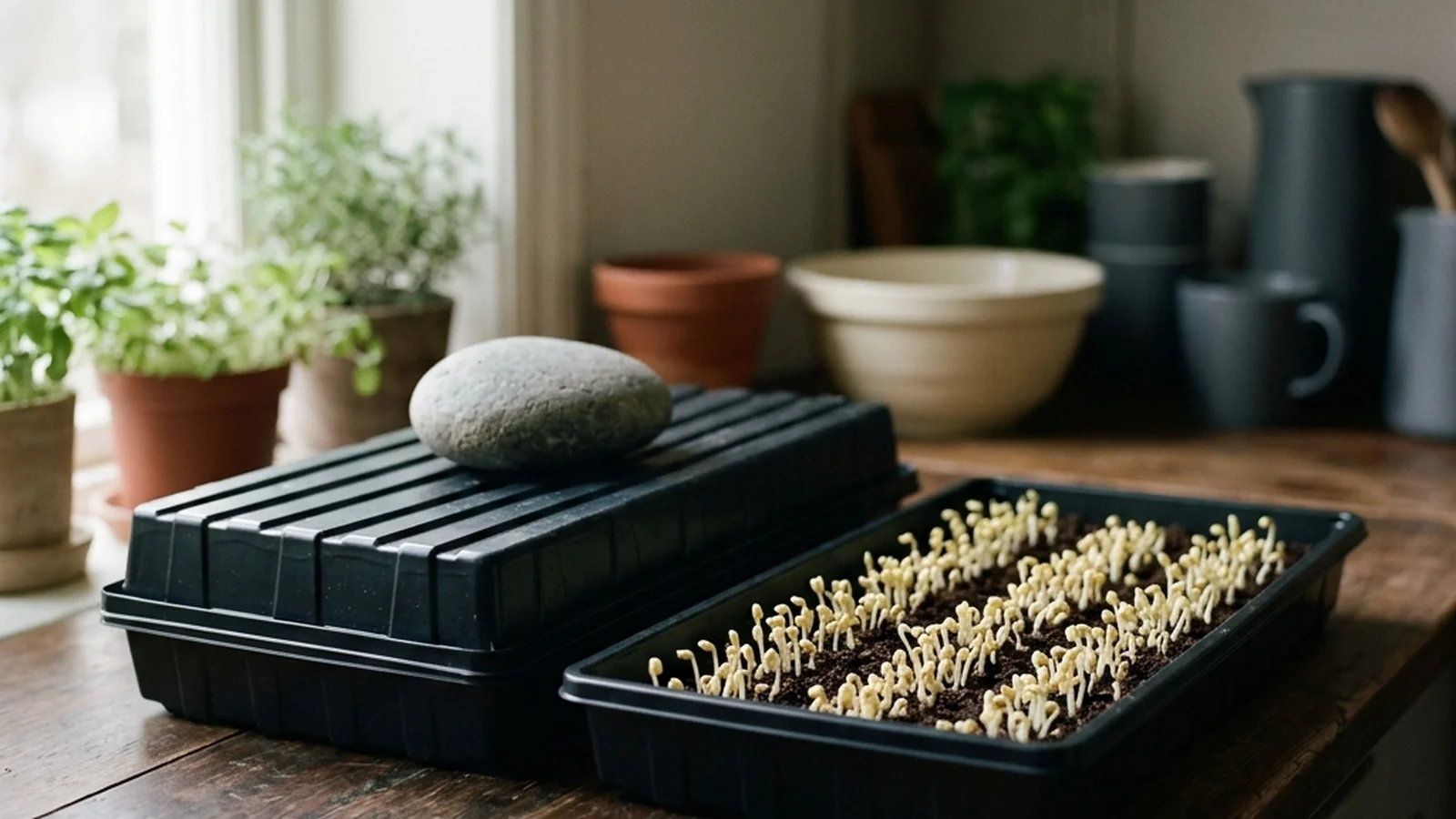
Microgreens blackout time by crop: what varies and why
Blackout time varies by crop — Utah State's table runs from 1-2 days for arugula to 7-14 for cilantro. Here is how that compares to the documented blackout methods, and how to judge readiness by the tray instead of the calendar.