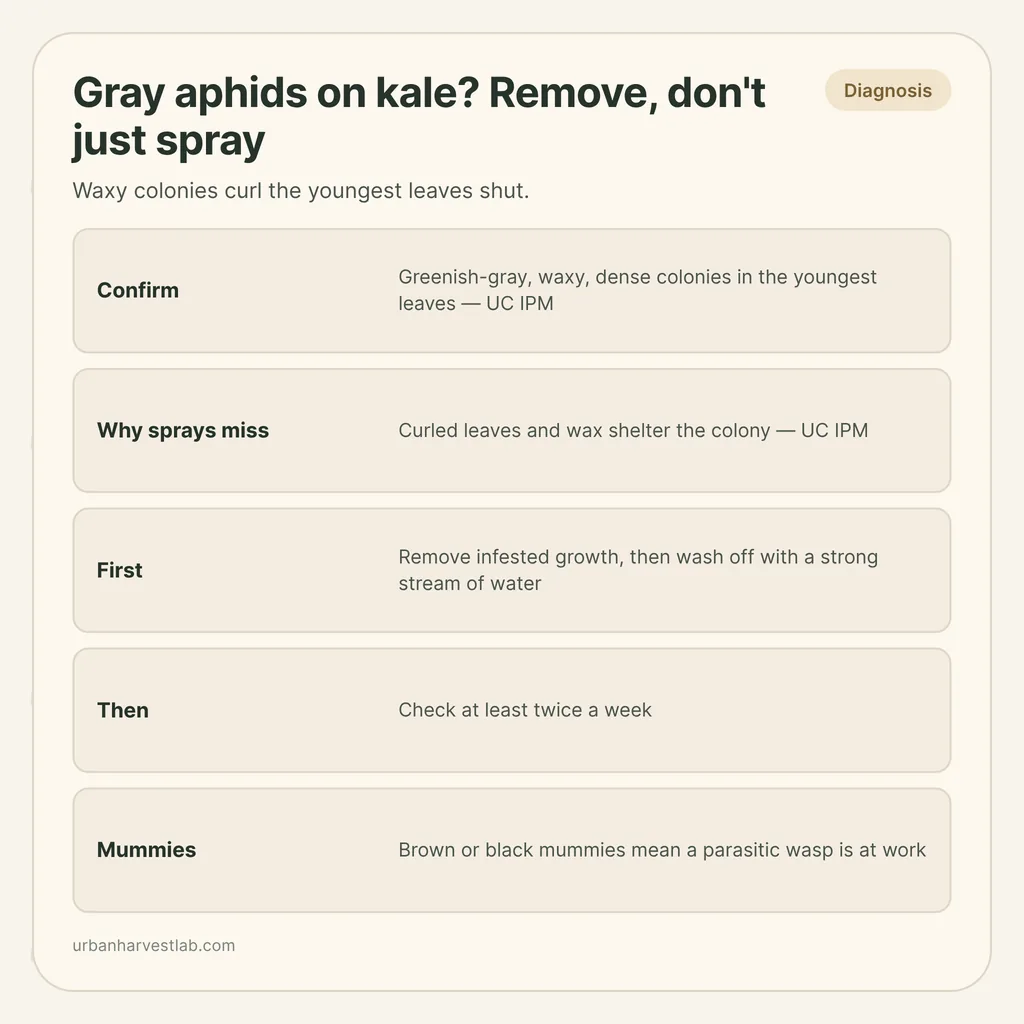
Troubleshoot the system before you change the inputs.
Symptoms
- Clusters of gray-green insects with a powdery white coat on the newest leaves, the flower buds or deep in the heart of the plant.
- Young leaves that curl, pucker or stay folded over the colony.
- Sticky leaves, sometimes with black sooty film, or ants climbing the plant.
Possible causes
- Cabbage aphids: waxy, gray-green, in dense colonies on the youngest growth.
- Green peach aphids: paler, no wax, scattered mostly on older leaves.
- Turnip aphids: dark olive green with only a thin wax coat.
Quick fixes
- Cut off the worst curled leaves or flower heads into a bag and remove the bag, rather than shaking them over the pot.
- Knock the rest off with a strong stream of water if the plant is sturdy, then look again in a few days.
- Check the heart of the plant twice a week and repeat as colonies return.
Three aphids that infest cabbage-family crops, from UC IPM
| Clue | Cabbage aphid | Green peach aphid | Turnip aphid |
|---|---|---|---|
| Coating | Thick, waxy, white | No waxy coating | Thin, less apparent wax |
| Colour | Greenish-gray | Pale green to yellowish, sometimes pinkish | Dark to olive green |
| Pattern on the plant | Dense colonies | Scattered more randomly | Scattered more randomly |
| Where | Youngest leaves, flowering parts, deep inside heads | Older leaves, rarely inside heads | Mostly a problem in the low desert of California; can feed on roots |
Gray, waxy aphids packed into the youngest leaves of kale, broccoli or cabbage are cabbage aphids. Hosing and removing infested growth beats spraying, because the leaves curl around the colony and the wax coat keeps most of a spray off the insects.
If your problem is green caterpillars rather than insects that cluster, see green caterpillars on kale. If it is aphids on a windowsill herb, aphids on indoor herbs covers that. Here the crops are the mustard family: kale, collards, broccoli, cabbage and Brussels sprouts. If you grow kale in pots, kale in containers covers the rest of the crop.
Confirm it is a cabbage aphid
UC IPM describes cabbage aphids as greenish-gray with a white, waxy coating, and says they commonly occur in dense colonies. Adults can be winged or wingless, and winged adults have a black thorax. They prefer the youngest leaves and the flowering parts, and in Brussels sprouts and cabbage they also work deep inside the head.
Like every aphid, they carry a pair of tubelike cornicles at the rear, which UC IPM says distinguishes aphids from all other insects. The two other aphids that infest these crops look different, and the difference matters because it changes what you do. UC IPM says green peach aphid is pale green to yellowish with no waxy coating, spread more randomly, and tends to stay on older leaves, rarely entering heads. Turnip aphid is dark to olive green with a much thinner coat of wax than the cabbage aphid.
Cabbage aphids feed only on plants in the mustard family, so a colony on kale will not move to your tomatoes. It can move to other mustard-family plants nearby, weeds included.
Why the leaves curl and the spray misses
UC IPM explains the problem in one sentence: because leaves curl around where the aphids feed in dense, waxy colonies, it is difficult to reach them with insecticide sprays once they are abundant. The wax and the curl together shelter the colony.
Insecticidal soap is the usual home answer, and UC IPM rates it as giving partial control on cabbage-family crops. It adds that spraying in foggy conditions improves results, and that soap can injure plants at higher concentrations, particularly Brussels sprouts and cabbage, so lower rates are advised. The general UC IPM aphid guide also stresses that oils and soaps work by smothering, so they must be applied thoroughly, and should not go onto drought-stressed plants or in very hot weather. What the label allows on a vegetable you plan to eat is covered in insecticidal soap on vegetables.
For the other options UC IPM lists as organically acceptable, azadirachtin (neem) and the fungus Beauveria bassiana, it notes that they may not significantly reduce aphids as a standalone application. That is the reason to lead with physical removal.
What to do, in order
1. Cut out the worst of it. UC IPM advises removing and destroying infested plants early in the crop cycle. On a single pot, the equivalent is cutting off the curled new leaves or the flower head that holds the colony, bagging them and taking the bag out. Do not shake them over the soil.
2. Wash off what is left. UC IPM recommends knocking aphids off sturdy plants with a strong stream of water. Sturdy is the condition: a small seedling is not. A colony inside a curled leaf will survive a quick rinse, so open the leaf and aim into the fold.
3. Look again within days. UC IPM says to check at least twice a week, upwind edge of the planting first, because aphid populations are often clumped. After any treatment it says to check frequently and spray again if aphids reappear. Cabbage aphids have many generations a year, and females give birth to live nymphs, so a few missed in a leaf fold rebuild the colony quickly.
4. Deal with ants. UC IPM notes that ants protect aphids from their natural enemies. If ants are running up the stem, the aphids have bodyguards: see ants in plant pots. The sticky film on leaves and black sooty mold is honeydew, which sticky leaves explains.
5. Only then consider a product. UC IPM says systemic insecticides can kill hidden aphids but are much more toxic and might also harm bees and other beneficial insects on flowering plants. The product label decides whether anything can go on a leafy crop and how long to wait before eating it. Choosing a pest treatment for edible plants walks through that decision.
Let the wasps work
Among the natural enemies UC IPM names for cabbage aphid are the parasitic wasp Diaeretiella rapae, fungal pathogens, lady beetles and syrphid fly larvae. A brown or black mummified aphid stuck to the leaf is a mummy: the larva of a parasitic wasp fed inside it and killed it. If mummies are scattered through the colony, wash less and watch more.
UC IPM is clear that natural enemies may not give adequate control when infestations are severe or deep inside heads. It also advises delaying insecticide use as long as the aphids do not threaten the crop, because the same enemies hold down caterpillars on these plants. Buying ladybugs is a separate question, answered in do ladybugs help with aphids.
How many is too many?
UC IPM’s thresholds are written for commercial fields, but they show the logic. Before heading, broccoli and cauliflower can tolerate up to 100 aphids per plant. Cabbage, whose leaves overlap and hide the colony, has less tolerance: treat when 1 to 2 percent of plants carry one or more aphids. Once heads begin to form, UC IPM says to control cabbage aphids even if only a few are present. Their most serious damage, it says, is contamination of the crop at harvest.
For a pot of kale, where you eat the leaves, the practical reading is this. A few aphids on an outer leaf you are about to eat are not an emergency; a colony in the heart, where new leaves unfold, is. UC IPM gives no figure for kale.
Seedlings differ. UC IPM says cabbage aphids do not commonly damage seedlings, but their numbers increase after thinning or transplanting and large colonies can then stunt or kill small plants.
Stop the next round
- Check transplants before they go into the pot; UC IPM says infestations on Brussels sprouts can start in seedling beds.
- Remove mustard-family weeds near your containers, which UC IPM lists as alternate hosts.
- Clear crop remnants right after harvest, as UC IPM advises, rather than leaving old stalks to host a colony.
- Check the growing tips twice a week while the plants are growing.
Sources
Related aphid and brassica guides
Cabbage aphids sit between the caterpillar problem on the same crops and the general aphid and spray guides.
Common questions
What are the gray aphids on my kale?
Most likely cabbage aphids. UC IPM describes them as greenish-gray with a white, waxy coating that occur in dense colonies, mostly on the youngest leaves and flowering parts. Green peach aphids are paler and sit scattered on older leaves instead.
Why did soap not get rid of the aphids on my cabbage plant?
UC IPM says leaves curl around the dense, waxy colonies, so spray is hard to get onto the aphids, and it rates insecticidal soap as partial control. It also warns that soap can injure cabbage and Brussels sprouts at higher concentrations. Removing the infested leaves works better than a stronger spray.
How many aphids can a broccoli or kale plant tolerate?
UC IPM gives a commercial threshold for broccoli and cauliflower of up to 100 aphids per plant until heading, and says to act on cabbage as soon as 1 to 2 percent of plants carry any aphids. Once heads start to form, it says to control them even if only a few are present. It gives no figure for kale. Because the damage is aphids in the part you eat, treat any colony in the heart as worth removing.
Do the brown or black mummified aphids mean the plant is dying?
No. UC IPM says brown or black mummified aphids show that the larva of a parasitic wasp fed inside and killed them. They are a sign that natural control is already working, so do not wash them all off if the rest of the colony is shrinking.
Related guides

Green caterpillars on kale: which cabbage worm it is and how to stop it
Three look-alike green caterpillars feed on kale, and a white butterfly fluttering round the pot is the early warning. Here is how to tell them apart and what actually protects a container crop you plan to eat.
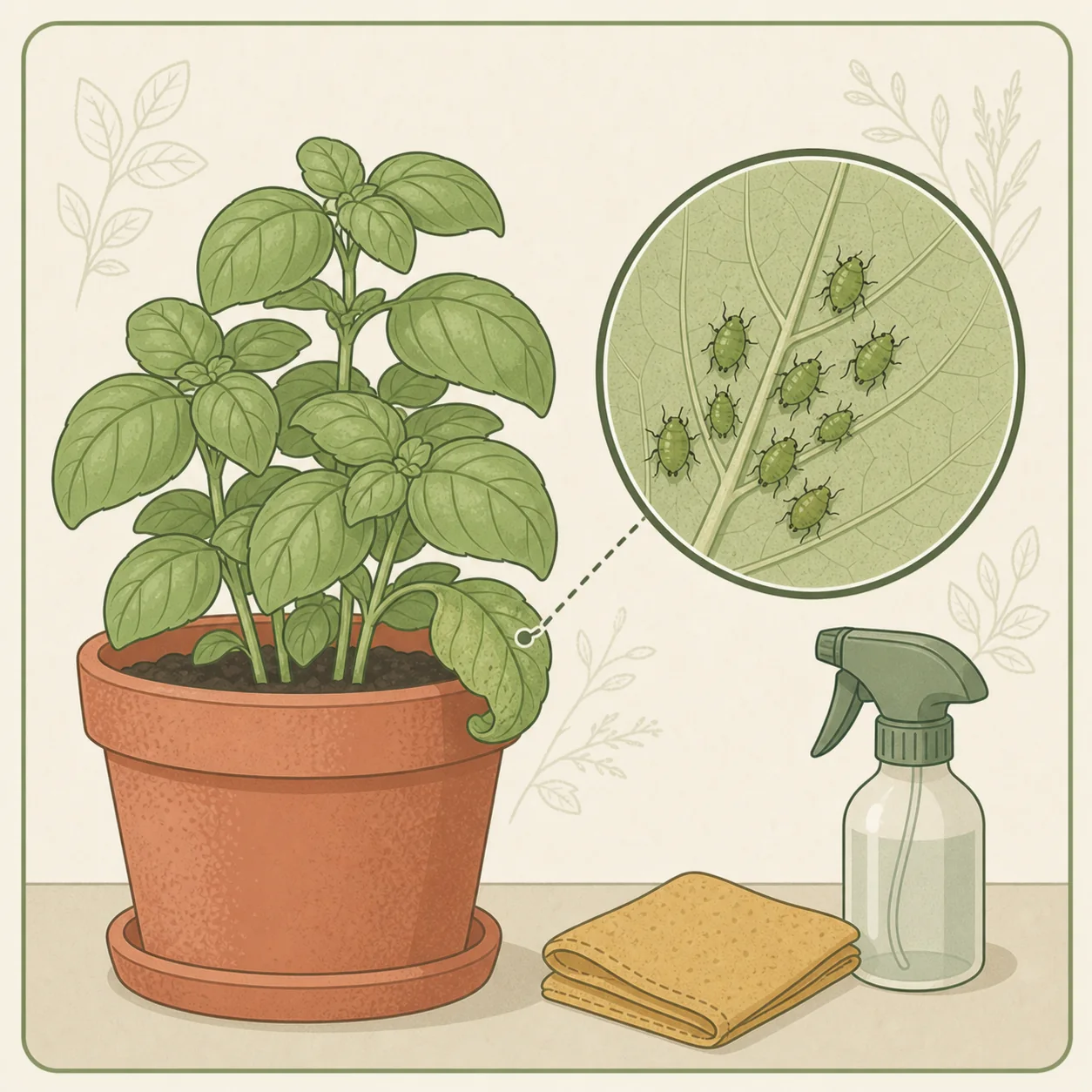
Aphids on indoor herbs: identify, isolate, and control them
Aphids are manageable when you find the colony, isolate the plant, remove most insects physically, and repeat inspections through the next generation.
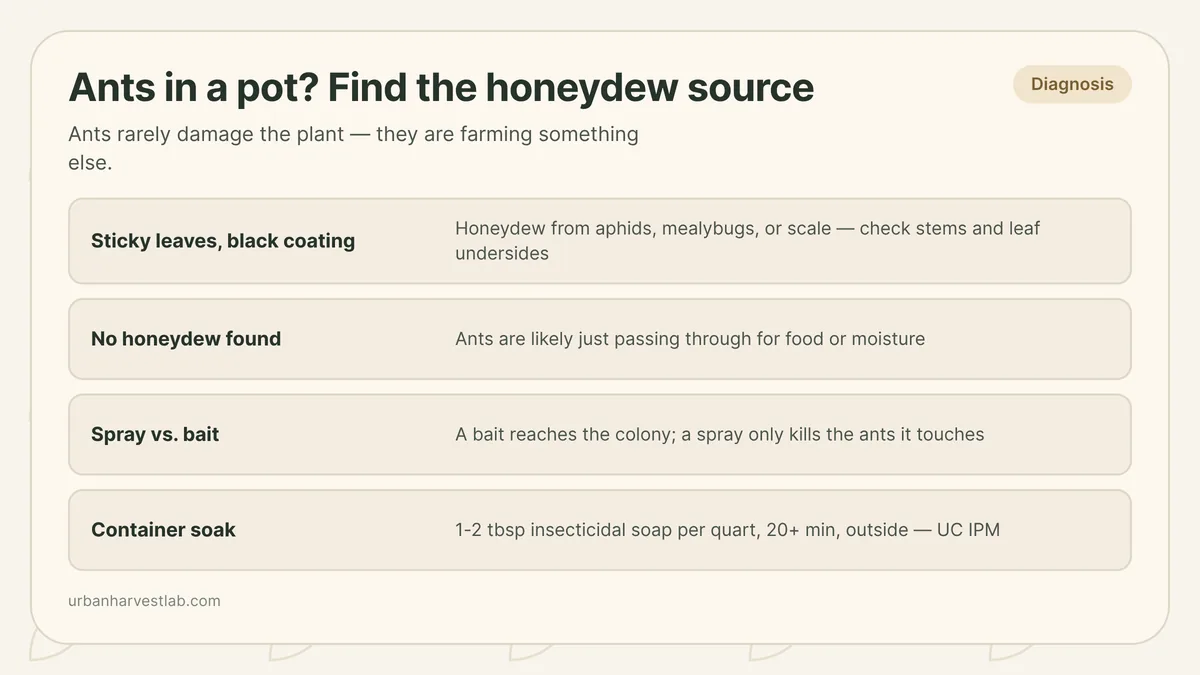
Ants in potted plants: what they mean and how to stop them
A trail of ants on a potted plant is almost always chasing honeydew from another pest, not damaging the plant itself, so the fix starts with finding that pest.