
Planting depth and spacing for leeks, by source
| Source | Planting method | Spacing |
|---|---|---|
| University of Maryland Extension | Dowel holes about 5 to 6 inches deep, filled by watering | 5 inches |
| Utah State University Extension | 6-inch dibble hole for 10 to 12 inch plants, filled in gradually | 4 to 6 inches |
| South Dakota State University Extension | Trench 6 to 8 inches deep, filled in as the plant grows | 6 to 9 inches |
| Oregon State University | Dibble holes 3 to 4 inches deep | 4 to 6 inches |
Grow leeks in a deep container by planting pencil-thick transplants into dibble holes, letting the hole fill in as you water, then pulling soil up around the stems as they thicken. University of Maryland Extension makes the holes 5 to 6 inches deep and picks leeks once the stalk is an inch across, which it says generally takes 100 to 120 days. It is a long-season crop that needs evenly moist mix for months.
Leeks are related to onions, but University of Maryland Extension notes that instead of forming a bulb, the stem keeps thickening into a sheath of furled leaves. That is the part you eat, and it is the reason a pot needs to be set up differently from the shallow container that suits green onions. The calendar is also different from container garlic, which runs fall to summer.
Start with transplants, not seed in the pot
Oregon State describes direct seeding as possible but not recommended, with harvest taking 8 to 12 months or longer from direct-seeded plantings. Utah State’s route is the usual one: start seed indoors and give transplants 6 to 8 weeks of growth before they go out. Oregon State transplants at 10 to 12 weeks, or when the plants are pencil thick, after a week or two of hardening off.
Leek seed keeps poorly: Oregon State puts its useful viability at less than 2 years unless stored under ideal conditions, so buy fresh seed rather than using a packet from several seasons back. And if you would rather skip seed starting, a bundle of nursery transplants does the same job. Seed-starting mix versus potting mix covers what to sow into if you do start your own.
Leeks are hardy. University of Maryland says plants withstand heavy frosts and can go out several weeks before the last frost date. Harden them off first. If you do not know your own date, the frost-date guide shows how to find it.
Plant deep, then leave headroom
The white, tender part of a leek is stem that has been kept out of the light. South Dakota State says that to grow a large white section the stem must be blanched, either by hilling soil up around it or by planting into a trench six to eight inches deep and filling it in gradually. University of Maryland adds that blanching makes leeks more tender and mild but is not absolutely necessary, so a shallower planting still gives you a usable, greener leek.
The table above sets the four sources side by side. For a pot, the dibble method is the practical one, because a trench does not fit in a round container:
- Fill the container with potting mix to within a few inches of the rim, not to the top. Those inches are your hilling space. Container depth for tomatoes, peppers and herbs explains why more soil volume steadies moisture and temperature.
- Make holes with a stick or dowel about 1 to 1¼ inches across, 5 to 6 inches deep (University of Maryland).
- Drop one transplant into each hole. Do not backfill. Water gently, and University of Maryland says the soil will wash in around the roots.
- As the plants grow, pull mix up around the stems. Utah State hills 2 to 3 times, adding 2 to 3 inches of banked soil each time, and notes that dibble planting partly eliminates the need for repeated hilling.
The hole alone takes 5 to 6 inches of soil, so the container must be deeper than that with root room below it. University of Maryland and Utah State both say one transplant yields one sheath 6 to 8 inches long and 1 to 2 inches wide, so pick a container deep enough to bury that length with root room below it. Oregon State recommends a pH of 6.5 to 7 with good drainage and good moisture retention, so start from fresh, well-draining potting mix and check the pH if your plants struggle. Put the pot where it gets at least 6 hours of direct sun a day; University of Maryland prefers 8 to 10.
How far apart
The sources split. University of Maryland gives 5 inches, Oregon State gives 4 to 6 inches and South Dakota State gives 6 to 9 inches. A pot has a fixed amount of soil and water, so lean to the wider end and plant fewer.
Water, feed and mulch for a slow crop
Leek roots do not go deep. University of Maryland says water needs are critical since rooting depth in leeks is shallow, and that drought stress decreases yield. Container mix dries faster than a bed, so check it by finger rather than by the calendar. How often to water container vegetables gives the test.
Feeding is modest. University of Maryland rates leeks as a light to medium feeder, and Utah State adds that they need extra nitrogen beyond what goes in at planting, side-dressed in mid-May and again in late June in its garden schedule. Follow your fertilizer label for a pot, and see the container vegetable fertilizer schedule for timing. South Dakota State also suggests removing the top half of the leaves in mid-summer to encourage greater stalk growth, along with a nitrogen side-dress at that time.
A layer of mulch pays off here. University of Maryland calls mulching essential to keep weeds out and moisture in, and says weed control matters most during the first 2 months, when plants are growing slowly and compete for water and nutrients. Weed by hand and avoid damaging the shallow roots.
Pests worth knowing about
Penn State Extension reports that allium leafminer attacks onion, garlic, leek, scallions, shallots and chives, and that control can be achieved with row covers during adult flight. Its guidance is to keep covers on until the end of adult emergence, which generally lasts 4 to 6 weeks, after first scouting so you do not trap adults under the cover. South Dakota State lists onion thrips, which can cause problems under hot, dry conditions, as tiny silvery-white spots on the leaf. Utah State and South Dakota State both mention onion maggot. Because the same pests attack garlic and green onions, a pot of leeks next to those crops shares their risk.
Harvest as you go
University of Maryland says leeks may be harvested as early as 60 days after planting at about green-onion size, but generally take 100 to 120 days. They are ready to eat when the stalks are 1 inch across. South Dakota State uses the same one-inch gauge and notes that some smaller varieties mature at one-half to three-fourths of an inch.
Unlike onions, leek tops do not brown and die back, according to South Dakota State, so you cannot wait for a visual signal. Watch the width. What you do not want to see, per South Dakota State, is swelling at the base, called bulbing.
To pick, SDSU Extension says to gently twist the leek and pull, and you can take them one at a time as needed. University of Maryland notes that leeks have large root systems, so digging is sometimes easier; in a pot, loosen the mix around the stem with a trowel first.
Cold weather and overwintering
South Dakota State says harvest can wait until after the first few frosts, and to mulch the mounds of leeks if temperatures start to go below 20 degrees Fahrenheit. University of Maryland says leeks covered with mulch can be dug throughout the winter. Cultivar matters: South Dakota State lists King Richard as frost resistant to 20 degrees Fahrenheit but not an overwintering type, while Autumn Giant and Tadorna have survived -10 degrees Fahrenheit in some trials. A pot exposes roots to cold from all sides, so treat those numbers as garden-bed figures and mulch heavily or move the container to shelter.
Cleaning and keeping
South Dakota State advises slicing the whole leek lengthwise, separating the layers and rinsing thoroughly, because soil hides between the leaves. In the refrigerator, University of Maryland gives 7 to 10 days. Longer-term, it recommends leaving leeks in the ground and digging as needed.
Sources
More container crops from the allium family
Green onions, garlic and regrown scallions each need a different pot and a different calendar from leeks.
Common questions
How deep should I plant leeks in a pot?
University of Maryland Extension makes holes about 5 to 6 inches deep with a dowel and drops a transplant into each one. Utah State puts 10 to 12 inch tall plants into a 6 inch hole, South Dakota State plants into a trench 6 to 8 inches deep, and Oregon State describes 3 to 4 inch holes. Deeper planting gives a longer blanched stem, so pick the depth your pot can hold with room left to top up.
How many leeks fit in one container?
Spacing figures run from 4 to 9 inches between plants: Oregon State gives 4 to 6 inches, University of Maryland 5 inches and South Dakota State 6 to 9 inches. In a pot, use the wider end if you want thick stems, and count plants by the spacing rather than by a fixed number per pot.
How long do leeks take to grow in a container?
University of Maryland Extension gives 70 to 120 days to maturity depending on cultivar, and generally 100 to 120 days. Utah State says leeks may be harvested as early as 60 days after seeding. Planting transplants rather than seed shortens the wait.
When are container leeks ready to pick?
When the stalk is about an inch across. University of Maryland and Utah State both use 1 inch, and South Dakota State uses bigger than one inch as the standard gauge, noting that some smaller varieties mature at one-half to three-fourths of an inch. Leek tops do not brown and die back the way onion tops do, so judge by stem width.
Related guides
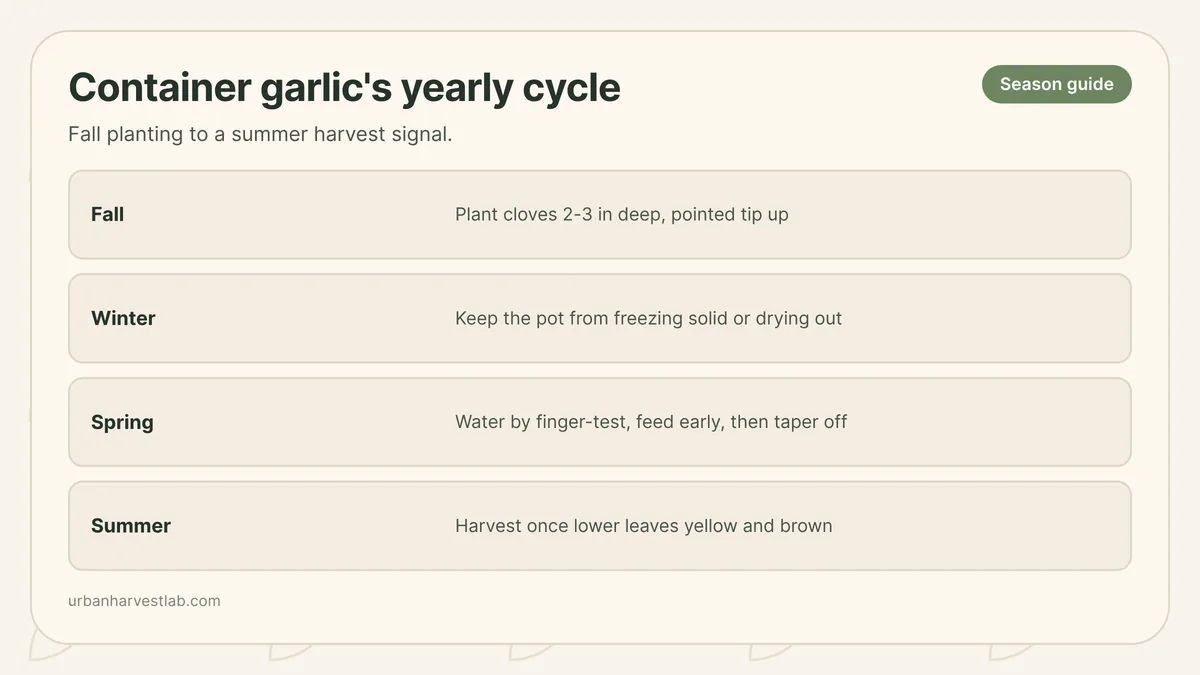
Growing garlic in containers: fall planting to summer harvest
Container garlic runs the same yearly cycle as garlic in the ground, but a pot freezes and dries out faster than garden soil. Here is the full process, season by season.
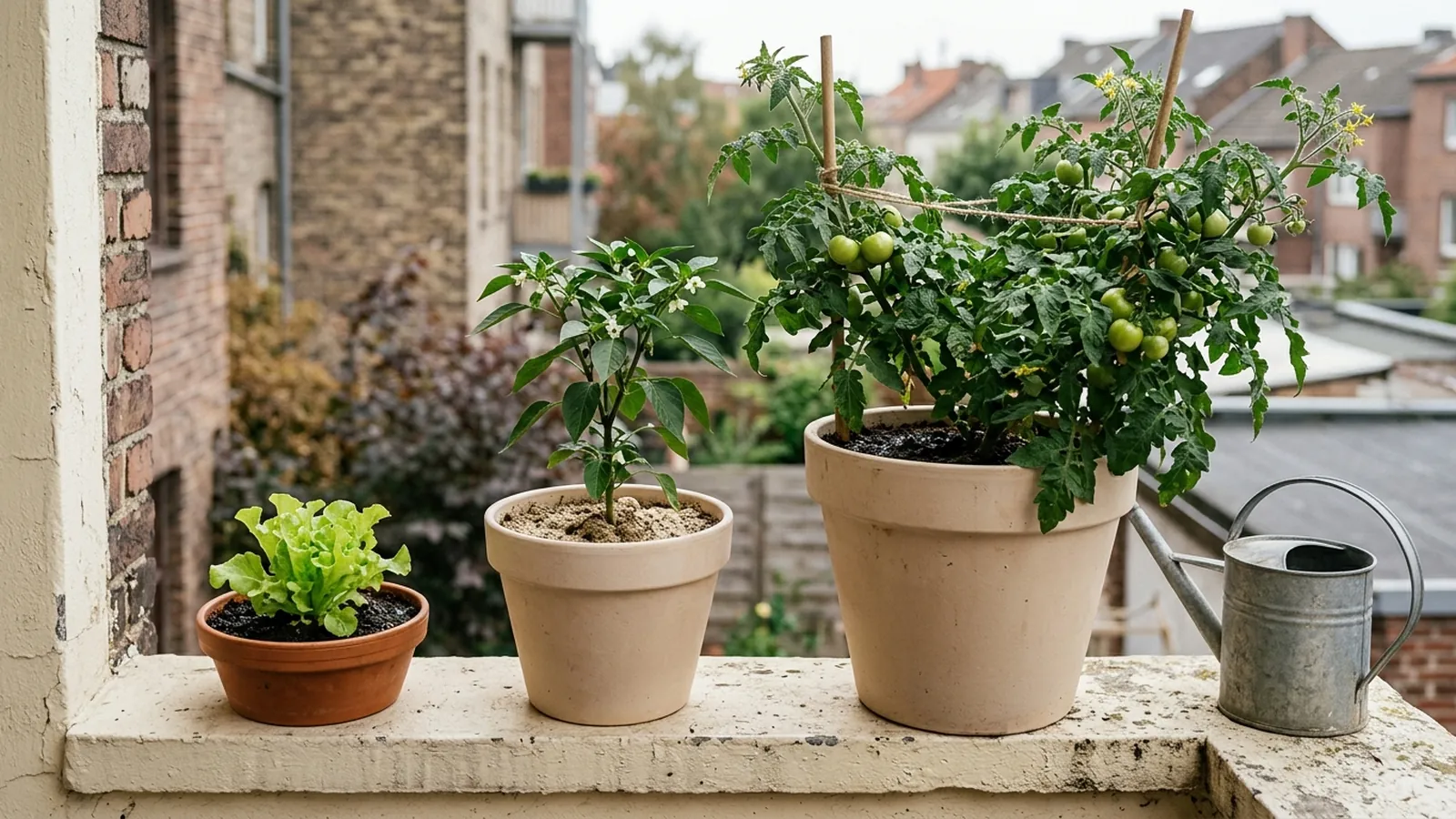
How often to water container vegetables: volume and crop stage set the interval
A pepper in a 2-gallon pot in May and the same pepper in the same pot in August are two different watering problems. Once you can see why, the question stops being how often and becomes how much mix you gave the plant, and what it is carrying right now.
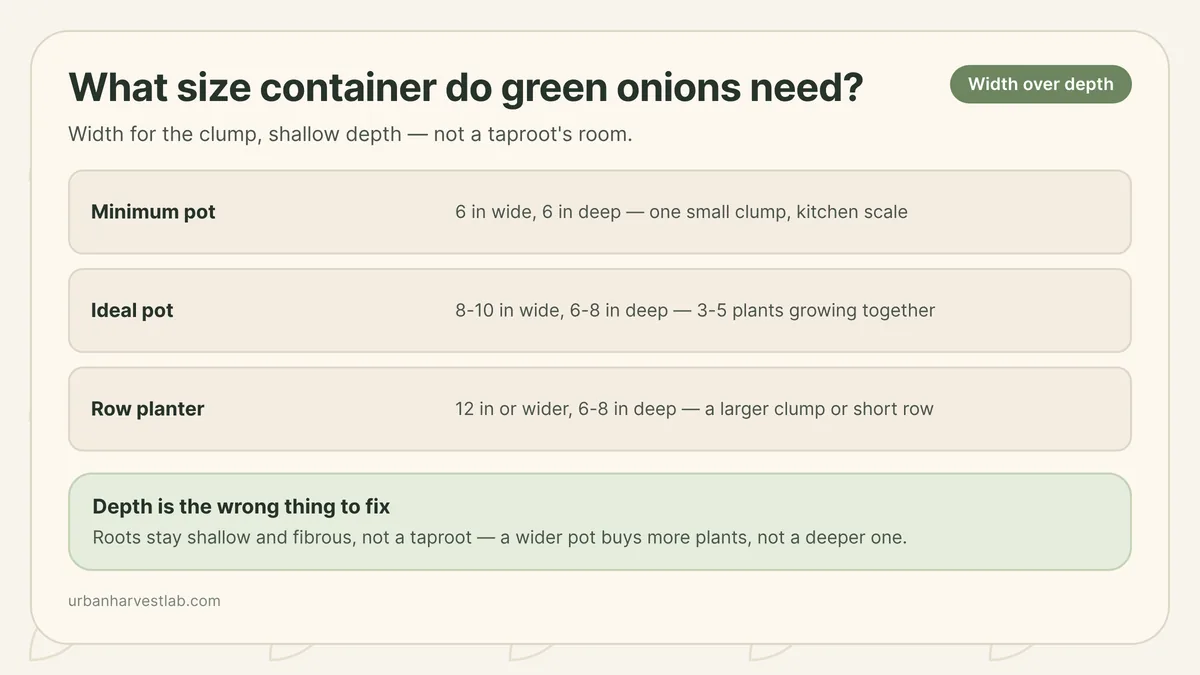
What size container do green onions need?
Green onions ask for width and shallow depth, not the deep taproot room parsley or carrots need, so one small container goes further than most growers expect.