Troubleshoot the system before you change the inputs.
Symptoms
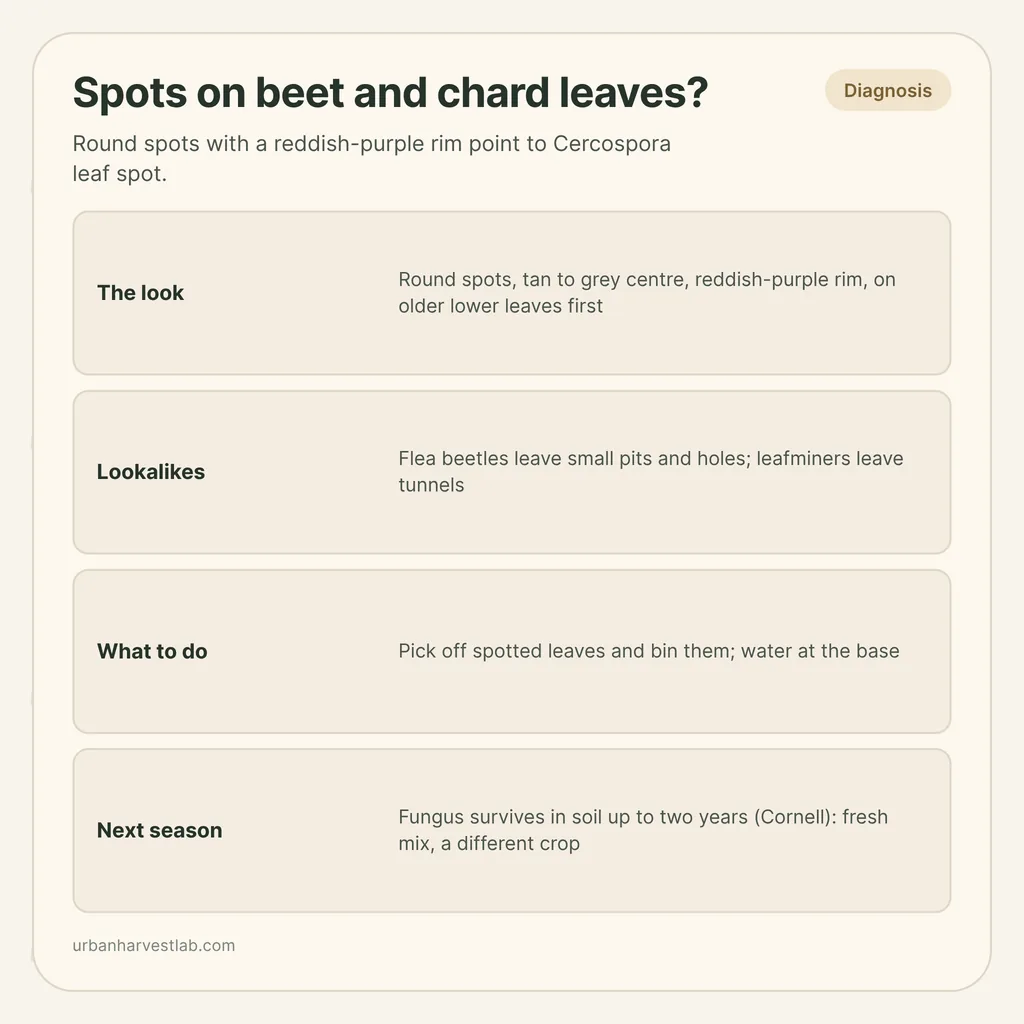
- Round spots, tan to grey in the centre, with a reddish-purple rim, mostly on the older lower leaves.
- Spots that merge into larger dead patches, or whose centres drop out and leave holes.
- Tiny black dots in the spot centres under a hand lens, or a fuzzy grey look in humid weather.
Possible causes
- Cercospora beticola, a fungus spread by splashing water and wet leaves in warm, humid weather.
- Spores carried over on infected seed, old plant debris, or related weeds in the same space.
- Overhead watering or crowded plants that keep the foliage wet for long periods.
Quick fixes
- Pick off spotted leaves and bin them, or hot compost them.
- Water at the base so the leaves stay dry and stop wetting the foliage.
- At season end, clear all debris and refill the pot with fresh mix before planting anything from the beet family again.
Round spots with a tan or grey centre and a reddish-purple rim on beet or chard leaves are the classic sign of Cercospora leaf spot, a fungal disease. You cannot cure a leaf that already has spots, but you can slow the spread by removing those leaves, keeping the foliage dry, and not handing the fungus a pot full of its own leftovers next season.
Confirm it is Cercospora
University of Minnesota Extension describes the spots as circular, about 1/8 to 3/16 inch across, brown to grey, with distinct reddish-purple borders. Lower leaves are infected first and are often the worst affected. Utah State Extension agrees that lesions first appear on older leaves before moving on to newer growth, and adds black dots in the lesion centres that you can see with a hand lens at 10x.
Three more clues help:
- Fuzz in humid weather. Minnesota notes the spots can produce silver or steel-grey spores, which gives them a fuzzy look.
- Holes where spots were. University of Maryland Extension says the centre of a lesion may drop out and leave a hole.
- Merging spots. Utah State says lesions merge over time and take over large sections of leaf. Cornell saw spots so numerous on young chard leaves that they had coalesced and distorted the leaf.
Beet and chard do not look identical
Cornell’s Long Island vegetable pathologists found the spot centres lighter on beets than on chard, and only the beets had the distinctive border. So a chard leaf with pale, borderless spots is not automatically something else. Judge by the whole plant: old leaves first, round spots, spreading in wet weather.
Rule out the lookalikes
Not every mark on these leaves is a fungus. Minnesota’s diagnostic page for chard lists two common alternatives:
| What you see | More likely | How to tell |
|---|---|---|
| Round spots with a coloured rim, lower leaves first | Cercospora leaf spot | Black dots in centres; fuzz when humid |
| Small shallow pits and irregular holes, a “shot hole” look | Flea beetles | Small beetles, 1/16 to 1/8 inch long |
| Tunnels that widen into a blotch, turning brown | Spinach leafminer | Pale maggot inside the leaf; see leaf miners on greens |
Holes with no coloured rim and no spot beforehand point to the beetle, not the fungus. A winding tunnel between two intact leaf surfaces points to the miner.
What makes it spread
Cornell lists the conditions that favour the disease: frequent rain, relative humidity of at least 90% and temperatures above 75 F. Spores move in wind and rain, and the rain also provides the leaf wetness the fungus needs to infect. Utah State describes optimal conditions as warm days and nights, high humidity or wet leaves.
A balcony is not immune. You are not at the mercy of the rain, but a hose or watering can that splashes the lower leaves does the same job, and so does a pot packed so tightly that the leaves stay damp all morning.
Where it comes from matters for what you do afterwards. Cornell names contaminated seed, infested debris from previous crops and related Chenopodium weeds as sources. Utah State says the fungus overwinters in infected plant debris and releases spores when the weather warms. Cornell adds that it forms survival structures in infected leaves that let it persist in soil for up to two years.
What to do now
- Pick off the spotted leaves. University of Maryland Extension advises picking off infected leaves and pulling up and hot composting badly infected plants. Bin the leaves or hot compost them.
- Water the soil, not the plant. Utah State advises avoiding practices such as overhead irrigation that leave foliage wet for prolonged periods. Water at the base so the leaves stay dry. Maryland also suggests a dense organic mulch around plants.
- Give leaves room. Thin crowded plants so air moves between them. The beet and chard container guides cover spacing: beets in containers and Swiss chard in containers.
- Keep harvesting clean leaves. Cornell notes that on chard and beets grown for greens, affected leaves are unmarketable, which is the real cost of this disease: the crop is the leaf. Cut the clean, unspotted leaves and leave the rest to be removed.
About fungicides
Cornell’s guidance on this disease names commercial products and states that the fungicides it mentions are for commercial production, not gardens. In a home pot, the controls that the extension pages agree on are cultural: clean seed, dry foliage, removing infected leaves and debris, and rotation. If you consider any spray, read the label for your crop first; Utah State warns that not all pesticides are registered for edible crops.
Stop it coming back
- Start with clean seed. Utah State advises certified disease-free seed, and Cornell includes clean seed and resistant varieties in its list of controls.
- Empty the pot at season end. Maryland advises cleaning up and removing all plant debris at the end of the season. Take out the roots and leaf litter too.
- Use fresh mix and a different crop. Because Cornell reports survival in soil for up to two years, and Maryland advises not planting susceptible crops in the same spot more than once every three years, a spotted pot should not go straight back to beets, chard or spinach. In a container the practical equivalent is fresh potting mix; crop rotation in pots covers how much rotation matters in a container.
- Pull related weeds. Cornell and Utah State both name weeds, including Chenopodium relatives, as a source. Keep the pot and its surroundings clear.
Sources
- Cornell University, Long Island Vegetable Health: Cercospora leaf spot on beets and Swiss chard
- University of Minnesota Extension: Swiss chard, spots or blotches on leaves
- University of Maryland Extension: Small tan, brownish spots, and holes in leaves
- Utah State University Extension: Cercospora leaf spot
Growing beets and chard in pots
Spots are one problem among several on these crops. These guides cover growing them well and ruling out lookalikes.
Common questions
What are the spots on my beet leaves?
Most often Cercospora leaf spot. University of Minnesota Extension describes circular brown to grey spots about 1/8 to 3/16 inch across with distinct reddish-purple borders, on the lower leaves first. Check the spot centres with a hand lens for tiny black dots.
Why does my chard have spots but no red border?
Cornell reported that on Long Island only the beets had the distinctive border, and the spot centres were lighter on beets than on chard. A chard leaf can have Cercospora without the red rim, so look at the pattern across the plant rather than one spot.
How do I stop Cercospora leaf spot from spreading?
Water the soil, not the leaves, and give the foliage room to dry. Utah State Extension advises avoiding watering that leaves foliage wet for long periods, and University of Maryland Extension advises picking off infected leaves and removing all plant debris at the end of the season.
Can I reuse the same pot of soil for beets or chard next year?
Not after a spotted crop. Cornell reports the fungus survives in soil up to two years and in infected debris, so empty the pot, remove roots and leaf litter, use fresh potting mix, and grow something outside the beet family there.
Related guides
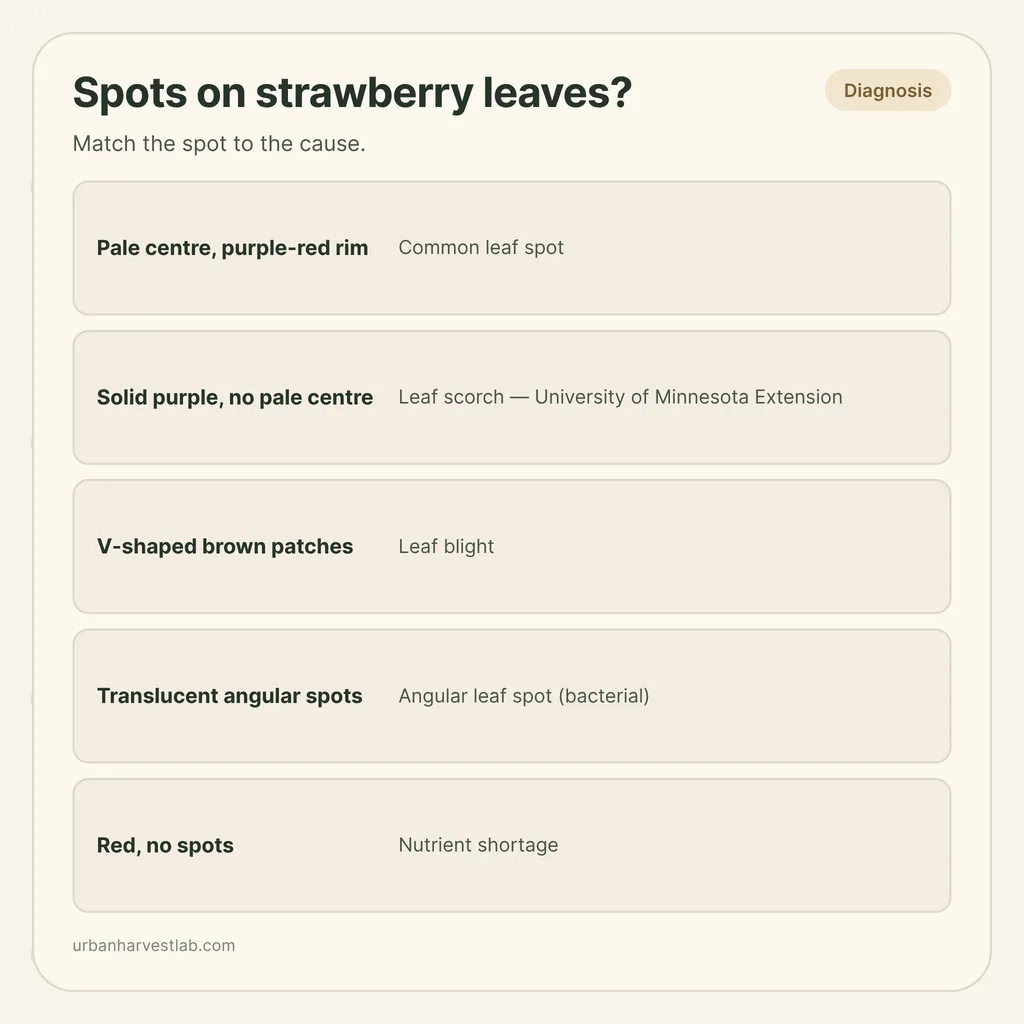
Red and purple spots on strawberry leaves: leaf spot, scorch or something else
Purple, red or brown spots on strawberry leaves are usually fungal leaf spot or leaf scorch. They rarely cut the crop, and the fixes are about cleanliness and water.

Brown spots on tomato leaves: early blight, septoria or bacterial spot
Three common diseases cause brown spots on tomato leaves, and each leaves a different mark. Read the spot, then pick the response that fits.
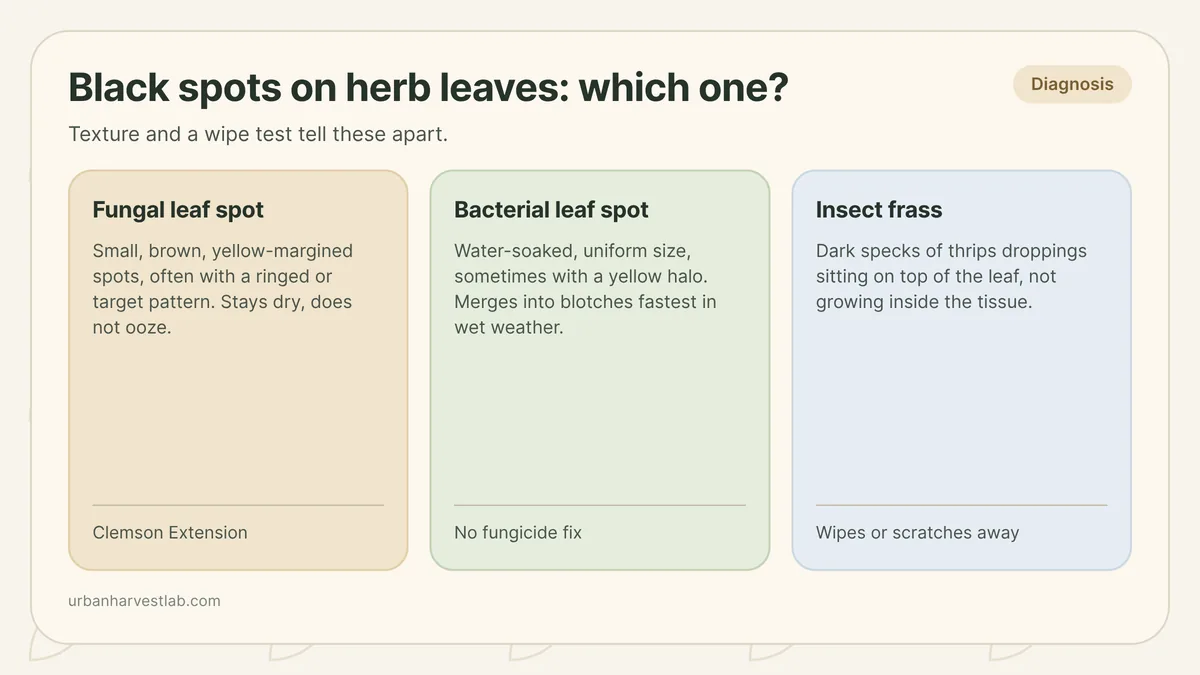
Black spots on herb leaves: fungus, bacteria, or frass
Black spots on herbs can be a fungal disease, a bacterial disease, or just insect droppings sitting on the leaf, and each one calls for something different.