
Swiss chard in a container, by stage
| Stage | What the sources give | What to do in the pot |
|---|---|---|
| Sowing | Seeds 1/2 inch deep (Utah State); germinate best at 55-75°F in 7-14 days (Utah State) | Sow in spring or late summer; avoid starting seed in a hot spot |
| Thinning | Thin at 3-4 true leaves; 6 inches between plants (Utah State); in pots 12 inches, or 2 inches for baby leaf (RHS) | Keep the strongest seedlings; the thinnings are edible |
| First picking | About 12 inches long, four to six weeks after planting (University of Georgia) | Take the largest outer leaves |
| Summer heat | Best at 75°F or below; heat reduces growth and can cause bitterness (Utah State) | Give afternoon shade, keep the mix evenly moist, resow |
| Fall and winter | Hardy but stops producing as temperatures drop (RHS); mild freezes tolerated (University of Georgia) | Cover on cold nights or move the pot under cover |
Swiss chard grows well in a pot, and a single container can give you leaves for months if you cut the outer leaves at the base and keep the centre intact. Give it a deep container, steady moisture and as much sun as your balcony offers, then plan for summer heat, which is the main thing that ends a pot of chard early.
Chard works in the same small-space logic as the cool-season crops in growing salad greens in containers this fall, with one difference: lettuce is cut once, while a chard plant is meant to be harvested repeatedly.
Choose a pot deep enough to stay moist
The sources give very different container sizes for chard. The RHS recommends a large container at least 16 inches (40 cm) wide and deep, filled with multi-purpose compost. University of Maryland Extension gives 2 gallons. Texas A&M AgriLife Extension says 1 to 2 gallon containers are best for chard. University of Kentucky Extension puts the minimum at 6 to 8 inches deep, the same figure it gives for beets, kale, lettuce, radish and spinach.
University of Kentucky frames its 6-8 inches as adequate and Texas A&M calls 1-2 gallons best; the RHS figure is far larger, and the extra volume is what buys moisture stability for a plant you cut for months. The RHS notes that chard in containers needs regular watering throughout its growing period because the compost holds limited moisture, and a bigger volume of mix is the easiest way to make that less urgent. The depth logic is the same as in container depth for tomatoes, peppers and herbs.
Drainage holes are not optional, and fresh potting mix does the job better than garden soil. The RHS says chard grows well in fresh potting compost and does not usually need feeding. Utah State Extension is more specific for the garden: it applies a nitrogen fertilizer (21-0-0) about four weeks after thinning or transplanting to encourage rapid leaf growth. If growth slows after weeks of repeated cutting, a feed along those lines is the option to consider.
Sun: how much, and when to back off
University of Georgia Extension says Swiss chard requires 8 to 10 hours of sunshine per day. The RHS is looser: full sun, or with some light shade in summer. Take the Georgia figure as the target for cool weather and the RHS wording as permission to move the pot out of the hottest afternoon light once temperatures climb.
That does not turn a deep-shade balcony into a chard balcony. Neither source gives a minimum below the RHS’s “light shade in summer”; on a shady balcony expect smaller, slower pickings, and see shade balcony vegetables for other leafy crops.
Sowing and thinning
Utah State Extension says chard seed germinates best at 55 to 75°F and takes 7 to 14 days to emerge, and that temperatures above 80°F reduce germination. Plant seed 1/2 inch deep; the RHS sows container seed about 1 inch (2.5 cm) deep and 4 inches (10 cm) apart. Thin when plants have 3 to 4 true leaves (Utah State), leaving about 6 inches between plants. For containers the RHS thins to 30 cm (12 in) apart for full-size leaves, or 5 cm (2 in) for baby salad leaves, so a 16-inch pot carries one or two full-size plants or a dense patch of baby leaf. Eat the thinnings.
Alabama Cooperative Extension’s soil-temperature table, on seedling heat mats and thermostats, runs chard’s workable range up to 85°F, while Utah State says germination falls off above 80°F; either way an ordinary room is inside the range, so a mat is not needed. For timing against your frost dates, first and last frost dates for a balcony shows how to find yours. Utah State plants chard 2 to 3 weeks before the last spring frost, and 3 to 4 weeks before the first fall frost for an autumn crop.
How to cut chard so it keeps producing
The RHS describes two methods. For a few leaves at a time, pick only the outer leaves, cutting cleanly at the base of the stalk with scissors or secateurs, and keep several central leaves in place to grow and provide the next harvest a few weeks later. For an established plant at least 8 inches (20 cm) tall, you can take all the leaves at once, but cut at least 2 inches (5 cm) above the base and wait longer between pickings. Utah State Extension agrees on the same limits: all leaves can be cut to within 2 inches of the soil, provided the growing point is not damaged.
University of Georgia Extension suggests picking at about 12 inches long, usually four to six weeks after planting, and taking the largest outside leaves. The RHS says young leaves up to about 2 inches long work raw in salads, and that regular picking encourages more leaves to form.
Keep the water even
Utah State Extension says moisture fluctuations make chard leaves tough, slow leaf development and contribute to off-flavors. Its garden figure is 1 to 2 inches of water per week, depending on soil and temperature; University of Georgia Extension gives about 1 inch per week. Neither number translates to a pot, where the right interval depends on size, heat and wind. How often to water container vegetables gives the finger test that replaces a schedule.
Mulch helps in a pot as much as in a bed. Utah State lists straw, grass clippings and newspaper as ways to cool the soil and reduce water stress. The RHS suggests leaving a gap around the base of each plant so the stems do not rot, and says mulching is not practical for chard grown as a close-spaced cut-and-come-again salad crop.
Heat, bolting and what to do about them
Heat is what ends most pots of chard. Utah State Extension says Swiss chard grows best when temperatures do not exceed 75°F, and that high summer temperatures reduce growth, decrease quality and may cause bitter or off-flavors. The RHS says chard may bolt in hot weather: cut off any flower stems as they form and the plant should keep producing tasty leaves for a while longer, but flowering is inevitable, and once it is under way in earnest the plant is no longer productive.
So the practical plan for a balcony is:
- Move the pot out of the hottest afternoon sun in midsummer, in line with the RHS’s note about light shade in summer. Protecting container plants during a heatwave covers shading and pot cooling.
- Snip flower stems the day you see them.
- When leaves turn tough or bitter, treat the plant as finished rather than nursing it.
- Start the replacement before you need it. The RHS sows a second batch in mid-summer that overwinters outdoors and gives early harvests the following spring, and small batches every few weeks from March to August for baby leaves. Succession planting in containers shows how to stagger pots.
Pests and the cold end of the season
The pest most often named for chard is the leaf miner. University of Georgia Extension says leaf miners lay eggs under the leaf surface and the larvae bore between the leaf layers, and suggests covering plants with cheesecloth or row cover as a barrier. The RHS lists beet leaf miner among the common problems for chard. A cover over a pot is easy to fit, so it is the simplest first step.
At the other end of the year, chard is tougher than most leafy crops. University of Georgia Extension says it tolerates mild freezes, and Utah State Extension says temperatures down to 32°F do not seriously damage young plants. The RHS says chard is hardy and survives winter outdoors without protection but stops producing new leaves as temperatures drop; plants in containers can be taken into a greenhouse over winter and may give light harvests. White-stemmed varieties tend to be hardiest and most productive, according to the RHS.
If you want a second leafy crop that tolerates the same conditions, growing kale in pots follows a similar pattern. Utah State Extension says harvested chard keeps for 1 to 2 weeks in the refrigerator.
Sources
- University of Georgia Extension: Home Garden Swiss Chard (Circular 1039)
- Utah State University Extension: How to Grow Swiss Chard in Your Garden
- RHS: How to grow chard
- University of Maryland Extension: Growing Vegetables in Containers and Salad Tables
- Texas A&M AgriLife Extension: Vegetable Gardening in Containers (E-545)
- University of Kentucky Extension, Daviess County: Vegetables Grown in Containers Improves Accessibility
Keep the greens coming
Pages that cover the cooler-season crops chard grows beside, how to stagger sowings, and how to keep a pot from drying out.
Common questions
How big a pot does Swiss chard need?
Sources disagree, and the gap is large. The RHS recommends a large container at least 16 inches (40 cm) wide and deep. University of Maryland Extension gives 2 gallons, Texas A&M AgriLife Extension says 1 to 2 gallon containers are best, and University of Kentucky Extension says 6 to 8 inches deep is enough. A larger pot holds moisture more steadily, which matters for a plant you keep cutting for months.
How do you harvest chard so it keeps growing?
Cut the outer leaves cleanly at the base of the stalk and leave the central leaves to grow the next harvest, as the RHS describes. Utah State Extension adds that all leaves can be cut to within 2 inches of the soil as long as the growing point is not damaged. Take the oldest leaves first.
How long until I can pick chard from a pot?
University of Georgia Extension says leaves are usually ready four to six weeks after planting, picked at about 12 inches long. Its variety table lists 40 to 45 days to maturity for varieties such as Bright Lights, Fordhook and Ruby.
Will chard survive summer on a hot balcony?
It can slow down. Utah State Extension says high summer temperatures reduce growth and quality and may cause bitter or off-flavors, and the RHS says hot weather may make chard bolt. Cutting off flower stems as they form can keep leaves coming for a while longer, but once flowering is under way in earnest the plant is no longer productive.
Related guides

How to grow kale in pots: cold, caterpillars and picking by the leaf
Kale suits containers: it is shallow-rooted enough for a modest pot, shrugs off frost, and gives leaf after leaf if you pick from the bottom.
Growing salad greens in containers this fall
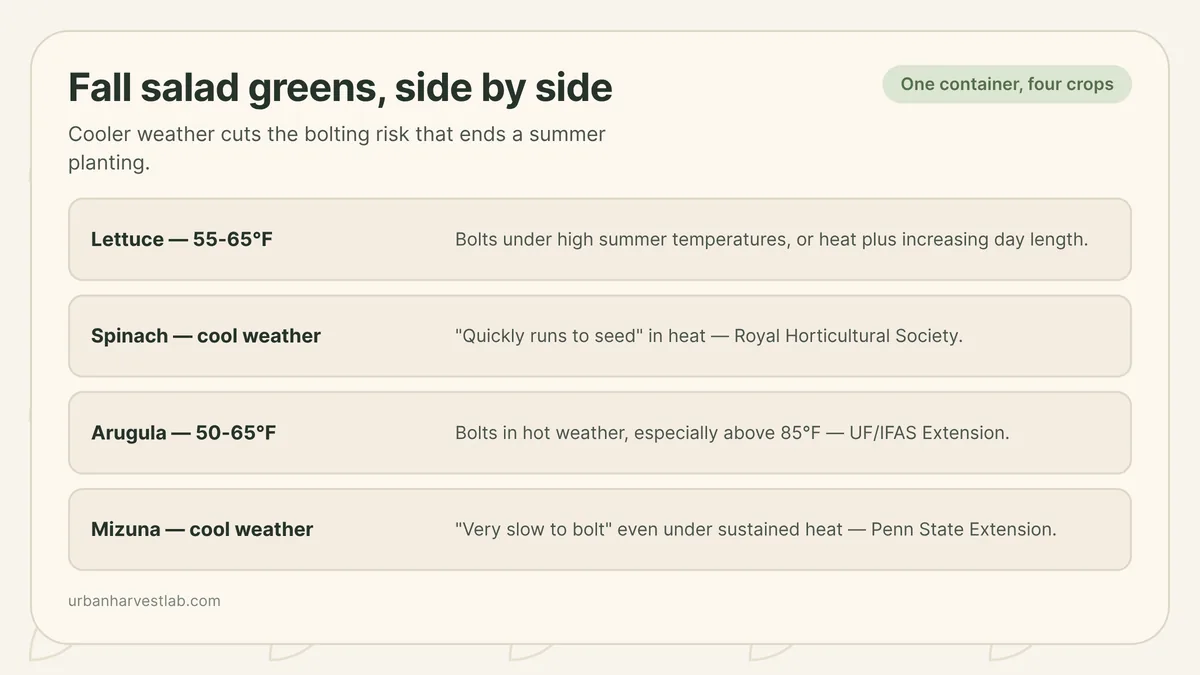
Lettuce, spinach, arugula, and mizuna all share the same summer problem and the same fall fix. Here is how to grow them together once the heat breaks.
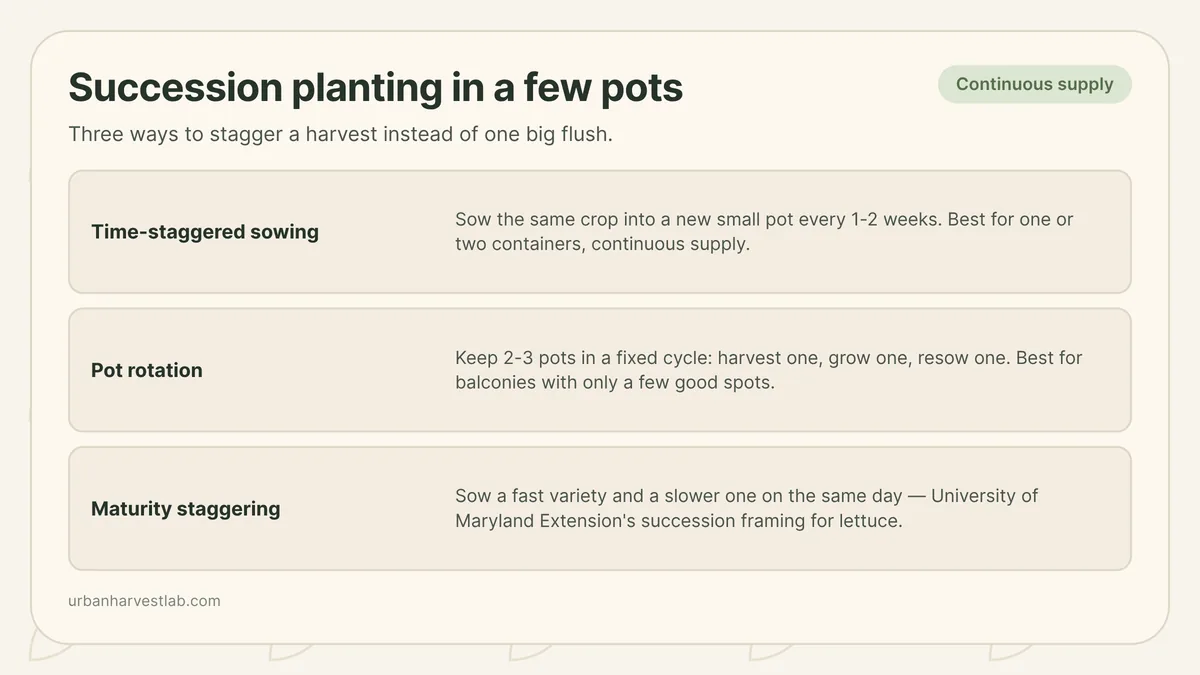
Succession planting in containers: how to stagger a harvest from a few pots
Succession planting in containers is a sowing rhythm: a few pots restarted on a schedule keep producing, where one large planting ripens together and then quits together.