Troubleshoot the system before you change the inputs.
Symptoms
- Dozens of tiny round holes scattered across the leaf, often concentrated on young or newly transplanted plants.
- Small dark beetles that spring away in all directions when you brush the foliage.
- Seedlings that look bleached or scorched, or that stall after emerging, with pitted leaves.
Possible causes
- Adult flea beetles are chewing the leaves. They are active on calm, warm, sunny days and favour eggplant and the cabbage family.
- A disease is producing shot holes without any beetle present, which Wisconsin Extension says can happen.
- Other chewers, such as caterpillars or slugs, are making larger or slimier damage that gets lumped in with flea beetles.
Quick fixes
- Brush the leaf and watch for tiny jumping beetles before you treat anything.
- Cover seedlings and new transplants with floating row cover over hoops, with the edges sealed.
- Keep the plant watered and fed so it outgrows the damage; older plants usually cope.
Small holes in leaves: flea beetles or something else
| Clue | Flea beetles | Caterpillars | Slugs and snails |
|---|---|---|---|
| Hole size | Many tiny, pinprick-sized holes | Larger, ragged holes, sometimes whole leaf edges gone | Irregular holes with smooth edges |
| Confirming sign | Tiny dark beetles that jump when the leaf is touched | The caterpillar itself, or droppings | A shiny slime trail on the leaf or soil |
| Where it hits hardest | Seedlings and new transplants | Any age of plant | Tender seedlings and low leaves |
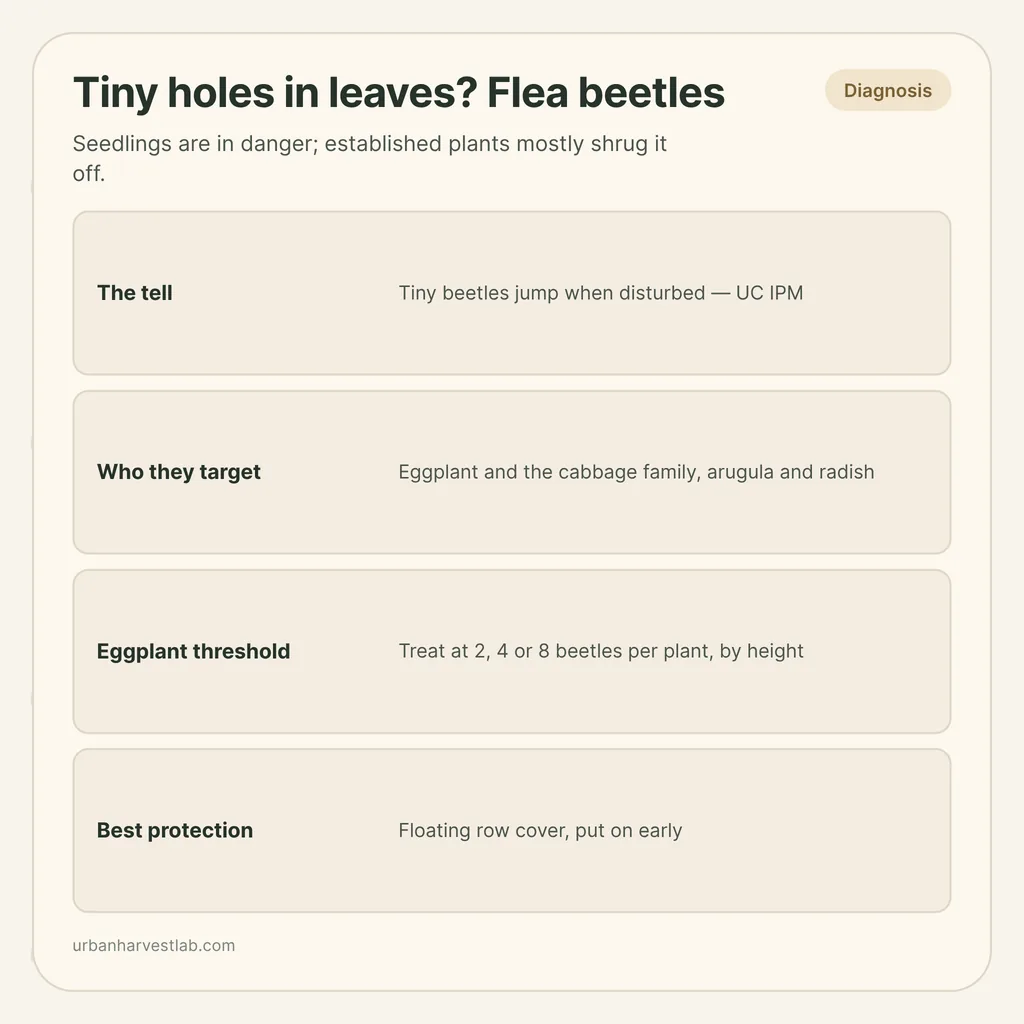
Tiny, pinprick holes scattered across a leaf, plus small dark beetles that jump when you touch the plant, mean flea beetles. They go for eggplant and the cabbage family (arugula, radish, kale, mustard greens) and do their worst on seedlings and fresh transplants. Established plants mostly shrug it off.
That distinction decides what you do. A seedling covered in holes is in danger. A big eggplant with a few dozen holes in its lower leaves is not, and spraying it is mostly wasted effort. If your holes are larger or ragged, or you are dealing with basil rather than a vegetable, start with what is chewing holes in your herb leaves instead.
How to recognise flea beetles
UC IPM describes flea beetles as small, shiny beetles with enlarged hind legs for jumping, and says all of them are “less than 1/10 inch long” and jump like fleas when disturbed. That jump is the tell. Brush the leaf with your hand, or tap the pot, and watch for tiny dark specks springing off in all directions.
The damage matches. University of Maryland Extension says adult feeding “riddles leaves with small feeding holes” that create a shot-hole effect, and Wisconsin Extension adds that the holes may or may not go all the way through the leaf. Heavy feeding can leave leaves looking bleached and pitted, according to UC IPM.
Colours vary by species. Maryland lists adults as shiny black or brown, some with white or yellow stripes. Wisconsin’s species table lists different flea beetles on different hosts, so the one on your eggplant is not necessarily the one on your arugula. You do not need the species to manage them.
One caution from Wisconsin: certain plant diseases can occasionally cause similar shot holes, so confirm the beetles before you act. If you see no jumping beetles, keep looking before you blame them. If caterpillars are the likelier culprit on kale, green caterpillars on kale shows you how to tell them apart, and slugs and snails in containers covers the slime-trail type of damage.
Which plants they go for
Maryland calls eggplant and the cabbage family “very susceptible” and says flea beetles feed on tomato, pepper, beet, spinach, turnip and radish too. Wisconsin lists mustards, radish and kale among the crucifer hosts, with eggplant, spinach and beans among the others. For a container grower that means the usual suspects: eggplant in pots, arugula, radishes and kale.
How much damage is too much
It depends on the age of the plant.
For seedlings, the answer is very little. Wisconsin Extension says recently emerged plants are the most vulnerable to feeding damage “and can even be killed by a heavy flea beetle infestation,” and that older plants are often able to withstand it. UC IPM agrees that damage is not usually serious beyond the early seedling stage. Maryland adds that flea beetles can ravage young eggplant and that newly transplanted plants need protection.
For eggplant that is already growing, Wisconsin publishes a treatment threshold by height:
| Eggplant height | Treat at (beetles per plant) |
|---|---|
| Under 3 inches | 2 |
| 3 to 6 inches | 4 |
| Over 6 inches | 8 |
For cole crops such as arugula, radish and kale, the same Wisconsin table lists the threshold as undetermined. For those crops, use the seedling rule: protect them while they are small, and treat a leaf with holes on a plant that is clearly growing as a cosmetic problem. Counting beetles on a calm, sunny day is easiest, since Wisconsin says adults are most active then.
Stop them before they start: cover and timing
The most reliable protection is a physical one, put on early.
Floating row cover. UC IPM says seedlings can be protected with coverings until they reach the sixth leaf stage, after which they are less likely to suffer damage. Wisconsin says to set the cover up just before the crop emerges or right after transplanting, so the beetles cannot get in first. Wisconsin’s arugula page also warns that because adults overwinter in soil, they can come up under a cover, so start with fresh potting mix rather than last season’s. Maryland says to secure the material to the ground, which on a balcony means clipping or weighting it right at the pot rim, with no gap. For eggplant, Maryland says to drape it over hoops rather than letting it rest on the plants, and to keep it on until the plants start to flower. A cover that is lifted for watering lets beetles in, so open it as little as you can.
Timing. Wisconsin says flea beetles overwinter as adults in the soil or under debris and become active in early spring once temperatures reach 50 degrees F, so the first sowings of cool-season greens meet them. It suggests planting after adult emergence as one way to lessen damage. Maryland says populations run high after mild winters and recommends setting eggplant out two weeks after all danger of frost.
Clean up. UC IPM and Maryland both recommend clearing plant debris, since adults overwinter in it. In pots, that means emptying old foliage and dead plant material from the balcony at the end of the season.
Keep plants growing. Maryland says healthy, fast-growing plants are more likely to outgrow light flea beetle feeding. Maryland’s eggplant advice is regular watering, fertile soil high in organic matter and feeding every 3 to 4 weeks if needed.
Water. Wisconsin says watering at mid-day may reduce feeding.
If you decide to spray
UC IPM says insecticides should not normally be necessary and are not very effective when beetle numbers are high. Wisconsin says home-garden options such as insecticidal soap and horticultural oils work only on insects they hit directly, so spraying must be thorough. Maryland describes kaolin clay sprays as a barrier that greatly reduces feeding and must be re-applied after rain.
Whatever you use on a crop you will eat, read the label for the crop and the waiting time before harvest. Choosing a pest treatment for plants you are going to eat walks through how to check.
Sources
Grow the crops flea beetles go for
Flea beetles favour eggplant and the cabbage family. These guides cover growing each crop in a pot.
Common questions
What causes tiny holes in eggplant leaves?
Most often flea beetles: tiny dark beetles, about 1/10 inch long, that chew small round holes and jump away when you disturb the leaf. University of Maryland Extension says they can ravage eggplant, and Wisconsin Extension warns that some plant diseases cause similar shot holes, so look for the beetles themselves before you decide.
How many flea beetles on an eggplant is too many?
Wisconsin Extension gives a treatment threshold for eggplant of 2 beetles per plant when the plant is under 3 inches tall, 4 beetles per plant at 3 to 6 inches and 8 beetles per plant above 6 inches. The same table lists the threshold for cabbage-family crops, which includes arugula and radish, as undetermined.
Will flea beetles kill my arugula or radish seedlings?
They can. Wisconsin Extension says recently emerged plants are the most vulnerable and can even be killed by a heavy infestation, while older plants often withstand the damage. UC IPM says seedlings can be protected with coverings until the sixth leaf stage, after which they are less likely to suffer damage.
Are leaves with flea beetle holes safe to eat?
Wisconsin Extension's arugula page says leaves with flea beetle shot-holes may not be as appetizing as undamaged leaves, but can still be consumed. That statement is about arugula; what matters on any crop is what you have sprayed, so follow the label for edible crops and its waiting time before harvest.
Related guides

Green caterpillars on kale: which cabbage worm it is and how to stop it
Three look-alike green caterpillars feed on kale, and a white butterfly fluttering round the pot is the early warning. Here is how to tell them apart and what actually protects a container crop you plan to eat.
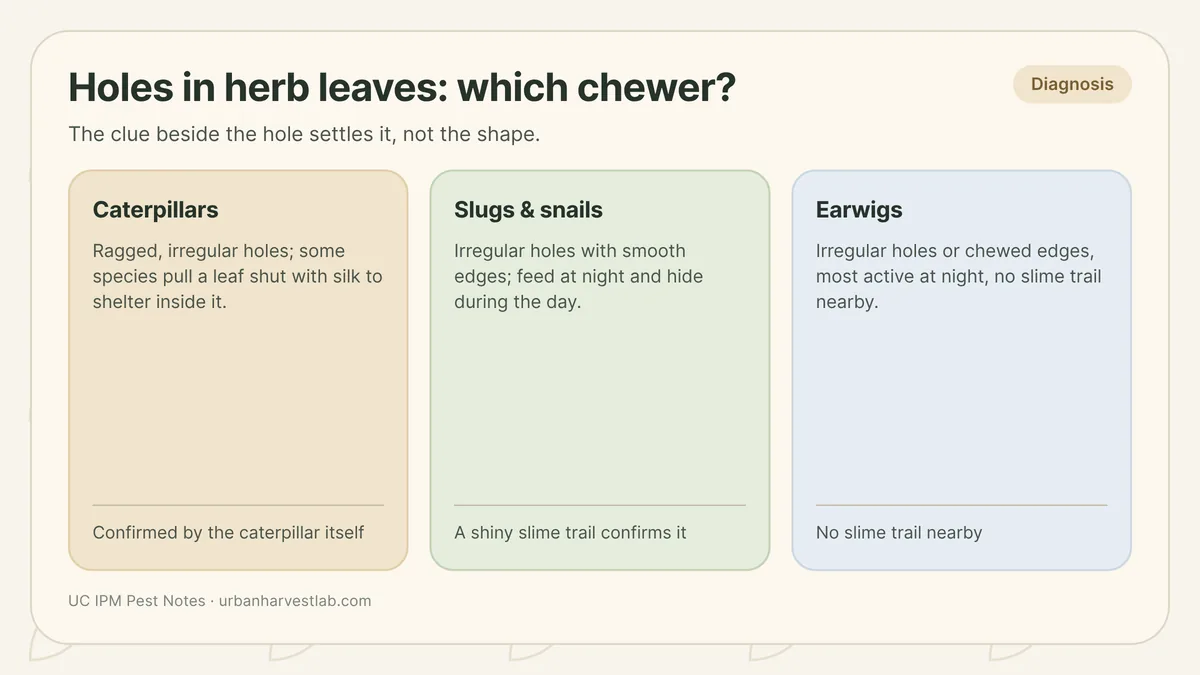
Holes in basil leaves: what's actually chewing them
Three insects punch actual holes through a herb leaf: caterpillars, slugs and snails, and earwigs. Each leaves its own clue, and the clue matters more than the shape of the hole.
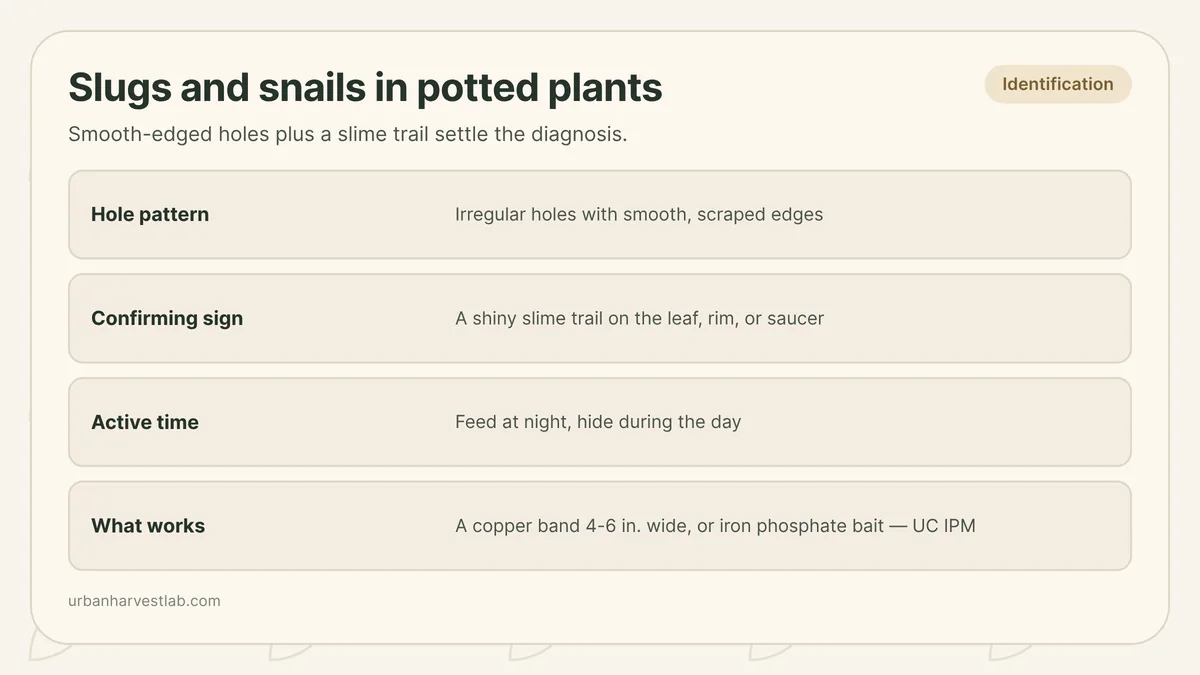
Slugs and snails in potted plants: barriers that actually work
Smooth-edged holes and a shiny trail on a potted herb point to slugs or snails. A copper barrier, iron phosphate bait, and checking after dark are the responses with evidence behind them.