
Leaves but no roots: cause, sign and fix
| Cause | What you see | Fix |
|---|---|---|
| Crowding | A dense mat of seedlings; a few roots at the edge of the pot swell while the rest stay thin | Thin early, snipping extras at soil level, to the spacing below |
| Heat | Fast, floppy leaf growth in warm weather; roots that turn hot and woody | Sow in spring and fall, move the pot to cooler light in summer, or try French Breakfast |
| Shade | Tall, lush leaves with little swelling at the base | Give the pot at least 6 hours of direct sun; 8-10 hours is better |
| Too much nitrogen | Dark, large tops from a rich mix or a leaf-feeding fertilizer | Skip nitrogen-heavy feeding; radishes have a low nutrient requirement |
Radishes grow well in a pot at least 6 inches deep, sown directly in loose mix, thinned early, and kept evenly moist in cool weather. Oregon State Extension puts the depth at 6 inches and the wait at 3 to 6 weeks from sowing. When a potted radish makes big leaves and no root, look first at crowding, heat, shade and too much nitrogen. All four are fixable on a balcony.
Radishes are a good first pot crop because they finish quickly. They also reward a sowing rhythm: one pot of seed all at once gives you a week of radishes and then nothing. The succession planting guide covers the staggering logic for fast crops in general, and the radish-specific intervals are below.
What kind of pot works
Radishes root shallowly, so depth is the easy part. Oregon State Extension says to choose containers at least 6 inches deep with drainage holes. University of Kentucky Extension lists radish among the crops that do fine in 6-8 inches. Compare that with a carrot, which Texas A&M AgriLife Extension says needs a pot 2 inches deeper than the variety’s mature root: the carrot container depth guide has that rule, and radishes do not need it.
What matters more is the footprint, because crowding is the usual reason radishes fail. Texas A&M AgriLife Extension gives 1 gallon of container for 3 radish plants. University of Illinois Extension recommends a pot at least 10 inches across, a size it also gives to onions, beets and leafy greens. A window box or a wide, shallow planter suits radishes well, and University of Illinois Extension names a window box or patio container as a place to start spring radishes early. If you are planning a whole balcony, the how many plants per container page lays out the numbers for other crops.
Sowing and thinning
Sow seeds 1/4 to 1/2 inch deep, according to both University of Maryland Extension and University of Illinois Extension. Maryland spaces seeds 1 to 2 inches apart. Cover them with a thin layer of mix and keep it moist until they sprout.
Thinning is where container radishes are won or lost, and the extension services do not agree on the final gap:
- University of Illinois Extension thins spring varieties to 1/2 to 1 inch between plants.
- Oregon State Extension leaves 1 or 2 inches, once the seedlings have formed a second set of leaves.
- University of Maryland Extension thins to 2 to 4 inches apart, depending on the type.
In a pot, lean toward the wider end for larger globe types and the closer end for small round ones. Snip the extra seedlings at soil level with small scissors, as Oregon State suggests, rather than pulling them, so you do not disturb the roots you are keeping. Illinois adds that the young thinnings are worth saving to eat, tops and bottoms.
Light, water and feeding
University of Maryland Extension says radishes need at least 6 hours of direct light and prefer 8 to 10. Oregon State accepts sun or part shade, and Illinois says shade must be severe to stop roots from swelling. In practice, a half-shaded balcony will still grow radishes, but a deeply shaded one will give you leaves.
Water evenly. Maryland says to keep the mix evenly moist but not wet. Oregon State warns against letting pots dry out completely, and Oregon State’s vegetable guide describes globe radishes as shallow-rooted and quick-growing, needing frequent, uniform irrigation. A swing from dry to soaking is how roots crack: Illinois notes that a flush of moisture after relative dryness can make mature roots burst and split. The container vegetable watering guide explains how to check a pot instead of watering by the calendar.
Feed lightly. Maryland lists radishes as a low-nutrient crop and warns that excess nitrogen causes top growth at the expense of roots. Penn State Extension puts radishes on the same diluted liquid feed every two to four weeks as other fast crops, and a radish that is pulled within a month may need only one feeding; the feeding schedule for container vegetables covers that interval.
Why you get leaves and no roots
Illinois Extension notes that even in a very crowded row, some roots along the outside usually develop well. If your pot has a few good radishes at the rim and a lot of leaf in the middle, crowding is your answer.
Heat is the cause that thinning cannot fix. Illinois says spring varieties do best in cool temperatures, and that weather too hot for them leads to tops without roots. Maryland adds that roots become spicy hot and woody in hot weather. Illinois suggests French Breakfast, which it says holds up and grows better than most early types in summer heat when water is supplied regularly. Oregon State recommends moving containers to cooler areas in hot summer months. For a heat spell that arrives anyway, the heatwave guide for container plants covers shade and watering tactics.
When to sow and how often
Radishes are cool-season. Illinois sows spring types from as soon as the soil can be worked until mid-spring and again from late summer for fall. Oregon State advises planting in spring and fall where summers are hot. Your own dates depend on your last and first frost, so use the frost date guide for balconies to place them, then the balcony vegetable garden calendar for the season around them.
For staggering, the intervals differ by source: Maryland says a small number of seeds every five days, Oregon State every 10 days, and Illinois short rows every 10 to 14 days. A reasonable approach for one household is to divide a rectangular planter into sections and sow one section whenever you pull the previous one.
When to pull
Maryland gives 25 to 35 days to maturity and Oregon State gives 3 to 6 weeks, so check the packet for your variety and start looking early. Both advise harvesting at a usable size: Maryland says about one inch across, before roots crack, turn pithy or become too hot.
Do not leave them. Illinois says radishes stay in edible condition for only a short time before they become pithy and hot, and that oversize summer radishes can be tough, woody and hollow. To check a big one, squeeze it gently: if it yields, it is probably fibrous. Illinois also says hotness comes from how long the radish has grown, not its size, so a slow, stressed radish can be hot even when small. The leaves are edible too, according to Maryland and Illinois.
Pests
Oregon State lists flea beetles and aphids as the key problems and suggests row covers for flea beetles and a hard spray of water for aphids. Illinois mentions root maggots, which it says are more common above 40 degrees north latitude.
Sources
- University of Maryland Extension, Growing Radishes in a Home Garden
- University of Illinois Extension, Radish (Home Vegetable Gardening)
- Oregon State University Extension, Radishes
- Oregon State University Horticulture, Radish (Oregon Vegetables)
- Texas A&M AgriLife Extension, Vegetable Gardening in Containers (E-545)
- University of Illinois Extension, How to Grow Fruits, Vegetables, Herbs in Container Gardens
- University of Kentucky Cooperative Extension, Vegetables Grown in Containers Improves Accessibility
Keep radishes coming
Stagger sowings, match the pot to the crop, and manage water and feeding in a small container.
Common questions
How deep does a pot need to be for radishes?
Not very. Oregon State Extension recommends containers at least 6 inches deep, and University of Kentucky Extension lists radish among the crops that do well in 6-8 inches. Texas A&M AgriLife Extension gives 1 gallon for 3 plants, and University of Illinois Extension asks for at least 10 inches across.
How long do radishes take to grow in a pot?
University of Maryland Extension gives 25 to 35 days to maturity, and Oregon State Extension says radishes are ready 3 to 6 weeks after sowing. Check the packet for your variety, and start pulling when roots reach about 1 inch across.
Why do my potted radishes only make leaves?
University of Illinois Extension lists seed sown too thickly and not thinned, weather too hot for spring varieties, and heavy shade. University of Maryland Extension adds that excess nitrogen gives top growth at the expense of roots. Thin the seedlings, move the pot to cooler light, and skip high-nitrogen feeding.
How often should I sow more radishes?
University of Maryland Extension suggests a small number of seeds every five days, Oregon State Extension every 10 days, and University of Illinois Extension short rows every 10 to 14 days. Pick the interval that matches how many radishes you eat in a week.
Related guides
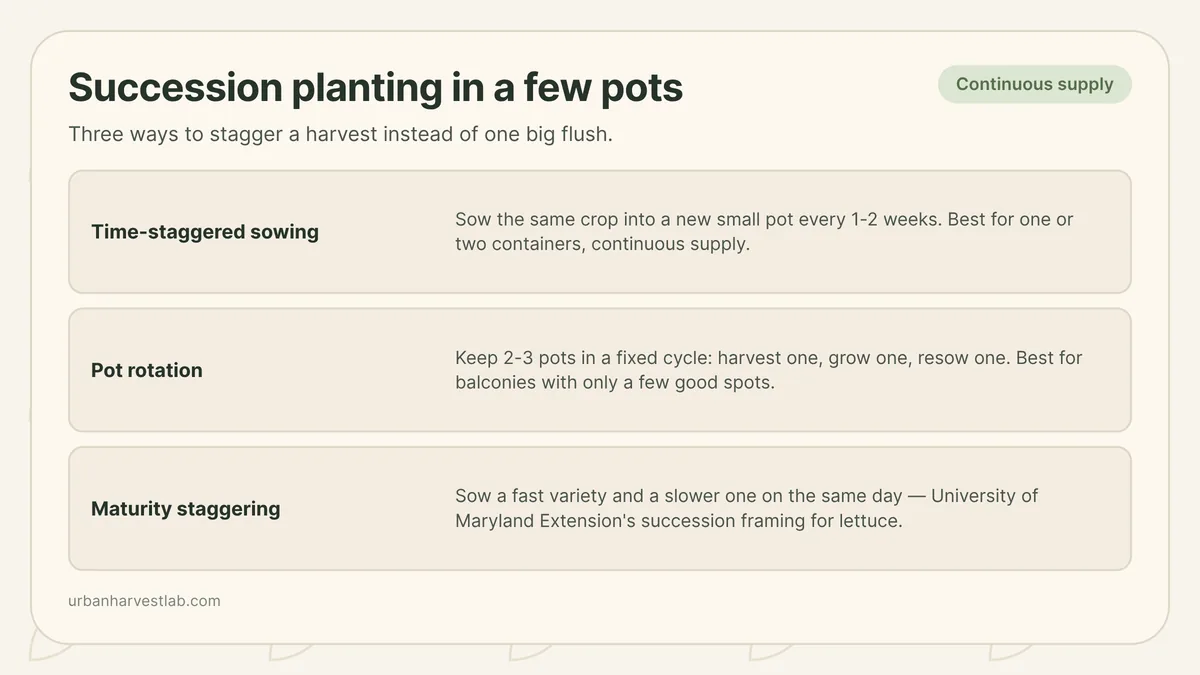
Succession planting in containers: how to stagger a harvest from a few pots
Succession planting in containers is a sowing rhythm: a few pots restarted on a schedule keep producing, where one large planting ripens together and then quits together.
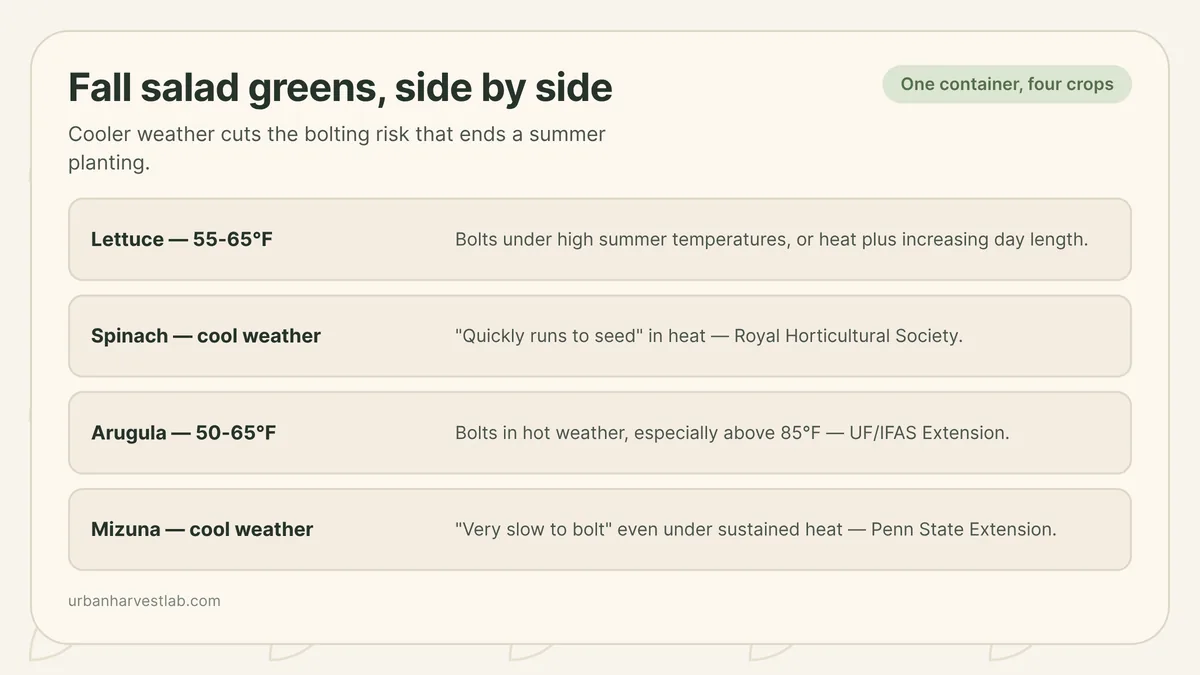
Growing salad greens in containers this fall
Lettuce, spinach, arugula, and mizuna all share the same summer problem and the same fall fix. Here is how to grow them together once the heat breaks.
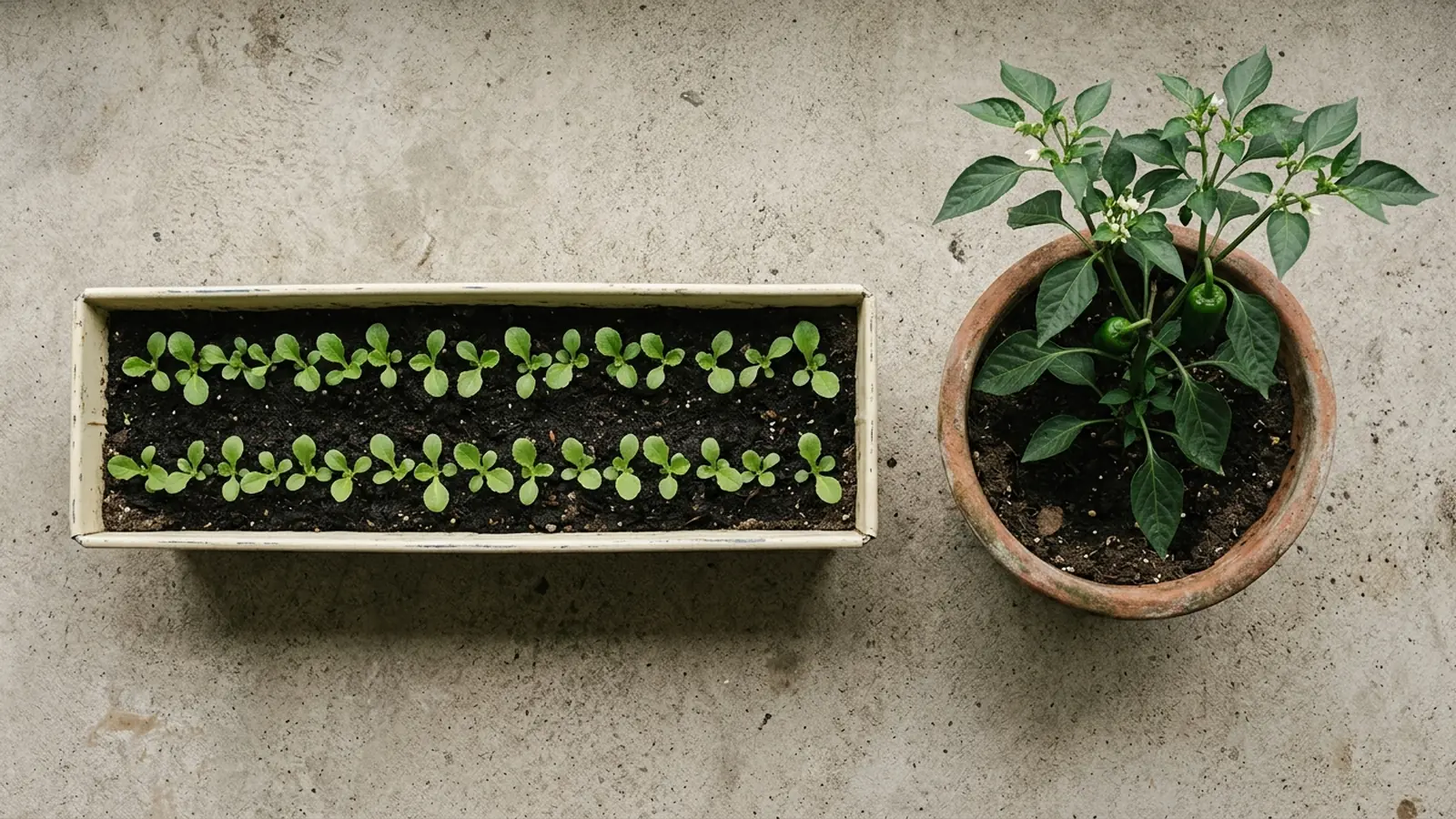
How many plants fit in one container?
Most container guides answer the opposite question -- one plant, what pot? The one people actually ask standing over an empty window box is how many go in, and it has two answers that have to agree.