Troubleshoot the system before you change the inputs.
Symptoms
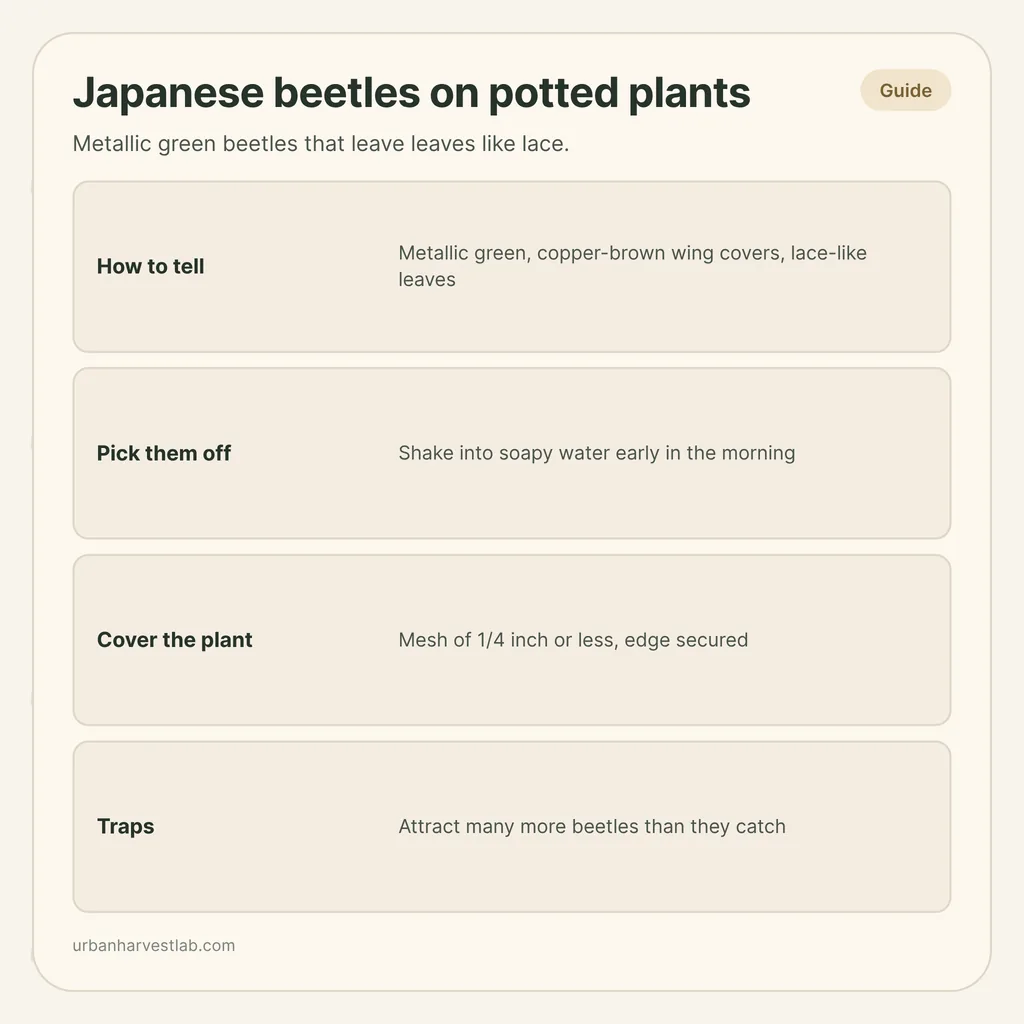
- Leaves reduced to a lace-like skeleton, with the veins left and the tissue between them eaten, mostly on the upper surface.
- Metallic green beetles with copper wing covers clustered on the sunniest, topmost leaves and on flowers or fruit.
- Damage that starts in late June or early July and worsens over several weeks of warm, sunny days.
Possible causes
- Adult Japanese beetles, which feed in groups and are drawn to plants already being eaten by other beetles.
- Caterpillars or slugs, if you see ragged or smooth-edged holes and no beetles. Those leave holes through the leaf rather than a skeleton.
Quick fixes
- Shake or pick beetles into soapy water early in the morning, every day while they are active.
- Cover the plants with mesh of 1/4 inch or finer, sealed to the pot or the ground, if you can spare the sunlight and access.
- Keep traps off the balcony. If you try one anyway, put it well away from the plants you want to protect.
Metallic green beetles with copper-brown wing covers, eating the soft tissue between the veins so the leaf turns to lace, are Japanese beetles. On a balcony the fix is manual: shake or pick them into soapy water early in the morning, every morning, and cover the plants you care about with fine mesh. Skip the traps.
If your leaves have actual holes rather than a skeleton, you are probably looking at something else, and what is chewing holes in your herb leaves sorts out caterpillars, slugs and earwigs. Japanese beetles feed openly in groups on the sunniest leaves, which University of Kentucky says they prefer.
How to tell it is a Japanese beetle
University of Kentucky describes the adult as a 7/16-inch metallic green beetle with copper-brown wing covers and a row of white tufts of hair along each side of the body. University of Minnesota Extension adds the green head and thorax. Virginia Cooperative Extension points out the similarly coloured green June beetle is much larger, about 0.75 inch against roughly 0.4 inch for the Japanese beetle.
The feeding pattern is the other clue. Wisconsin Extension says adults feed on the upper surface of the leaf and eat the soft tissue between the veins, leaving a lace-like skeleton, often in the upper canopy first. University of Kentucky says they feed in groups, starting at the top of a plant and working downward, and that they are most active on warm, sunny days and prefer plants in direct sunlight. Your sunniest pot gets hit first.
University of Minnesota Extension lists adults from late June to early September. Wisconsin puts the first emergence in late June or early July, with beetles found into September, and says there is one generation a year. Individual beetles live about 30 to 45 days, according to Kentucky, so a problem that starts in early July usually fades by late summer.
What they eat on a balcony
The host list runs past 300 species, according to University of Minnesota Extension. For container growers, three matter:
- Basil. Wisconsin Extension names basil among the preferred hosts. See basil varieties for containers if you are choosing what to grow.
- Raspberries. Minnesota fruit growers reported heavy infestations on raspberry, and researchers say adults damage yield and quality by feeding on leaves and by damaging developing berries. Raspberries in containers covers the growing side.
- Beans. Virginia Cooperative Extension lists green beans among the vegetables the adults can pest. Beans in containers has the variety and support advice.
Variety matters too. In the Minnesota trial, the summer raspberry Prelude averaged 22 beetles per meter of row and 5.39 percent defoliation per leaf, while Nova averaged one beetle and 0.82 percent. That is one farm in one year, but if you are buying a new plant where Japanese beetles are established, it is a reason to ask which variety they leave alone.
Pick them off in the morning
University of Kentucky says removing beetles by hand may give adequate protection for small plantings, especially when numbers are low. Shake them off early in the morning when they are sluggish, into a bucket of soapy water. Wisconsin gives the same instruction for smaller plants.
The reason to do it daily is chemical. Kentucky says the presence of beetles on a plant attracts more beetles, and that odours from beetle-damaged leaves seem to be an important factor in the aggregation of beetles on particular food plants. So the first few matter most. Take them off before the plant starts advertising.
Hold a wide container of soapy water under the leaf, tap or shake the stem, and let them drop. Kentucky notes a single beetle does not eat much; it is the group feeding that does the damage.
Cover the plant
For herbs, vegetables and small shrubs, Wisconsin recommends nylon insect screening from late June to early September, mesh size of 1/4 inch or less, with the edge secured to the ground. In a pot, that means sealing the mesh around the rim or the base of a frame. Kentucky suggests cheesecloth or other fine netting for valued plants during peak beetle activity. If you have none, browse fine garden insect netting on Amazon and check the listed mesh size against Wisconsin’s 1/4 inch.
Basil grown for leaves can stay covered for the whole of that window. Support the mesh on a frame or hoops rather than draping it over the leaves.
Why not use a trap
A scented trap looks like the obvious answer. University of Kentucky says commercial traps combine a lure that mimics the scent of virgin females with a sweet food lure, and can draw thousands of beetles in a day. Its research found the traps attract many more beetles than they catch, so plants near them are likely to suffer more damage than with no trap at all, and it concludes that in most landscape situations traps probably do more harm than good. Wisconsin Extension does not recommend pheromone lure traps, for the same reason.
Virginia Cooperative Extension is a little more open: it says lure traps are more effective at reducing populations as a broad community effort, and that any trap should sit at least 30 feet from plants you want to protect, though it also warns that traps can draw additional beetles into the yard from surrounding areas. A balcony rarely offers that distance.
Sprays, and what to check first
Soap and oils are weak against this insect. Wisconsin says insecticidal soaps and horticultural oils such as neem oil have very limited effectiveness against Japanese beetles, and Kentucky lists insecticidal soap, garlic, hot pepper and orange-peel extracts and companion planting as generally ineffective. Insecticidal soap on vegetables covers what soap does suit.
If you are tempted by anything stronger on a plant you will eat, read choosing a pest treatment for plants you are going to eat first. Kentucky’s rule applies to all of them: be sure the product is registered for the plant you are spraying, and for a food crop observe the minimum days between the last application and harvest.
Treating the lawn does not help either. Both Kentucky and Wisconsin say controlling grubs in turf does not protect plants from adults, which fly in from elsewhere.
When the damage matters: basil versus berries
On basil, any skeletonized leaf is lost harvest, so protect early. On fruiting plants the picture is milder. University of Minnesota Extension calls the damage cosmetic but potentially injurious when beetles are abundant, and its researchers note that a leaf that looks half eaten can measure only 10 percent defoliated, a level that does not necessarily translate to yield loss. They also say further studies are still needed to work out what defoliation level causes yield or quality loss, so its article gives no threshold to count against. The exception is the fruit: beetles that reach developing berries damage them directly. Check raspberries every day through the harvest.
Sources
- University of Kentucky Entomology, ENTFACT-451: Japanese beetles in the urban landscape
- University of Wisconsin-Madison Extension: Japanese beetle
- University of Minnesota Extension: Managing Japanese beetle in fruit crops
- University of Minnesota Extension: Japanese beetle identification
- Virginia Cooperative Extension: Japanese beetle (ENTO-514)
Grow the plants beetles go for
Basil, raspberries and beans all show up on Japanese beetle host lists. These guides cover growing them in pots.
Common questions
How do I get rid of Japanese beetles on my plants without spraying?
Pick or shake them into a container of soapy water, early in the morning when they are sluggish. University of Kentucky says hand removal may provide adequate protection for small plantings, especially when beetle numbers are low. Wisconsin Extension adds covering smaller plants with mesh of 1/4 inch or less, secured at the edge, from late June to early September.
Do Japanese beetle traps work?
Not for protecting a garden. University of Kentucky research found that traps attract many more beetles than are actually caught, and Wisconsin Extension does not recommend pheromone lure traps. Virginia Cooperative Extension says lure traps are more effective as a broad community effort, and advises placing any trap at least 30 feet from plants you want to protect.
Will Japanese beetles kill my raspberry or basil plant?
University of Minnesota Extension describes the leaf damage as cosmetic, though it can injure plants when beetles are abundant. University of Minnesota researchers note that a leaf that looks half eaten may be only 10 percent defoliated when measured, and that this level does not necessarily translate to yield loss, but beetles also damage developing berries directly. On basil, the leaves are the crop, so even cosmetic damage costs you harvest.
Do insecticidal soap or neem oil kill Japanese beetles?
Wisconsin Extension says insecticidal soaps and horticultural oils such as neem oil have very limited effectiveness against Japanese beetles, and University of Kentucky calls insecticidal soap generally ineffective. For edible plants, any product has to be labelled for the crop and the pest, so check the choosing-a-treatment guide before buying anything.
Related guides
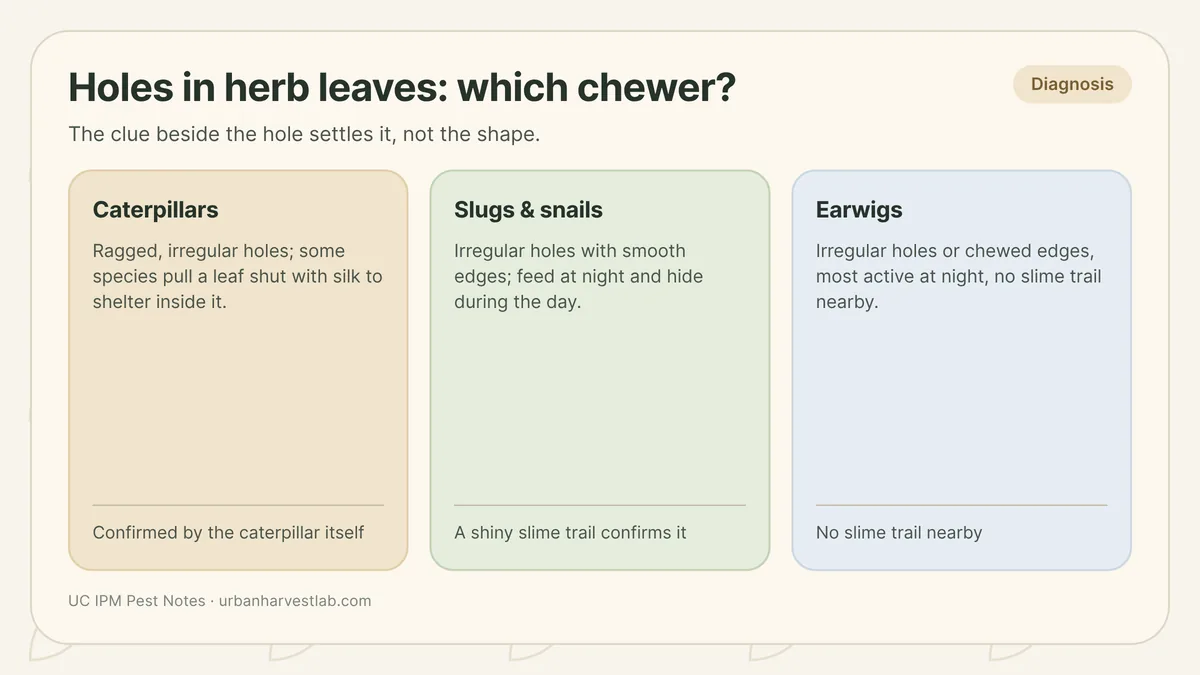
Holes in basil leaves: what's actually chewing them
Three insects punch actual holes through a herb leaf: caterpillars, slugs and snails, and earwigs. Each leaves its own clue, and the clue matters more than the shape of the hole.
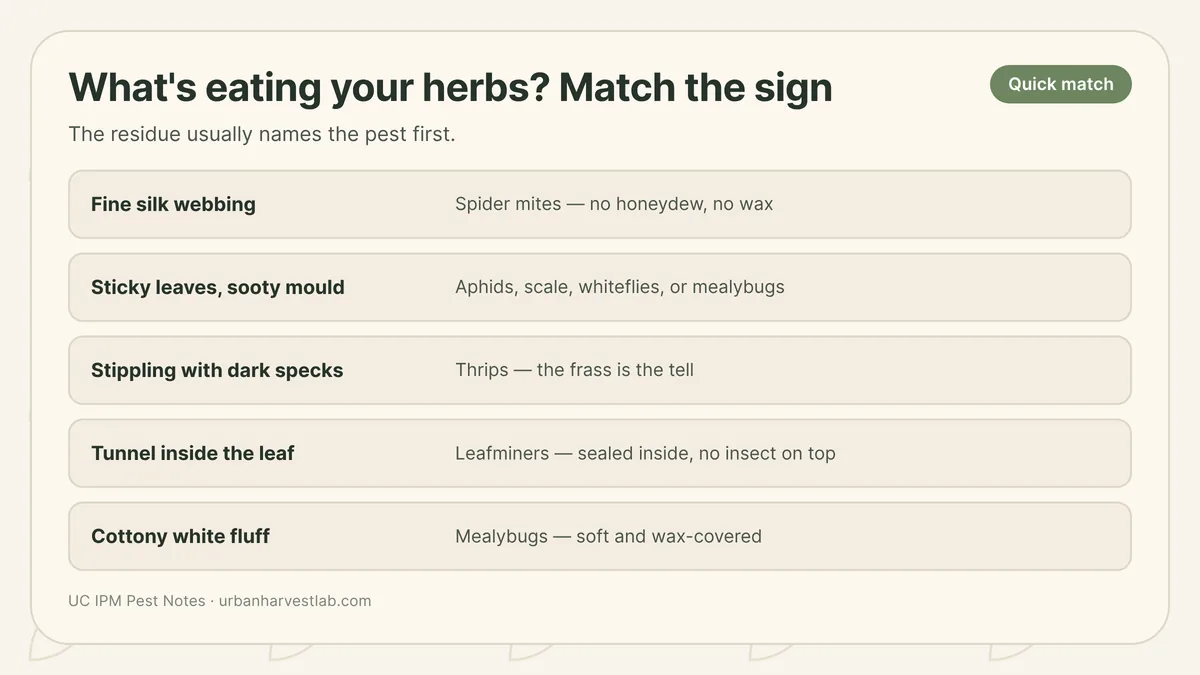
What's eating your herbs? Match the signs to the pest
Every common herb pest leaves its own tell before you ever spot the insect itself. Pick out what you are actually seeing, then go straight to the page that treats it.
Choosing a pest treatment for plants you are going to eat
Once you know which pest you have, the next question is what you can treat it with without compromising the food. The answer is a ladder of methods, and the label on any product you buy sets the legal limits of the top rung.