Troubleshoot the system before you change the inputs.
Symptoms
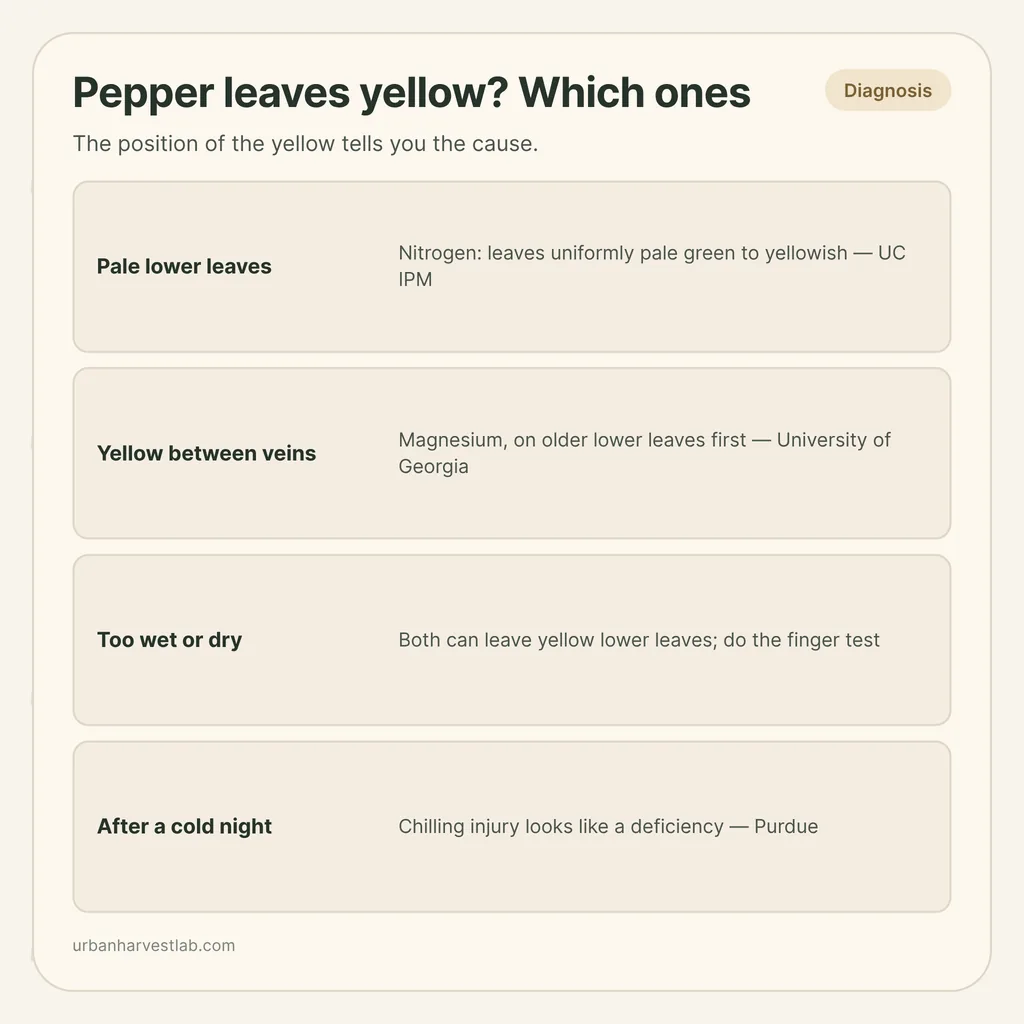
- The lowest leaves fade evenly to pale yellow or light green, veins included, while the top stays green.
- Older leaves are yellow between the veins, which stay green.
- Leaves yellow after a cold night or after planting out, often with a slow, stalled plant.
- Yellow leaves carry small angular spots, or the pot stays wet for days.
Possible causes
- Cold stress, a waterlogged mix or a mix that dries out completely.
- Nitrogen running short in a pot that has been watered and fed for weeks.
- Magnesium short on older leaves, often tied to soil pH.
- Bacterial leaf spot, aphids or spider mites.
Quick fixes
- Push a finger into the mix up to the first joint before changing anything else; Clemson Extension says if it is dry at your fingertip it needs water.
- Compare old and new leaves: even pale yellow low down is nitrogen, green veins point to magnesium.
- Feed at the label rate only if the pot is neither soggy nor dry and the pattern fits.
- Turn over a spotted leaf and look for small angular spots on the underside.
Yellow pepper leaves: what each pattern points to
| Pattern | Likely cause | First move |
|---|---|---|
| Lowest leaves pale yellow all over, new growth smaller and light green | Nitrogen running short | Check the pot is not soggy, then feed at the label rate |
| Older leaves yellow between green veins | Magnesium short, or pH out of range | Test the soil pH and the mix before adding anything |
| Yellowing after a cold night or planting out, plant stalled | Chilling injury | Keep plants warm and hold off feeding |
| Yellow, drooping leaves in a pot that stays wet | Waterlogged roots | Let the mix dry down, check drainage |
| Yellow leaves with small angular spots, worst in wet weather | Bacterial leaf spot | Remove spotted leaves, water the soil not the foliage |
| Yellow leaves with stippling, sticky residue or insects underneath | Spider mites or aphids | Inspect the undersides with a hand lens |
Yellow pepper leaves are usually a pot or temperature problem before they are a nutrient problem. Look at which leaves are yellow, whether the veins stay green, and what the mix feels like when you push a finger in up to the first joint. Lower leaves fading evenly to pale yellow point to hunger. Older leaves yellow between green veins suggest magnesium. Yellow after a cold night, or in a pot that stays soggy, is not fixed by feeding.
Why the position of the yellow matters
Plants move some nutrients out of old leaves into new growth, so the position of the yellow tells you something. UC IPM’s nutrient guide describes nitrogen shortage as leaves “uniformly pale green to yellowish” with sparse, undersized new growth. The University of Georgia puts it plainly: “Nitrogen deficiency results in yellowing and stunted growth in lower limbs.” The same bulletin says magnesium deficiency shows as “interveinal yellowing in the older, lower foliage first.”
Iron goes the other way, with yellowing on new growth. UC IPM puts manganese there too, but Illinois Extension says manganese and zinc deficiencies “develop on the inner or the older leaves first and then progress outward,” so the two services disagree on manganese. If the top of your plant is the problem and the veins are still green, Illinois Extension notes that most soils have enough iron and the problem is its availability to the plant, which usually comes down to pH. UC IPM gives 6.0 to 7.5 as a good range for most gardens, and Clemson Extension’s pepper advice is to keep the pH between 6.0 and 6.5 by following a soil test.
UC IPM adds a caution that applies to every pattern here: deficiency symptoms commonly come from adverse soil conditions and anything that makes roots unhealthy. A plant can sit in a nutrient-rich mix and still go yellow if its roots cannot work.
Water and cold can fake a deficiency
Too wet. Missouri Botanical Garden lists “stunted slow growth with yellowing leaves” among the signs of overwatering. A pepper in a pot with no drainage, or a saucer that stays full, shows exactly that. UC IPM describes the root disease that follows: leaves “wilt and turn dull green, yellow, red, or purplish,” and the plants do not recover when irrigated. Lift the pot. If it feels heavy days after watering, the roots are sitting in water.
Too dry. Clemson’s houseplant guidance says lower leaves yellow when plants are “allowed to become too dry for an extended time.” A dry pot and a wet pot can both leave the same yellow lower leaves, so the finger test matters more than the leaf. The full comparison is in overwatered versus underwatered.
Too cold. Purdue University’s vegetable crops hotline says chilling injury occurs between 32 and 55 degrees Fahrenheit, and that injured plants “often show symptoms similar to nutritional deficiency.” The same page adds that peppers seem to have more difficulty recovering from it than tomatoes. A pepper that yellowed and stalled after being put out on a cool night does not need fertilizer. It needs warmth and time. The emergency cold-snap guide covers shelter for pots.
Nitrogen: pale lower leaves in an old mix
If the pot drains and the plant has not been cold, even pale yellow on the lowest leaves, with new growth small and light green, fits nitrogen. Peppers in containers have a limited supply of mix to draw on, and watering over weeks carries nutrients with it.
Feed at the rate on the product label. Do not push harder. Clemson notes that a plant with “a great deal of foliage but few blooms and fruit” indicates over-fertilization of nitrogen, so a heavy hand trades yellow leaves for a leafy plant that will not fruit; why peppers fail to produce explains that trap. How to read the three numbers on a bag is in the NPK label guide.
Yellow between the veins: magnesium, pH and Epsom salt
Older leaves yellow with the veins still green fit magnesium. The University of Georgia suggests checking soil pH and, before planting, adding dolomitic lime when magnesium needs to rise. That is a pre-planting step for a bed, so in an established pot the useful move is checking pH and the mix.
Reaching for Epsom salt is common. It supplies magnesium and nothing else, so it does nothing for the nitrogen pattern above, and it is not the fix for blossom end rot either. What the evidence says about Epsom salt covers both. Use it only when the interveinal pattern fits.
Yellow with spots: bacterial leaf spot
Spots change the diagnosis. UC IPM says bacterial spot first appears as “small, angular spots on the undersurface of the leaf” and is favoured by high relative humidity and free moisture on the plant. University of Maryland Extension adds that the lesions develop gray to tan centers with darker borders, “Leaves may then turn yellow, then brown, and drop,” and that it is spread by splashing rain and by working with wet, infected plants.
Turn leaves over and look. If you find the spots, no feeding will help. University of Maryland Extension’s advice for home gardens includes selecting resistant varieties, avoiding overhead watering and, to slow spread, spraying fixed copper every 10 to 14 days. Check the product label for pepper before using it.
Insects on the undersides
Large aphid populations can turn leaves yellow and stunt shoots, per UC IPM, and spider mites cause stippling that can turn leaves bronze. Both sit on the underside. Shake a leaf over white paper and use a hand lens. Aphids and spider mites have their own identification pages. If the new growth is also twisting or curling, go to pepper leaves curling.
A five-minute check on a yellowing pepper
- Push a finger into the mix up to the first joint and lift the pot. Clemson Extension says if it is dry at your fingertip it needs water. Fix wet or dry first.
- Check the night temperature. If it has been near or below 55 degrees Fahrenheit, move the pot somewhere warmer.
- Compare old leaves with new ones. Even pale yellow low down: feed at the label rate. Green veins: test the pH.
- Turn leaves over for spots, mites and aphids.
- Wait for new growth. Yellow leaves will not turn green again, so judge the plant by what grows next.
Tomatoes yellow for overlapping reasons, but with their own patterns; see tomato leaves turning yellow. If the pot itself seems too small, pepper pot size compares extension figures.
Sources
- University of Georgia Extension, “Nutritional Deficiencies in Vegetables” (B1569)
- Purdue University, Vegetable Crops Hotline, “Chilling Injury on Young Warm-season Vegetable Plants”
- University of Maryland Extension, “Bacterial Leaf Spot on Peppers”
- UC IPM, “Bacterial Spot” in peppers
- Clemson Cooperative Extension, “Pepper”
- UC IPM, “Common Nutrient Deficiency Symptoms”
- UC IPM, “pH Problems”
- UC IPM, “Phytophthora Root and Crown Rot in the Garden”
- Illinois Extension, “Chlorosis”
- Clemson HGIC, “Indoor Plants – Watering”
- Clemson HGIC, “Houseplant Diseases & Disorders”
- Missouri Botanical Garden, “Overwatering”
Related pepper and yellow-leaf guides
Curling, poor fruiting, pot size and the wider yellow-leaf finder.
Common questions
Why are my pepper plant leaves turning yellow?
The usual container causes are a pot that is too wet or too dry, a cold spell, and nutrient shortage. University of Georgia Extension links nitrogen deficiency to yellowing in lower foliage and magnesium deficiency to yellowing between the veins of older, lower leaves. Where the yellow starts and whether the veins stay green separates them.
Should I cut off yellow pepper leaves?
Leaves that are fully yellow will not turn green again, so removing them is cosmetic. Pull off leaves that are mostly dead or spotted, since spotted leaves can carry disease, and leave partly green ones until the plant has recovered.
Do I need Epsom salt for yellow pepper leaves?
Only if the yellowing is between green veins on older leaves and a test or the pH points to magnesium. Magnesium is one of several causes, and Epsom salt supplies no nitrogen, so it does nothing for the more common uniform pale yellow.
Why do pepper leaves turn yellow after I plant them outside?
Cold is a likely cause. Purdue University says chilling injury occurs between 32 and 55 degrees Fahrenheit, that injured plants often look nutrient-deficient, and that peppers seem to have more difficulty recovering from it than tomatoes do.
Related guides

Tomato leaves turning yellow in pots: read the pattern first
Which leaves yellow, and in what pattern, tells you whether a potted tomato is hungry, waterlogged, short of magnesium or diseased.
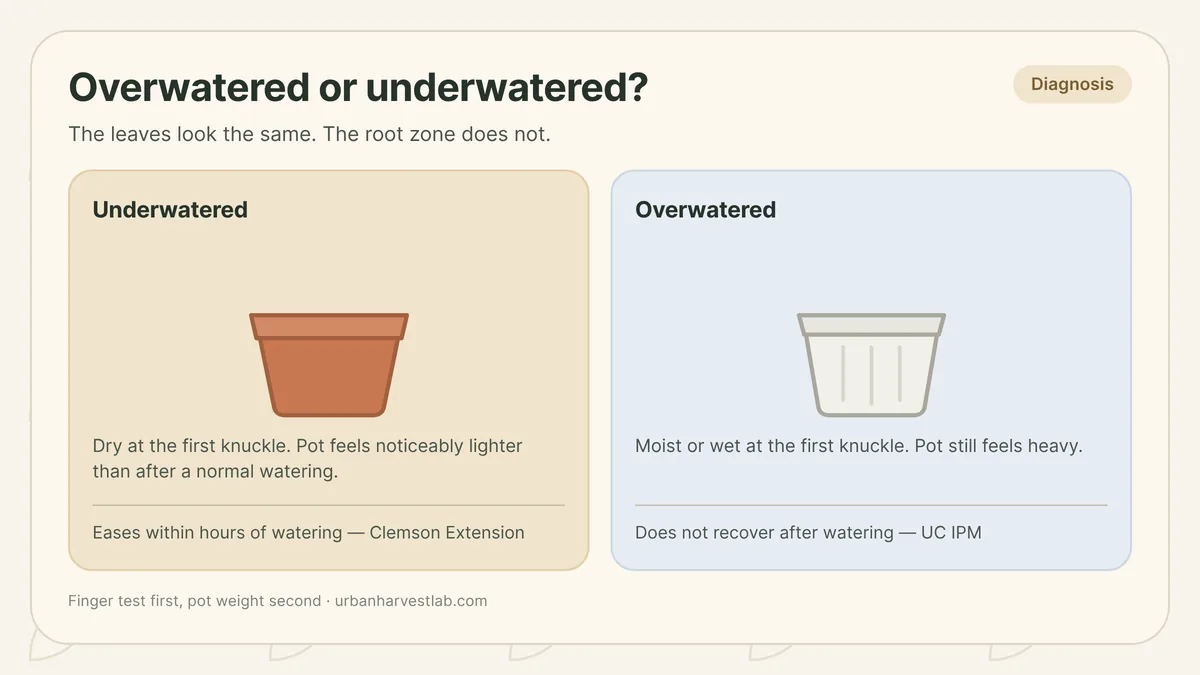
Overwatered vs underwatered: how to tell which one you have
Reading the root zone directly, with a finger test, pot weight, and how the plant responds to being watered, settles what the leaves alone cannot.
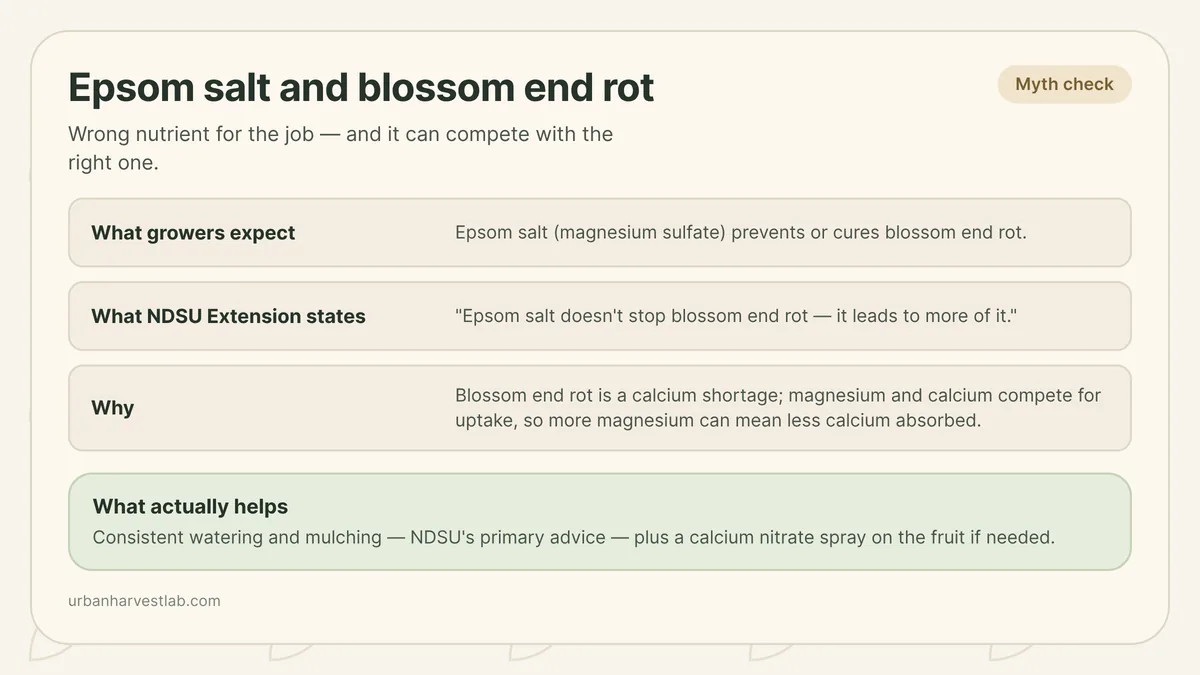
Epsom salt for plants: what the evidence actually shows
Epsom salt is one of the most repeated garden fixes there is, and North Dakota State University Extension says the opposite of what the jar's reputation claims.