Troubleshoot the system before you change the inputs.
Symptoms
- Firm, bead-like swellings on the roots that do not rub off, sometimes giving the root a gnarled look.
- Wilting in the hottest part of the day even though the mix is moist.
- Slow growth, yellowing leaves, and fewer, smaller fruit than neighbouring plants.
Possible causes
- Root-knot nematodes (Meloidogyne species) brought in with garden soil, an infested transplant or an unwashed tool.
- Normal nitrogen-fixing nodules on beans, peas and other legumes, which look similar but come off the root.
- Other gall-forming problems, which UC IPM notes are many.
Quick fixes
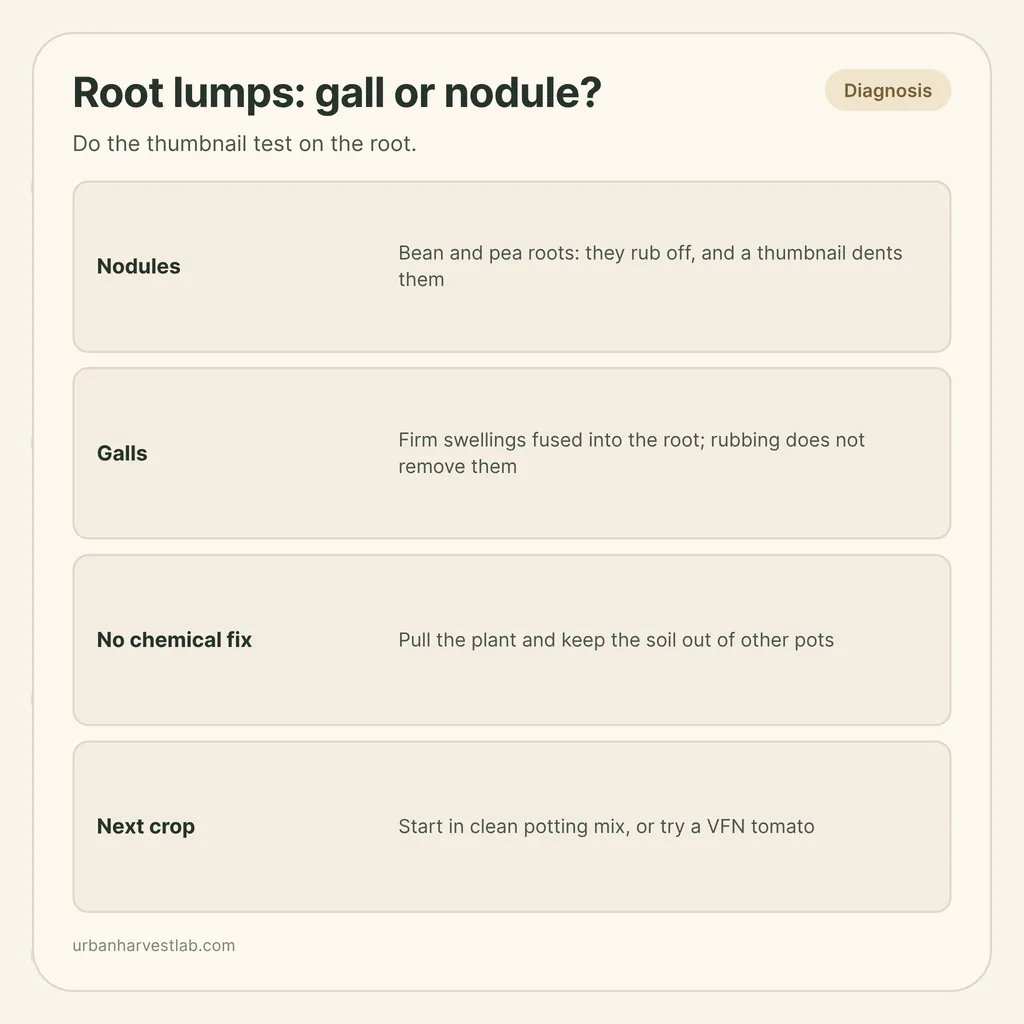
- Rub a lump with your thumb and press a thumbnail into it. A lump that rubs off or dents is a nodule.
- If galls are firm and fixed, pull the plant and do not move its soil into other pots.
- Refill with clean potting mix, not garden soil, and wash tools and the pot.
- Choose resistant varieties next time, such as tomatoes labelled VFN.
Lumps on a root are either root-knot nematode galls or the nodules that bean and pea roots are meant to grow, and you can tell them apart in ten seconds. Nodules rub off. Galls are part of the root and stay put. If yours stay put, the mix in that pot should not be used again, and the soil should not travel to other pots.
Gall or nodule: the thumb test
UC IPM puts the difference this way: nitrogen-fixing nodules on beans and other legumes “rub off roots easily, while galls caused by root knot nematodes are truly swellings of the roots.” It adds a second check: a thumbnail can easily be pressed into a nitrogen-fixing nodule, “but not into a root knot gall.” The University of Maryland Extension agrees that root-knots are firmly attached.
Wash the soil off gently and look at the whole root system before you decide. UC IPM says galls can grow as large as 1 inch across on some plants but are usually much smaller, and washed roots may look gnarled and restricted.
| What you see | Likely cause | Test |
|---|---|---|
| Round beads on bean or pea roots that wipe off | Nitrogen-fixing nodules, normal | Thumbnail dents it |
| Firm swellings fused into the root, on tomato, pepper, cucumber or carrot | Root-knot nematode | Rubbing does not remove it |
| Bumps on the stem above the soil line | Root starts, not nematodes | See bumps on tomato stems |
Two cautions. UC IPM notes that some infected plants, especially certain legumes, may show no galls even though nematodes still reproduce on them, so a clean root is not proof of a clean pot. And it lists many other causes of plant galls, so lumps alone are not a diagnosis.
What the plant above ground is telling you
UC IPM lists wilting “during the hottest part of the day even with adequate soil moisture”, loss of vigour, yellowing leaves and symptoms that resemble a lack of water or nutrients. Infested plants grow more slowly and give fewer, smaller leaves and fruit. The University of Maryland Extension adds that transplants may fail to establish.
Those signs overlap with rot and drought, so check the roots before changing your watering. A plant that wilts at midday with wet mix and healthy white roots points elsewhere; see root rot in potted plants and tomato plant wilting. Carrots are among the crops UC IPM lists as root-knot hosts; forked and stunted carrots covers the symptoms and other causes.
How nematodes get into a pot
The University of Florida IFAS says growing vegetables in containers off the ground “can help you avoid nematode problems”, on two conditions: inspect transplant roots for galls before you buy, since nematodes can arrive on contaminated plants, and use clean potting media. Its warning is blunt: do not mix potting media with native soil or you might contaminate it.
UC IPM names the other route: nematodes spread in soil on tools and boots, and in infested plants. Its sanitation rules apply to a balcony as much as a garden.
- Buy plants and soil from a reliable supplier.
- Do not transfer soil from around infested plants to healthy plants.
- Thoroughly wash soil and plant parts from tools used around infested plants.
- Work on uninfested plants first.
- Do not let water draining from an infested pot run onto soil around healthy plants.
Why bother with the garden-soil rule? Because UC IPM believes root-knot nematodes survive from season to season mainly as eggs in the soil. Soil dug from a bed that grew galled tomatoes can carry them. Garden soil in pots explains the wider drawbacks.
What to do with an infested pot
There is no chemical fix. The University of Maryland Extension says there are no chemical treatments available to home gardeners, and UC IPM says no nematicides or soil fumigants are available for backyard gardens. Management is preventive.
What the extension sources do support:
- Pull the plant. The University of Maryland Extension says to pull up and remove badly infested plants. UC IPM adds that removing annual vegetables, roots included, as soon as harvest ends stops nematodes feeding and breeding on the root system.
- Keep the soil where it is. Do not tip it into other pots or beds, and wash the trowel and pot.
- Start the next crop in clean potting mix. UF IFAS recommends clean potting media for containers; fresh potting mix on Amazon is the simple route. The sources reviewed give no safe way to reuse a pot of mix known to be infested, so treat it as the case reusing potting mix tells you to avoid.
- Or grow a resistant variety in the same place, as below.
Solarization is a garden-bed method
UC IPM describes solarization as moistening the soil, covering it with a clear plastic tarp and leaving it for 4 to 6 weeks during the hottest part of summer. It says root-knot nematodes, eggs included, die when soil temperature exceeds 125°F for 30 minutes or 130°F for 5 minutes, and that the effect reaches only the top 12 inches or so. UF IFAS says to solarize only beds that get full sun. Both describe beds, not containers, and neither source gives a method for pots, so fresh mix is the simpler choice.
Resistant varieties
UC IPM says tomato varieties with the code VFN on the seed packet or label are resistant to common root knot nematode species. It also says even resistant tomatoes can still show some galling under high nematode levels but usually maintain yield, and in garden-type trials on infested soil, resistant tomatoes yielded almost 6 times more than a similar susceptible variety. Some blackeye, lima and snap bean varieties are resistant to Meloidogyne incognita.
Read the limits. The University of Florida says “nematode resistant” labels refer to only one or two species of root-knot nematodes, and UC IPM warns that a plant resistant to one species may still be susceptible to others. Tomatoes and beans are not safe from every species. A grafted plant on a resistant rootstock is another route; see grafted vegetable plants.
Confirming it
Only a laboratory can confirm which nematode you have. UC IPM says you must collect root and soil samples and send them to a lab for positive identification, and the University of Maryland Extension says soil and tissue testing is the only accurate method. The University of Florida runs a Nematode Assay Lab, and your county extension office can usually point you to a local one.
Cool soil helps a little. UC IPM says most species cannot penetrate roots below 64°F, so waiting until soil cools below that can reduce injury to fall-planted crops such as carrots and lettuce. It does not clean a pot.
Sources
Root and soil problems in pots
Related guides on odd root growth, garden soil in containers and reusing old mix.
Common questions
Are the bumps on my bean roots nematodes?
Probably not. UC IPM says the nodules that nitrogen-fixing bacteria form on beans and other legumes rub off roots easily, while root-knot galls are true swellings of the root. A thumbnail presses into a nodule but not into a gall.
Can I get rid of nematodes in a pot with a spray?
No chemical treatment is available to home gardeners, according to the University of Maryland Extension and UC IPM. Plan on fresh mix, clean tools and resistant varieties instead.
Why do my potted tomatoes have galls when I used bagged mix?
The University of Florida IFAS warns against mixing potting media with native soil, and says nematodes can arrive on contaminated transplants. Garden soil, a nursery plant or a tool used elsewhere are the usual routes. Check the roots of any transplant before buying.
Which tomatoes resist root-knot nematodes?
UC IPM says tomato varieties coded VFN on the seed packet or label are resistant to common root knot nematode species. The University of Florida adds that such resistance covers only one or two species, so some can still be damaged.
Related guides
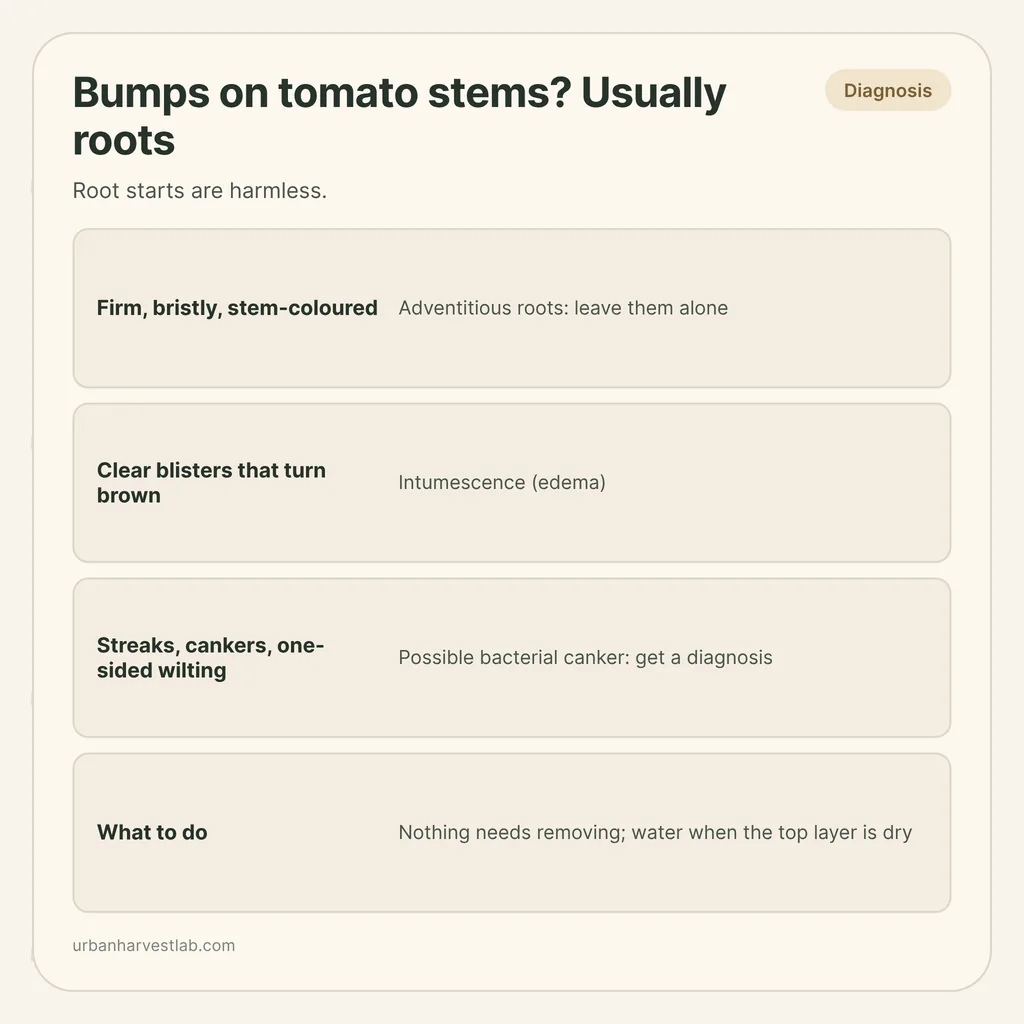
Bumps on tomato stems? Usually roots, not disease
Those little knobs along a tomato stem are root starts waiting for soil or a wet spell. Learn how to confirm them and which stem symptoms are different.

Tomato plant wilting even though you water it: heat, roots, or disease
Midday droop that clears by evening is usually heat. Wilt that stays after watering points to rotting roots or a vascular disease, and a cut stem tells you which.
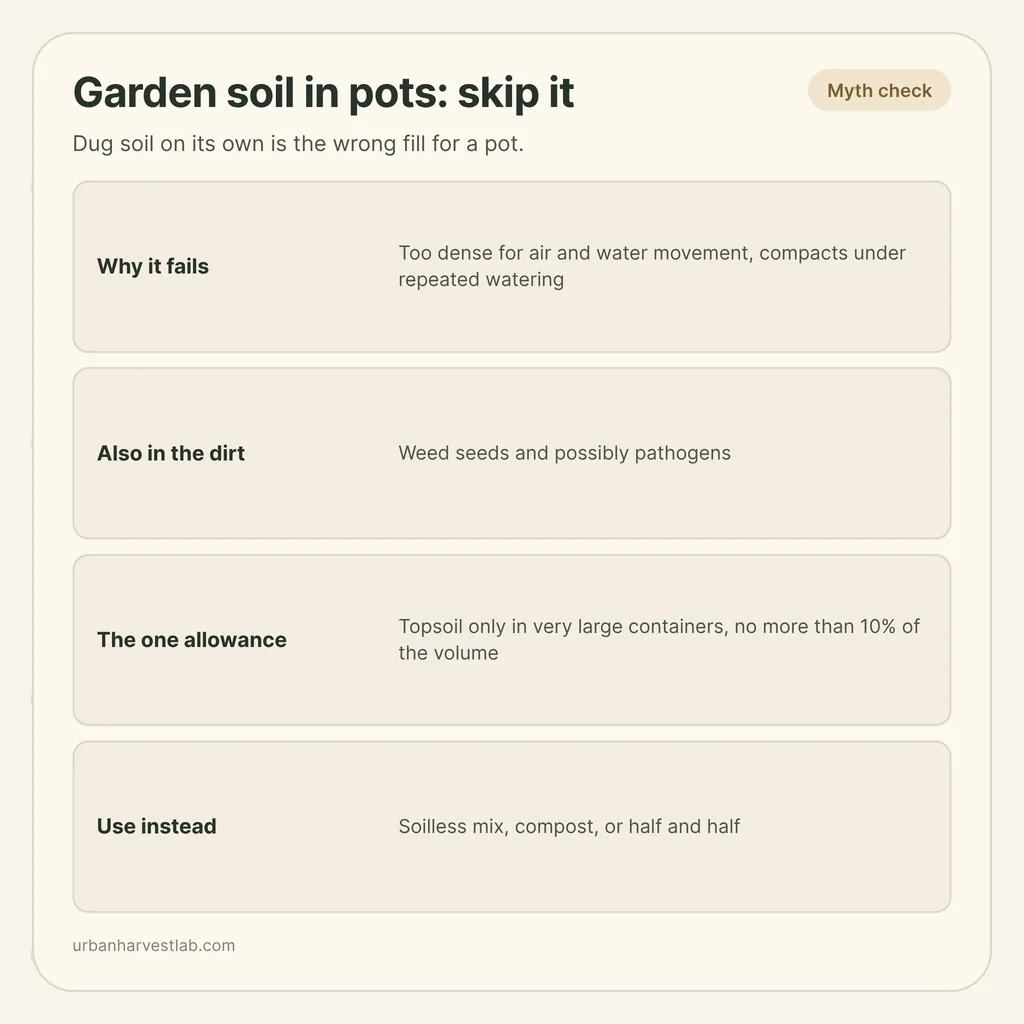
Can you use garden soil in pots? When it works and when it fails
Soil that grows a fine bed can smother roots once it is walled into a pot. Here is why it compacts, how much (if any) to mix in, and the better ways to use that free dirt.