Troubleshoot the system before you change the inputs.
Symptoms
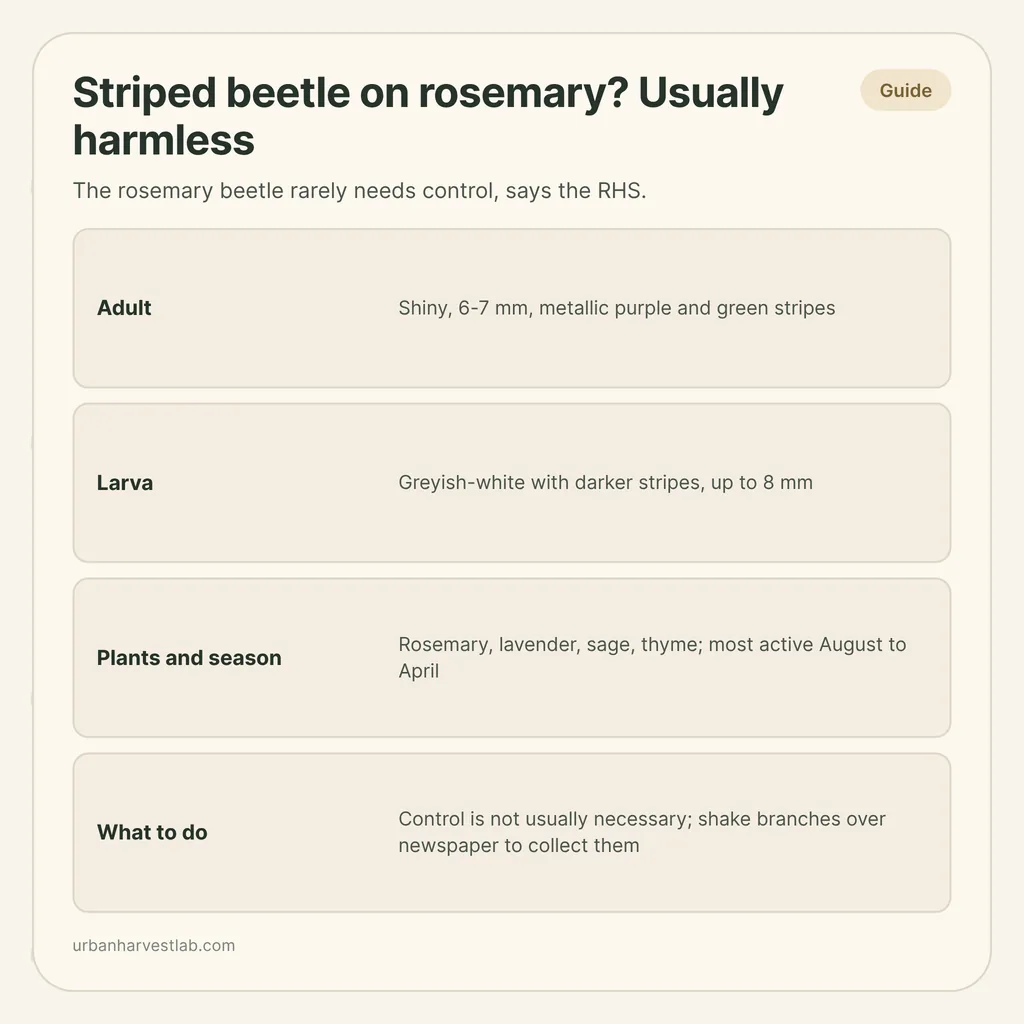
- Shiny beetles about 6-7 mm long with metallic purple and green stripes sitting on rosemary, lavender, sage or thyme.
- Greyish-white, dark-striped grubs on the same plants, mostly between late summer and spring.
- Leaves chewed down to short stumps with greyish-brown dried edges, and sometimes flowers eaten.
Possible causes
- Rosemary beetle adults and larvae feeding on the foliage and flowers, which the RHS says happens mainly between late summer and spring.
- If you see no beetles or grubs, the damage is more likely something else, such as scale insects or root problems.
Quick fixes
- Put newspaper or a sheet under the pot, tap or shake the branches, and collect what falls.
- Repeat during mild spells from late summer to spring while beetles and larvae are about.
- If the plant is otherwise healthy, tolerate a few beetles: the RHS says it can usually be treated as a colourful addition to the garden.
A shiny beetle with metallic purple and green stripes on your rosemary, lavender, sage or thyme is almost certainly the rosemary beetle, and the plant will usually shrug it off. The Royal Horticultural Society (RHS) says control is not usually necessary, but if you want fewer beetles, picking them off by hand is the method it gives.
Most of what is written about this beetle comes from Britain, Ireland and the Mediterranean, where it is established. Match the insect against the descriptions below, and if the damage is on a plant with no beetle or grub in sight, start with why rosemary dies instead.
How to recognise adults and larvae
The RHS gives two descriptions, and both are easy to match against what you see on the stem.
- Adults: the RHS describes shiny insects 6-7 mm long, with metallic purple and green stripes on the wing cases and thorax.
- Larvae: greyish-white with darker stripes running along the body, which the RHS says reach 8 mm when fully grown.
The rosemary beetle (Chrysolina americana) is a leaf beetle, in the family Chrysomelidae. The RHS notes that there are about 250 leaf beetle species in Britain, most with no noticeable effect on garden plants, so a colourful beetle on a different plant is not automatically this one. Look at the host: rosemary, lavender, sage, thyme and some related plants are the ones the RHS lists.
What the damage looks like
Both adults and larvae eat the leaves. The RHS says the leaves can be reduced to short stumps with greyish-brown discolouration where the damaged tissue has dried up. Flowers can be eaten too, which matters on lavender in bloom.
The same page adds that in most cases the overall appearance and health of the plant remains unaffected. That is worth keeping in mind before you reach for anything stronger than your fingers: ragged tips on a vigorous plant are cosmetic.
If you find stumps but no insects, the cause may lie elsewhere. Sap-sucking scale insects are covered in scale insects on rosemary and woody herbs, and a lavender that is declining rather than chewed is in lavender dying in a pot. For chewed leaves on other herbs, see holes in herb leaves, and the herb pest identification chart lines up the usual culprits side by side.
When to look: the calendar
The RHS puts the most active period at August to April, with adult beetles present throughout the year. Its biology notes fill in the sequence:
| Time of year | What the RHS says is happening |
|---|---|
| Mid-summer | Adults can be on the plant but usually do little or no feeding |
| Late summer | Adults begin feeding, mating and laying eggs; eggs hatch after about ten days |
| Autumn to spring | Adults and larvae feed during periods of mild weather |
| After full growth | Larvae go into the soil to pupate |
| Early summer | Adults emerge from pupae in the soil |
There is one generation a year, but adults are long-lived, so old and new adults overlap. That is why you can find an adult in any month.
For a potted plant, the practical reading is that a beetle count in May is not a sign the problem has ended, and a quiet July does not mean it has gone. Mild days in autumn, winter and spring are when the feeding resumes.
What to do about it
Decide whether to act
The RHS says host plants often survive populations of this beetle without noticeable adverse effects, so control is not usually necessary. Its advice is to tolerate the beetles where possible and to treat them as a colourful addition to the garden. It also says the beetle does not eat enough to harm healthy plants.
The RHS does not give a count of beetles or larvae at which you must act. What it does say is that removing beetles by hand where practical can help keep numbers below the level at which serious damage occurs.
Pick them off
For taller rosemary and lavender, the RHS says beetles and larvae can be collected by tapping or shaking the branches over newspaper spread underneath the plant. A pot lets you do this more neatly than a border: set the pot on the paper, tap the branches, then fold the paper up and deal with what fell.
A paper on the beetle in Cyprus lists hand-picking, net sweeping and shaking the plants and collecting the beetles from the ground as manual options, and notes that they take extra labour. On a few pots that labour is small.
Because mild spells keep the beetle feeding from late summer to spring, a quick check of the plant whenever the weather is mild is more useful than one big clear-out.
Let predators help
The RHS suggests encouraging wildlife such as birds, frogs and predatory ground beetles, which will eat the larvae and sometimes the adults. On a balcony that is a modest lever, but it is one reason not to reach for sprays that harm everything in the pot.
Sprays
The RHS page lists no insecticide for this beetle. The Cyprus paper, which looks at commercial aromatic crops, says farmers can use pesticides as a last resort. Rosemary, sage and thyme go straight on the plate, so a spray on the leaves is a poor trade for what is usually cosmetic damage. If you are weighing neem on an edible herb for any pest, read the safe-use guide for neem oil on herbs first.
Keeping it in proportion
The beetle has spread widely from southern Europe: the RHS says it has been widespread in Britain since the mid-1990s, and the Cyprus paper says it was probably carried to some countries along with imported plants. That trade link is a reason to look over new woody herbs before you bring them home, along with the rest of your pest prevention routine for herbs.
For most gardeners with a pot or two, the whole routine is: learn the two shapes, check on mild days from late summer to spring, tap the branches over paper, and leave the rest.
Sources
Other reasons woody herbs look rough
If the damage does not match a beetle, these pages cover the other usual suspects on rosemary and lavender.
Common questions
What does a rosemary beetle look like?
The RHS describes adults as shiny insects 6-7 mm long with metallic purple and green stripes on the wing cases and thorax. The larvae are greyish-white with darker stripes along the body and reach 8 mm when fully grown.
What plants does the rosemary beetle eat?
The RHS lists rosemary, lavender, sage, thyme and some other related plants. An open-access paper on the beetle in Cyprus names plants in the mint family (Lamiaceae), including rosemary, lavender, sage and thyme.
When do rosemary beetles feed?
The RHS says they are most active from August to April. Adults feed little in mid-summer, start feeding, mating and laying eggs in late summer, and both adults and larvae feed through autumn to spring in mild weather. Adults can be found at almost any time of year.
Do I need to get rid of rosemary beetles?
Usually not. The RHS says host plants often survive the beetle without noticeable ill effects and that it does not eat enough to harm healthy plants. Removing beetles by hand where practical can keep numbers below the level at which serious damage occurs.
Related guides

Lavender dying in a pot: wet roots, winter damp, or old wood
Lavender is built for dry, stony ground, so a pot that holds water kills it faster than neglect does. Work through drainage, winter, light, and pruning in order.
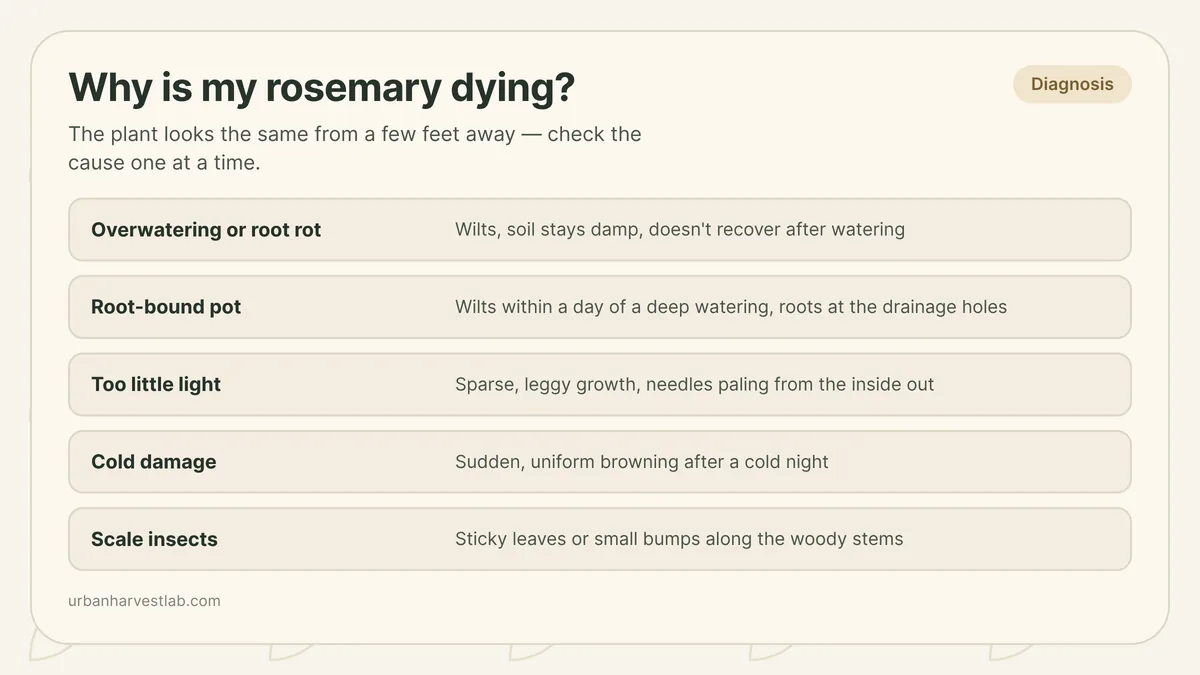
Why is my rosemary dying? A cause-by-cause diagnosis
A dying rosemary looks much the same from a few feet away no matter what caused it, so finding the fix means ruling causes in and out one at a time, not guessing.
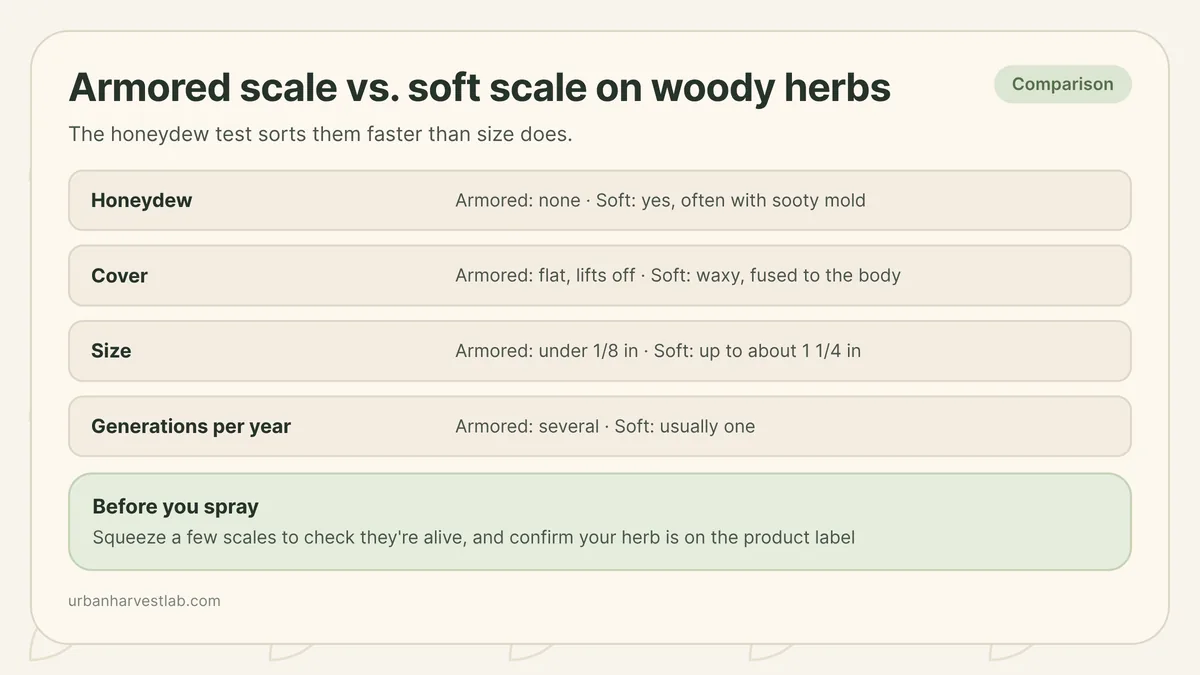
Scale insects on rosemary and other woody herbs
Scale on a woody herb often goes unnoticed until the leaves turn sticky or a stem starts to die back, and the right treatment depends on which kind of scale you have.