
What each compost tea claim looks like against the sources
| Claim | What the sources report | Practical reading |
|---|---|---|
| Suppresses leaf diseases | University of Arizona: foliar sprays suppressed plant pathogens on crops including tomatoes. Washington State University: cherry brown rot trial showed no reduction, and some cultivars got worse. | Mixed. Do not count on it in place of a fungicide or of good airflow and watering. |
| Feeds plants | Washington State University: teas add nitrogen, potassium and other minerals all at once. | A nutrient input, but with no label to dose by. |
| Plain tea is low risk | USDA Agricultural Research Service: pathogens undetectable in plain non-aerated tea by 8.5 days and E. coli O157:H7 undetectable in plain aerated tea at 36 hours. | Holds only for tea made without supplements, from compost that was not contaminated. |
| Sugar-boosted tea is fine | Same USDA study: supplements let E. coli O157:H7, Salmonella and fecal coliforms grow by 1 to 4 log in both methods. | Avoid molasses and other additives on anything you will eat. |
Compost tea has less evidence behind it than its reputation suggests, and the part with the clearest evidence is a food-safety warning rather than a benefit. Washington State University Extension says few controlled, replicable studies support the claims for it. A USDA laboratory found that the sugary supplements often added to brew it can let E. coli O157:H7 and Salmonella multiply. For a pot of herbs or salad greens, working finished compost into the mix is a simpler route to the same goal.
If you want to judge the compost itself first, choosing compost that’s safe for edible containers covers maturity, source and salt.
What compost tea is, and the two ways it is made
Compost tea is a liquid extract made by soaking compost in water. UConn Extension describes two versions. The old-fashioned one steeps mature compost in unheated water, then is diluted to about the color of a typical cup of brewed tea and used to water plants. The aerated version passes air through the bucket, usually with an aquarium pump, and after 24 hours is sprayed on plants or soil. Its aim is to build up beneficial microbes that may suppress diseases.
Aerated brews often get a food source for those microbes. The University of Arizona lists molasses, yeast, humic acid, soluble kelp and fish hydrolysates among the common additives.
Does it suppress disease?
The results are mixed, and which result you hear depends on who is talking.
Washington State University Extension states that few controlled, replicable scientific studies exist to support the tea’s effectiveness. It also points to a reason the data disagree: the age and ingredients of the compost, the way the tea is prepared and applied, and the weather all differ between trials.
Its own trial is a useful example. Researchers sprayed 32 cherry trees of eight cultivars with either compost tea or plain water at the stages when a fungicide would normally go on. WSU reports that the tea did not reduce blossom brown rot, and that in some cultivars the tea applications worsened infection.
The University of Arizona reads the literature more favorably. It reports that compost tea applied directly to leaves has been shown to suppress plant pathogens on a variety of edible crops, including tomatoes. Both statements can be true: a particular tea can work against a particular disease in a particular trial without that making tea a general-purpose remedy.
For a balcony grower, the practical reading is modest. If a plant has powdery mildew or leaf spot, tea is not a documented replacement for the basics. Those are airflow, watering at the soil rather than the leaf, and removing infected leaves.
Does it feed plants?
Yes, in the sense that it carries nutrients. WSU notes that compost teas add nitrogen, potassium and other minerals all at once, unlike compost used as mulch, which releases them slowly. In a large bed that is a concern about runoff. In a pot it means a concentrated, unmeasured dose with no label.
A fertilizer with a stated analysis is easier to get right; how to read an NPK fertilizer label explains the numbers, and whether potted herbs need fertilizer at all is worth settling before you feed anything.
The food-safety problem
This is where the sources are most specific. Compost made from manure or kitchen waste can carry pathogens, and the University of Arizona notes that adding nutrient additives and water can cause them to proliferate in a tea.
The USDA study. Researchers at the USDA Agricultural Research Service, publishing in the Journal of Food Protection in 2007, seeded compost with E. coli O157:H7 and Salmonella Enteritidis and brewed aerated tea for 36 hours and non-aerated tea for 8.5 days. Without supplements, pathogen and fecal coliform populations were undetectable by 8.5 days in the non-aerated tea, and E. coli O157:H7 fell below detection in the aerated tea at 36 hours. With commercial nutrient mixtures, both pathogens and fecal coliforms grew by 1 to 4 log CFU/g in both kinds of tea, and the aerated tea held higher concentrations than the non-aerated one. The authors conclude that supplements should be avoided when tea is used on fresh produce.
Aeration alone did not protect against growth once a food source was added.
What extension services advise.
- UConn Extension: unless you are positive the methods minimize human pathogens, save compost tea for non-edible plants. It adds that backyard piles often do not reach the 130 to 150 degrees F needed to control pathogens.
- University of Hawaii CTAHR: avoid additives, and molasses in particular. If tea is made with additives and not tested, food crops may not be harvested until 90 to 120 days after application. Make tea only from compost that held at least 131 degrees F for three days, and sanitize the equipment.
- University of Arizona: use tea only on non-edible plants or non-edible parts of plants. It also states that links between foodborne illness and compost tea have not been established in peer-reviewed medical literature, while the potential for exposure exists.
Hawaii adds one point that matters for leafy greens in pots: tea can collect inside the plant, in the stalk base of a lettuce for example. If pathogens are in it, the plant could become a breeding ground for them. Its advice is to keep untested tea off the edible portion, especially near harvest. Worm-castings teas are not exempt; the same page says there is scientific evidence that human pathogens can be found in teas produced from worm castings.
What to do instead in a container
Two lower-risk routes give a pot most of what the tea is meant to.
- Work finished compost or worm castings into the mix. How much compost to put in potting mix gives the proportion, and worm castings in a container mix covers what castings add and in what amount. Both stay in the medium rather than splashing onto leaves.
- Feed with a labelled product when the plant needs it. A label-first guide to fertilizer for potted herbs has the dosing you cannot get from a bucket of tea, and organic versus synthetic fertilizer compares what changes in a pot.
If you brew tea anyway, put it on ornamentals, not salad. For anything edible, follow the University of Hawaii rules: finished compost that has been heated, clean equipment, drinking-quality water, no sugars, and no contact with the part you will eat.
Sources
- Washington State University Extension compost tea fact sheet
- Ingram and Millner, “Factors affecting compost tea as a potential source of Escherichia coli and Salmonella on fresh produce,” Journal of Food Protection 70(4), 2007 (USDA Agricultural Research Service)
- University of Arizona Cooperative Extension, AZ1739, compost tea publication
- University of Connecticut Extension, “Compost, compost tea, and manure: Food Safety Implications in the Vegetable Garden”
- University of Hawaii CTAHR, FST-41, Best Food Safety Practices for Hawai’i Home Gardeners
Compost and organic feeding for containers
Safer ways to get what compost tea promises, and how to judge compost before it touches food plants.
Common questions
Does compost tea work?
The evidence is thin and mixed. Washington State University Extension says few controlled, replicable studies support the claims, and its cherry trial found tea did not reduce brown rot. The University of Arizona reports foliar sprays have suppressed plant diseases on crops including tomatoes, so results depend on the tea, the crop and the disease.
Is compost tea safe to use on vegetables and herbs?
It can be, but the risk is real. A USDA Agricultural Research Service study found commercial nutrient supplements let E. coli O157:H7 and Salmonella grow by 1 to 4 log in both aerated and non-aerated tea. The University of Hawaii advises avoiding additives such as molasses and keeping untested tea off the edible portion, especially near harvest.
Is aerated compost tea better than non-aerated?
Not on the evidence found here. In the USDA study, plain aerated tea cleared E. coli O157:H7 within 36 hours and plain non-aerated tea cleared pathogens by 8.5 days, but with supplements the aerated tea held higher pathogen counts than the non-aerated tea.
What can I use instead of compost tea in pots?
Mix finished compost or worm castings into the potting medium, and feed with a labelled fertilizer if the plant needs more. Washington State University notes that tea delivers nitrogen, potassium and other minerals all at once, which is hard to dose in a small container.
Related guides
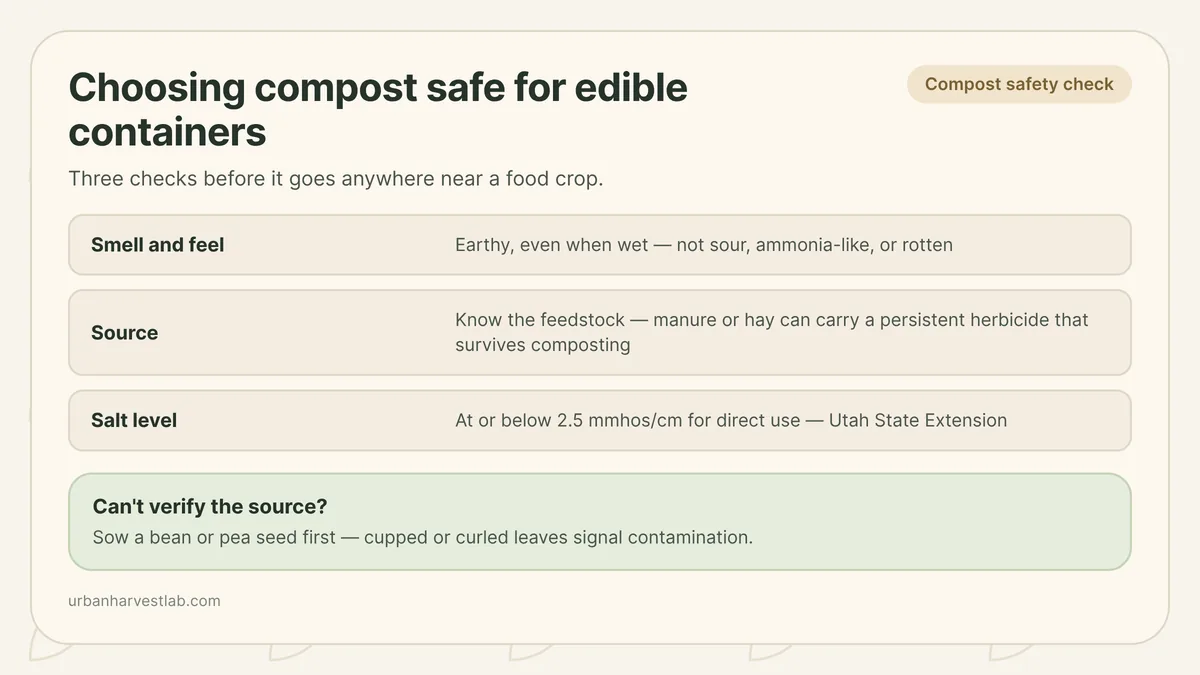
Choosing compost that's safe for edible containers
A pile or a bag that looks like good compost can still carry a persistent herbicide or too much salt for a small pot. Three checks catch most of it before you plant.
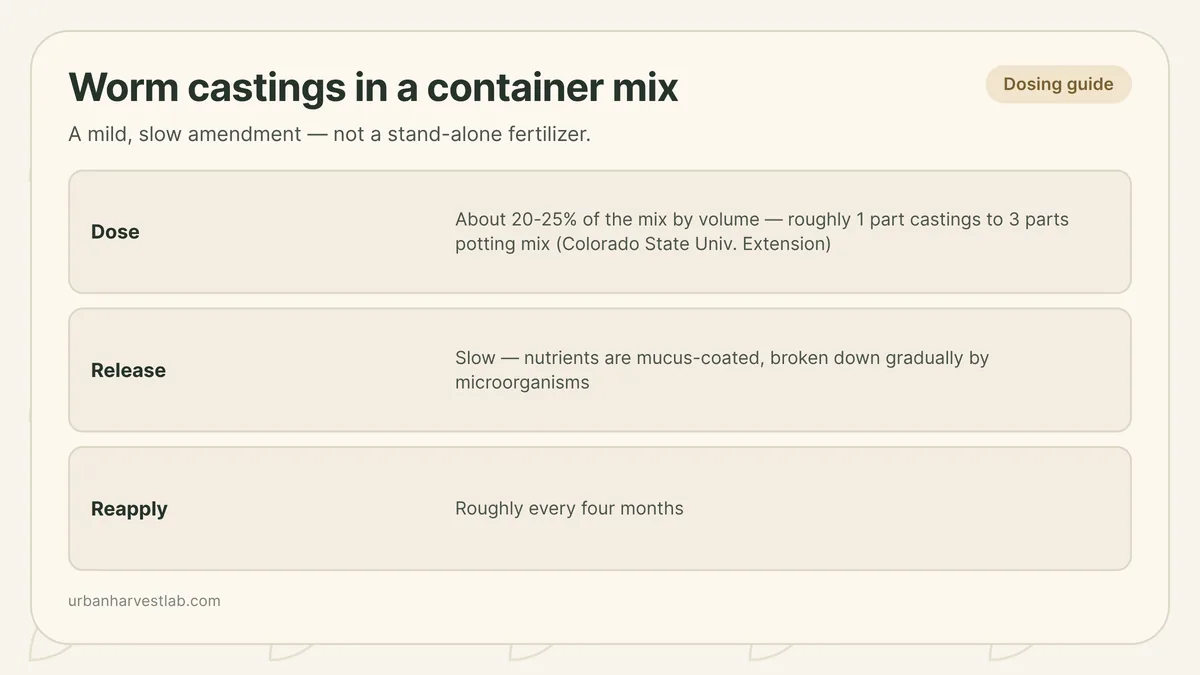
Worm castings in a container mix: what they do and how much to use
Worm castings are a modest, slow-release amendment, not the cure-all the bag copy suggests. Here is what the extension research actually supports and the ratio to mix them at.
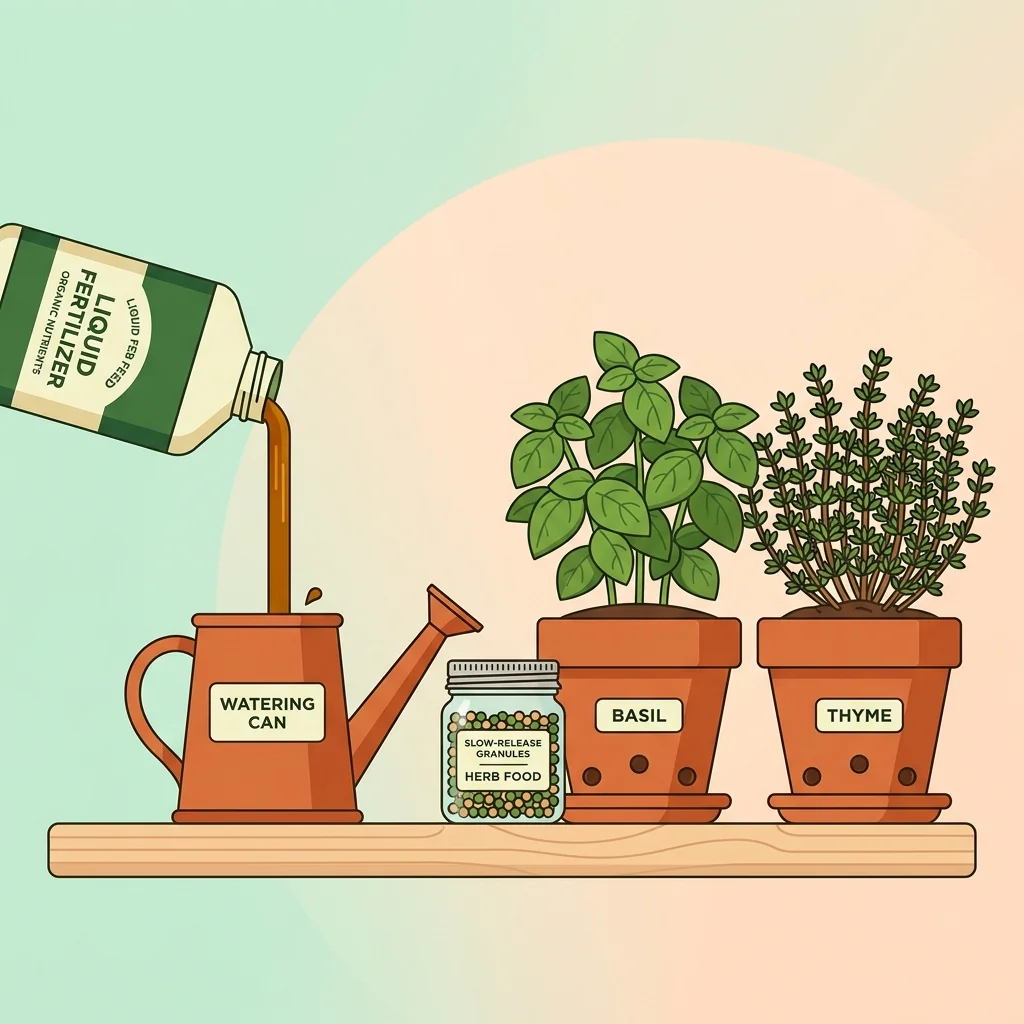
Best fertilizer for herbs in pots: a label-first guide
A practical, label-first guide to complete liquid and controlled-release fertilizers for potted herbs, with a decision table and a safer first application.