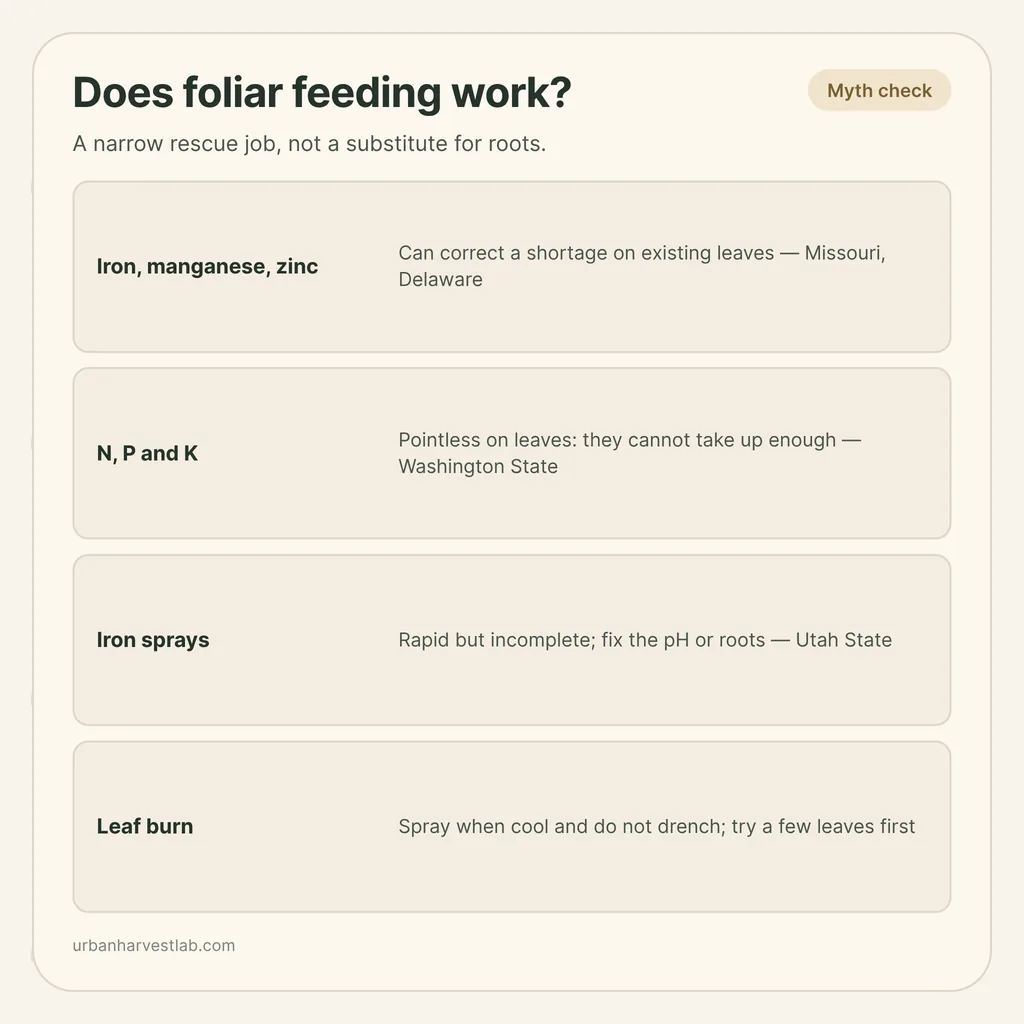
What each kind of nutrient does when sprayed on leaves, according to extension sources
| Nutrient | What the extension sources say | Practical reading |
|---|---|---|
| Nitrogen, phosphorus, potassium | Washington State: leaves cannot take up enough to supply the whole plant, and strong sprays burn leaves | Feed through the roots |
| Iron, manganese, zinc | Delaware and Missouri: very effective at correcting local deficiencies in leaves, but slow to enter and not mobile in the plant | Useful rescue for existing leaves while you fix the cause |
| Calcium | Delaware: moves very little, so timing matters; for blossom end rot the spray must go on when fruits are very small | Narrow use, mostly for fruiting crops |
| Boron | Missouri: can work for some crops but is very toxic if applied in excess | Not a casual home spray |
Foliar feeding works only for a narrow job: quickly correcting a micronutrient shortage, most often iron, manganese or zinc, on leaves that already exist. It does not replace feeding through the roots, and it does not fix whatever caused the shortage. Extension specialists at Washington State, Missouri and Delaware reach the same conclusion from different directions, and none of them recommends sprays as the main way to feed a plant.
If your plant is pale or stunted and you are wondering whether a spray will rescue it, start with the root zone. In a pot that usually means the mix’s pH or the way you water, covered in nutrient lockout and soil pH and container soil pH.
Why the leaf is a poor mouth
A leaf is built to keep water in. Delaware Extension says foliar nutrient entrance is mostly through the waxy cuticle, and that research has shown limited entrance through the stomata. Missouri’s extension specialist agrees that nutrients are more likely to be taken in through the cuticle than the stomata, and notes that only 15 to 20 percent of the nutrients applied to leaves is estimated to be taken in.
Two consequences follow. First, species differ. Washington State points to differences in cuticle thickness and stomatal resistance, and says plants raised in a protected place such as a greenhouse have thinner, more porous cuticles and take up sprays much more readily than field plants. Second, what gets in often stays put. Delaware says iron, manganese, copper and zinc enter slowly and do not mobilize once inside the plant. Missouri adds that foliar applications are very effective at correcting local deficiencies in leaves, which is a statement about the sprayed leaf and not about the new growth coming later.
What a spray can do, and what it cannot
University of Delaware Extension notes that commercial vegetable growers apply most (over 90%) of their plant nutrients to the soil. Foliar sprays are the exception, used when something specific is going wrong.
Nitrogen, phosphorus and potassium. These are needed in larger quantities. Washington State’s Linda Chalker-Scott writes that applying them to foliage is pointless because leaves cannot take up enough to supply the entire plant’s demands, and that high concentrations often cause leaf burn as water evaporates and the fertilizer salts remain behind. Her point about workarounds is brief: lots of weak applications would not be cost effective. Delaware makes the matching point that only small amounts can be taken up through leaves at one time. Missouri sums it up: foliar feeding is usually not the most cost effective way to supply nutrients.
Micronutrients. This is where sprays earn their keep. Washington State’s bottom line is that micronutrients are the only minerals effectively applied through foliar application. Missouri says foliar feeding micronutrients appears to be much more effective than feeding macronutrients, and Delaware says foliar application is also useful when root function is impaired, for example after extended rainy weather leaves soil waterlogged, or when low pH ties up nutrients so that uptake from the soil is limited.
Calcium. Delaware cautions that calcium moves very little once in the plant, so for blossom end rot in tomatoes or peppers the spray has to go on when fruits are very small. For the bigger picture on blossom end rot, see Epsom salt for plants.
Doses. The foliar rates University of Delaware Extension and University of Missouri publish are per acre for commercial vegetable growers, for example 1 to 10 pounds per acre for nitrogen, and do not translate to a windowsill. University of Delaware Extension gives a general range of 0.5-2% fertilizer solution for foliar use, but says to apply fertilizers at recommended rates and dilutions for each specific crop. For a pot, the label of a product made for foliar use is the number to follow. No source read here gives a safe homemade recipe, so do not mix one.
The one case where a spray earns its keep: iron
The classic example is iron chlorosis, where new leaves turn pale while the veins stay green. In alkaline or high-pH mix, iron is present but out of reach of the roots.
Utah State Extension lists foliar sprays of ferrous sulfate or chelated iron as one of several treatments and says foliar treatments produce a rapid but incomplete response, while a soil treatment will last longer. Its guidance adds that the response is often spotty and temporary and that repeat applications may be needed as new foliage appears. That page covers trees and shrubs, but the logic carries over to a potted plant: the spray greens the leaves in front of you, and the new leaves that grow next week come out pale again if the mix still locks up iron.
Washington State offers a useful diagnostic trick. Spraying leaves with iron chelate can help determine whether interveinal chlorosis is from iron deficiency. If a few sprayed leaves green up, you have learned what the problem is, and the permanent fix is correcting the pH or root problem, not spraying every week.
How to avoid leaf burn
Fertilizer is salt. Delaware says because foliar fertilizers are in salt forms they can damage plant tissue if applied at rates that are too high, and that young tissue is the most susceptible. Large thin leaves are riskier than thick ones: Delaware says muskmelons with large thin-cuticled leaves have greater risk of salt injury than a thick-cuticled crop such as cabbage.
The practical rules from the extension sources:
- Cool conditions. Missouri says to spray when the air is relatively cool (around 72°F), which for summer crops means early morning or late evening. Washington State prefers overcast, cool days, and Utah State says evening or a cool, cloudy day to prevent burning.
- Do not drench. Missouri says not to apply to the point that droplets form on the leaves, because that encourages burn.
- Weak and often over strong and rare. Missouri says weaker concentrations applied more frequently beat stronger ones applied less often.
- Try a few leaves first. Missouri advises starting any foliar program on a trial basis.
- Spray fertilizer alone. Delaware recommends not mixing it with pesticides, for better effect and less risk of plant injury.
If leaf edges crisp after you spray, compare what you see with signs of overfertilizing, because leaf burn from sprays and salt stress from feeding the pot look alike.
Fish emulsion and seaweed sprays
Sprays sold as a shortcut for big yields are a different matter from a spot rescue. University of Illinois Extension reports that studies of sweet peppers showed no difference in yield using fish emulsion as a foliar spray, while the product works as a fertilizer when applied the usual way. The page on fish emulsion and seaweed for herbs covers using it on the roots.
A short decision path
- Leaves pale, whole plant slow: the plant needs nitrogen or general feeding. Feed the pot; reading how to read an NPK label and slow-release vs liquid fertilizer will help you choose.
- New leaves pale with green veins: suspect iron or another pH-locked micronutrient. Check the mix’s pH first; a micronutrient spray on a few leaves is the stopgap.
- Waterlogged or cold mix, roots struggling: fix drainage and watering first. Delaware names impaired roots as a case where sprays fit, but the roots still need to recover.
- Plant is simply growing steadily: skip the spray. Washington State says applying fertilizers to leaves (or the soil) without regard to actual mineral needs wastes time and money.
Sources
- Washington State University Extension: The Myth of Foliar Feeding (Chalker-Scott)
- University of Missouri IPM: Foliar Feeding Revisited
- University of Delaware Cooperative Extension: Foliar Fertilization of Vegetable Crops
- Utah State University Extension: Preventing and Treating Iron Chlorosis in Trees and Shrubs
- University of Illinois Extension: fish emulsion fertilizer
Feeding through the roots instead
The pages that cover pH lockout, fertilizer labels and the signs you have overdone it.
Common questions
Does foliar feeding work?
For some jobs, yes. University of Missouri and University of Delaware extension both say foliar sprays are effective at correcting local micronutrient deficiencies, such as iron, manganese and zinc, in leaves. Both also say it is a supplement to soil feeding and not a substitute. Washington State University Extension adds that micronutrients are the only minerals effectively applied this way.
Can plants get all their nutrients through their leaves?
No. Washington State University Extension says it is pointless to apply nitrogen, phosphorus and potassium to foliage because leaves cannot take up enough material to supply the whole plant. Strong sprays also tend to burn leaf edges as the water evaporates and salts remain.
Is foliar feeding better than feeding the soil?
Not on the evidence. The claim that sprays are 8, 10 or even 20 times more effective traces back to 1950s radiolabel research, and Washington State University Extension explains why that conclusion does not follow. University of Missouri extension adds that foliar feeding is usually not the most cost effective way to supply nutrients.
Does a fish emulsion or seaweed spray help?
University of Illinois Extension reports that studies of sweet peppers showed no difference in yield when fish emulsion was used as a foliar spray. The same product works as a root-zone fertilizer.
Related guides
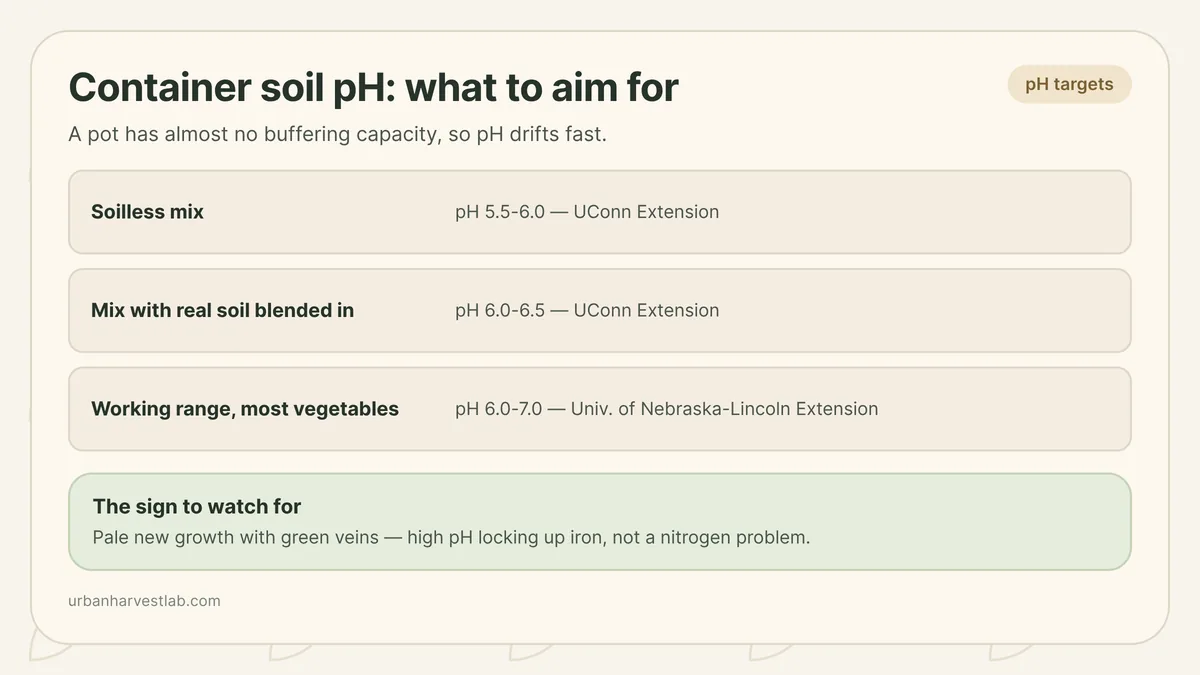
Container soil pH: when it matters and how to fix it
A container's small volume has almost none of the buffering capacity open ground has, so pH drifts faster and matters sooner. Here is when to test, what to aim for, and how to move it.
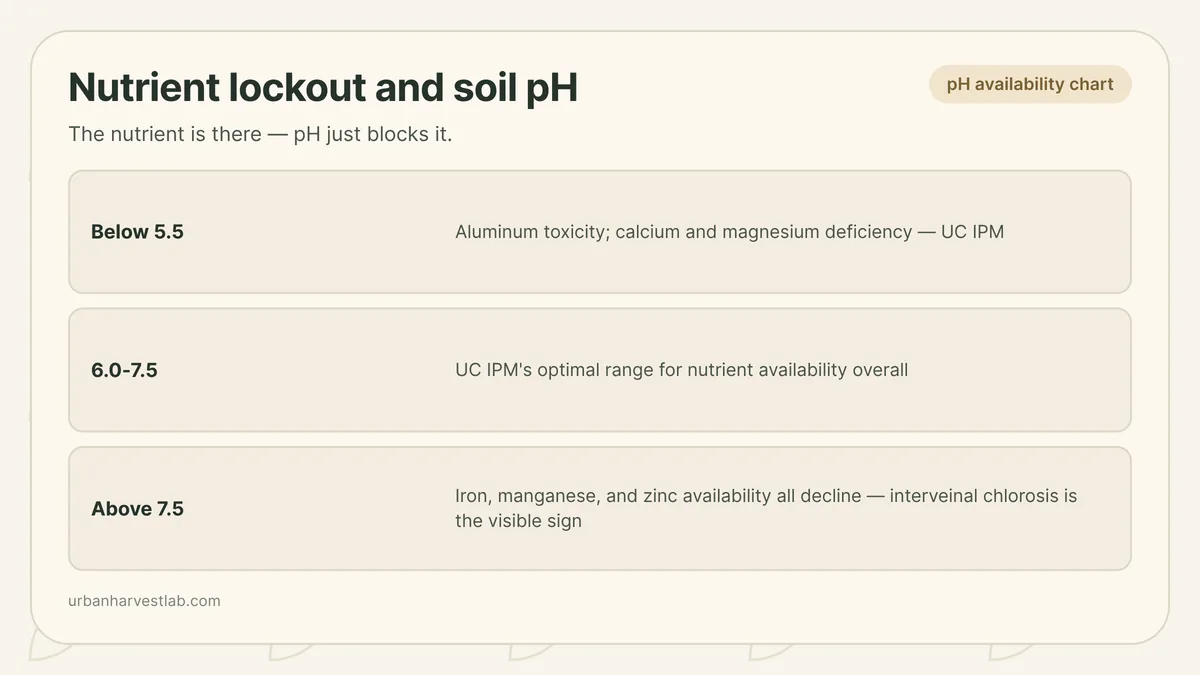
Nutrient lockout and soil pH: why pH blocks nutrients that are already there
A fertilizer that tests complete on the label can still leave a plant starving if the mix's pH is wrong. Here is what pH does to nutrient availability, zone by zone, and why it isn't a salt problem.
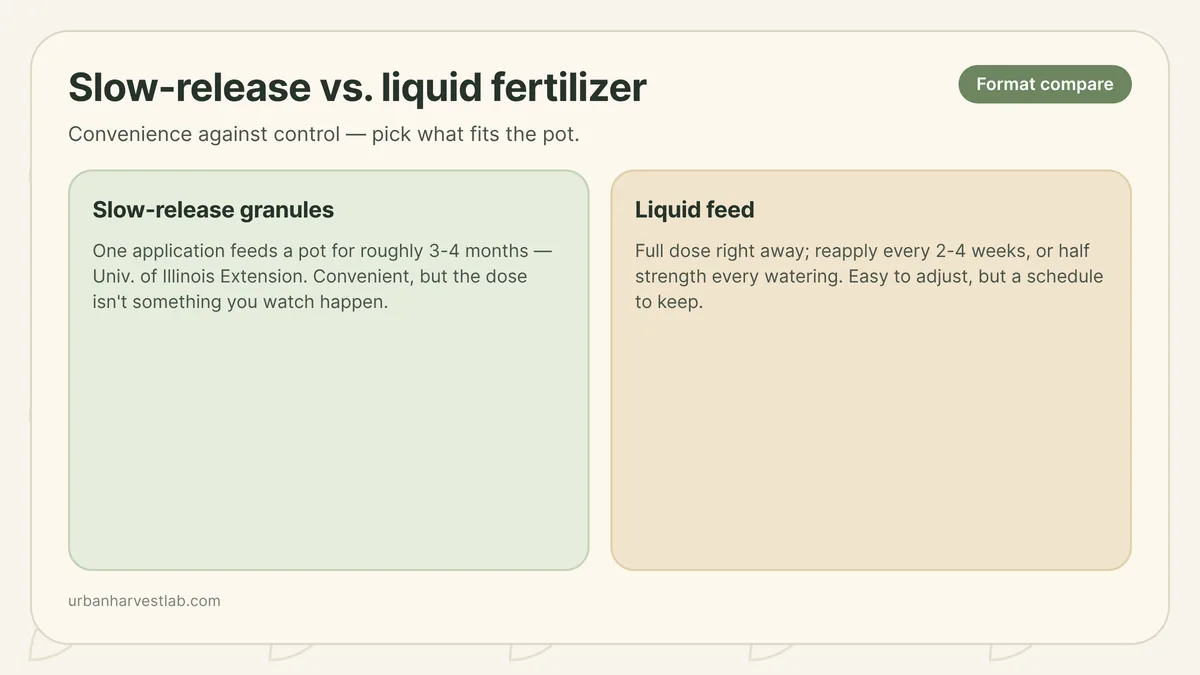
Slow-release vs. liquid fertilizer: which one fits your container
Granular slow-release and liquid fertilizer solve different problems in a pot. Here is how each one actually releases nutrient, and which situation calls for which.