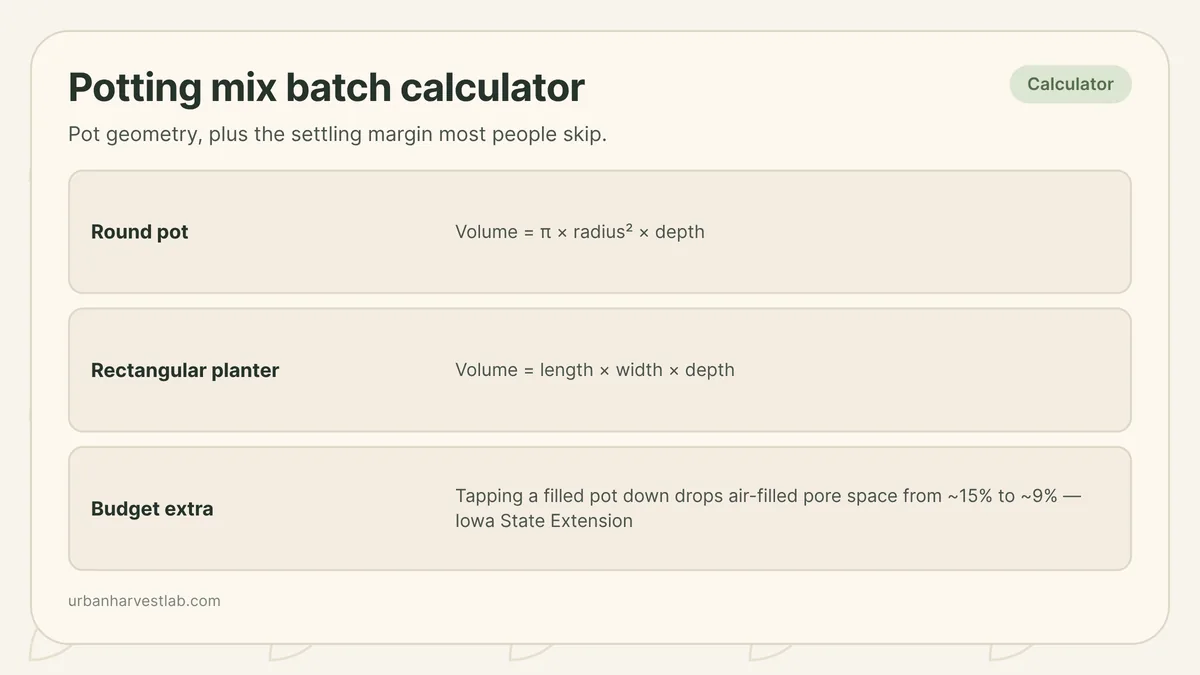
Enter your pot’s diameter and depth below to get the batch volume in liters, or work it out by hand with one formula: volume = pi × radius² × depth, summed across every pot and divided by 1,000 to convert cubic centimeters into liters. That number is a floor, not a finished shopping list — a filled container settles once it is watered, so the actual amount worth buying or mixing runs a bit ahead of the bare geometric figure.
Pot volume calculations matter most once you are past choosing a container and into filling it. If you have not settled on a recipe yet, how to make potting mix for container vegetables covers the components and the physical tests that tell you whether a batch is right. What follows turns a pot’s dimensions into the number of liters that recipe needs to fill.
Calculate your own batch
Live estimate
Add a second pot size if you are filling more than one kind of container in the same batch. Leave the aeration share at zero if you are not tracking that component separately.
Potting mix needed
37.1 L
≈ 1.31 cubic feet, before shopping for a bag size
- Base (75%)
- 27.8 L
- Aeration (0%)
- 0.0 L
- Compost (25%)
- 9.3 L
[π × (15.2 cm)² × 25.4 cm × 2] ÷ 1,000 = 37.1 L geometric
37.1 L × 25% compost = 9.3 L · remaining 75% base = 27.8 L
Do the math yourself
A round pot is a cylinder, and a cylinder’s volume is pi times its radius squared, times its depth:
volume = π × radius² × depth
Radius is half the diameter, so measure across the pot’s inside rim and halve it. Work in one unit throughout — centimeters keep the arithmetic in cubic centimeters, which convert to liters by dividing by 1,000.
A 12-inch-diameter pot, 10 inches deep, converts to 30.5 cm diameter (15.2 cm radius) and 25.4 cm depth:
π × (15.2 cm)² × 25.4 cm = 18,533 cm³ per pot
Two of those pots need double that volume:
18,533 cm³ × 2 = 37,067 cm³ ÷ 1,000 = 37.1 liters
That is the same 37.1 L the calculator above returns for its default inputs. If you are filling several different pot sizes, run the formula once per size and add the results — the calculator’s second pot-size field does exactly that.
Rectangular and square planters skip pi entirely
A window box or raised container is length times width times depth, with no radius or pi involved:
volume = length × width × depth
A 90 cm × 25 cm × 30 cm window box holds 90 × 25 × 30 = 67,500 cm³, or 67.5 liters. In inches, a 36-inch × 10-inch × 12-inch box holds 4,320 cubic inches; multiplied by 16.39 cm³ per cubic inch and divided by 1,000, that is about 70.8 liters — slightly more than the 67.5 L above, because 36 × 10 × 12 inches is a fraction larger than the rounded 90 × 25 × 30 cm box. Use whichever unit your tape measure gives you and convert once, at the end, rather than mixing inches and centimeters mid-calculation.
Tapered pots need one adjustment
Most nursery and patio pots taper slightly from a wider rim to a narrower base. For a mild taper, measuring the diameter at the midpoint between rim and base gives a volume close enough to plan a batch around. For a pronounced taper — a pot noticeably narrower at the base than the rim — the true volume sits between the rim-diameter and base-diameter results, closer to the midpoint number than to either extreme.
Why the geometric number runs short
The formula above gives the pot’s internal volume, not the volume of mix you will actually need to buy or mix. Handling compresses a potting medium more than most people expect. Iowa State University Extension found that simply tapping a filled container down on a bench reduces its air-filled pore space from about 15% to 9%, and that pressing the mix down firmly reduces it again to roughly 4%.
That is not a reason to compress a mix on purpose — the same source recommends filling to level, brushing off the excess, and letting watering settle the mix on its own rather than packing it down by hand. It is a reason to budget a bit more mix than the raw geometric number, since a bag that looked like exactly enough loose volume can end up visibly short once the pot has been watered in and the mix has settled to its natural density. How much extra to budget depends on the specific base material, how moist it is, and how firmly it gets tamped while filling, so the settling-margin field above starts at zero. Set it based on how your own mix behaves rather than a fixed percentage.
Turn total volume into a recipe
Once you know how many liters a container needs, the same total splits into components if you are building a batch rather than buying it finished. Iowa State University Extension describes what each part of a soilless mix is doing: a moisture-holding base (peat moss or coir), a coarse aeration component (perlite, screened bark, or rice hulls) that keeps pores open under watering, and compost, which supplies a modest, slow dose of nutrition and biological activity but decomposes faster than the base material and does not replace supplemental feeding on its own.
Compost’s share is the one fraction with a sourced range worth using as a starting point. Utah State University Extension gives 20% to 33% of a potting mix by volume as typical, while Penn State Extension states compost can make up as much as 50% of a soilless mix. The calculator defaults to 25%, inside both ranges, but the right fraction depends on what the container is growing: a seedling batch generally wants less than Utah State’s 20-33% range, and a large, long-season vegetable container sits toward the top of it. How much compost should you add to potting mix? covers what pushes that fraction up or down for a given crop and container.
Neither Utah State nor Penn State gives a general-purpose aeration percentage the way compost has a range — how much perlite, bark, or rice hulls a mix needs depends on the base material’s own drainage and the crop’s tolerance for a wetter or drier root zone. Clemson and Penn State’s named seedling recipes run up to 25-50% aeration material by volume, but that figure is specific to seed-starting mixes, not a general-purpose batch. Vermiculite vs perlite walks through when a mix wants more of one aeration material over another; use that judgment to set the aeration-share field, or leave it at zero and treat the calculator’s “base” figure as base-plus-aeration combined if you are not measuring the two separately.
Buying instead of mixing
If you are filling a container straight from a bag rather than combining components, the total-volume number is still what you need — set the compost and aeration shares to zero and read only the top figure. Bagged mixes are commonly sold by volume in quarts, liters, or cubic feet, and label wording is not standardized: University of Maryland Extension notes that “potting soil” and “potting mix” are used inconsistently across brands, and the ingredient list on the bag, not the front-of-bag name, is what tells you whether it is a soilless mix or one that includes real soil. Best potting soil for potted herbs covers how to read that label. Whichever bag size you buy, compare its stated volume against the calculator’s total, and round up to the next full bag rather than buying the exact fractional amount and running short mid-fill.
A quick reference for common pot sizes
For a round pot whose depth is roughly equal to its diameter — a common shape for straight-sided nursery and patio pots — the geometric volume works out to. University of Illinois Extension’s diameter-to-volume table, reproduced in the pot size calculator, gives lower figures for the same diameters because it models the shallower proportions of typical nursery pots, whereas this table assumes depth equals diameter — where the two disagree, the exact-depth formula above is what to use:
| Pot diameter | Volume (depth ≈ diameter) | Cubic feet |
|---|---|---|
| 6 in | 2.8 L | 0.10 |
| 8 in | 6.6 L | 0.23 |
| 10 in | 12.9 L | 0.45 |
| 12 in | 22.2 L | 0.79 |
| 14 in | 35.3 L | 1.25 |
| 18 in | 75.1 L | 2.65 |
| 24 in | 177.9 L | 6.28 |
Treat this as a starting estimate rather than your actual pot. A squat pot that is wider than it is deep, or a tall narrow one, needs the exact-depth calculation above — the table only holds for a pot whose proportions happen to match.
Choosing the pot before you fill it
Volume math assumes you already know the container’s dimensions. If you are still deciding what depth a crop actually needs, container depth for tomatoes, peppers, and herbs covers root depth by crop, which is a separate decision from how much mix a chosen container holds.
Common ways this calculation goes wrong
- Measuring the outside of the pot instead of the inside. A thick-walled ceramic or double-walled plastic pot can lose a surprising amount of internal diameter to wall thickness. Measure the inside rim.
- Confusing radius and diameter. Halving the diameter before squaring it is the step people skip most often, and it produces a volume four times too large if the full diameter goes into the radius² term by mistake.
- Adding a gravel layer “for drainage” and forgetting it takes up mix volume. A gravel layer at the bottom of a pot does not improve drainage — see the gravel-in-the-pot myth — and it also reduces the usable volume for mix, which this calculator does not account for because there is no reason to include one.
- Packing the mix down to “fit more in.” As above, compaction reduces air-filled pore space rather than adding useful capacity, and a pot filled that way often needs a top-up once it has been watered and settled anyway.
- Assuming every pot with the same diameter needs the same volume. Depth varies independently of diameter across pot styles; a shallow bulb pan and a tall cylinder with the same rim size hold very different volumes.
- Mixing inches and centimeters in the same calculation. Convert once, at the start, and carry a single unit through the whole formula.
Sources
- Iowa State University Extension, Yard and Garden — “Potting Media: Components and Handling”
- Penn State Extension — “Potting Media and Plant Propagation”
- Utah State University Extension — “Using Compost in Utah Gardens”
- UC ANR, Stanislaus County Master Gardeners — “Adding gravel to your planting container does not improve drainage”
- University of Maryland Extension — “Growing Media (Potting Soil) for Containers”
Build or buy the mix that fills that volume
Once you know how much mix a container needs, these guides cover what goes into it, how much compost belongs in it, and how to keep it fed.
Common questions
How much potting soil do I need for a 12-inch pot?
A 12-inch-diameter pot that is also about 12 inches deep holds close to 22 liters, or roughly 0.8 cubic feet, using the cylinder formula pi times radius squared times depth. A shallower or deeper pot of the same diameter needs proportionally less or more, so measure the actual depth rather than assuming a cube shape.
Do I need to buy extra potting mix beyond the calculated volume?
A small margin is reasonable. Iowa State University Extension found that simply tapping a filled container down reduces its air-filled pore space from about 15% to 9%, and pressing it firm reduces that further to about 4%, so a fill that looked adequate loose can end up short once it settles.
What percentage of a potting mix should be compost?
Utah State University Extension gives 20% to 33% of the mix by volume for potting mixes generally, while Penn State Extension states compost can go as high as 50% of a soilless mix. A higher compost fraction adds nutrition and biological activity but also adds density and salts, so more is not automatically better.
Does a square or rectangular planter use the same formula?
No. A cylindrical pot uses pi times radius squared times depth. A rectangular or square planter uses length times width times depth, with no pi involved. Both give a volume in cubic centimeters or cubic inches, which converts to liters the same way.
Related guides
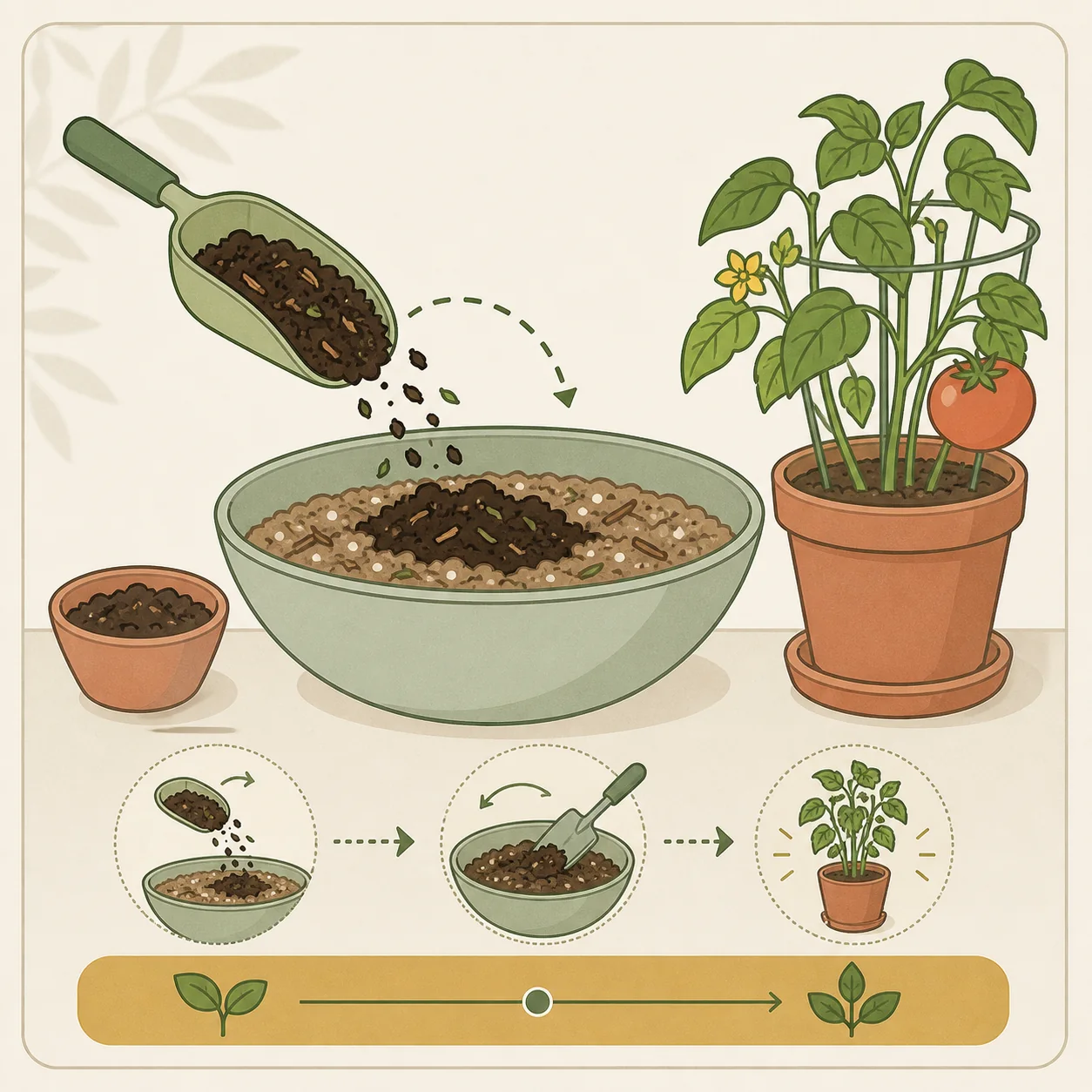
How much compost should you add to potting mix?
More compost is not automatically better. In a container, compost must share limited space with the coarse particles that preserve air around roots.
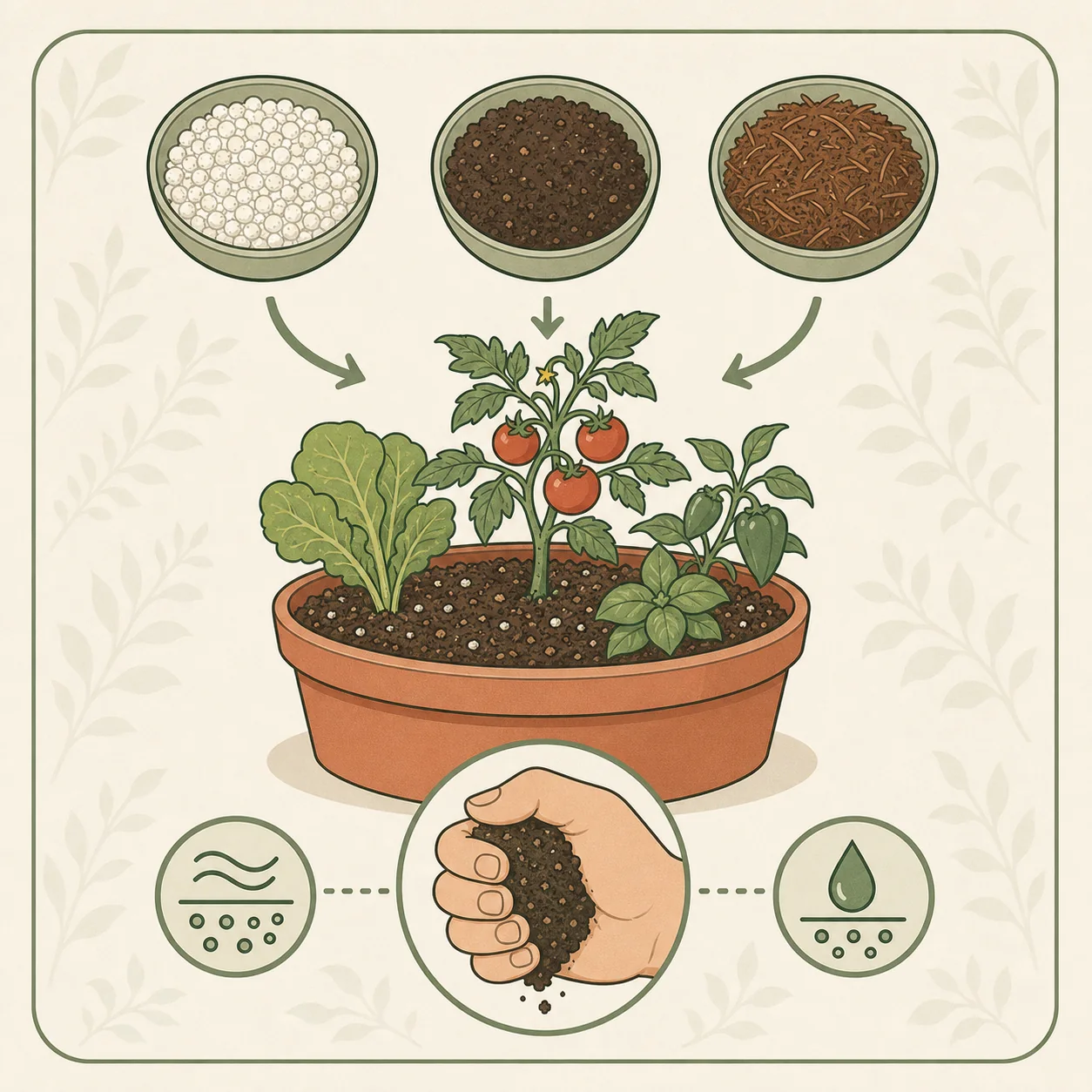
How to make potting mix for container vegetables
A useful potting mix recipe describes the job of each ingredient and gives you a way to correct the result. The goal is stable air and moisture, not a magic ratio.
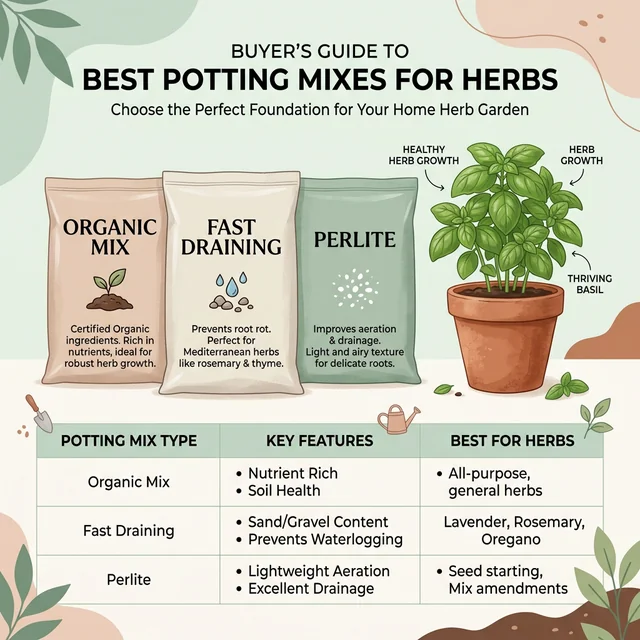
Best potting soil for potted herbs: how to pick the right mix
A practical buyer's guide to choosing potting mix for potted herbs, from richer blends for basil and parsley to faster-draining options for rosemary and thyme.