How Purdue reads a pour-through EC result
| Pour-through EC (mS/cm) | Purdue's label | What Purdue says |
|---|---|---|
| 0 to 0.9 | Very low | Nutrient levels may not be sufficient to sustain rapid growth. |
| 1.0 to 2.6 | Low | Suitable for seedlings, bedding plants, and salt sensitive plants. |
| 2.7 to 4.6 | Normal | Standard root zone range for most established plants; upper range for salt sensitive plants. |
| 4.7 to 6.5 | High | Reduced vigor and growth may result, particularly during hot weather. |
| 6.6 to 7.8 | Very high | May result in salt injury due to reduced water uptake; marginal leaf burn and wilting. |
| Above 7.8 | Extreme | Most crops will suffer salt injury at these levels. Immediate leaching required. |
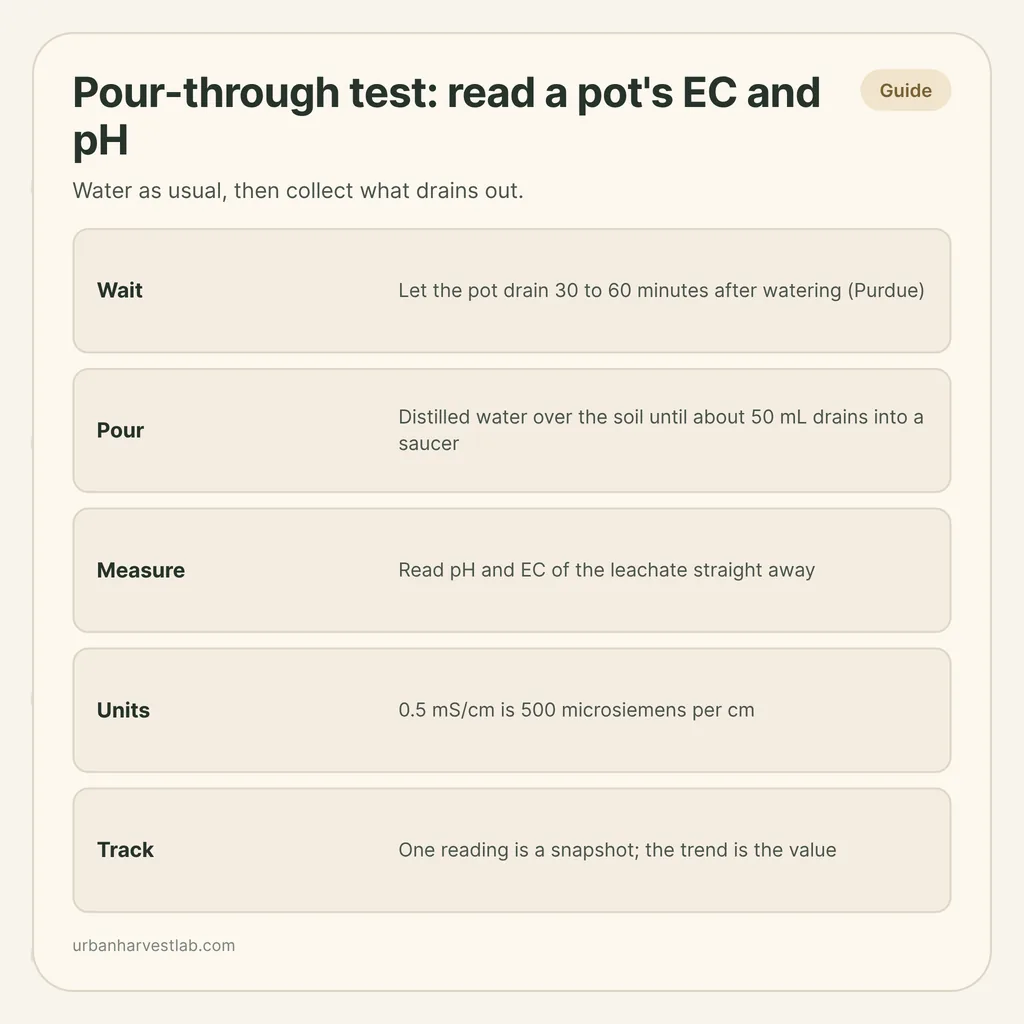
A pour-through test collects the water that drains from a pot after you pour distilled water over the soil, then reads its pH and electrical conductivity (EC) with a meter. In Purdue Extension’s version, you water the pot as usual, let it drain for 30 to 60 minutes, pour until about 50 mL drains into a saucer, and measure that. It reads the whole pot without disturbing a root, which makes it a sensible first step before you decide whether the plant needs flushing, a repot or just a lighter feeding hand.
What the test measures
EC is a measure of the dissolved salt concentration in a growing substrate, according to Purdue Extension. Fertilizer is made of salts, and so is the mineral load in hard tap water, so EC rises when feed or minerals pile up in the pot. The pH is a separate reading with a separate job: Purdue notes that all nutrients are readily available at a pH of 5.4 to 6.2, but each plant species has an optimal range, and that high alkalinity in irrigation water can push substrate pH up over time.
Keep the two apart. A salty pot and an off-range pH are different problems with different fixes, and the pour-through gives you both numbers in one sample. For what pH does to nutrient access, see container soil pH.
NC State Extension describes the leachate reading as an average of the nutrients available to the plant. It is not a map of the pot. A cluster of fertilizer granules on one side will not show up cleanly, and Purdue lists the main weakness of the method as variability: sampling from dry pots may read a higher EC because of higher salt concentration, and adding too much water can dilute the sample and read lower.
What you need
- A meter that reads both pH and EC. The University of Kentucky e-GRO alert prefers a combination pH/EC meter but accepts separate single-purpose ones. Any meter that reads both, hydroponic ones included, fits; the meter guide covers choosing one, or browse combination pH/EC meters on Amazon.
- Calibration solutions. e-GRO says leachate readings are only as accurate as the last calibration, and gives 1.413 mS/cm as the usual EC standard, with manufacturer instructions taking priority. Purdue adds that peat or bark mixes may need the pH calibration set at 4.0, so calibrate to the range you are testing.
- Distilled water, which Purdue specifies because it has no mineral content.
- A saucer or shallow dish under the pot, a small clear cup, and a measuring cup or syringe that reads in millilitres.
NC State recommends calibrating before each use, and notes that glass electrodes last two years if stored in pH buffer rather than left dry.
The steps
- Water the pot as usual. Use whatever you normally give, plain or fertilized. Purdue’s instruction is to irrigate the way your routine works, so the sample reflects how you actually grow.
- Let it drain for 30 to 60 minutes. The e-GRO alert allows 30 minutes to 2 hours for the nutrients in the pot solution to equilibrate. Pick one wait and keep it the same every time.
- Set the pot on a saucer. NC State advises elevating the pot about half an inch above the saucer for best results.
- Pour distilled water over the soil surface. e-GRO says to circle the plant and avoid pouring in one spot. Aim to collect about 50 mL (1.7 oz) of leachate.
- Measure straight away. e-GRO notes leachate pH can change within 2 hours of sampling. Rinse the probe with distilled water afterwards.
- Write the numbers down with the date, pot and what you last fed.
How much water to pour
The sources give different pour volumes but the same collection target. Purdue says more than 70 mL of leachate can dilute the salt content, while less than 50 mL may not cover the probe. e-GRO allows up to 90 mL before dilution lowers the EC reading. A 2021 review by a USDA researcher found that, in one study, leachate pH and EC tended to decrease with increasing volume applied.
| Pot | Purdue (distilled water) | University of Kentucky e-GRO |
|---|---|---|
| 4 to 6 inch pot | 75 mL | n/a |
| 1 quart | 75 mL | 70 mL |
| 6.5 inch pot | 100 mL | n/a |
| 1 gallon | 150 mL | 75 mL |
| 3 gallon | 350 mL | 80 mL |
The two tables differ most for large pots, and both target about 50 mL of leachate. Peat, coir and bark hold different amounts of water, and a pot that was not watered thoroughly first will swallow more. Treat the figure as a starting point: pour the lower amount, see what drains, and if you collect less than 50 mL, add a little more. If you collect much more than 70 mL, note that the next test needs less water. The pot sizes in nursery labels do not match gallons, so check yours with nursery pot sizes explained.
Reading the result
The table above shows Purdue’s scale for pour-through EC. Three cautions apply before you act on it.
The scale belongs to the method. Purdue states that the target EC range varies by sampling method, and its table runs different numbers for pour-through, a 1:2 dilution and a saturated paste. A reading from one method does not compare with a range from another.
The ranges come from commercial crops. Purdue’s lists are greenhouse floriculture, and e-GRO’s pour-through targets cover perennials, nursery stock and hemp. Neither lists basil, parsley, tomato or lettuce. For a sense of how much ranges vary by plant: e-GRO gives lavender a pH of 5.8 to 6.2 and EC of 1.3 to 2.0 mS/cm, and perennial sage 5.5 to 6.2 and 2.0 to 3.0. NC State’s 2009 nursery guide suggests leachate EC of 0.5 to 2.0 mS/cm for most nursery crops during active growth, and Virginia Tech’s peony guide gives pH 5.5 to 7.0 and 0.8 to 3.0 dS/m. Use these as a frame, not as a target for your basil.
Units must match. NC State gives 0.5 mS/cm as the same value as 500 microsiemens per cm, so a meter that reads 1,400 is showing 1.4 mS/cm. If your meter reports ppm instead, switch it to EC mode or use the EC and ppm converter, because the published ranges are in EC.
Tap water carries minerals too. NC State measures the EC of the irrigation water and subtracts it from the leachate reading; what is left comes from the fertilizer and the mix.
What to do with the number
Purdue ties the extremes to action: at the top of its scale it says most crops suffer salt injury and immediate leaching is required, and in the band below it describes marginal leaf burn and wilting. A reading that high together with a white crust or brown leaf tips is the point to flush, and salt buildup in herb pots gives the flushing and repotting steps. A reading in the middle of the range means flushing would remove nutrients you are paying for. A very low EC on a pale, slow plant points toward under-feeding, since Purdue says nutrient levels at that end may not sustain rapid growth. Signs of overfertilizing covers the opposite case.
The real value is the trend. Purdue’s advice is to be consistent, ideally with the same person testing each time, and to track values over time on a graph. One reading is a snapshot, while a month of readings on the same pot shows whether the EC is climbing between feedings.
Do not push the probe into the soil as a shortcut. Purdue does not recommend sensors inserted directly in the substrate unless the moisture is highly consistent and the same routine is followed every week, which a houseplant seldom gives you.
Sources
- Purdue Extension HO-237-W, pH and Electrical Conductivity Measurements in Soilless Substrates
- University of Kentucky e-GRO Alert 10-10, PourThru Method for Large Containerized Crops
- NC State Extension, The Pour-Through Extraction Procedure: A Nutrient Management Tool for Nursery Crops (2009)
- Virginia Tech Extension SPES-388, Container Production of Peonies
- Altland 2021, USDA ARS, The Pour-Through Procedure for Monitoring Container Substrate Chemical Properties: A Review, Horticulturae 7(12):536
After the reading
Once you have a number, these pages cover what to do about salt, pH and the meter itself.
Common questions
How much water do I pour through a pot for the test?
Enough distilled water to collect about 50 mL (1.7 oz) of leachate. Purdue gives roughly 75 mL for a 4 to 6-inch pot or 1 quart pot, 100 mL for a 6.5-inch pot and 150 mL for a 1-gallon pot. The University of Kentucky e-GRO table gives 75 mL for a 1-gallon pot. Start with the lower figure and add a little if less than 50 mL comes out.
How long should I wait after watering before the pour-through test?
Purdue says to let the pot drain for 30 to 60 minutes after irrigating. The University of Kentucky e-GRO alert says to wait 30 minutes to 2 hours so the nutrients in the pot solution equilibrate before testing.
What is a good EC reading for a potted plant?
It depends on the plant and on the method. For pour-through readings, Purdue calls 1.0 to 2.6 mS/cm low (suitable for seedlings and salt-sensitive plants) and 2.7 to 4.6 mS/cm normal for most established greenhouse plants, while NC State's 2009 nursery guide suggests 0.5 to 2.0 mS/cm for most nursery crops. Kitchen herbs are not in those tables, so compare your own readings over time.
Can I use a hydroponic EC and pH meter for the pour-through test?
Yes, if it reads both pH and EC and you calibrate it first. Read it in EC units (mS/cm or microsiemens) so the numbers match the published ranges, and rinse the probe with distilled water between samples.
Related guides
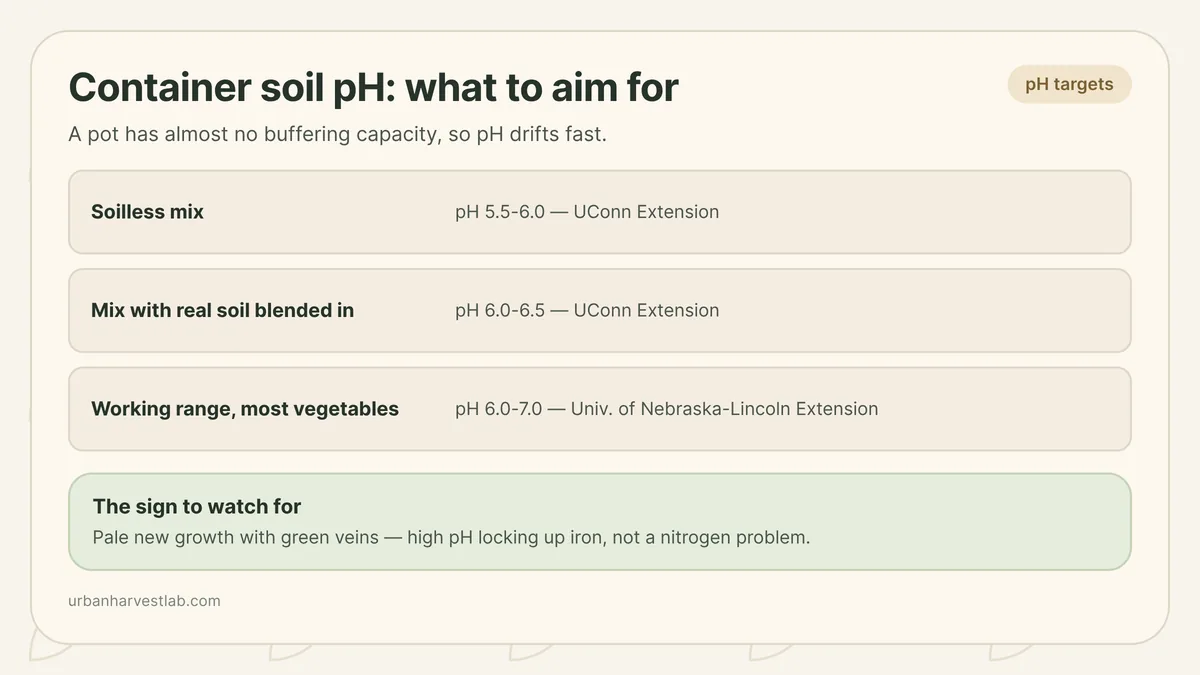
Container soil pH: when it matters and how to fix it
A container's small volume has almost none of the buffering capacity open ground has, so pH drifts faster and matters sooner. Here is when to test, what to aim for, and how to move it.
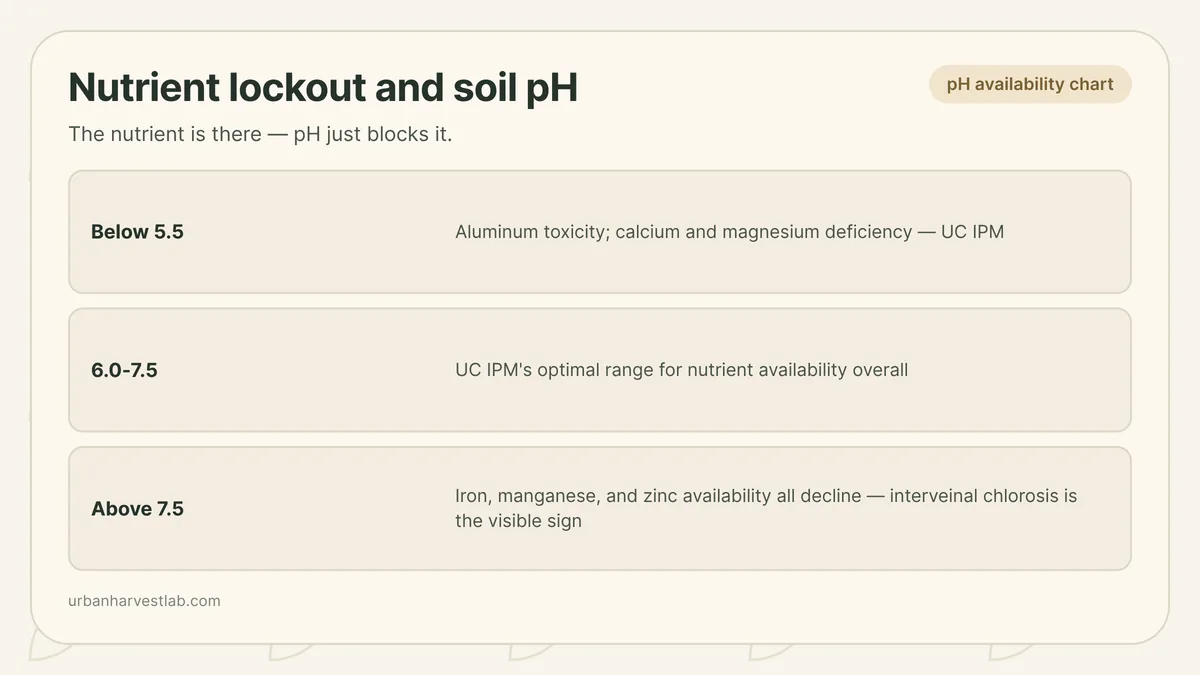
Nutrient lockout and soil pH: why pH blocks nutrients that are already there
A fertilizer that tests complete on the label can still leave a plant starving if the mix's pH is wrong. Here is what pH does to nutrient availability, zone by zone, and why it isn't a salt problem.
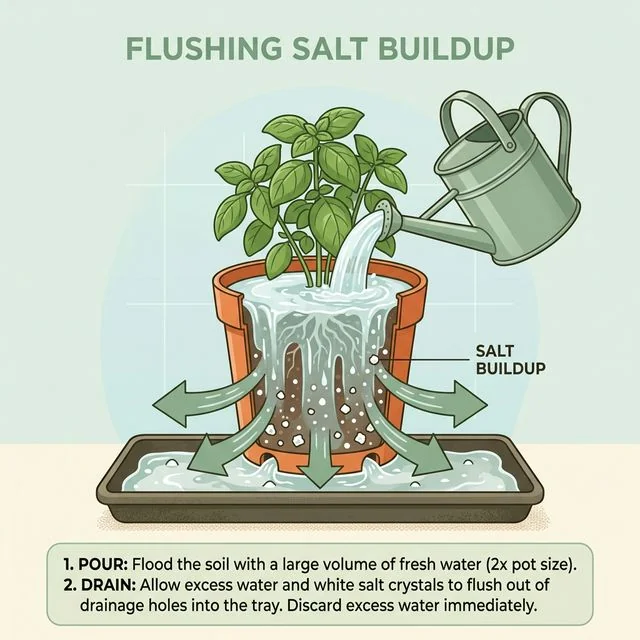
Salt buildup in herb pots: when to flush and when to repot
Every time you water your plants with liquid fertilizer, you are leaving heavy chemical salts behind. If you don't periodically wash them out, your herbs will suffer from chemical burn and nutrient lockout.