Two ways to grow a globe artichoke in a pot
| Factor | Annual route (Imperial Star from seed) | Perennial route (Green Globe type) |
|---|---|---|
| Chilling needed | Less than 250 cumulative hours below 50 F (Connecticut estimate) | At least 500 hours below 50 F (Connecticut) |
| Buds | Possible in the first summer after a cold start | From the second summer (RHS) |
| First year | Sow indoors early, chill, set out after frost | Remove first-year buds so roots establish (RHS) |
| Winter | Optional: treat as a one-season crop | Protect the crown every winter |
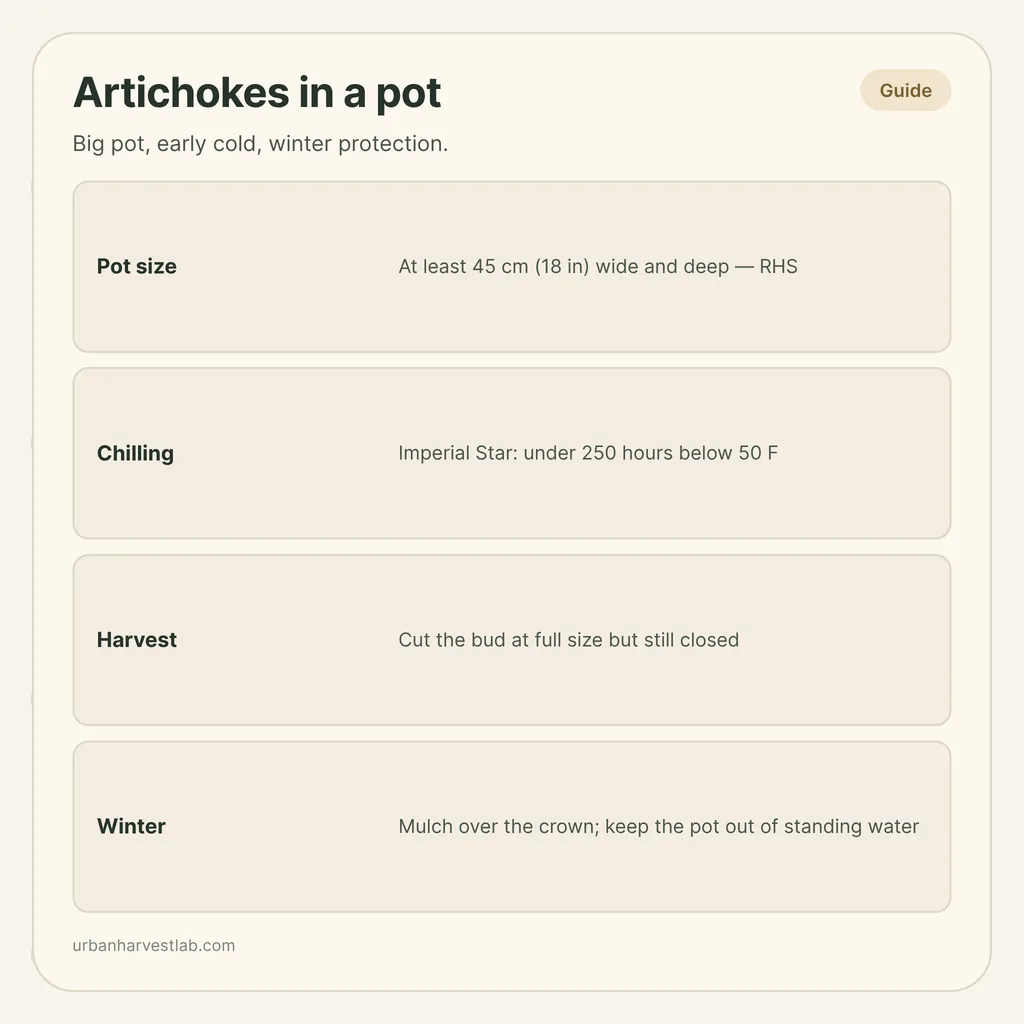
An artichoke grows in a pot if the pot is big, the plant gets cold early, and you protect it through winter. The Royal Horticultural Society (RHS) says containers should be at least 45 cm (18 in) wide and deep. Whether you get buds this summer or next depends mostly on the variety and on how much cold the young plant has had.
Pot, mix and feeding
The RHS rates artichokes as best grown in the ground, but possible in pots. The reason is size: plants generally reach 1 to 1.5 m (3 to 5 ft) tall and up to 1 m (3 ft) wide, and the roots are extensive. That makes one plant per pot the rule, and the 45 cm (18 in) minimum a floor rather than a target. Pick the biggest pot your balcony can carry once wet; container depth for tomatoes, peppers and herbs helps you compare depths, and the drainage holes guide covers getting water out of it. If you are shopping for the pot itself, you can browse extra large planters with drainage holes on Amazon.
The RHS suggests a peat-free multi-purpose compost. University of California Master Gardeners (Ventura County) say to use potting soil or a blend of compost, topsoil and vermiculite for containers.
For feeding, the RHS says that in a container you can boost bud production by feeding in spring with an organic-based, high-potassium fertiliser. The Ventura County guide adds that high-nitrogen fertilizer increases green growth, not fruit, which is a reason not to push leafy growth with a general feed.
The RHS says to be prepared to water pots regularly in dry weather. It also says that in prolonged hot, dry spells while buds form, a lack of water can lead to fewer, smaller buds. Connecticut researchers link moisture stress to a disorder called black tip, where the tips of the bracts turn dark and leathery.
Choose the route: annual or perennial
Artichoke plants switch from leaves to flower buds after a spell of cold, called vernalization. How much cold varies by variety, which is why the advice on timing differs so much.
The Connecticut Agricultural Experiment Station describes Imperial Star as a cultivar designed for annual culture from seed, with low vernalization requirements. It estimates the need at less than 250 cumulative hours below 50 F. Green Globe and Green Globe Improved, the standard California types, need at least 500 hours below 50 F by the same source. University of Florida (UF/IFAS) gives a broader general range of 250 to 500 hours below 50 F.
Oregon State University cites Virginia trials where about 1,300 hours under 50 F fully vernalized both Green Globe and Imperial Star. But after only 200 hours, over 80% of Imperial Star plants flowered, against 25% of Green Globe. The sources disagree on exact hours, so treat the figures as a ranking of varieties rather than a promise.
- Annual route. Grow Imperial Star from seed, chill the young plant, set it out after frost and aim for buds in the first summer. Connecticut says cold treatment starts flower budding in five to six-month-old plants.
- Perennial route. Grow a Green Globe type or buy a plant, and expect buds from the second summer. The RHS says to remove any buds that form in the first year so the plant builds roots.
Oregon State also reports that Imperial Star is tolerant of warm summer temperatures, which helps on a hot balcony.
Getting the chilling in a small space
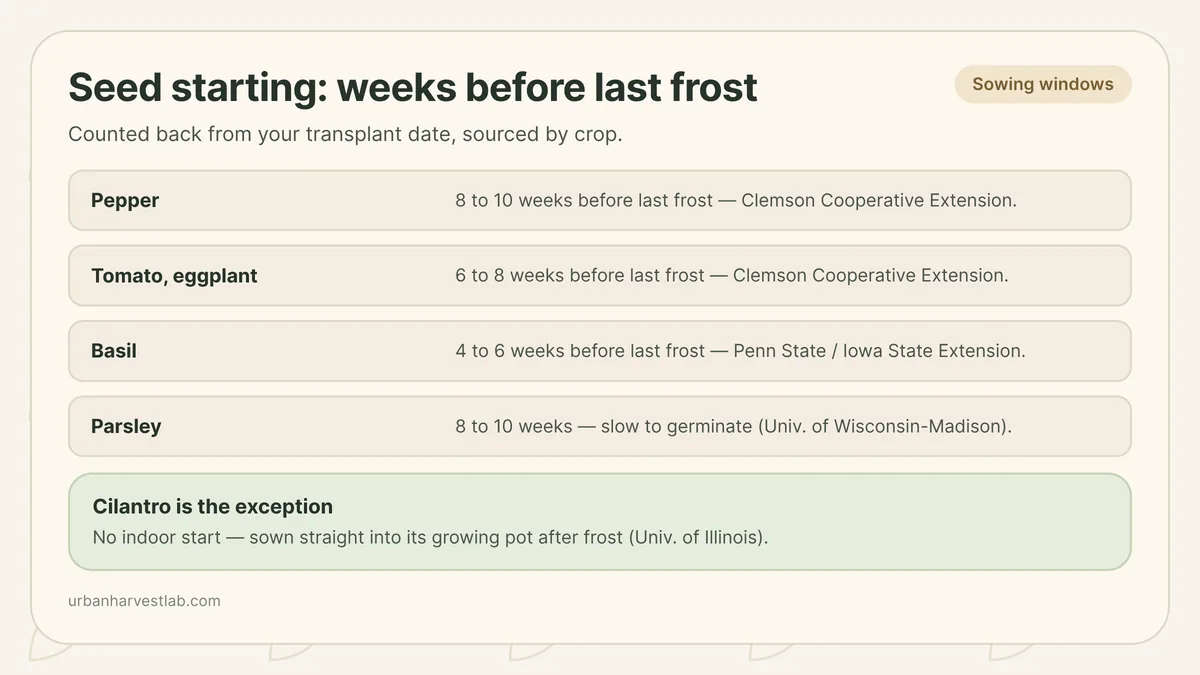
Count back from your last frost date; the seed starting calculator does that, and first and last frost dates for a balcony explains how to find yours. The RHS sows indoors from late winter to mid-spring, one seed to a small pot or module about 2 cm (¾ in) deep, and moves plants up once roots show through the drainage holes. It sets plants outside in late spring or early summer; Connecticut transplants in early to mid-May.
Two chilling methods come from the Connecticut station:
- Cold seed. Soak seed in tap water for two days, pack it in moist unshredded sphagnum moss in an unsealed bag and refrigerate it for four weeks at 36 to 40 F, starting in the first week of February. Then pot the germinated seed.
- Cold frame. Start seed in early March at room temperature, then move the pots to a cold frame in early April until the four-leaf stage. A cold frame is a covered, unheated box outdoors.
Oregon State is less sure about seed chilling: researchers have used four weeks at 35 to 40 F for soaked seed with questionable success, while transplants may be more responsive. Its suggestion for young plants is a two to four-week exposure at about 40 F, to be tested for your location and variety.
Heat can undo the work. Connecticut found summer heat of 80 to 90 F may devernalize unprotected plants, and mulched the soil with four inches of organic mulch right after transplanting. In a pot, a layer over the compost serves the same purpose, and mulching container plants shows how. UF/IFAS adds that temperatures above 86 F reduce the tenderness of the heart and make buds open quickly.
Where there is not enough cold, Connecticut and UF/IFAS both describe gibberellic acid as a substitute. UF/IFAS calls it a plant hormone that induces the genes cold weather activates. Connecticut gives a rate for field plants only, so a dose for a pot is not something to guess.
Harvesting the bud
Look for a bud at full size but still closed. The RHS says to cut it with a length of stalk, just above a leaf joint. UF/IFAS gives 2 to 3 inches below the base of the bud. The Ventura County guide says buds are ready when tight and firm, usually at least 3 inches across. Connecticut’s cue is that the lower bud bracts have just begun to separate.
The RHS notes that buds can open quickly in warm weather, and the Ventura County guide says over-mature buds lose their tenderness and become fibrous. Cut the main bud first. Smaller side buds follow over the summer, and the RHS says a mature plant can produce up to 12 buds in a season.
Any bud you leave opens into a purple thistle-like flower that the RHS says feeds bees and other pollinators. The choke is the fuzzy centre of an unopened bud.
Winter
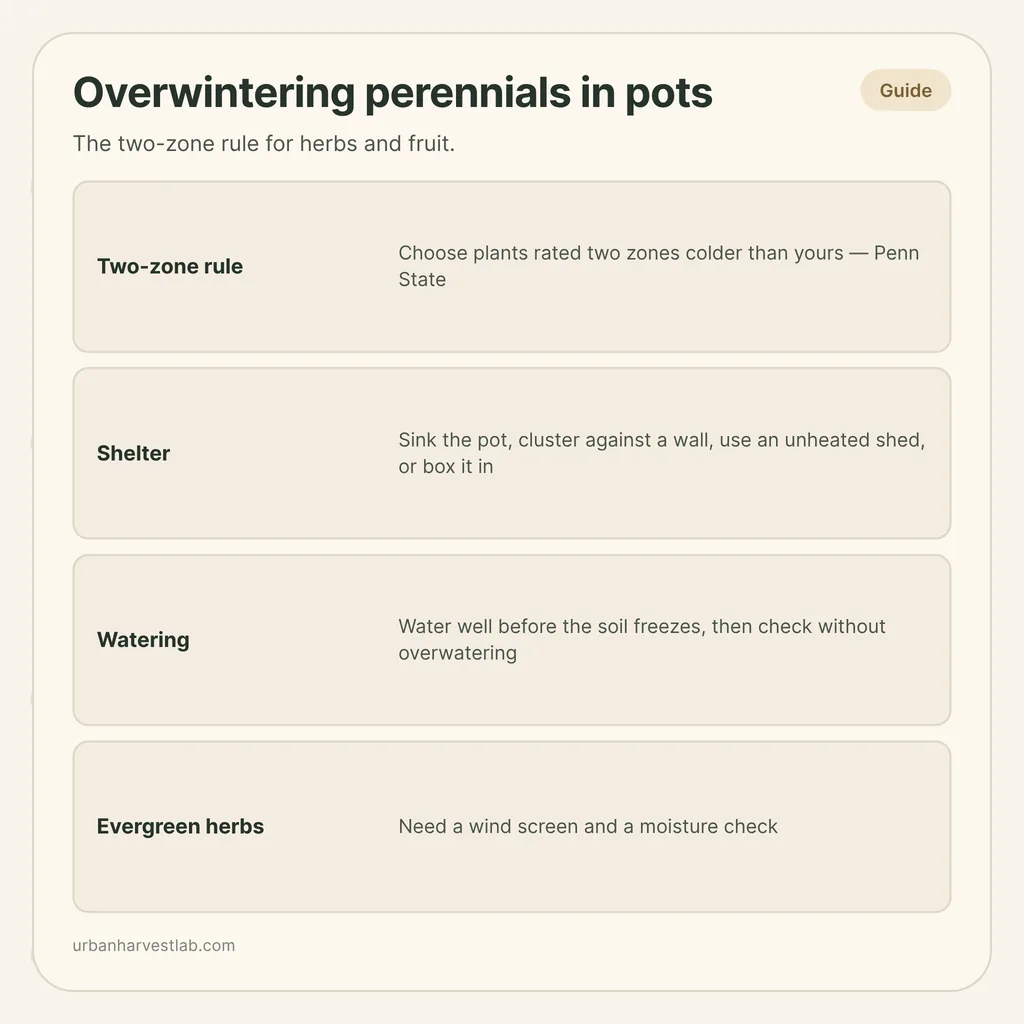
Young plants are particularly vulnerable to cold in their first winter, says the RHS, and very cold or wet conditions can kill even established ones. Overwintering perennials in pots explains the two-zone rule for potted perennials.
Cold limits from the sources, both for plants in the ground:
- UF/IFAS: plants suffer significantly below 28 F.
- Oregon State: avoid temperatures below 25 F, and under 15 F severe loss of crowns is expected even with mulch.
What to do in autumn:
- After harvest, remove old flower stems. In late autumn the RHS prunes off faded foliage at the base.
- Lay the spent foliage over the crown, then add a thick mulch such as straw or garden compost, as the RHS advises in colder regions.
- In hard frost, add fleece or a cloche over a young plant (RHS).
- Keep the pot out of standing water. Wet winters are as dangerous as cold ones, according to the RHS.
If you would rather bring the plant inside, Connecticut dug barren plants and kept them in two-gallon pots in a cool, sunny window. They did not enlarge, and were replanted outside around May 1 and it expected most to produce buds that July. That test was done with field plants, so a pot you already have is simpler.
After four or five years the RHS divides clumps to renew vigour. In a pot that means lifting and splitting the plant in spring, which also gives you spare plants. If the plant is a one-season crop, you can compost it and sow again.
If you want another big perennial with different needs, rhubarb in a pot is a cool-season crop that wants cold rather than warmth.
Sources
- Royal Horticultural Society: How to grow globe artichokes
- Connecticut Agricultural Experiment Station: How to grow globe artichokes in Connecticut
- Oregon State University Horticulture: Artichoke, globe
- UF/IFAS Extension: Production guidelines for globe artichoke in Florida (HS1289)
- UC Master Gardeners of Ventura County: Artichoke
Big perennials and winter care for pots
Another large perennial with its own rules, the winter plan for potted perennials, and the sowing calendar.
Common questions
Can you grow artichokes in pots?
Yes. The Royal Horticultural Society says globe artichokes are best grown in the ground but a crop is possible from pots, which should be at least 45 cm (18 in) wide and deep, filled with peat-free multi-purpose compost and watered regularly in dry weather.
How many artichoke plants go in one pot?
One. The RHS describes plants 1 to 1.5 m (3 to 5 ft) tall and up to 1 m (3 ft) wide, with extensive roots, so a single plant fills a pot of the minimum size.
Will a potted artichoke produce buds in its first year?
Only some will. Connecticut Agricultural Experiment Station describes Imperial Star as a cultivar designed for annual culture from seed, with flower budding starting in five to six-month-old plants after a cold treatment. The RHS says standard perennial plants can be harvested from the second summer.
When do you pick an artichoke?
When the bud has reached full size but is still tight. The RHS says to cut with a length of stalk just above a leaf joint, and the University of California Master Gardeners say buds left to over-mature lose tenderness and turn fibrous.
Related guides

How to grow rhubarb in a pot: size, cold and the leaf warning
A rhubarb planting stays productive for 8 to 15 years, according to Michigan State Extension, so the pot, the winter and the patience matter more than any feeding trick. Here is what a container changes, and what it does not.
Overwintering perennials in pots: the two-zone rule for herbs and fruit
The hardiness zone on a plant tag assumes the roots are in the ground. In a pot they are not, so the rule, the shelter and the winter watering all change.
Seed starting calculator: sowing dates from your last frost date
A last frost date is only useful once you count backward from it. This works out that count crop by crop, instead of applying one week figure to everything in the seed drawer.