
French and Russian tarragon side by side
| Trait | French tarragon | Russian tarragon |
|---|---|---|
| Flavor | Peppery with a hint of liquorice (RHS) | Grassy with a slight bitterness (RHS) |
| How you get it | Divisions or cuttings; seed generally not sold (RHS) | Seed is sold; easy from seed in spring (RHS) |
| Size | 20-30 in. tall, about 12 in. wide (RHS) | About 3.5 ft tall, 20 in. wide (RHS) |
| Wet, cold winters | Often suffers; best in a movable pot (RHS) | More robust, generally survives outside (RHS) |
Tarragon grows well in a pot if you start with a French tarragon plant, give it a sharply drained mix and water only once the soil has dried. Do not start from seed: Utah State Extension says seed typically gives the less flavorful Russian type. French tarragon is the one cooks want, and it is also the one that does best in a pot, because you can move it out of cold, wet weather.
If you are still choosing which herbs to pot, the small-space herb gardening hub puts tarragon in context with the rest.
French or Russian: check before you buy
Both are Artemisia dracunculus, so a label can mislead. Utah State Extension says Russian tarragon is not classified as a different species but has flavor “vastly inferior” to French. The RHS describes French tarragon as peppery with a hint of liquorice, and Russian as more grassy with a slight bitterness. The RHS also warns that plants sold as either can be quite variable.
The practical test is smell. The RHS recommends buying tarragon plants in person so you can check the aroma first. Utah State Extension says the same thing in different words: consult a reputable nursery to get the type you want.
Seed is where people go wrong. French tarragon is shy to flower, so the RHS says its seed is generally not available to buy, and Utah State Extension says a packet of tarragon seed typically produces the less flavorful Russian plant. Russian tarragon is the one you can sow, which suits a gardener who values toughness over flavor.
The size difference matters on a balcony. The RHS gives French tarragon as 50-75 cm (20-30 in.) tall and about 30 cm (12 in.) wide, and Russian as about 1 m (3.5 ft) tall and 50 cm (20 in.) wide. One plant is usually enough for most households, the RHS says.
A small pot with sharp drainage
University of Maryland Extension lists tarragon among the herbs that grow well in 2- to 5-gallon pots. The RHS sets a floor for one plant: a container at least 20 cm (8 in.) wide and deep, with plenty of drainage holes. A pot nearer the 2-gallon end suits a single French plant, and a larger one gives you room to grow it for a few seasons.
Drainage is the point of the whole setup. Utah State Extension says French tarragon grows best in warm, dry, well-aerated soil and does not tolerate wet or saturated soil. The RHS suggests a peat-free, soil-based compost with up to 25 percent horticultural grit by volume. Utah State gives a preferred pH of 6.5 to 7.5.
Put the pot in full sun. Both the RHS and Utah State Extension say French tarragon wants it. Utah State adds one caution for hot places: where summer temperatures exceed 90°F, partial shading increases plant survival. On a south-facing balcony in midsummer, that means moving the pot back from a hot wall for the afternoon. The best herbs for a sunny balcony covers which neighbours share this taste for heat and dry roots.
Let it dry out, and skip the feed
Water new plants regularly until they establish, then hold back. Utah State Extension says French tarragon performs best when the soil is allowed to dry between irrigations, and that overwatering or poor drainage encourages root rot. The RHS says tarragon dislikes damp conditions and asks you to take particular care not to overwater in containers, especially in cooler weather.
A pot dries faster than a bed, though. The RHS points out that container compost can dry out quickly in summer, so check regularly. Press a finger into the mix: if it is dry, water thoroughly and let it drain. If it is still damp, wait. Cool, cloudy weeks need the longest gaps. The potted herb watering chart shows where tarragon sits among other pots.
Skip the feed. Utah State Extension says tarragon needs little fertilizer, that flavor is intensified in nutrient-poor soil, and that you should fertilize only at planting.
Picking for flavor
The RHS says to harvest from spring into autumn, picking from the shoot tips regularly to encourage fresh young growth, and to pinch out any stems with flower buds to prolong leaf harvests through summer. Utah State Extension defines a sprig as typically one-third the length of the stem. For the general method, see how to harvest herbs so they keep growing.
Tarragon is best fresh. The RHS says dried leaves have a milder flavor, and Utah State Extension reports a reduction in flavor after drying. Both mention freezing: Utah State says freshly chopped leaves or sprigs can be frozen in tightly sealed freezer bags. The freezing guide has the method.
Propagation: division first, cuttings second
A French tarragon plant is itself a copy, and the only way to get more is to copy it again. The RHS calls division usually the easiest method for French tarragon. Softwood cuttings taken from new growth in summer are the other route.
Division
- Wait for spring. Utah State Extension says to divide just as new shoot tips are emerging.
- Lift the plant from the pot and cut it with a knife. Utah State says French tarragon roots are brittle, so use a knife rather than a shovel or hoe.
- Pot each piece in fresh mix. Utah State Extension says you should get three to five new plants from each parent.
Cuttings
Utah State Extension’s method: cut 4 to 6 inch stems just below a node, remove the lower third of the leaves, dip the end in rooting hormone and plant it in warm, moist potting media, misting periodically. The general routine for rooting and potting on is in how to regrow herbs from cuttings, which uses basil, mint and rosemary as examples; the same steps work for tarragon.
Plan on renewing. The RHS describes tarragon as a short-lived perennial and suggests dividing every few years or taking cuttings. Utah State Extension says to renovate French tarragon every 2 to 3 years for flavor and vigor. A crowded pot is a signal too; root pruning is an option if you would rather not move up a size.
Winter
Tarragon is a herbaceous perennial. The RHS says the top growth dies back after the first hard frost, then the plant resprouts in spring, so a bare pot in winter is not a dead one. In spring, cut away last year’s growth to the lowest new shoots near the base (RHS).
The risk is cold plus wet. The RHS says French tarragon often suffers in winter because of that combination, and recommends moving the pot somewhere dry, such as a greenhouse or porch. With no covered space, it suggests a sheltered outdoor spot near a building, in a rain shadow. Russian tarragon is more robust and generally survives outside, unless the compost becomes waterlogged.
You have two routes. To keep picking, follow Utah State Extension: bring a potted French tarragon inside after the fall harvest, water and fertilize it to stimulate growth, and place it where it gets 6 hours of direct sun each day. To let it go dormant, use the RHS approach above: a dry, sheltered spot such as a porch or a rain shadow, with the top growth left to die back and no push for new growth. Where the plant is grown in the ground as a perennial, the same source says to shear it to the ground after frost has killed the top growth and to mulch heavily. Utah State rates the plant winter hardy to zone 4 in the ground, but that figure is for plants with the soil around their roots; a pot exposes the roots more, and neither source gives a pot-specific minimum.
For the dormant route, the placement and wet-roots advice in overwintering rosemary and thyme applies to tarragon too. If you plan to keep picking over the dark months, the winter indoor herb guide covers light.
Sources
Herbs through the year
Propagation, winter care and harvesting for perennial herbs in pots.
Common questions
How do you grow tarragon in a pot?
Plant a nursery-bought French tarragon in a pot of 2 to 5 gallons (University of Maryland Extension), at least 8 inches wide and deep, in a soil-based mix with up to 25 percent grit (RHS). Put it in full sun, let the soil dry between waterings (Utah State Extension), and pick from the shoot tips.
Can you grow French tarragon from seed?
No. Utah State Extension says French tarragon seldom flowers, so little seed exists, and that seed-grown plants typically turn out to be the less flavorful Russian tarragon. The RHS says French tarragon is generally propagated by division or softwood cuttings instead.
How do you tell French tarragon from Russian tarragon?
Check the aroma. The RHS says French tarragon has a peppery flavor with a hint of liquorice, while Russian is more grassy with a slight bitterness, and that plants sold as either can be quite variable. Buy in person and crush a leaf if you can.
Does tarragon survive winter in a pot?
The RHS says French tarragon often suffers in cold, wet winters and is best moved somewhere sheltered and dry, such as a greenhouse or porch. Utah State Extension says to bring a potted plant indoors after the fall harvest and give it 6 hours of direct sun. The top growth dies back after the first hard frost (RHS).
Related guides
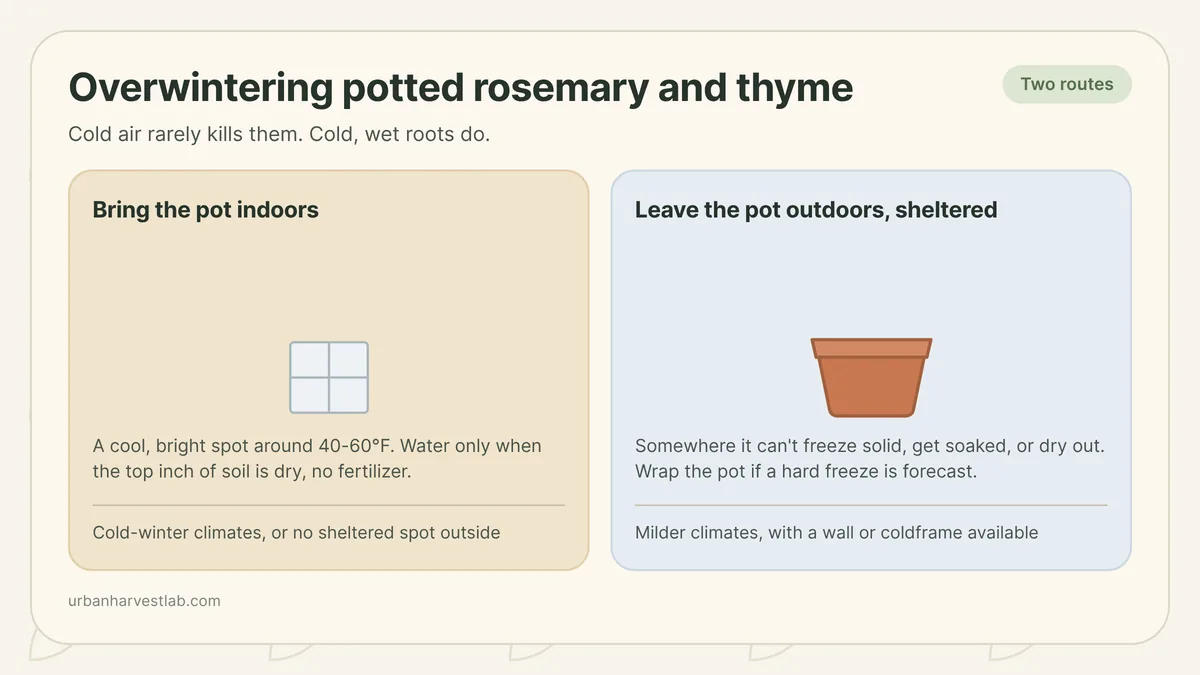
How to overwinter rosemary and thyme in pots
Winter kills more potted rosemary and thyme through mistimed watering and cold-wet roots than through cold air alone. Here is what to do indoors and out.
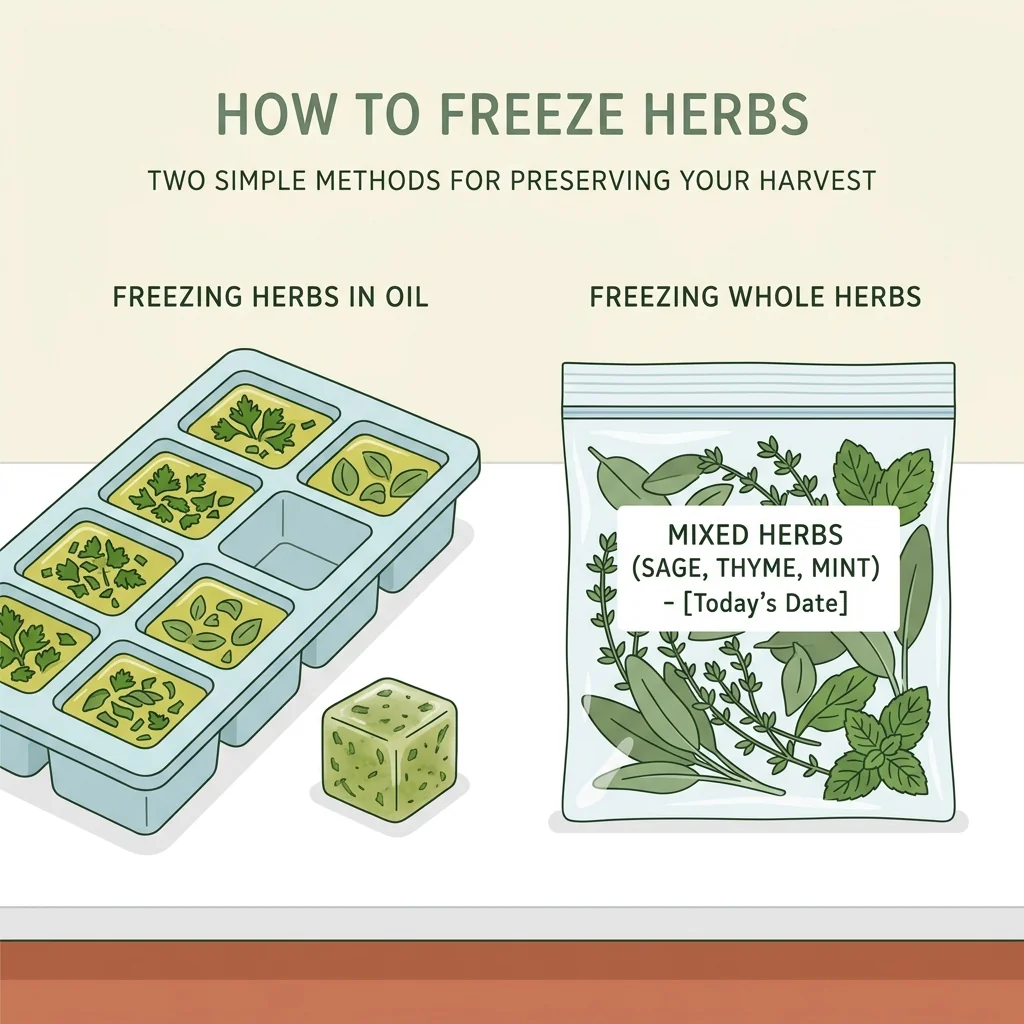
How to freeze herbs without losing flavor
Freezing beats drying for soft herbs. Chopped into oil-filled ice cube trays or frozen whole, basil and parsley keep far more of their fresh flavor.
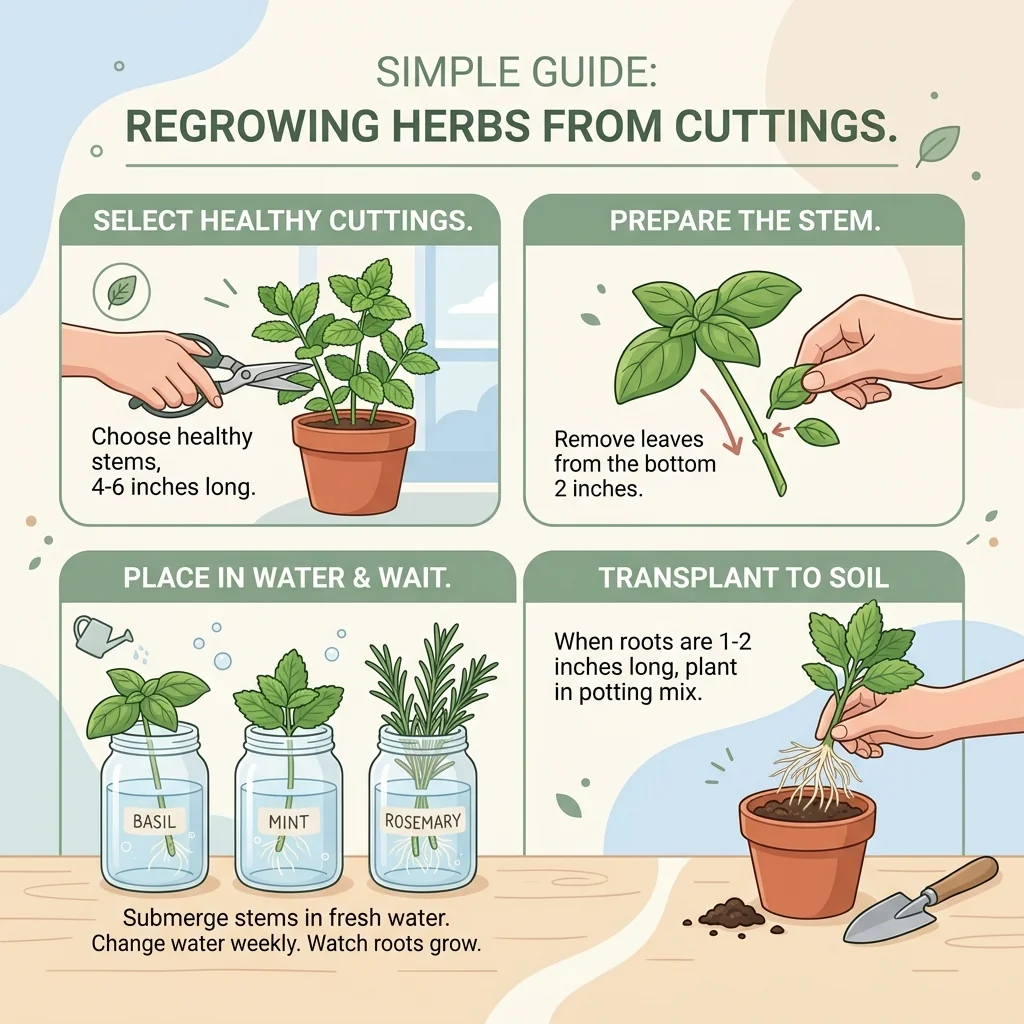
How to regrow herbs from cuttings (basil, mint, rosemary)
Many herbs root from a simple stem cutting in a glass of water. It is the cheapest way to turn one plant, or a supermarket bunch, into many.