Potted pomegranate: what the sources say
| Question | Answer | Source |
|---|---|---|
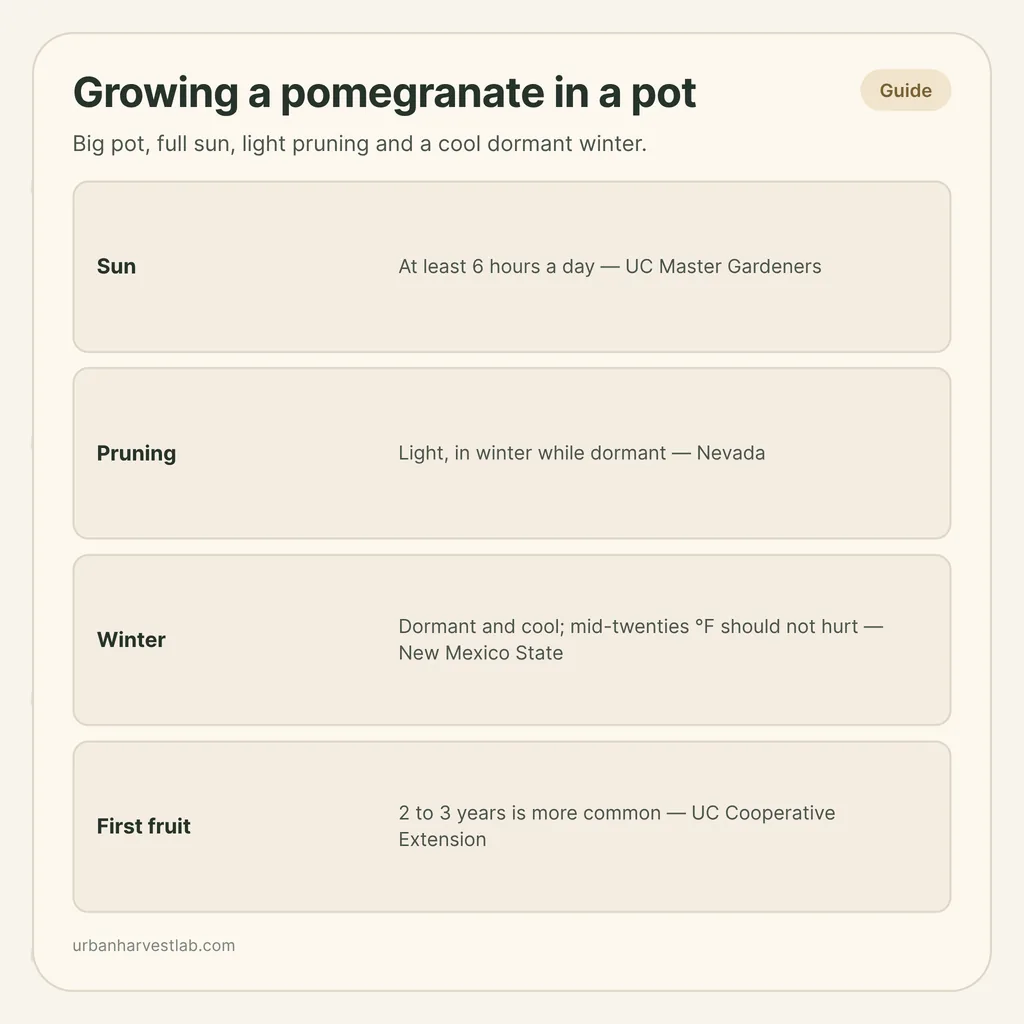
| Sun | Minimum 6 hours a day; partial shade reduces fruit set | UC Master Gardeners, Clemson |
| First fruit | One year is possible, 2 to 3 years more common | UC Cooperative Extension |
| Fruit ripening | 5 to 7 months after bloom | UC Cooperative Extension |
| Pruning | Light, in winter, while dormant | University of Nevada |
| Winter | Dormant and cool; mid-twenties °F should not hurt it | New Mexico State |
| Pollination | Plant two or more for better fruit set | Clemson |
A pomegranate grows well in a large pot if it gets at least 6 hours of sun, light pruning and a cool dormant winter, and a fruiting variety may start cropping in two to three years. Clemson Extension says the compact forms perform quite well in large containers. Its other advice for the ground applies in a pot too: full sun, good drainage and even moisture.
It is a Mediterranean fruit like the fig and the olive, but it loses its leaves in winter, which changes where you keep it.
Check that your “dwarf” will fruit
The label matters more than the size. NC State Extension describes ‘Nana’ as a compact or dwarf form growing to about 3 feet tall. The sources disagree about whether it fruits. The University of Nevada Cooperative Extension lists ‘Nana’ among ornamental varieties and says plainly: “Ornamental cultivars do not produce fruit.” Clemson’s cultivar list describes ‘Nana’ as “2 – 3 ft tall; red-orange flowers followed by small fruit”. Either way, any fruit is small. Clemson also adds that double-flowering cultivars generally produce few, if any, fruit.
So if you want a harvest, buy a variety sold for its fruit and ask the seller how big it gets. Nevada names ‘Wonderful’ as the long-standing commercial variety, and ‘Granada’ and ‘Early Red’ as patented cultivars that mature earlier. UC Master Gardeners in Riverside County list Ambrosia, Granada, Eversweet and Wonderful for home gardens. None of those sources says which are small enough for a pot, so a fruiting variety may need pruning to stay in bounds. A plant of the species can reach 12 to 16 feet in the ground, according to the University of Nevada.
Buy a plant grown from a cutting. Nevada says cuttings keep the parent’s fruiting traits, while seedlings differ from the parent. Clemson says seed-grown plants do not come true to variety.
Pot, sun and pollination
No extension page I opened gave a pot volume, so go large and heavy-ready. A big pot full of wet mix is a real load, so read the balcony weight limit guide first. Drainage holes matter, since Nevada notes poor drainage hurts yield and fruit quality; see the drainage hole guide. If you will move the pot for winter, wheels help: New Mexico State mentions wheeled platforms under heavy pots. You can browse plant caddies with wheels on Amazon before you fill the pot.
The UC Master Gardeners of Riverside County factsheet gives a minimum of 6 hours of sunlight a day. Clemson says partial shade reduces fruit set. Work out which corner gets that with the sunlight measuring guide.
Clemson also says to plant two or more pomegranates, as cross-pollination increases fruit set. UC Cooperative Extension agrees that fruit set increases with cross-pollination. On a balcony that may mean two pots.
Water and feeding
Water evenly. Nevada says drought produces a small crop of poor fruit or none, and that big swings in late summer make ripening fruit crack and split. Clemson likewise says even moisture reduces fruit drop and splitting.
Go easy on nitrogen. Nevada warns that excessive or late nitrogen causes vegetative growth and reduces fruit production, and says to use less fertilizer on dwarf plants. Its rates are for plants in the ground, so follow your fertilizer label for pots.
Pruning
Pomegranates fruit on short spurs. Nevada says spurs on 2- or 3-year-old wood bear the flowers and fruit, and Clemson says light annual pruning encourages new spurs. Both say heavy pruning reduces fruit.
- Prune in winter while the plant is dormant (Nevada), or before spring growth starts (Clemson).
- Remove dead, broken or diseased wood and crossing branches.
- Remove basal suckers. Clemson says the plant suckers profusely from the base, and Nevada says to remove them each year.
- Cut back on pruning if the plant puts out more than 8 to 10 inches of new growth a year or many water sprouts (Nevada).
Winter
Cold hardiness figures are for plants in the ground. NC State says the plant is killed to the ground below 10 °F; Clemson says the same and adds that it usually re-sprouts; Nevada says dormant plants can be severely injured below 12 °F. A pot is colder: New Mexico State says roots in an above-ground container get colder than roots in soil and are damaged at higher temperatures.
New Mexico State says pomegranate does better in winter if it goes dormant in a very cool place, and that temperatures down to the mid-twenties °F should not hurt it. It needs little light while dormant but periodic watering to prevent drying out. If the storage spot warms early and new growth starts, move the plant to a well-lit place. Iowa State gives 20 to 45 °F as the range that keeps container trees dormant, and says an attached unheated garage can work if temperatures stay in that range.
The two-zone logic is in the overwintering guide, and the indoor winter guide covers bringing pots inside.
When to expect fruit
UC Cooperative Extension says a tree may fruit one year after planting, but 2 to 3 years is more common, and fruit ripens 5 to 7 months after bloom. Clemson puts the first year at one or two fruits at most and good bearing around year three. If your plant flowers but sets nothing, work through Clemson’s list: sun, pollination, over-pruning or cold damage.
Sources
- University of Nevada Cooperative Extension, The pomegranate
- Clemson HGIC, Pomegranate factsheet
- UC Cooperative Extension, Pomegranates in the Valley
- UC Master Gardeners of Riverside County, Pomegranate factsheet
- NC State Extension Plant Toolbox, Punica granatum
- New Mexico State University, Southwest Yard and Garden, Nov 9 2013
- Iowa State University Extension, overwintering container trees and shrubs
More fruit trees in pots
Other fruit and Mediterranean trees that grow in containers, and how to carry them through winter.
Common questions
Can you grow a pomegranate in a pot?
Yes. Clemson Extension says the compact forms perform quite well in large containers. The plant needs full sun, a pot with drainage and a cool dormant winter. Wild-type plants can reach 12 to 16 feet in the ground, so choose a compact form.
How long does a potted pomegranate take to fruit?
UC Cooperative Extension says a tree may begin to fruit one year after planting, but 2 to 3 years is more common. Clemson says plants may carry one or two fruits in the first year and more commonly bear well three years after planting.
Why is my potted pomegranate flowering but not fruiting?
Clemson lists inadequate sunlight, lack of pollination, and over-pruning or cold damage as the usual causes. Double-flowered types produce few if any fruit. The University of Nevada says ornamental cultivars do not fruit, and lists 'Nana' as one, while Clemson describes 'Nana' as bearing small fruit, so the label and the source both matter.
Does a potted pomegranate need to come indoors for winter?
Where winters fall below about 10 °F, plants in the ground can be killed to the ground (NC State, Clemson), and roots in a pot get colder than roots in soil (New Mexico State). Move the pot to a cool, sheltered place while the plant is dormant.
Related guides
How to grow an olive tree in a pot: light, winter and whether it fruits
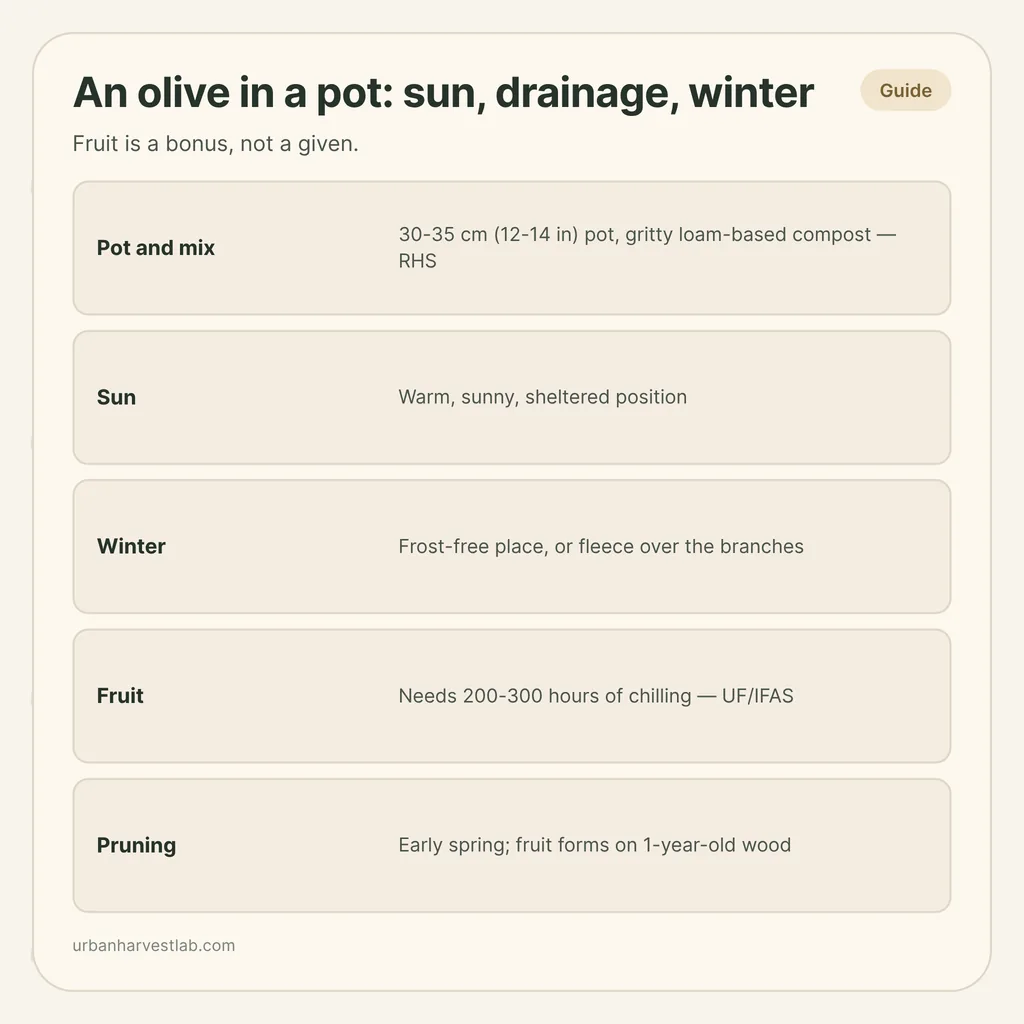
An olive in a pot wants strong sun, sharp drainage and a cold, frost-free winter. Here is how to set it up, prune it and judge your chance of olives.
Overwintering perennials in pots: the two-zone rule for herbs and fruit
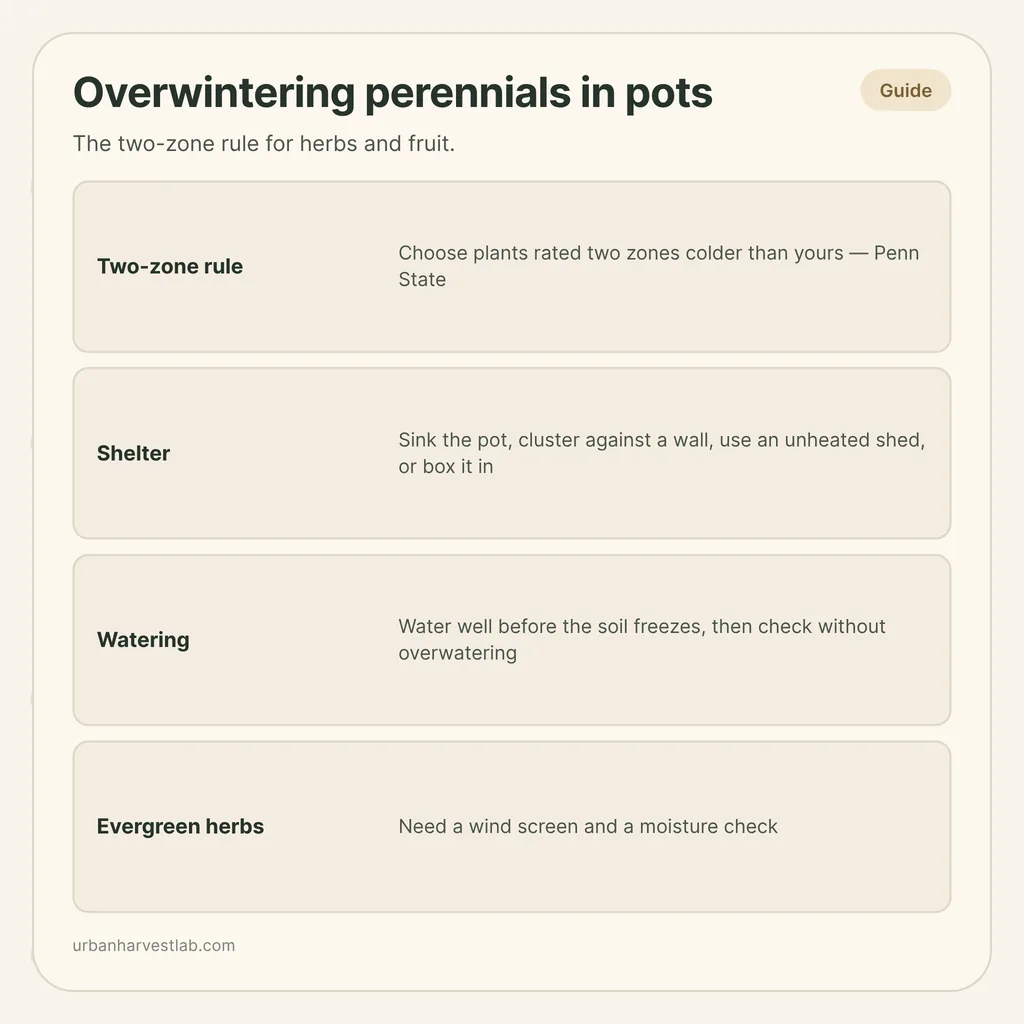
The hardiness zone on a plant tag assumes the roots are in the ground. In a pot they are not, so the rule, the shelter and the winter watering all change.

Bringing potted plants indoors for winter: what to move and what to leave
Not every pot deserves a spot on the windowsill. Here is how to decide what comes in, clear the pests, and get the plants through the light drop.