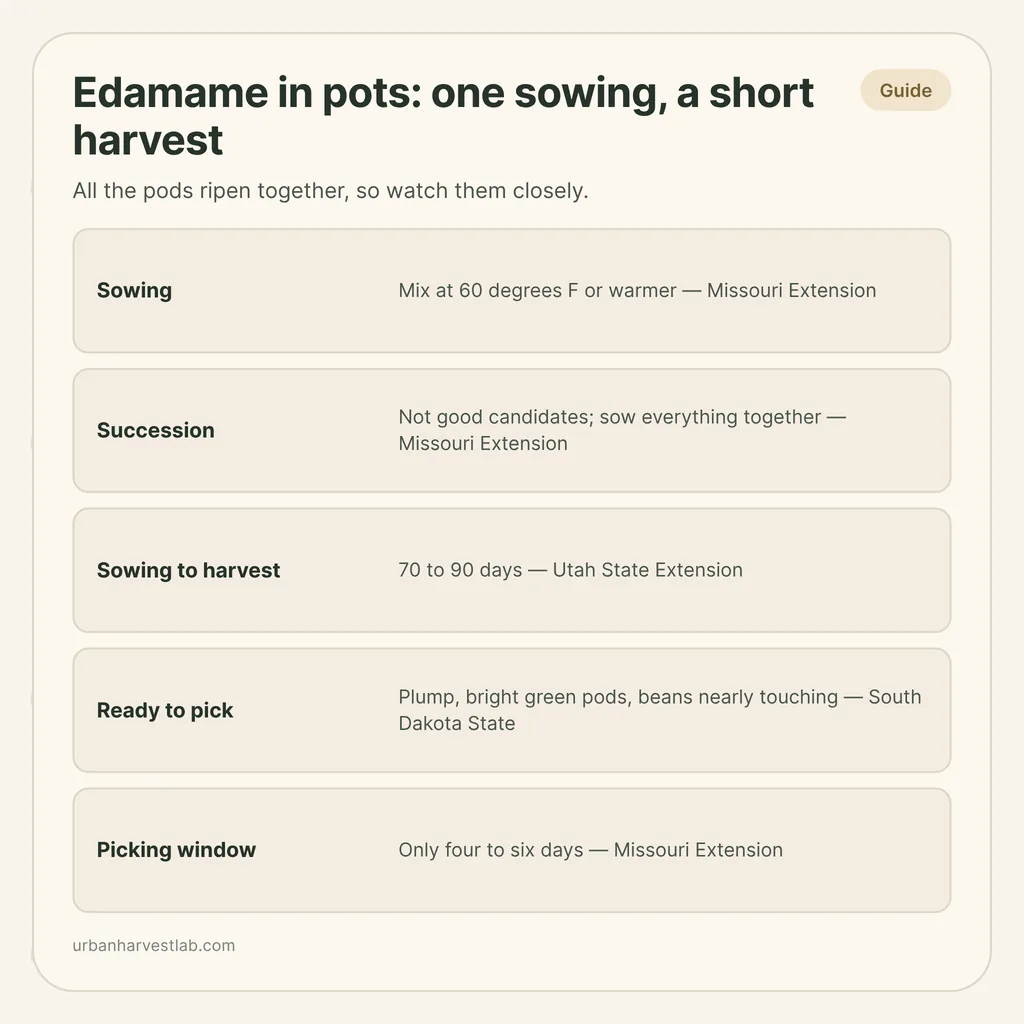
Edamame is a soybean picked green. In a pot it grows like a bush bean, needs no support, and wants warm mix, one sowing and a close eye on the pods, because the whole crop is ready within about a week. University of Missouri Extension says to sow straight into the final container once the soil is at least 60 degrees F, and pick when the beans swell to nearly touch inside the pod.
It looks like a bean and it is grown like one, which is where the trouble starts. Common beans are covered in how to grow beans in pots, and they keep cropping while you pick. Edamame is a different species, Glycine max, and it behaves differently in three ways: it answers to day length, it sets its pods together, and it is picked before the seed is mature.
What makes edamame different from a bean
University of Missouri Extension says edamame is very similar to green beans to grow, but that “edamame plants ripen all pods simultaneously.” Utah State Extension agrees that all the pods on a plant mature at about the same time. So you do not pick a few every other day for weeks. You pick the plant once, over a few days, and then it is finished.
Missouri also notes that soybeans are short-day plants, which flower when nights reach a critical length. For a gardener that has one consequence. University of Missouri Extension says they are not good candidates for succession planting, and that everything you mean to grow should go in together in early to mid May. South Dakota State University Extension takes the other view and says continuous harvests can be had by sowing several times, as with green beans. The two sources disagree, and in a small container garden the safer plan is one sowing, and variety choice (below) is where the days to harvest differ, rather than the sowing dates.
University of Florida IFAS adds that edamame seed is larger than most vegetable seed and takes longer to emerge, and that it needs oxygen to germinate. That matters for a pot: a waterlogged mix is the failure to avoid. The same publication says excessive moisture and cool soil slow seedlings and raise the risk of fungal infection.
Sowing in the pot
Sow where the plant will finish. Missouri’s advice is to sow edamame the way you sow green beans or peas, and direct sowing versus transplanting explains why that suits beans and peas. South Dakota State notes that edamame can be transplanted from a greenhouse, but there is nothing to gain from it in a pot and a good deal to lose from the extra handling.
Timing. Missouri says to wait until the soil warms to at least 60 degrees F, and warns not to rush out when farmers plant corn and soybeans: farm seed is often treated to withstand lower soil temperatures, and edamame seed is not. Utah State says to plant after danger of frost is past. Use your frost dates as the floor and not the target for sowing.
Depth and spacing. The extension sources differ a little, and all of it is workable:
- Missouri: 1 to 1 1/2 inches deep and 2 to 4 inches apart.
- Utah State: 1 1/2 inches deep and 2 inches apart in the row.
- University of Florida IFAS: 0.5 to 1 inch is normal, and if seeds are sown deeper than 2 inches the germination rate may decline.
For the general depth rule across crops, see how deep to plant seeds in pots. Expect emergence in five to seven days, according to University of Florida IFAS.
Inoculant. Missouri says to apply an inoculum to the seed so the plant can use nitrogen from the air. University of Minnesota Extension says inoculation with Rhizobium may help growth and yield, and Florida describes the bacterium as Bradyrhizobium japonicum and recommends it where legumes have not been grown before. A fresh bag of potting mix has not grown a legume, so that is the situation to plan for. The seed-coating powder is sold as a legume or soybean inoculant; browse soybean inoculant on Amazon and check that the label names soybeans, since the strain is specific to the crop.
Pot, water and light
Plant size is the best guide to pot size. Utah State says mature plants are roughly the size of bush green beans, about 18 to 24 inches tall. Minnesota says up to three feet, upright and sturdy, with no support needed. Clemson’s floor for any container plant is 6 to 8 inches of depth, so a pot well beyond that is the sensible choice for a plant this size. As a starting point, the pot sizes and plant counts in the bean pot guide for bush types fit a plant of the same size, with the caveat that this is a comparison rather than an edamame trial.
Missouri’s own yield figures help set expectations: at 4-inch spacing, a pound of edamame per foot of row, and about a dozen plants to feed a family of four. A single pot will not reach that, so think of edamame as a side dish from a few plants rather than a staple.
Water until it runs from the drainage holes. Clemson warns that containers can dry out very quickly on a sunny patio and that daily or even twice-daily watering may be necessary. Florida says water stress during leaf growth can lower yield potential. For the interval by volume, see how often to water container vegetables.
Rabbits and woodchucks eat soybean plants, according to Minnesota, and University of Maryland Extension’s Harford County master gardeners say rabbits love edamame sprouts. On a balcony this rarely applies, but a ground-level patio may need a cover until the plants are past the seedling stage.
Choosing a variety
Varieties differ in days to harvest. Utah State lists varieties in order of ripening: Soy Good, Envy, Beer Friend, Early Hakucho, Lucky Lion, Midori Giant, Bee Sweet, Butterbeans and Sayamusume. The order is a guide to which varieties come first, so you can choose by how soon you want to pick.
South Dakota State describes Chiba Green as early, productive and a bush type, and Tohya as an early variety that performed well in North Dakota. Where summers are short, the earliest names matter most. How the packet number is counted is explained in days to maturity.
The timeline
| Stage | What to expect | Source |
|---|---|---|
| Sowing | Mix at 60 degrees F or warmer, after frost | Missouri, Utah State |
| Emergence | 5 to 7 days after planting | Florida IFAS |
| Sowing to harvest | 70 to 90 days, or 10 to 12 weeks | Utah State, South Dakota State |
| First small seed to full seed | 15 days on average, range 11 to 20 | Minnesota |
| Best picking window | About 4 to 6 days; within a week | Missouri, Florida IFAS |
Picking at the right moment
The harvest is the part that catches people out. Minnesota’s staging table defines the picking stage, R6, as a pod holding a green seed that fills the pod cavity. In the garden that is a plump, bright green, full-sized pod with the beans nearly touching, as South Dakota State puts it, and Minnesota says to pick when plump seeds make the pods bulge, while they are still green.
Do not wait. Florida says pods turn from immature to overripe quickly, going yellow, and that the ideal window is typically within one week. South Dakota State says to harvest before the leaves yellow, because afterwards the beans taste starchy instead of sweet and nutty. Missouri puts the optimum at only four to six days.
Pull the pods by hand or snip them with shears. South Dakota State describes both, plus the traditional East Asian method of cutting the whole plant at the soil line. Cooling matters: South Dakota State says harvest in the early morning, and refrigerate right away. South Dakota State says edamame can wait up to three days before it wilts, and keeps about two weeks at 32 degrees F and 95 percent humidity. University of Maryland Extension’s Harford County master gardeners put it more bluntly, saying that after three days the pods are not good to eat. Eat or freeze within days either way.
Freezing is the usual way to keep a larger pick. Missouri says to blanch whole pods in boiling water for three to four minutes before freezing, and Utah State says three minutes, then cool, dry and bag. Eat edamame cooked: South Dakota State says it is boiled or steamed and not eaten raw, and Minnesota says to cook the beans in boiling water in the pod and not to eat the hairy pods. For ripeness cues across other crops, see when container vegetables are ripe.
Sources
- University of Missouri Extension: The ‘soy of gardening’ includes edamame
- University of Missouri Extension: Edamame, an easy crop to introduce to your vegetable garden
- Utah State University Extension: What is edamame and should I grow it?
- South Dakota State University Extension: Edamame, harvest and storage
- University of Minnesota Extension: Growing beans in home gardens
- University of Minnesota Extension: Soybean growth stages
- UF/IFAS Extension: Edamame growth stages in Miami-Dade County (HS1498)
- Clemson Cooperative Extension: Container vegetable gardening
- University of Maryland Extension, Harford County: Edamame
Beans, sowing and ripeness
The neighbouring pages for legumes in pots, sowing where the plant will finish, and picking at the right moment.
Common questions
Can you grow edamame in a pot?
Yes. Utah State Extension says mature edamame plants are roughly the size of bush green beans, at about 18 to 24 inches tall, and University of Minnesota Extension says they are sturdy and upright and need no support. Give the roots more depth than the 6 to 8 inches Clemson names as the minimum for any container plant, and water often.
When do you plant edamame?
Wait until the soil is at least 60 degrees F, according to University of Missouri Extension, and Missouri puts planting everything together in early to mid May. Utah State Extension says to plant after danger of frost is past. Sow once, because edamame is a short-day plant.
How long does edamame take to grow?
Utah State Extension gives 70 to 90 days from planting to harvest. South Dakota State University Extension gives 10 to 12 weeks for the Midwest. South Dakota State calls Chiba Green and Tohya early-ripening.
How do you know when edamame is ready?
South Dakota State University Extension says the beans are nearly touching inside full-sized, bright green pods. Harvest before the leaves yellow, because the beans turn starchy rather than sweet and nutty afterwards.
Related guides
When container vegetables are ripe, crop by crop
A tomato tells you it's ready with color and give. A zucchini tells you with size and how easily it lets go. The signal is different for every crop, and waiting costs more when the plant only has a pot's worth of reserve behind it.
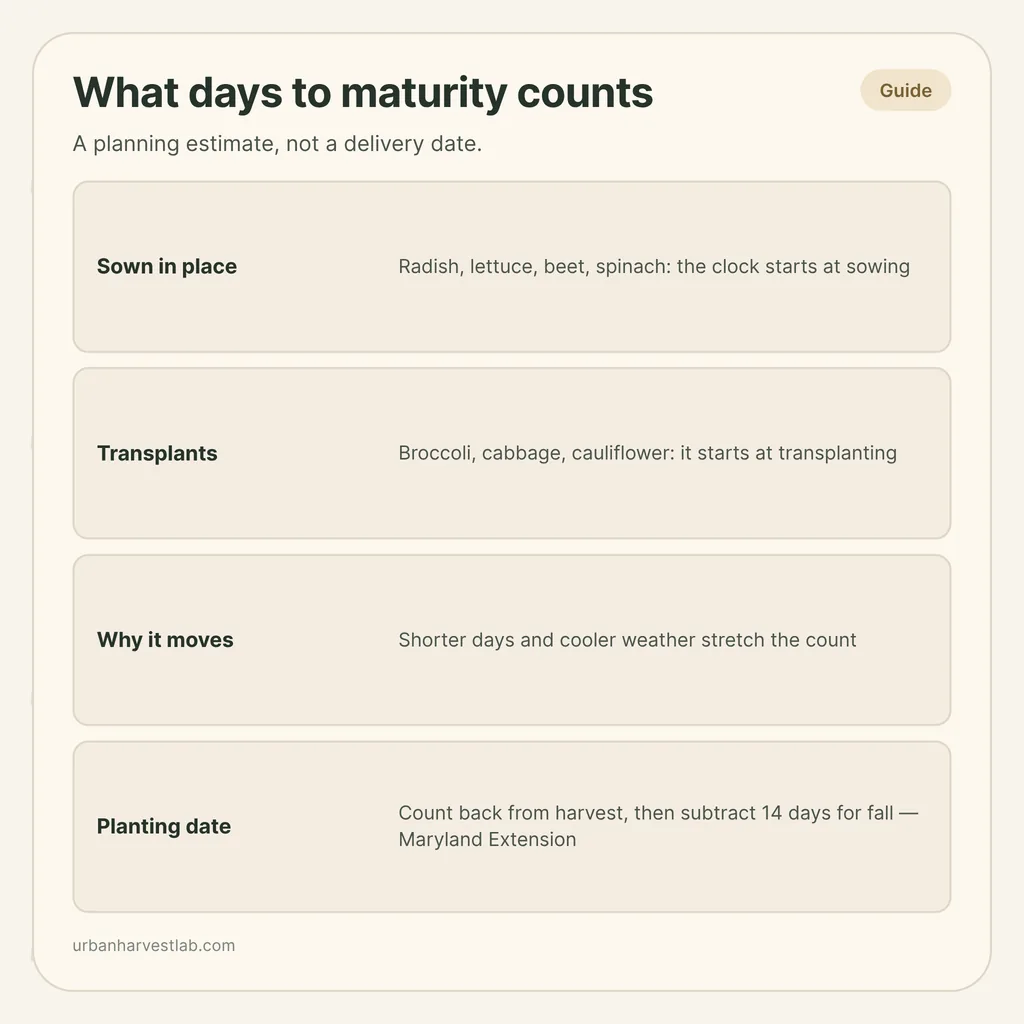
Days to maturity explained: what the seed packet number counts
The number on the packet is a planning estimate, not a promise. Here is where the count starts, what stretches it, and how to use it to date a sowing.
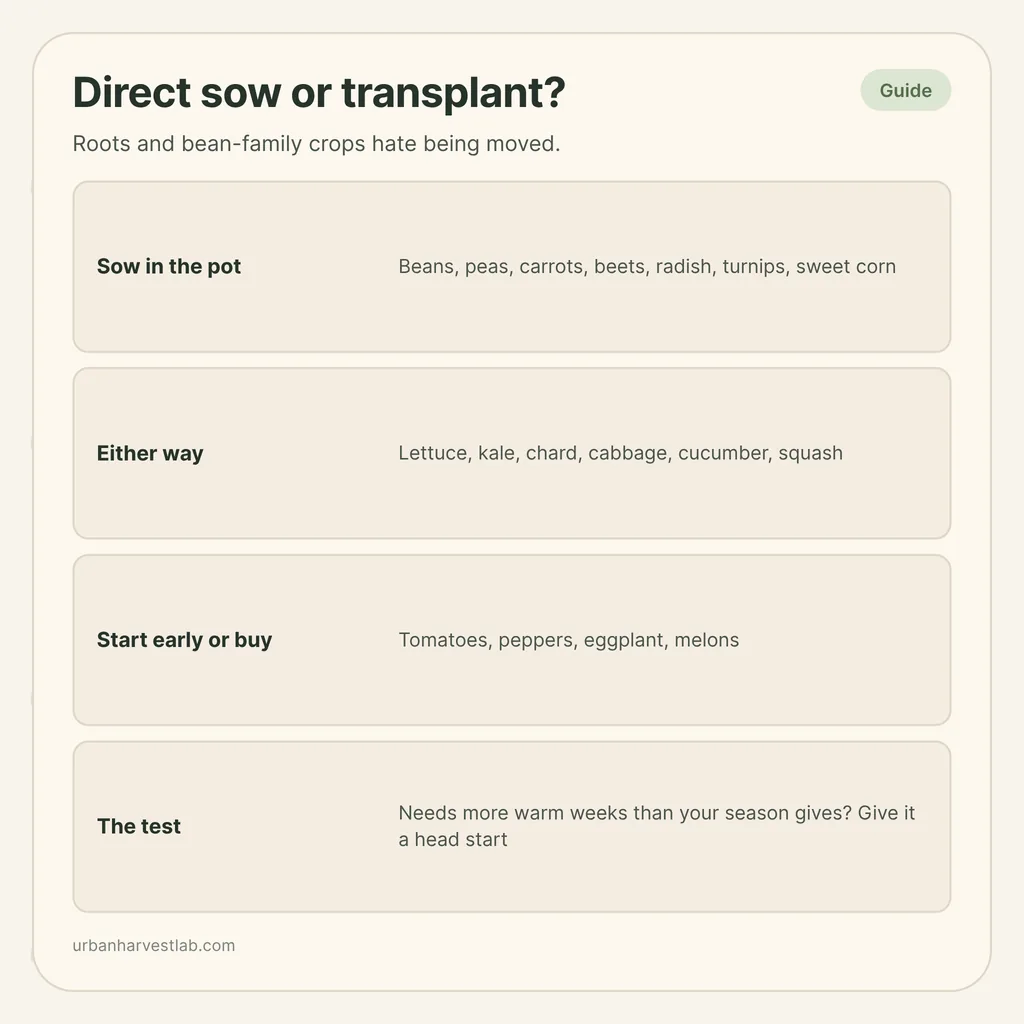
Direct sow vs transplant: which crops to start in the pot
Some crops sulk when moved, others need a head start. Here is which vegetables to sow where they will grow, which to start indoors or buy, and which work either way.