Pot size for a grapevine, by source
| Source | Pot size | Note |
|---|---|---|
| Michigan State Extension | At least 15 to 20 gallons; 16 to 18 in deep, 18 to 24 in wide | Avoid dark pots; wood is the best material |
| NC State Extension | 15 gallons minimum | Listed as the minimum size for grapes |
| RHS | Start at 30 to 38 cm (12 to 15 in); final 45 cm (18 in) deep and wide | For a standard-trained vine; heavy clay pot for stability |
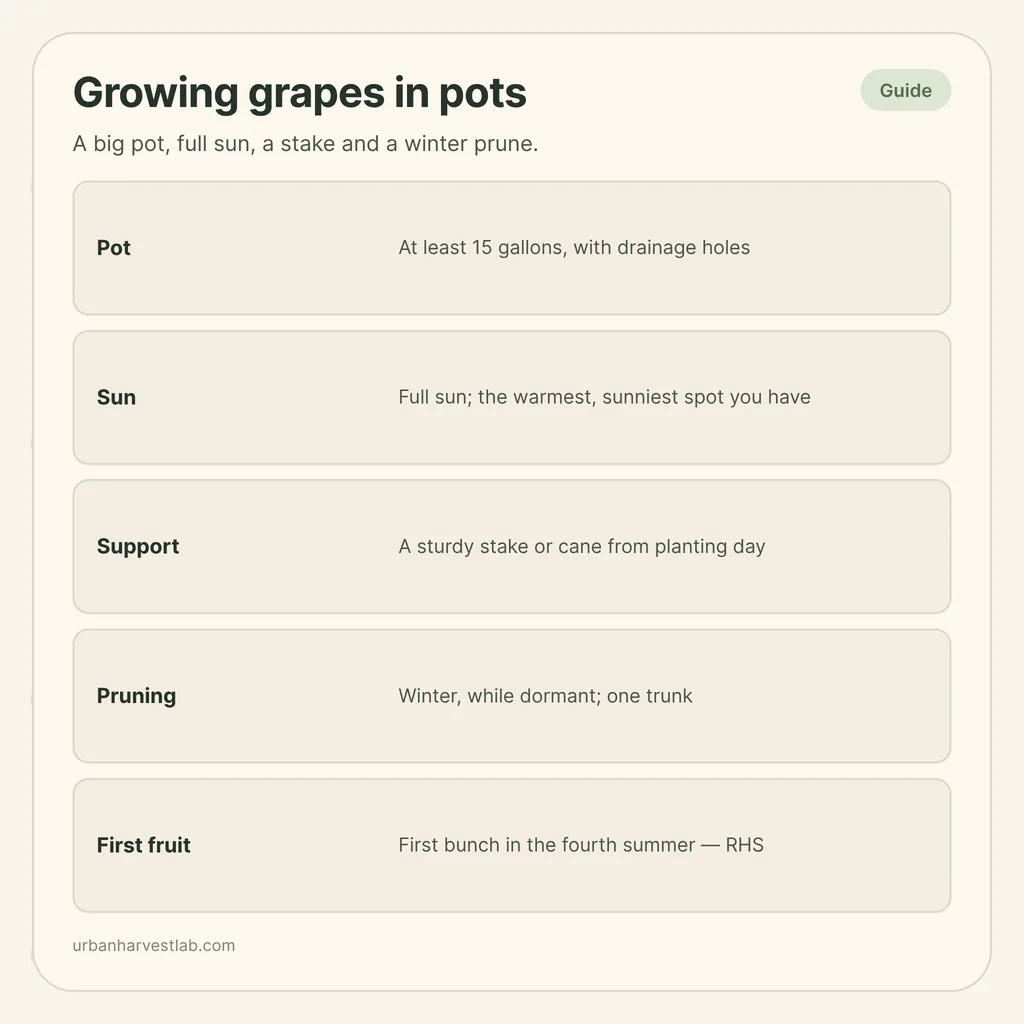
A grapevine will fruit in a pot if you give it a container of at least 15 gallons, the sunniest spot you have, a stake or trellis and a winter prune (hard for most varieties, little for Pixie). Michigan State Extension says you can grow almost any grape variety in a container on a sunny patio or balcony. Plan for patience: the RHS says a vine trained in a large pot gives its first bunch in the fourth summer.
Grapes are a different job from other potted climbers. Blackberries in pots fruit on canes you replace every year, while a grapevine builds a permanent trunk and is pruned back to a few buds each winter.
Choose a variety and a pot
Michigan State Extension names one naturally small option: Pixie grapes grow only 18 to 24 inches tall and wide and need little or no pruning. The RHS lists ‘Chasselas’, a small white early grape, as one that performs well in pots. Michigan State says almost any variety can be grown in a container, though most need regular pruning.
You need one vine. Oregon State Extension says grapes are self-fertile, so a single cultivar sets fruit. Michigan State says most varieties fruit on their own, and that shaking the plant gently at flowering gives a better yield.
The pot is where sources differ, so the numbers are worth seeing side by side. Michigan State asks for at least 15 to 20 gallons with drainage holes, 16 to 18 inches deep and 18 to 24 inches wide. NC State Extension lists 15 gallons as the minimum for grapes. The RHS is smaller, but it describes a staged approach: start in a pot 30 to 38 cm (12 to 15 in) across and deep, then pot on to a final 45 cm (18 in).
Material matters in sun. Michigan State says to avoid dark pots, which absorb and hold too much heat, and calls wood optimal. The RHS recommends a heavy clay pot for a standard, because a trained vine is top heavy and can tip. A pot this size is heavy once it is wet, so check the load before you commit; how much a container garden weighs covers the sum for a balcony.
This is a real buying decision: a large planter with drainage holes, ideally wood. If you need one, you can browse 15-gallon wooden planters on Amazon and check the inside depth and width against the figures above.
Fill it with a light potting mix. Michigan State says not to use garden soil, and the RHS suggests a soil-based, peat-free compost. Spread 2 to 3 inches of mulch on top (Michigan State), which also keeps the mix from drying out so fast.
Sun, water and support
Oregon State says full sunlight is required for good table grape production, though some ornamental grapes tolerate partial shade. The RHS puts a potted vine in the warmest, sunniest spot available, ideally against a south- or south-west-facing wall. If the vine sits where wind rattles the shoots, see windproofing a balcony garden.
Water regularly. The RHS says vines in containers need regular watering during the growing season, and Michigan State asks for a thorough soak at least once a week in the first season. In summer heat a big pot may need more; check the mix rather than the calendar.
Support starts on day one. Michigan State suggests a four-foot stake, and the RHS inserts a sturdy bamboo cane at planting to carry the main stem. Tie loosely: Michigan State says not to tie tightly. If you want the vine on a rail or wall instead, a no-drill trellis works with the same pot.
Train a single trunk
The RHS calls this a standard: a clear trunk topped with a rounded head of fruiting spurs. Oregon State describes the same idea as head training, a self-supporting trunk tied to a stake that suits small spaces, with the trade-off that yields are lower.
The RHS timeline for a new vine:
- Winter after planting: cut the stem back to a strong bud about 15 cm (6 in) from the base. Michigan State’s equivalent is to keep the strongest cane and cut it to two or three buds.
- Year 2: tie one strong shoot to the cane and remove the rest. In winter, cut the last season’s growth by about half, just above a bud.
- Year 3: keep tying the leader up, trim side-shoots to five leaves, and in winter cut the main stem back by at least half again. A mature standard trunk is usually 60 to 120 cm (2 to 4 ft) tall.
- Year 4: let five or six shoots grow at the top to form the head, and allow one bunch.
- Winter of year 4: cut the head shoots back to two or three buds to build the spurs that carry fruit.
Once established, Oregon State explains why you cut so hard. The buds for next year’s fruit sit on last year’s canes, and a vine left to carry too much fruit ripens late, produces poorer fruit and weakens. The RHS allows one bunch per shoot, so five or six in total.
Prune and flower on schedule
Timing varies by climate. The RHS says early winter is the main pruning time for a standard, while the vine is fully dormant, because later cuts can bleed sap. Oregon State gives December through March; Michigan State says late winter to early spring.
Michigan State’s cut to two or three buds happens at planting; after that it advises no pruning in the first year of growth, meaning the growing season that follows. The RHS schedule above instead cuts back again the next winter, so pick one source’s timetable rather than mixing them. For fruit, the RHS says to remove all flowers for two years, allow about three bunches in year three and about five in year four. NC State agrees that grapes take several years to bear full crops.
Winter and problems
Winter cold is the main risk for a root ball sitting above ground; how hardy a pot’s roots are explains it. Michigan State says that in harsh winters you need to protect the plant, and that an unheated garage works well. Do not move it somewhere warm and bright: the RHS says a vine kept in heated space still needs a chilling period, outdoors for four to six weeks below 5°C (41°F). Overwintering perennials in pots lays out the two-zone approach.
Michigan State lists fungal diseases such as black spot and powdery mildew, especially in dry, warm weather, plus aphids, Japanese beetles, moths and caterpillars.
Another woody fruit that suits a large pot is covered in growing a fig in a pot.
Sources
- Michigan State University Extension: Let’s grow grapes in containers
- NC State Extension Gardener Handbook: Plants grown in containers
- RHS: Grapes, training as a standard
- RHS: Grapes, how to grow
- RHS: Grapes, indoor cultivation
- RHS: Grapes, outdoor cultivation
- Oregon State University Extension: Growing table grapes (EC 1639)
Fruit, supports and winter
The pages that help a potted vine survive and fruit on a balcony.
Common questions
Can you grow grapes in pots?
Yes. Michigan State Extension says you can grow almost any grape variety in a container on a sunny patio or balcony, using a pot of at least 15 to 20 gallons. The RHS describes the same approach for limited space: a vine trained as a standard in a large container, which gives a modest crop.
How big a pot does a grapevine need?
It depends on the source. Michigan State Extension says at least 15 to 20 gallons, 16 to 18 inches deep and 18 to 24 inches wide. NC State lists 15 gallons as the minimum for grapes. The RHS starts a young vine in a pot 30 to 38 cm (12 to 15 in) across and deep and pots it on to a final 45 cm (18 in) deep and wide.
How long until a potted grapevine fruits?
The RHS says you can harvest the first bunch of a standard-trained vine in the fourth summer, then five or six bunches a year. NC State says grapes take several years to bear full crops. Remove the flowers for the first two years, as the RHS advises, so the vine puts its energy into roots and trunk.
Do I need two grapevines to get fruit?
No. Oregon State Extension says grapes are self-fertile, so one cultivar is enough for fruit. Michigan State adds that most varieties set fruit on their own, although gently shaking the plant at flowering gives a better yield.
Related guides
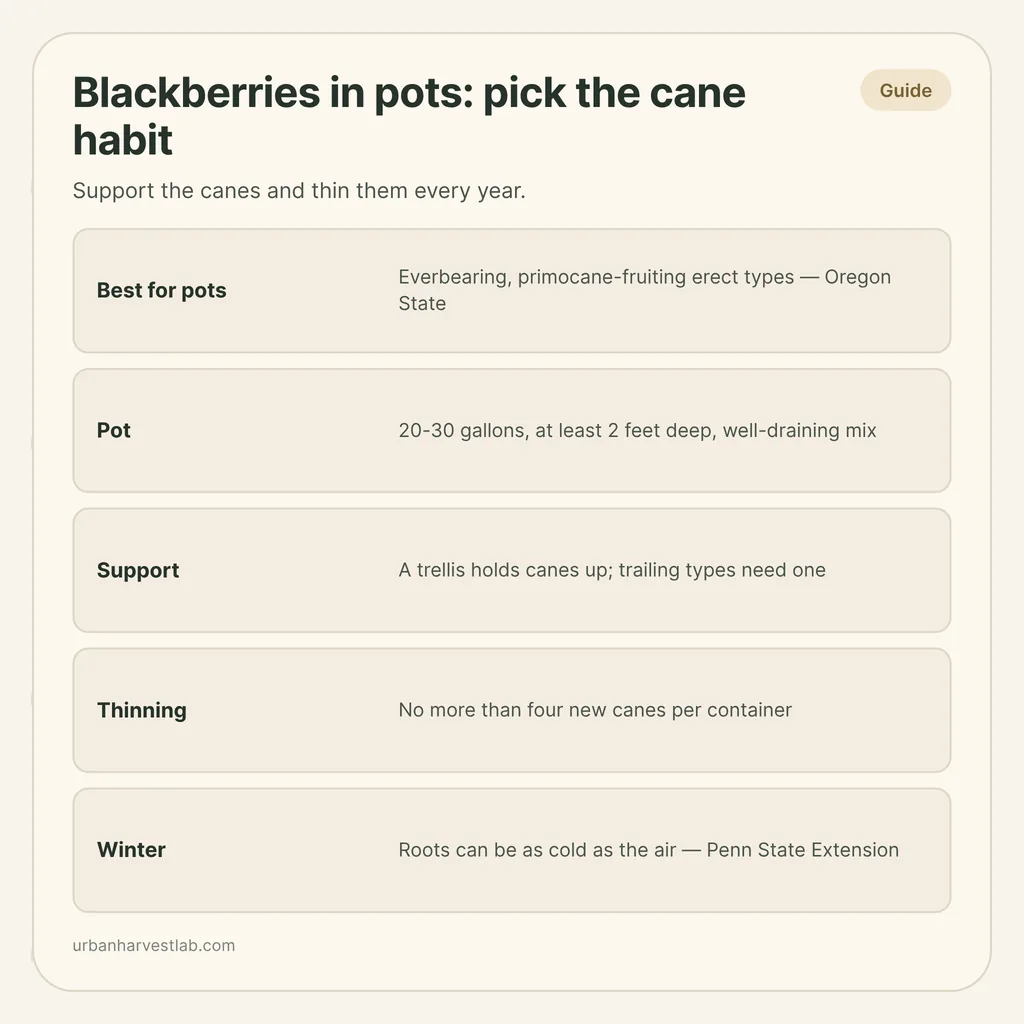
How to grow blackberries in pots: cane habit, support and pruning
Whether a container blackberry behaves comes down to the cane habit you buy, what holds the canes up and which canes you cut. Here is each choice, with the pot sizes and cane counts the extension services give.
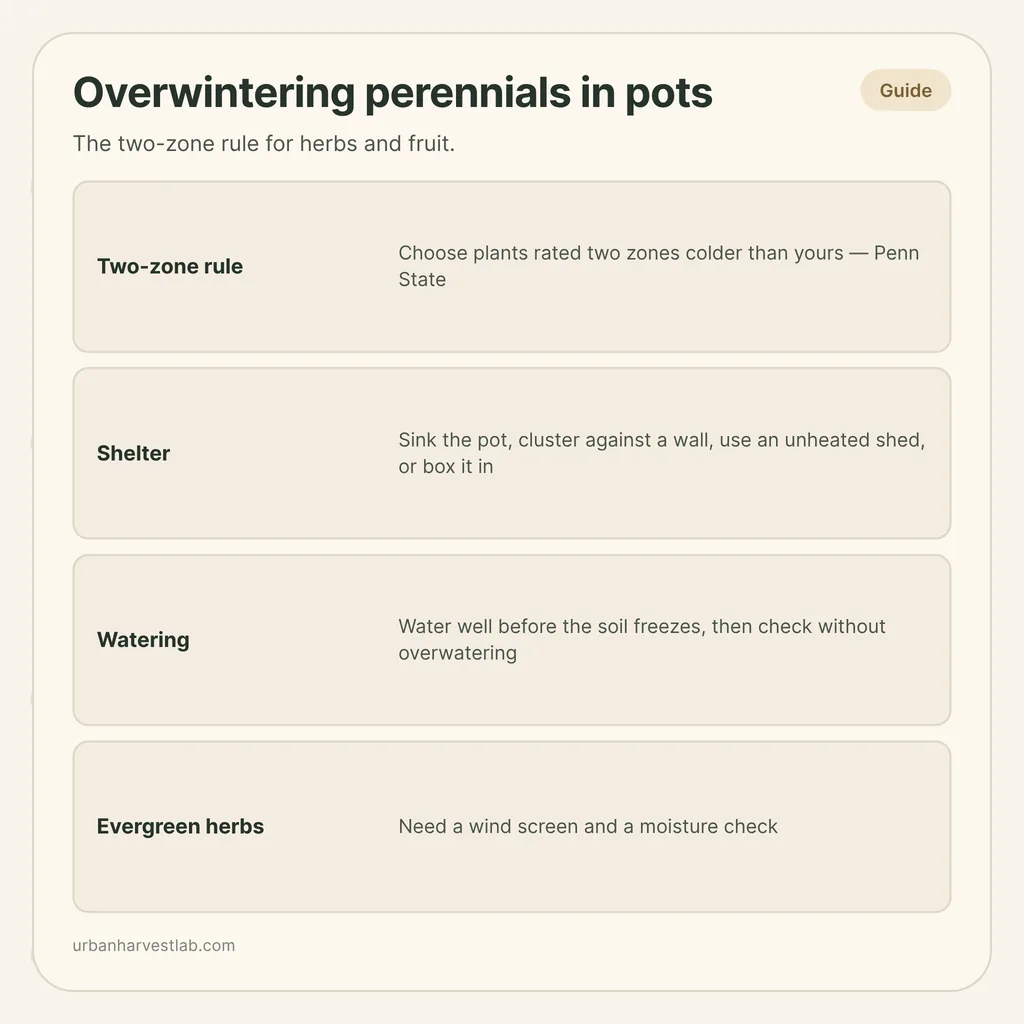
Overwintering perennials in pots: the two-zone rule for herbs and fruit
The hardiness zone on a plant tag assumes the roots are in the ground. In a pot they are not, so the rule, the shelter and the winter watering all change.

How to grow a fig tree in a pot: size, pruning and winter
A fig in a container needs a big pot, strong sun, regular water and a dormant winter in an unheated, frost-free spot. Here is how to size, prune and overwinter it.