Blackberry cane habits for a pot, by source
| Habit | What the source says | Source |
|---|---|---|
| Erect, everbearing | Best for containers when pruned for two crops a season | Oregon State Extension |
| Erect, summer-bearing | Stiff canes that need tipping in summer and pruning in winter | Oregon State Extension |
| Trailing | Can be potted with a trellis; canes are not self-supporting and can pass 15 feet | Oregon State Extension |
| Semierect | Generally too vigorous for containers; suits larger raised beds | Oregon State Extension |
| Compact varieties | Suit large pots, at least 45 cm (18 in) wide and deep | Royal Horticultural Society |
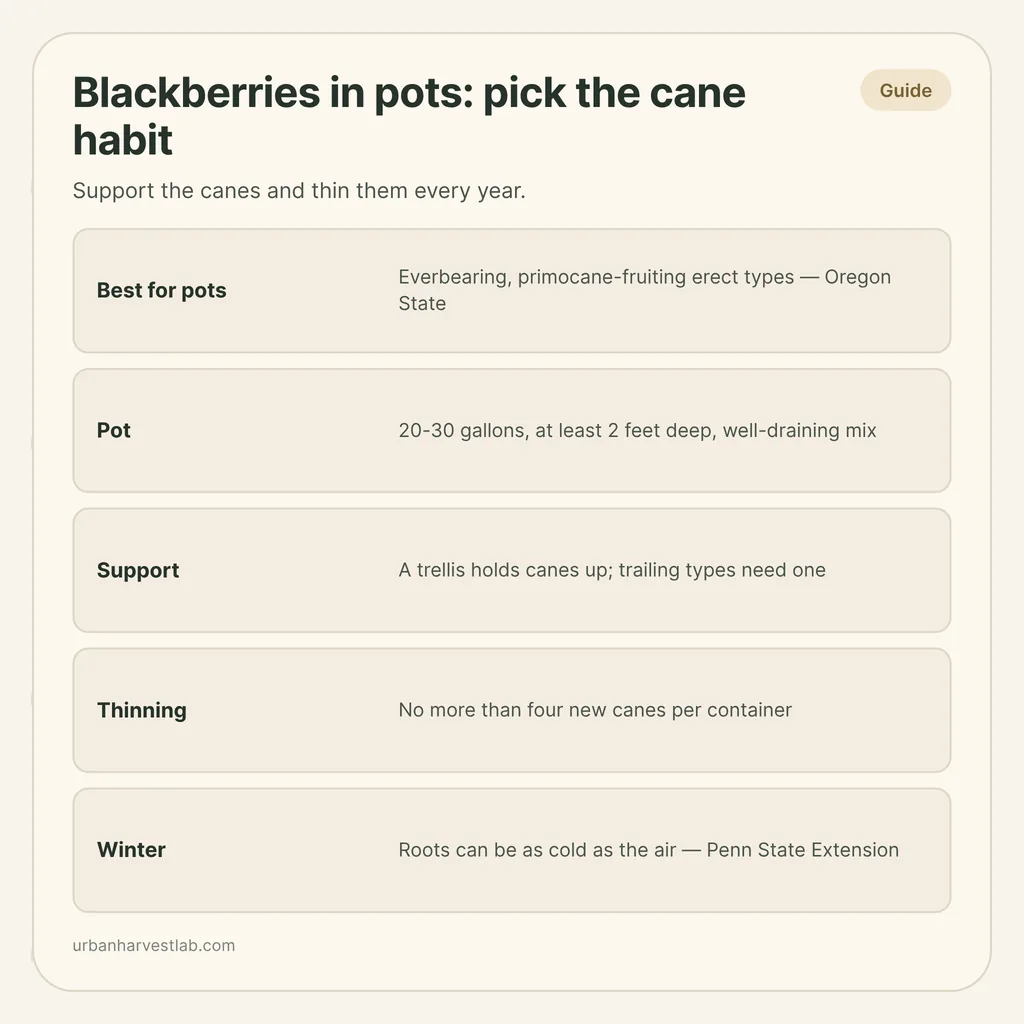
Blackberries fruit in a large pot if you choose a cane habit that suits a container, hold the canes up on a trellis and cut or thin them every year. Oregon State Extension says the best types for pots are everbearing, primocane-fruiting erect blackberries pruned for two crops a season. The RHS adds that a few compact varieties are suited to large pots. You only need one plant: Oregon State notes that blackberry cultivars do not need cross-pollination to produce fruit.
Oregon State gives raspberries the same 20- to 30-gallon pot but different cane counts and pruning; if you are growing raspberries instead, see raspberries in pots.
Which blackberry will live in a pot
Two terms decide everything below. A primocane is a first-year cane; a floricane is the same cane in its second year, when it fruits and then dies, according to Oregon State Extension. Primocane-fruiting (everbearing) types also flower at the tips of their new canes in late summer or fall, and the part that fruited dies back in late fall or winter.
Oregon State sorts home-garden blackberries by how the canes grow:
- Erect. Stiff canes that need tipping in summer as well as pruning in winter. New canes come from the crown and from buds on the roots, so the plant can spread. Oregon State rates the everbearing kind as the best container choice.
- Trailing. Canes that are not self-supporting and can grow more than 15 feet long. Oregon State says trailing types may be grown in containers using the same methods as in the ground, which means a trellis.
- Semierect. Vigorous, thick, arching canes. Oregon State says these are generally too vigorous to grow easily in containers.
The RHS takes a different route to the same place: look for a compact variety. It names ‘Little Black Prince’ as an example that reaches only 1 m (3¼ ft) tall and wide and can be grown without supports.
Thornless types
The RHS says some varieties are thornless, which makes pruning, training and picking easier, and on a balcony where you brush past the plant every day that matters. Oregon State’s cultivar table lists the thorn status of each cultivar. Among the erect everbearing ones it shows ‘Prime-Ark Freedom’ (zones 5 to 9) and ‘Black Gem’ (zones 5 to 8) as thornless. Thorn status varies by cultivar, so read the label rather than assuming.
A deep pot, a draining mix and sun
Oregon State says blackberries are relatively deep rooted and need a deep pot or raised bed, a minimum of 2 feet deep. A 20- to 30-gallon container works well, but careful pruning is needed so the plant does not outgrow it. The RHS gives a smaller floor for its compact varieties: a pot at least 45 cm (18 in) wide and deep, filled with a good-quality loam-based compost.
A pot of that size and wet mix is heavy. Check your balcony’s weight limit before you fill it.
The mix and the container must drain well, says Oregon State. Its recommended mixture is one part perlite or pumice, one part finely ground bark and two parts garden or potting soil. The perlite, pumice and rice hulls comparison helps you choose between the first two, and the pot drainage guide covers the holes. If you mulch, keep organic mulch off the crown: Oregon State warns that burying it can promote rot.
Give the pot good sun. Oregon State says plants tolerate partial shade but yield and fruit quality may be lower, and the RHS asks for a sunny, sheltered site. On an exposed balcony the windproof balcony guide shows how to anchor a tall pot.
What holds each cane habit up
Oregon State says blackberries require trellising to support the canes, keep fruit off the ground and protect canes from wind damage. The exception is ornamental, dwarf, everbearing erect cultivars, which it says also produce much lower yields. The RHS agrees on the practical side: its compact varieties can be grown in containers with no supports.
For an erect type, Oregon State suggests a simple T-trellis: a rebar post with a cross piece about 1.5 feet wide, with twine or wire down each side to hold the canes. Trailing types must have a trellis because their canes cannot hold themselves up. If you rent and cannot drill into walls or railings, the no-drilling trellis guide shows how to build support without holes.
One crop or two: pruning an everbearing blackberry
Pruning comes down to two choices: how many crops you want, and how many new canes you keep.
One crop. Oregon State says to cut all the canes of an everbearing erect plant to just above ground level in late winter. New canes grow in spring. Tip them in late spring or early summer by removing the top 6 to 12 inches, so they reach about 3 feet and branch. The branches flower and fruit from late summer, and fruiting ends when killing frosts arrive. Repeat the late-winter cut.
Two crops. Oregon State says the double-crop route reduces and delays the later primocane crop, but that if you are growing in a container, double cropping will produce fruit over a longer period. Tip the new canes the same way. In winter, cut out the dead floricanes at their base, then on the remaining canes remove the dead tips and any unbranched primocanes by cutting a couple of nodes below the dead part. The early-summer crop forms on those remaining floricanes. Cane out right after harvest only if disease shows on the dying canes; otherwise wait for winter so you do not damage flowering primocanes.
Thin in the pot. Oregon State says a container needs thinning of new canes on top of the winter pruning. Wait until the earliest are about 2 feet tall, then keep no more than four new canes per 20- to 30-gallon container. Remove those thinner or shorter than average and those at the outside edge. The RHS also says removing old fruited stems is necessary to make room for new productive ones.
Watering, and the dull-black cue for picking
Oregon State says to irrigate several times a week or as needed so the root zone is thoroughly wetted but standing water does not accumulate. Fruit is mostly water, so watering during fruiting decides yield and quality. The RHS says container plants need regular watering through the growing season. For interval and fingertip-test details, see how often to water container vegetables.
Pick every four to seven days, depending on cultivar and weather, according to Oregon State. Choose the dull black berries: shiny black fruit are high in acid with comparatively less flavor and sweetness. Do not wash them before storing.
Roots in the cold: blackberries over winter
Penn State Extension says the roots of above-ground container plants can be as cold as the winter air. It advises going two zones colder with containerized plants, using larger pots for insulation and giving some protection. By our arithmetic from “two zones colder”, a pot on a zone 6 balcony should be treated as a zone 4 root system, and the zone range on the plant label needs to cover that. Water the plant well before the soil freezes, and check moisture through winter, since dry soil freezes faster than moist soil. Clay, ceramic and glazed pots may crack if left exposed; the winter pot cracking page covers cracking, and overwintering perennials in containers covers the wider routine.
If you want another fruit for the same balcony, Strawberries suit the space a blackberry pot leaves: strawberries in containers covers pots and towers.
Sources
Fruit, supports and big pots
The pages that make a container blackberry work on a balcony.
Common questions
Can you grow blackberries in pots?
Yes. Oregon State Extension says the best types for containers are everbearing, primocane-fruiting erect blackberries pruned to give two crops a season, and that trailing types can be grown in containers or raised beds too. The RHS says a few compact varieties suit large pots. One plant is enough, because Oregon State notes blackberry cultivars do not need cross-pollination to produce fruit.
How big a pot do blackberries need?
The two sources differ. Oregon State Extension says blackberries are deep rooted and need a pot at least 2 feet deep, and that a 20- to 30-gallon container works well if you prune carefully. The RHS says at least 45 cm (18 in) wide and deep, but only for the compact varieties it describes as suited to containers.
How do you prune a blackberry in a container?
For an everbearing erect type, Oregon State Extension gives two routes. For one crop, cut all canes to just above ground level in late winter, then tip the new canes by 6 to 12 inches at about 3 feet. For two crops, remove only the dead tips a couple of nodes below the dead part, and cut out dead floricanes. In either case, keep no more than four new canes per 20- to 30-gallon pot.
Are there blackberries without thorns for a balcony?
Yes. The RHS says some varieties are thornless, which makes pruning, training and picking easier. Oregon State Extension marks several erect everbearing cultivars as thornless in its table, including Prime-Ark Freedom (zones 5 to 9) and Black Gem (zones 5 to 8). Check the thorn status on the plant label, because it differs between cultivars.
Related guides

How to grow raspberries in pots: type, support and cane pruning
A container raspberry lives or dies on three choices: which type you buy, what holds the canes up, and which canes you cut. Here is each one, with the pot sizes and cane counts the extension services give.

How to grow blueberries in pots: acidic mix, a second variety and the right water
Blueberries are fussy about acidity, not about space. Here is the pot size, the mix, the pollination partner and the watering that keep a container bush fruiting.
How to trellis a plant without drilling a single hole
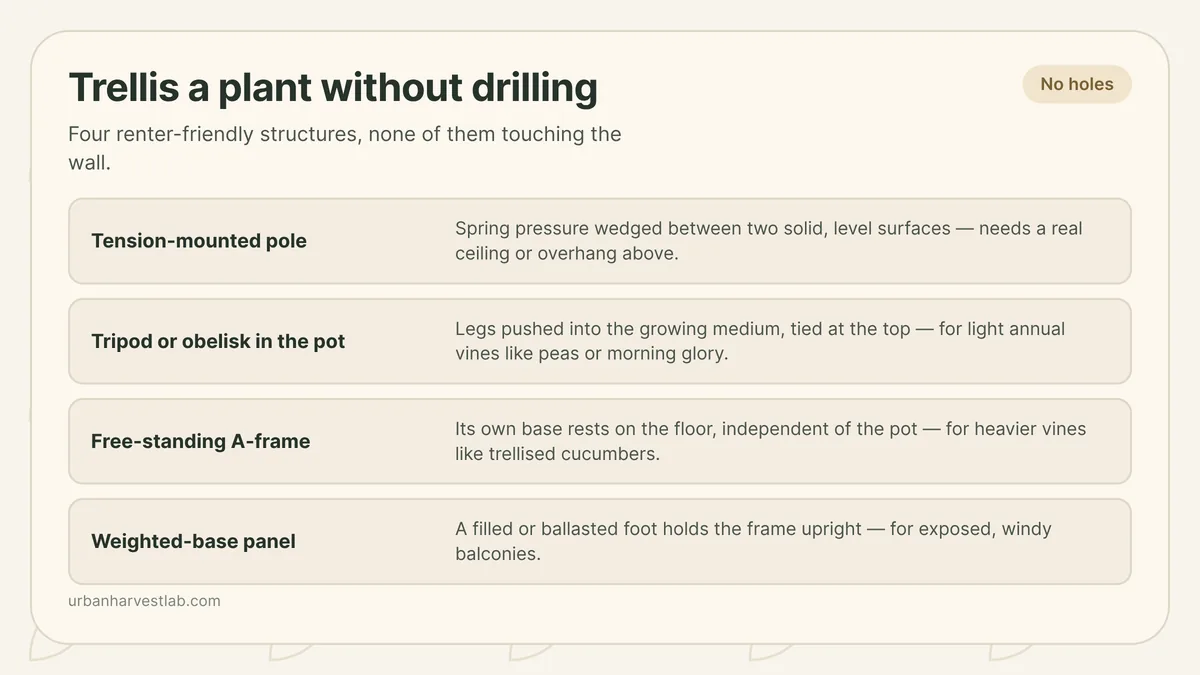
A container has no ground to sink a post into, so a renter-friendly trellis has to get its stability from somewhere else. Four approaches do that without touching a wall, railing, or ceiling.