Summer greens for pots, as the extension sources describe them
| Green | Habit | Heat and moisture notes | Start from | First pick |
|---|---|---|---|---|
| Malabar spinach | Climbing vine, typically six feet (NC State) | Well adapted to the 90s F; keep soil moist (NC State) | Seed (scarify it) or cuttings (NC State, UF/IFAS) | Interval not given in the pages read |
| New Zealand spinach | Low and highly branched, 1 to 2 feet tall (Hawaii) | Heat tolerant; mulch to hold moisture (Hawaii) | Seed soaked overnight (Hawaii) | Top 2 to 3 inches of shoots once plants are 1 to 2 feet tall (Hawaii) |
| Amaranth (callaloo) | Upright, 3 feet for most; dwarf types 1.5 feet (Connecticut) | Holds up in summer heat (UF/IFAS); water before it wilts at noon (Connecticut) | Seed, thinned to 3 inches (UF/IFAS) | 3 to 6 weeks (UF/IFAS); 5 to 6 weeks (Texas A&M) |
| Swiss chard | Leaf beet, cut and come again | Spring through early fall (Maryland) | See the chard page | See the chard page |
| Collards | Leafy brassica | Reliable harvests summer through fall (Maryland) | See the collards page | See the collards page |
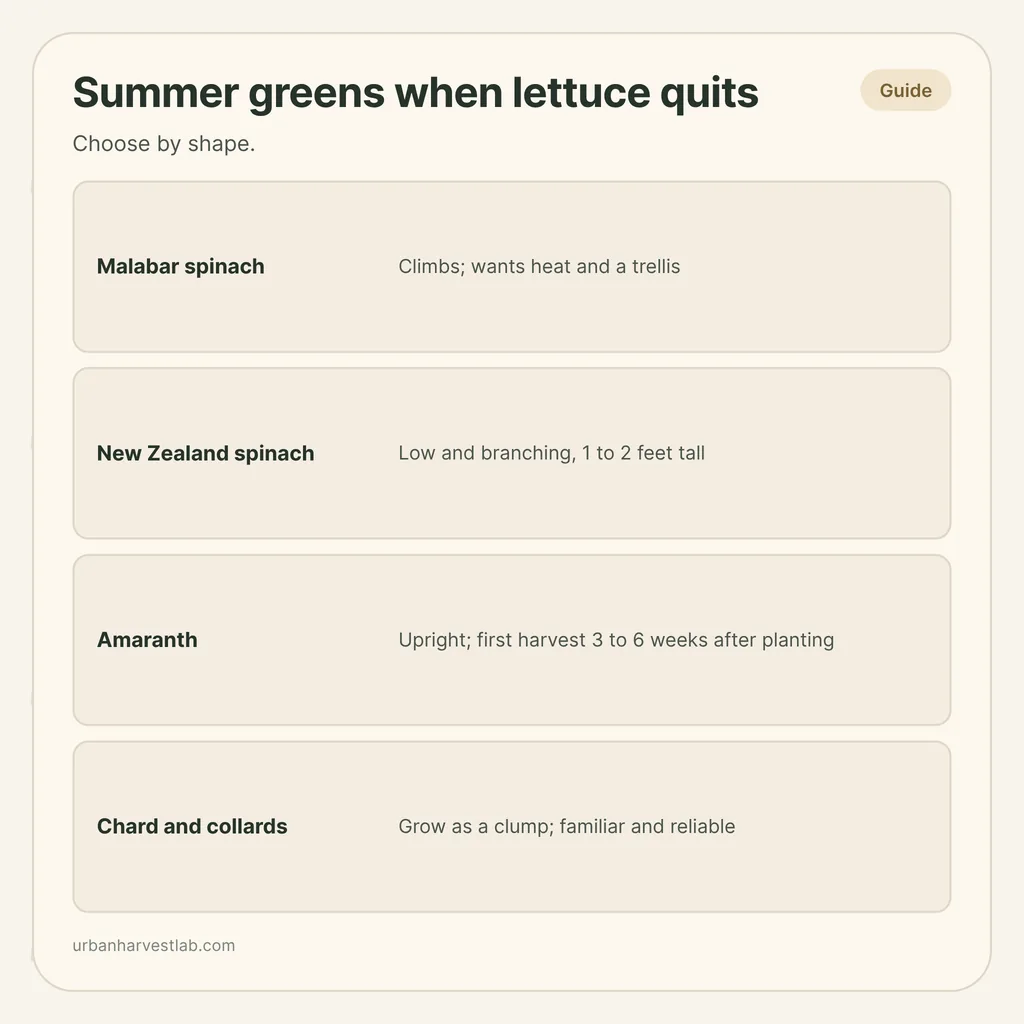
When lettuce and spinach have bolted, the leafy greens extension sources list for hot weather are Malabar spinach, New Zealand spinach, amaranth, chard and collards. Choose by shape: Malabar climbs, New Zealand spinach branches low, amaranth stands upright, and chard and collards grow as a clump.
UF/IFAS Extension puts the problem plainly: true spinach is a cool-season crop, and finding edible plants for the summer garden “can be a real challenge.” The tropical “spinaches” are not true spinach, and UF/IFAS says they can be harvested all summer long. For the calendar side of ordinary spinach, see growing spinach in containers. If lettuce is already bolting, why lettuce bolts in containers explains what is happening.
How to choose between them
The table above puts the facts side by side. The decision comes down to four questions: how much vertical space you have, how you plan to eat the leaves, how soon you want a first harvest, and how closely you can watch the pot.
- You have a railing or trellis and real heat: Malabar spinach.
- You have a wide, low planter and no vertical space: New Zealand spinach.
- You want leaves soonest and will cut often: amaranth.
- You want a plant you already know how to handle: chard or collards.
Malabar spinach: the climber
NC State Extension describes Malabar spinach as a vigorous climbing vine, a frost-tender perennial grown as an annual, that typically grows to a six-foot vine and can often reach 30 feet. Plan the support before the plant. UF/IFAS says the vines perform best on a trellis, and NC State suggests posts, fences, hanging baskets or large containers.
It wants heat. NC State says the plant is well adapted to high temperatures, even into the 90s F, but growth is disappointing when temperatures stay below 80 F. A cool early summer will hold it back. The same page says it will produce in weather too warm for other spinach, but the soil must be kept moist, and that dry soil or extremely high temperatures cause flowering, which leads to bitter leaves.
Start it from seed or cuttings, according to UF/IFAS. NC State advises scarifying the seed to hasten germination and, in Zone 7 and warmer, direct seeding 2 to 3 weeks after the last frost date. UF/IFAS adds that a small amount of shade is beneficial, although the plants can be grown in full sun, and that two plants will generally give a small family enough leaves for summer and fall.
For eating, UF/IFAS says the leaves resemble spinach and can be used the same way, and that cooked Malabar spinach is less slick in texture than other greens. NC State lists the leaves raw in salads or cooked. Two species are sold: UF/IFAS notes that Basella rubra has red leaves while B. alba has green leaves.
New Zealand spinach: the low, branching one
University of Hawaii extension describes New Zealand spinach as heat tolerant and highly branched, 1 to 2 feet tall, with a flavor similar to but milder than spinach. University of Maryland Extension adds that it is a low-growing annual with a spreading habit and somewhat fuzzy, arrow-shaped leaves.
The seeds are large and germinate slowly, so Hawaii’s publication says to soak them overnight before sowing. Once plants are 1 to 2 feet tall, the top 2 to 3 inches of shoots can be harvested, and the plant keeps producing new shoots. The same publication recommends mulching to conserve moisture in the summer months, which matters more in a pot than in a bed. It gives in-ground spacing of 12 to 18 inches between plants, which is a reasonable hint at how wide a container should be, though it is not a pot recommendation.
This is the pick when there is no wall or railing to train a vine up.
Amaranth (callaloo): the quick one
UF/IFAS calls amaranth a leafy green that can hold up in the heat of Florida’s summers, and Texas A&M AgriLife Extension says amaranths do well in hot, high light conditions. The Connecticut Agricultural Experiment Station makes the point for cooler regions: unlike spinach, the ideal season for producing amaranth in temperate climates is the hot, humid, sunny conditions of summer. University of Maryland Extension notes that the plant uses a C4 photosynthetic pathway, also present in corn and sugarcane, which allows vigorous growth under hot, dry conditions.
It is also the earliest to pick. UF/IFAS says to harvest young leaves and shoot tips 3 to 6 weeks after planting; Texas A&M says 5 to 6 weeks after sowing. UF/IFAS recommends broadcasting seed and thinning seedlings to 3 inches apart, and says the thinnings can be eaten as microgreens. Cold weather kills it, so sow in the warm months.
Size varies by variety. Connecticut says most reach about 3 feet and Texas A&M gives 2 to 4 feet or more, but some dwarf varieties grow only 1.5 feet high and suit a small garden, so look for a dwarf type on a balcony. Maryland’s photographs show callaloo growing in 3-gallon bags in a high tunnel.
Two cautions come with it.
Water. Connecticut says amaranth is relatively drought tolerant, but insufficient water reduces yield by promoting flowering, and that plants should be irrigated if they wilt at noontime. In a pot, that means checking in the afternoon.
Seed. Maryland Extension warns that callaloo can quickly become a weed problem, that each plant can produce more than 100,000 tiny seeds, and that you should not let plants flower. Flowering accelerates as days shorten after the summer solstice, and frequent harvesting delays it and promotes branching. Connecticut agrees that frequent harvesting of leaves and shoots delays flowering and prolongs the harvest. On a balcony, cut often and take off any flower stalk the moment it appears.
Chard and collards: the familiar ones
Not every summer green has to be unfamiliar. Maryland Extension says Swiss chard and perpetual spinach (leaf beet) will produce large amounts of leaves from spring through early fall, and that collards produce reliable and abundant harvests from summer through fall. The same page says mustard and kale are somewhat less heat-tolerant than collards.
Each has its own page with pot size, picking and heat notes: Swiss chard in containers and collard greens in containers. For a hardier brassica at the cool end of the season, kale in containers is the page.
Other options
UF/IFAS describes Okinawa spinach as another heat-tolerant leafy green that grows low as an edible groundcover and is well suited to container gardening. It is propagated by stem cuttings, and cold kills it. Maryland also covers molokhia (Egyptian spinach), sweet potato shoot tips and young leaves, and suggests checking seed catalogs for mild Asian greens such as Tokyo Bekana and komatsuna that hold up well in warm weather. Maryland says harvesting young sweet potato foliage, even regularly, will not reduce the later root harvest; sweet potatoes in containers covers the plant.
Raw or cooked
Maryland Extension says that some summer greens, such as chard and kale, can be torn into fresh salads, but most benefit from some level of cooking. New Zealand spinach may be eaten fresh in salads or cooked like spinach, according to Hawaii. Malabar spinach leaves are listed raw or cooked by NC State.
Amaranth has one caveat. Connecticut says its leaves may be eaten raw or cooked, but that rather high amounts of oxalic acid and nitrates limit the quantity of raw leaves that can be eaten daily. It says boiling the leaves and discarding the water reduces both, and that the oxalic acid content is roughly the same as in spinach and chard.
Keeping any of them going in a pot
Maryland Extension’s general advice for summer greens fits containers well: water and fertilize to promote rapid, healthy growth and keep leaves and stems succulent, and treat most of them as cut-and-come-again crops, since they put on new growth below each cut. It also suggests planting summer greens in containers you can move to shady spots near the door.
Two more of its tips are worth acting on. It advises against row cover, which can cause heat build-up, and recommends insect netting to exclude pests instead. For lettuce and other marginal crops it suggests planting on the north side of taller crops or using 30% to 50% shade cloth. If you want to try that, browse shade cloth on Amazon and check the percentage on the label.
For keeping pots alive through a hot spell more broadly, see protecting container plants in a heatwave. For the wider list of what suits six or more hours of direct sun, see full-sun balcony vegetables.
Can lettuce still work?
Maryland Extension says lettuces are generally a cool-season crop, but a long list of varieties has shown some level of heat tolerance, among them Summer Crisp, Little Gem, Cherokee and most oakleaf types of leaf lettuce. It also reports an Auburn University study in which Aerostar, Monte Carlo, Nevada, Parris Island, Rex, Salvius and Sparx grown in a hot greenhouse out-performed 10 other heat-tolerant cultivars. Those were greenhouse results, so treat them as a shortlist for your own trial.
Sources
- UF/IFAS Gardening Solutions: Tropical spinaches
- UF/IFAS Gardening Solutions: Amaranth
- NC State Extension Plant Toolbox: Malabar spinach
- University of Hawaii CTAHR: New Zealand spinach
- University of Maryland Extension: Heat-tolerant greens
- Connecticut Agricultural Experiment Station: How to grow a vegetable amaranth in Connecticut
- Texas A&M AgriLife Extension: Amaranths (Chinese spinach)
Greens in pots, season by season
The pages that cover each green in depth.
Common questions
What greens grow in summer heat?
University of Maryland Extension lists leafy amaranth, Swiss chard, collards, Malabar spinach and New Zealand spinach among its summer greens. UF/IFAS Extension adds Okinawa spinach, and says tropical spinaches can be harvested all summer long.
Which summer green is closest to spinach?
University of Hawaii extension says New Zealand spinach has a similar and milder flavor to spinach. The Connecticut Agricultural Experiment Station says amaranth leaves are comparable to spinach in taste, and UF/IFAS says Malabar spinach leaves can be used the same way as spinach.
Do I need a trellis for any of these?
For Malabar spinach, yes. UF/IFAS says the vines perform best on a trellis, and NC State Extension asks for a sturdy trellis or fence because the plant can grow rapidly. New Zealand spinach, amaranth, chard and collards do not climb.
Can I still grow lettuce in summer?
Some varieties tolerate heat better. University of Maryland Extension names Little Gem, Summer Crisp and most oakleaf types among varieties that have shown some heat tolerance, and suggests 30% to 50% shade cloth for lettuce and other marginal crops.
Related guides

How to grow Swiss chard in pots: cut-and-come-again through the season
Chard is one of the few vegetables that rewards a small pot for months. The trick is cutting the right leaves, keeping the pot evenly moist, and planning for what summer heat does to it.

How to protect container plants during a heatwave
Watering more is only one piece of getting containers through a heatwave. This is the wider plan: cutting the heat load, grouping and staging pots, and reviving one that has already dried out.
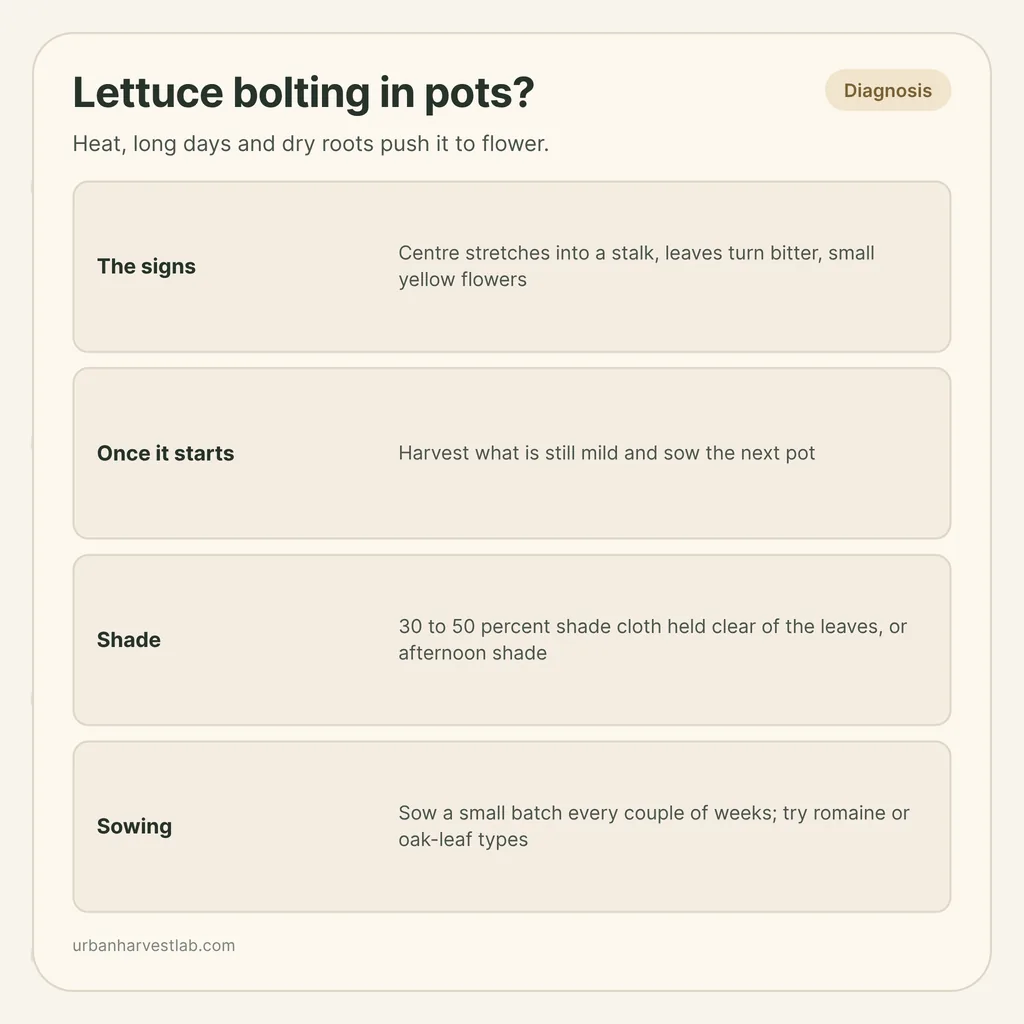
Lettuce bolting in pots? Heat, day length and what you can still change
Lettuce in a pot bolts faster than lettuce in the ground because the pot heats and dries quickly. Sowing date, shade, watering and variety are the levers you hold.