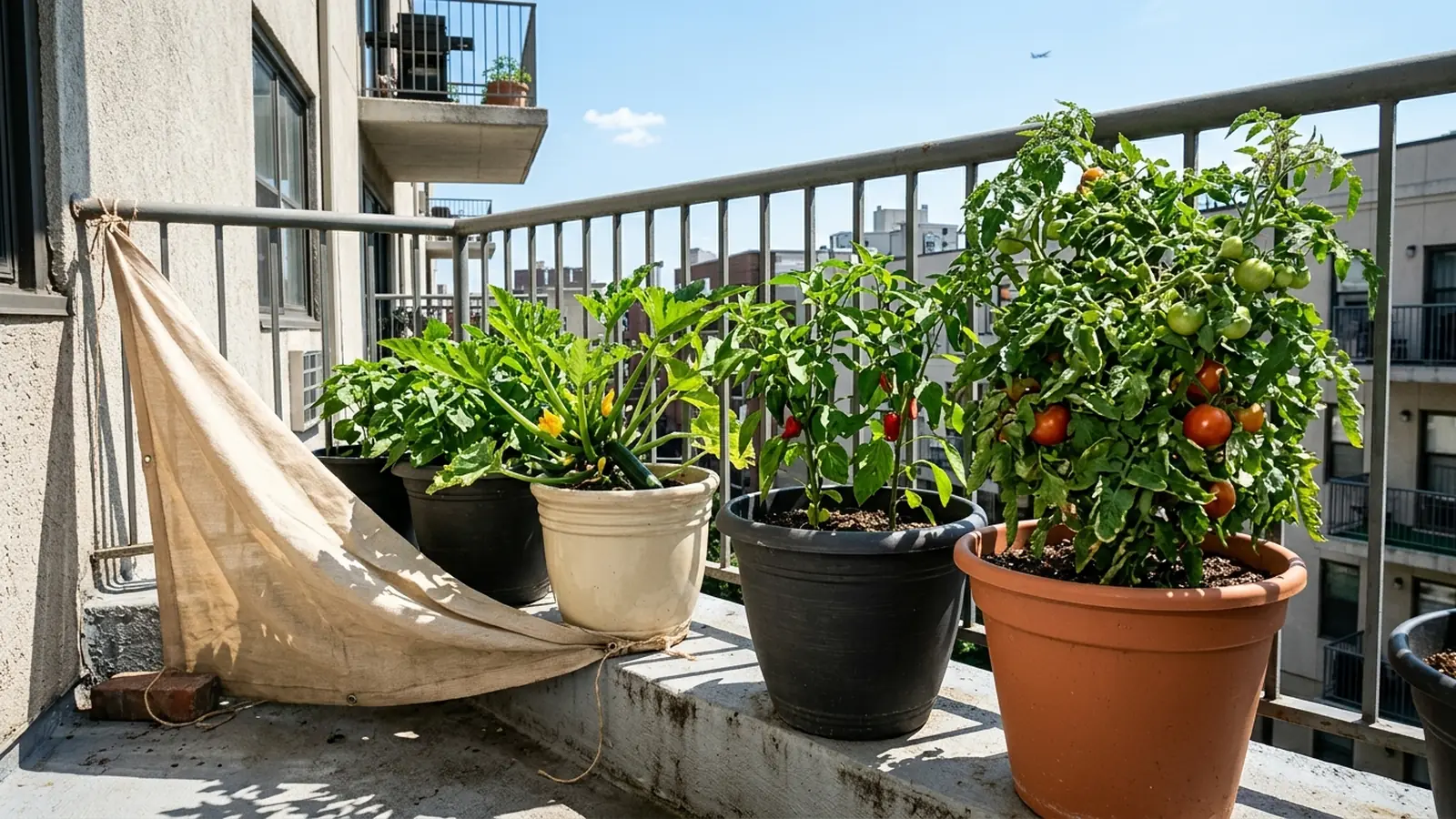
Container sizing and heat management by full-sun vegetable
| Crop | Minimum container volume | Typical water need in full sun | Heat-management note |
|---|---|---|---|
| Tomato (determinate) | 5 gal / 19 L or more | Daily in peak summer heat | Larger volume buffers root-zone heat swings; avoid dark, thin-walled pots |
| Tomato (indeterminate) | 10 gal / 38 L or more | Daily, sometimes twice | Needs the deepest, most heat-stable container of the group |
| Pepper | 5 gal / 19 L (about 14 in / 35 cm wide) | Daily in peak heat | Smaller plant, but still stressed fast in a small dark pot |
| Zucchini / summer squash | 5-10 gal / 19-38 L | Daily, more as the plant fills out | Large leaf canopy loses water quickly; check the root zone, not the surface |
| Eggplant | About 14 in / 35 cm wide, similar to pepper | Daily in peak heat | Heat-loving, but carries the same small-pot risk as pepper |
A full-sun balcony sounds like the good problem to have, and for one narrow reason it is: it is the only exposure where tomatoes, peppers, zucchini, and eggplant genuinely thrive rather than merely survive. But “full sun” gets treated as a single fact about a balcony, when it is really three separate things stacked on top of each other — how many hours of light the space gets, how hot that light makes a small volume of potting mix, and how a particular container handles that heat. Skip past the second and third and the same sun that should be an advantage turns into a container that cooks its own roots by mid-afternoon.
Before choosing crops, confirm the number the rest of this depends on. Orientation is only a starting guess, and it is a surprisingly unreliable one: a “south-facing” balcony boxed in by a taller building can get less light than an open east-facing one, and season shifts the total further still. The balcony sun estimator turns compass direction and obstacles into a starting range, then a one-day tracking method turns that range into your own real number. What follows is written for whatever balcony tracks at 6 or more hours of direct sun, whichever way it happens to face.
Quick answer
At 6 or more hours of tracked direct sun, fruiting crops become not just viable but the best use of the space: tomatoes, peppers, zucchini, and eggplant all need that much light to flower and set fruit reliably. The catch is entirely in the container. A pot sized and colored for a herb bed will dry out and overheat under this much sun; the same crop in a larger, lighter-colored container with a consistent watering check handles it well. Selection is the easy part here — container management is where full-sun balconies actually succeed or fail.
Why orientation and hours of sun are not the same thing
Most people describe their balcony by which way it faces, and it is a reasonable shorthand — but it is not the same measurement as hours of direct light, and the gap between the two is exactly where full-sun growing plans go wrong.
Two things break the link between orientation and hours: obstacles and season. A tree, a neighboring building, or a deep overhang cuts into a balcony’s light for part or all of the day regardless of which way it faces, and a low winter sun clears an overhang that the same overhang blocks nothing against in summer. That is why the orientation estimator treats compass direction as a baseline that obstacles and season then move up or down, not as a fixed answer.
There is also a less obvious gap, and it matters specifically here: east- and west-facing balconies are often assumed to sit on opposite ends of a spectrum, when in fact the site’s own estimator puts them in a similar, lower range — each one only catches one end of the sun’s daily arc, a morning slice or an afternoon slice, rather than the sustained exposure a wide-open southern wall gets across most of the day in the northern hemisphere (northern wall, in the southern hemisphere). East and west differ mainly in when the heat lands, not in how much total light accumulates. The genuine full-sun extreme, in most real balconies, is the open south-facing exposure north of the equator, or the open north-facing one south of it — which is why tracked hours, not a specific compass label, sets the crop picks below.
Full sun, accumulated heat, and container stress are three different things
It is easy to collapse these into one idea — “lots of sun” — but each behaves differently and each needs its own fix.
Full sun is a light measurement: the number of hours the growing surface sits in direct, unfiltered sunlight, as logged with the tracking method above. It is what a plant’s leaves use for photosynthesis and what a flower needs to set fruit.
Accumulated heat is what that same light does to the thing holding the plant’s roots. A raised garden bed has a large volume of soil in contact with the cooler ground beneath it, which buffers temperature swings. A container does not have that buffer — it is a small, isolated volume of mix, often standing on a hot floor or against a hot wall, with several sides directly exposed to the sun. NC State Extension’s container growing handbook notes that the growing medium in outdoor pots can swing by as much as 30°F between day and night, and that dark-colored containers absorb more heat than light-colored ones, which raises the potting mix temperature further and speeds up drying. A balcony and a backyard bed can log identical sun hours and still produce very different root-zone conditions.
Container stress is the practical consequence for the plant: faster drying, a higher risk of the root zone overheating in a small or dark pot, and the need for a watering check rather than a fixed schedule. This is the part that is actually manageable — the fixes are container volume, container color and material, and attentive watering, not less sun.
What to grow: fruiting crops built for this exposure
Tomatoes
Tomatoes are the clearest full-sun crop and also the most container-hungry. A determinate variety needs at least 5 gallons (19 liters) of root volume, and an indeterminate one needs 10 gallons (38 liters) or more; a compact patio or dwarf variety trims that requirement without trimming the sun requirement itself, and growing dwarf tomatoes in pots on a small balcony covers the varieties built for that trade. Whichever size you choose, container depth for tomatoes, peppers, and herbs and the dedicated tomato pot size guide both work from the same principle: more root volume buys more buffer against a hot afternoon, not just more room to grow.
Peppers
Peppers ask for less room than tomatoes but are not immune to the same small-pot risk. Penn State Extension puts a workable minimum at a 14-inch pot, and the pepper pot size guide gives the fuller range by cultivar. Because peppers set fruit less reliably than tomatoes on a balcony with little insect traffic, hand-pollinating tomatoes and peppers is worth reading alongside crop selection, not after fruit fails to set.
Zucchini and summer squash
Zucchini rewards full sun with fast, heavy production, but the seedling gives no hint of the volume it eventually needs — the zucchini container guide puts the real number at 5 to 10 gallons per plant. Its large leaf canopy also loses water quickly in full sun, which shows up as a wilted look by late afternoon even when the root zone is not actually dry; check the mix itself rather than reacting to the leaves. Zucchini also carries separate male and female flowers, unlike tomato or pepper, which changes how pollination works in a pollinator-light balcony.
Eggplant
Eggplant is as heat-loving as tomato and peppers, needing the same 6 or more hours of direct sun to perform well. Penn State Extension groups it with peppers for container sizing, around a 14-inch pot as a workable minimum, though a larger container still buys the same drying and heat buffer it does for every other crop on this list.
Managing container heat in practice
Choose the pot color and material deliberately. NC State Extension’s guidance is direct: avoid dark-colored containers in full sun, since they absorb more heat than light ones and dry out faster as a result. A glazed ceramic or a light-colored plastic container manages heat more evenly than an unglazed dark pot of the same size; the trade-offs between materials are covered in glazed vs. terracotta pots.
Add a mulch layer. A thin surface layer slows evaporation and softens the heat swing at the top of the root zone, though it does not replace adequate container volume. Mulch for potted plants covers what actually helps in a container versus what is really a garden-bed technique that does not transfer directly.
Check the root zone, not the calendar. Penn State Extension notes that most container vegetable gardens need watering at least once a day during hot summer months, and the University of Maryland Extension frames the same idea around a simple test: press a finger into the mix and water when it is dry, rather than watering on autopilot. A larger, lighter container needs this check less urgently than a small dark one, but neither replaces it.
Reserve shading for a genuine heatwave, not a normal full-sun day. These crops are chosen because they need the sun; cutting it on an ordinary day usually costs more in fruiting than it saves in heat. When an actual heatwave hits, protecting container plants during a heatwave covers temporary shade, grouping pots, and the rescue soak for a container that has already dried out past the point a normal watering fixes.
Common mistakes
- Sizing the container for the seedling, not the mature plant. Every crop on this list looks modest for its first few weeks and then needs several times that root volume by midsummer.
- Using a small, dark pot because “it’s just one plant.” A dark, thin-walled container in full sun heats and dries faster than the same crop needs to handle, independent of how many plants share it.
- Watering on a fixed schedule instead of checking the mix. A cool, cloudy stretch and a heatwave do not dry a pot at the same rate, and a rigid schedule gets both wrong in opposite directions.
- Treating a full-sun crop list as valid for a partial-sun exposure. Tomatoes, peppers, zucchini, and eggplant genuinely need the 6-or-more-hour range; planting them on a balcony tracked lower sets them up to limp along rather than produce.
- Skipping hand-pollination on a balcony with little insect traffic. Full sun gets the flowers open; it does not guarantee anything moves the pollen between them several floors up.
Sources and further reading
Once you have picked your crops, manage the heat
These guides cover pot color and material, mulching, and the wider heatwave response once full-sun vegetables are planted.
Common questions
Does full sun mean a south-facing balcony?
Not exactly. Full sun means the growing surface tracks 6 or more hours of direct light in a day, and orientation is only a starting estimate for that number. In the northern hemisphere, an open south-facing balcony reaches full sun most reliably; in the southern hemisphere, north-facing does. East- and west-facing balconies typically land in a similar, lower partial-sun range regardless of hemisphere, because each only catches one end of the sun's daily arc. Obstacles and season shift all of these numbers further, which is why tracking your own balcony matters more than naming its compass direction.
Can I still grow eggplant or peppers in a small pot on a full-sun balcony?
You can, but a small or dark container works against you exactly where full sun works for you. Peppers and eggplant can manage in a container around 14 inches (about 5 gallons) across, but that volume dries out fast under 6 or more hours of direct summer sun, especially in a dark, thin-walled pot. A bigger volume or a lighter-colored, thicker-walled container buys real margin.
Do tomatoes and peppers need afternoon shade on a full-sun balcony?
Not as a default. Full sun is what these crops are built for, and cutting their light on a normal day usually costs more in fruiting than it saves in heat stress. Afternoon shading becomes worth considering only during an actual heatwave, alongside grouping pots and checking the root zone more often, which is covered in the full heatwave response.
What color and material of pot works best for full-sun vegetables?
Light-colored, thicker-walled containers hold up best. NC State Extension's container handbook notes that dark-colored containers absorb more heat than light ones, which raises the potting mix temperature and speeds up drying; a glazed ceramic or a light plastic container manages that better than an unglazed dark pot of the same size.
Should I water full-sun containers on a fixed daily schedule?
Use it as a starting assumption, not a fixed rule. Penn State Extension notes that most container vegetable gardens need watering at least once a day during hot summer months, but the real signal is the root zone itself: check about 2 inches down before watering, since pot size, material, and a particular day's heat all move the real interval around that daily baseline.
Related guides
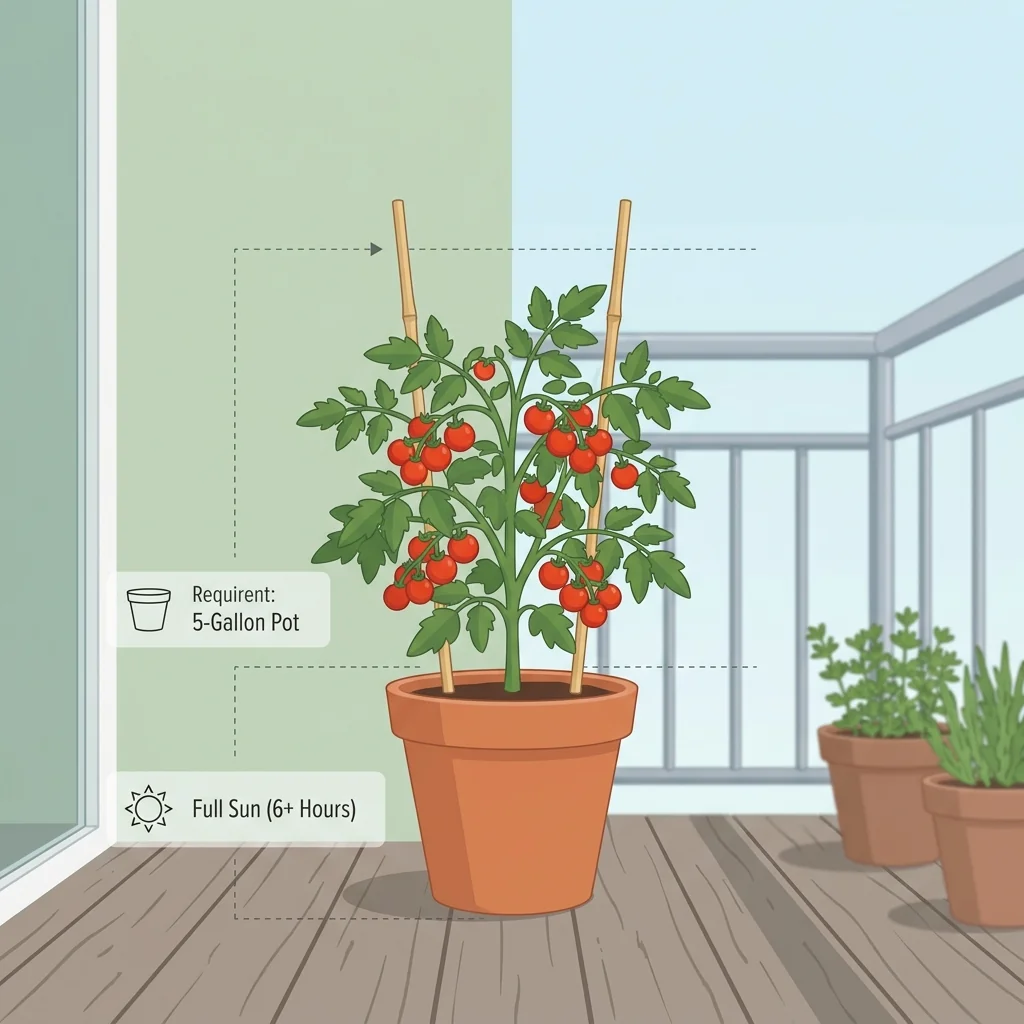
How to grow dwarf tomatoes in pots on a small balcony
Traditional tomato plants grow into massive, untameable 8-foot jungle vines that require giant cages and take over your entire balcony. But with modern 'micro-dwarf' or patio tomato varieties, you can grow heavy yields of sweet cherry tomatoes on a plant that stays under 2 feet tall. Here is the dwarf tomato container blueprint.
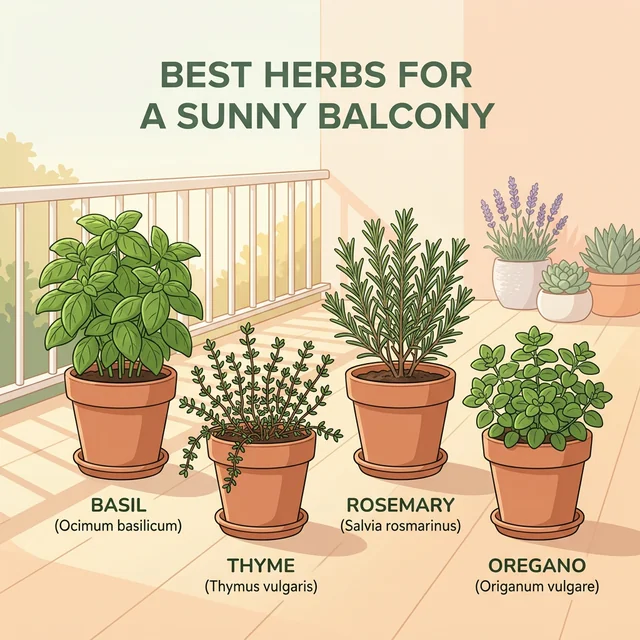
Best herbs for a sunny balcony: full-sun picks that handle heat and wind
A sunny balcony is perfect for herbs, but the intense heat and wind require the right crop choices. Start with basil, thyme, and rosemary for reliable harvests.
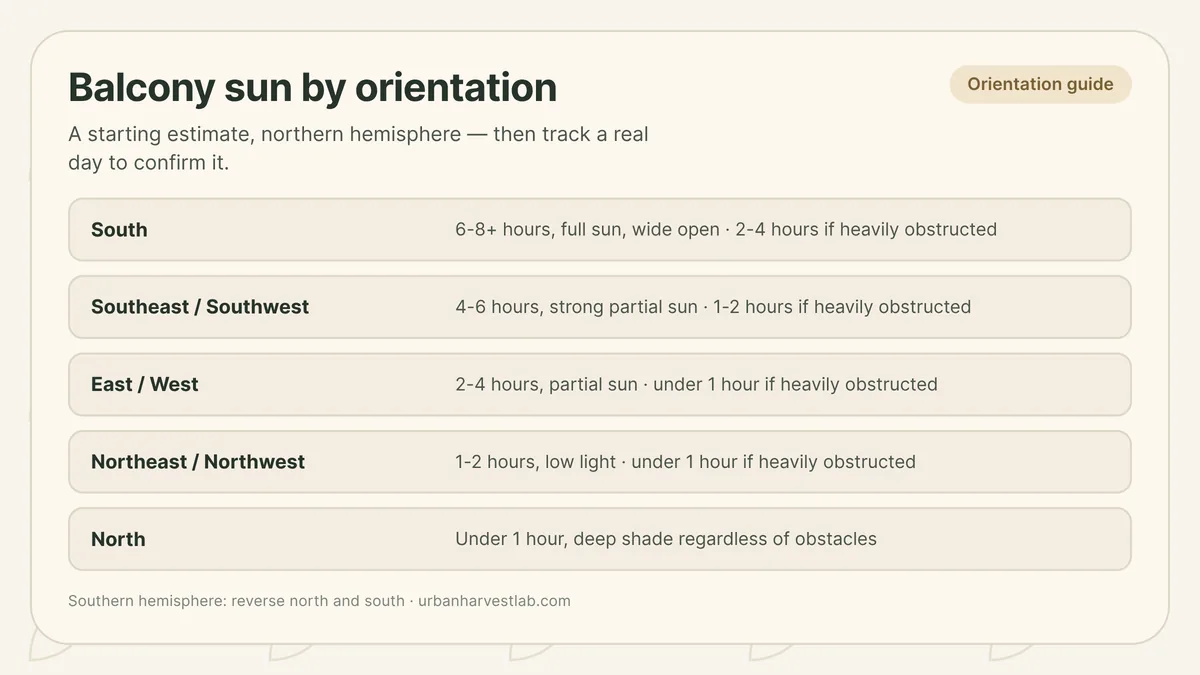
How much sun does my balcony get: an orientation estimator and one-day tracking method
Compass direction and nearby obstacles give a starting range for how much sun a balcony gets. One day of tracking turns that range into a real number.