If you travel every few weeks, the plant question is not “can this survive without water?” No potted edible plant does that indefinitely. Every container crop draws down a fixed, small reserve of moisture, and promising otherwise would just set you up for another dead basil. The more useful question is which species and which setup lose the least ground on the days you are gone, and recover cleanly the day you are back.
That is a different problem from watering for one specific trip, and a different scale of neglect from letting a garden go through months of inattention. What follows covers the middle case: a system, plant choice, container, and a short routine, built around repeated, short absences rather than a single suitcase or a long stretch of forgetting. For the daily mechanics that system still depends on, watering, feeding, and pruning, start with Potted Herb Care: Watering, Feeding, and Pruning Without Guesswork if those basics are not settled yet.
Three situations that need three different answers
It helps to separate these before choosing anything:
- Frequent, short, recurring trips. You are away for a few days at a time, often enough that a plant sitter or a rebuilt wick system before every departure is not realistic. Species selection and a container system designed to absorb that pattern is what the rest of this covers.
- A single planned absence. One trip, a suitcase, a known return date. That is a watering-technique problem, not a plant-selection problem, and it is solved by a temporary passive setup sized to that one gap. If this is your actual situation, a plant-selection guide is the wrong tool; you need a watering method built for a defined window, not a different set of species.
- Long or open-ended neglect. Weeks away with no one checking in, or a garden that has genuinely been abandoned. No pot, species, or reservoir compensates for that indefinitely. Section 7 below is honest about where the line sits.
Conflating these three is where most “low-maintenance plant” lists go wrong: they either promise more than any living plant can deliver, or they solve the wrong absence.
What actually makes a plant tolerant of irregular watering
“Low maintenance” is not a fixed trait, it is the outcome of a few measurable characteristics working together:
- Water reserve in stem and root tissue. Woody, shrub-like plants store more water in thickened stems and roots than soft, herbaceous ones, giving them a longer runway before the leaves show stress.
- Transpiration rate. Leaf area, a waxy cuticle, and surface hairs (trichomes) all reduce how fast a plant loses water to the air. Small, needle-like, or fuzzy leaves lose water more slowly than broad, soft ones under the same light and heat, a well-documented factor in plant water-loss research.
- Root depth relative to pot volume. A woody perennial with a modest but well-distributed root system in a reasonably sized pot can draw on moisture lower in the profile after the surface has dried, buying extra days that a shallow, dense root mat cannot.
None of this means “does not need water.” It means the same missed watering costs a Mediterranean herb far less than it costs a moisture-loving one in an identical pot.
Choosing the crops
The tier that actually works: woody Mediterranean herbs
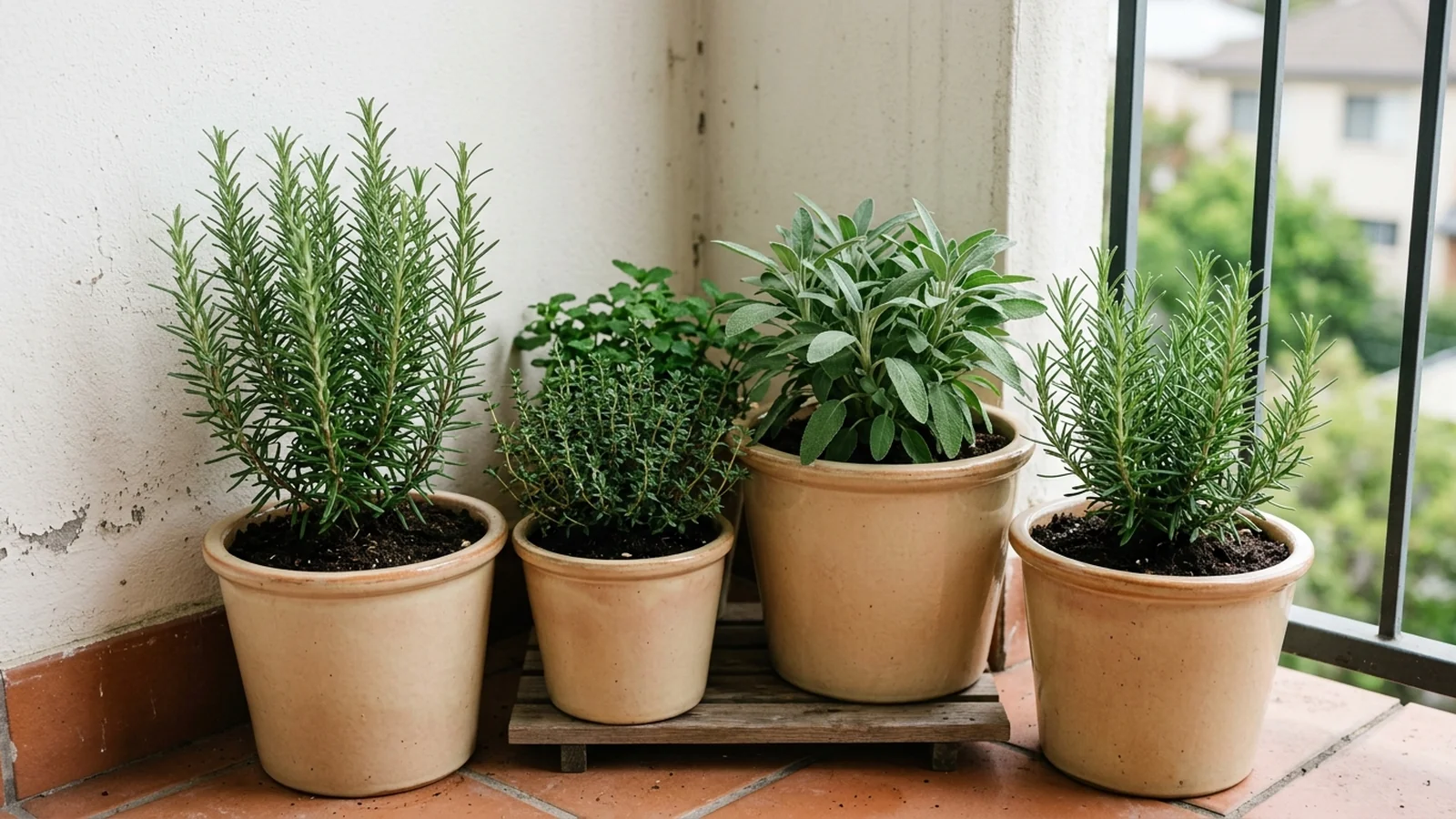
Rosemary, thyme, oregano, sage, and lavender share the traits above: small or needle-shaped leaves, a waxy or hairy surface, and a genuinely woody structure once established. Extension horticulture guidance on rosemary and thyme in containers goes further, describing rosemary as a plant that “thrives on neglect” and noting that both herbs perform best in drier, well-drained conditions rather than a constantly moist root zone. That is close to the opposite of what a basil or mint plant wants, which is exactly why these five are the starting list for a travel-tolerant setup rather than an arbitrary substitution.
This lines up with how this site already separates herbs by water needs: rosemary, thyme, oregano, sage, and lavender are the group that wants a drier cycle between full soakings, not constant moisture.
What does not fit this pattern
Basil, mint, parsley, cilantro, and lemon balm sit at the other end. They are soft-leaved, high-transpiration plants that wilt within days of a dry pot and do not reliably bounce back from repeated dry-outs the way a woody herb does. They are not bad plants, they are simply the wrong choice to anchor a low-attention system.
Most fruiting container vegetables are also a weak fit. Tomatoes, peppers, cucumbers, and zucchini need comparatively steady moisture, particularly during flowering and fruit set, and an uneven supply tends to show up as dropped flowers, blossom-end rot, or split fruit rather than a plant that simply waits patiently for you to get home. If vegetables matter to you, treat them as a separate, higher-attention project rather than folding them into a travel-tolerant collection.
Designing the container for absence, not just for growth
Volume: your buffer, not just your plant’s headroom
A larger volume of potting mix holds more total moisture and dries out more slowly than a small one, extension guidance on container vegetables confirms this directly: bigger soil volumes need watering less often than smaller ones for the same plant. For a travel-tolerant setup, size the pot toward the generous end of what the pot size calculator recommends for the mature plant, not the seedling stage, since that extra volume is the buffer you are actually paying for.
Material: what the pot itself does to the schedule
An unglazed terracotta pot loses water through its porous walls in addition to normal surface evaporation, which is useful when you are worried about waterlogging but costly when you are worried about missed waterings. A glazed ceramic or plastic pot holds moisture measurably longer for the same volume and location. See Plastic vs. Terracotta for Herbs for the full trade-off; for a travel-first setup, that trade-off tips toward glazed or plastic.
Grouping and placement
Clustering pots together raises the local humidity around the foliage and lets neighboring pots shade part of each other’s soil surface, which slows evaporation compared to a single pot standing alone. These herbs still want as much direct sun as your space allows; that is what they are adapted to. The placement adjustment that actually matters for a travel-tolerant setup is avoiding a wind tunnel or a heat-reflecting corner, since wind and heat are two of the strongest external drivers of transpiration, not cutting their light.
The minimum routine that keeps the system honest
None of the above works without a short routine on the days you are actually home:
- Water deeply, not often. When you do water, apply enough that some drains from the bottom, rather than topping off the surface on a whim. Shallow, frequent watering trains roots toward the surface, which is exactly the shallow root pattern that dries out fastest.
- Check before you assume. Use the pot-weight or finger check described in How Often to Water Potted Herbs rather than watering by calendar habit.
- Reset before you leave. A quick trim to reduce excess canopy lowers total leaf surface area and, with it, total water loss while you are gone. Empty saucers so the pot is not sitting in standing water for a week.
- Adjust for the season. The same trip length in a summer heatwave is a different bet than the same trip in a mild autumn week, because heat, light, and wind drive transpiration, not because the plant itself changed. Plan shorter intervals between checks in hot stretches.
Common mistakes with a “low-maintenance” setup
- Treating low-maintenance as no-maintenance, and skipping the home-day routine entirely.
- Filling the collection with basil, mint, or parsley because they are familiar, then being surprised they do not tolerate the same gaps as rosemary or thyme.
- Using a small, unglazed terracotta pot outdoors in wind and expecting the same drying rate as an indoor windowsill.
- Assuming grouping pots together solves a mismatch in species or pot volume on its own; it helps at the margins, not as a substitute.
Where this stops working
A well-designed system extends how long a container garden tolerates neglect. It does not remove the ceiling. Passive reservoirs and wicking systems still need a periodic refill, extension guidance on self-watering containers notes reservoirs sized for roughly a week to ten days in mild conditions, and closer to daily refills in a heatwave, so a genuinely long or open-ended absence is beyond what a passive system covers on its own. If you are gone most of the month rather than a few days at a time, the honest choices are a smaller collection someone else can check periodically, a larger-reservoir setup from Self-Watering Pots for Herbs or Best Self-Watering Pots for Herbs as a partial extension, or accepting that this particular season of travel is not compatible with an unattended container garden.
Sources and further reading
- Mississippi State University Extension: Try Rosemary and Thyme in Home Gardens, Containers
- University of Maryland Extension: Maintaining Container-Grown Vegetables
- University of Maryland Extension: Self-Watering Containers
- University of Nebraska-Lincoln PASSeL: Transpiration and Water Movement Through Plants
Ready to build the watering system itself?
Species and container choices only solve half of this. These guides cover the reservoirs, wicks, and pots that make the routine below actually hold.
Common questions
Is this the same as watering plants while I'm on vacation?
No. If you have one specific trip coming up, a suitcase, a return date, the moisture problem is solved by a passive watering setup built for that one absence. What follows here is about a standing system for people who travel every few weeks on an ongoing basis, where the question is what to plant and how to set up pots, not how to rig a single week of watering.
Do any edible plants really survive without water?
No. Every containerized edible plant needs water eventually; a small pot has a hard limit on stored moisture no matter what grows in it. What changes between species is how slowly they draw that reserve down and how well they recover afterward, not whether they need water at all.
Can vegetables work for this, not just herbs?
Some do better than others, but most common container vegetables are a poor fit. Fruiting crops like tomatoes, peppers, and cucumbers need steady moisture, especially around flowering and fruit set, and an uneven supply shows up as blossom drop or split fruit. The woody Mediterranean herbs covered here are a safer starting point than most vegetables for irregular care.
What if I'm away most of the month, not just every few weeks?
That is a different, harder case, and a well-designed system has a real limit. At that point the honest options are fewer pots that a neighbor or a friend can check every week or two, a larger-reservoir self-watering setup that still needs a periodic refill, or accepting that container edible gardening does not fit that season of travel.
Does grouping pots together actually help?
Yes, modestly. Clustering pots raises the local humidity around the leaves and lets them shade part of each other's soil surface, which slows evaporation compared to a single pot standing alone in open sun and wind. It is a real but small effect, not a substitute for matching species and pot volume to how long you are actually gone.
Related guides
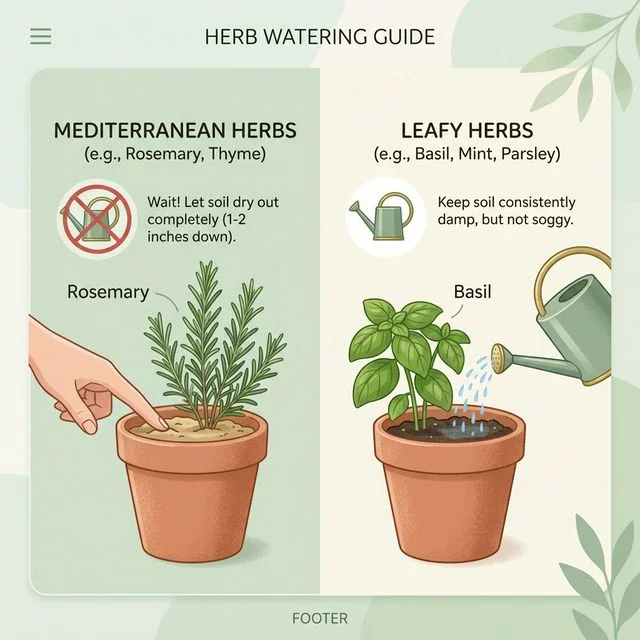
How often to water potted herbs: a by-herb chart
Most potted herbs should be checked often but watered only when the root zone is actually drying. Judge the pot instead of following a rigid calendar.
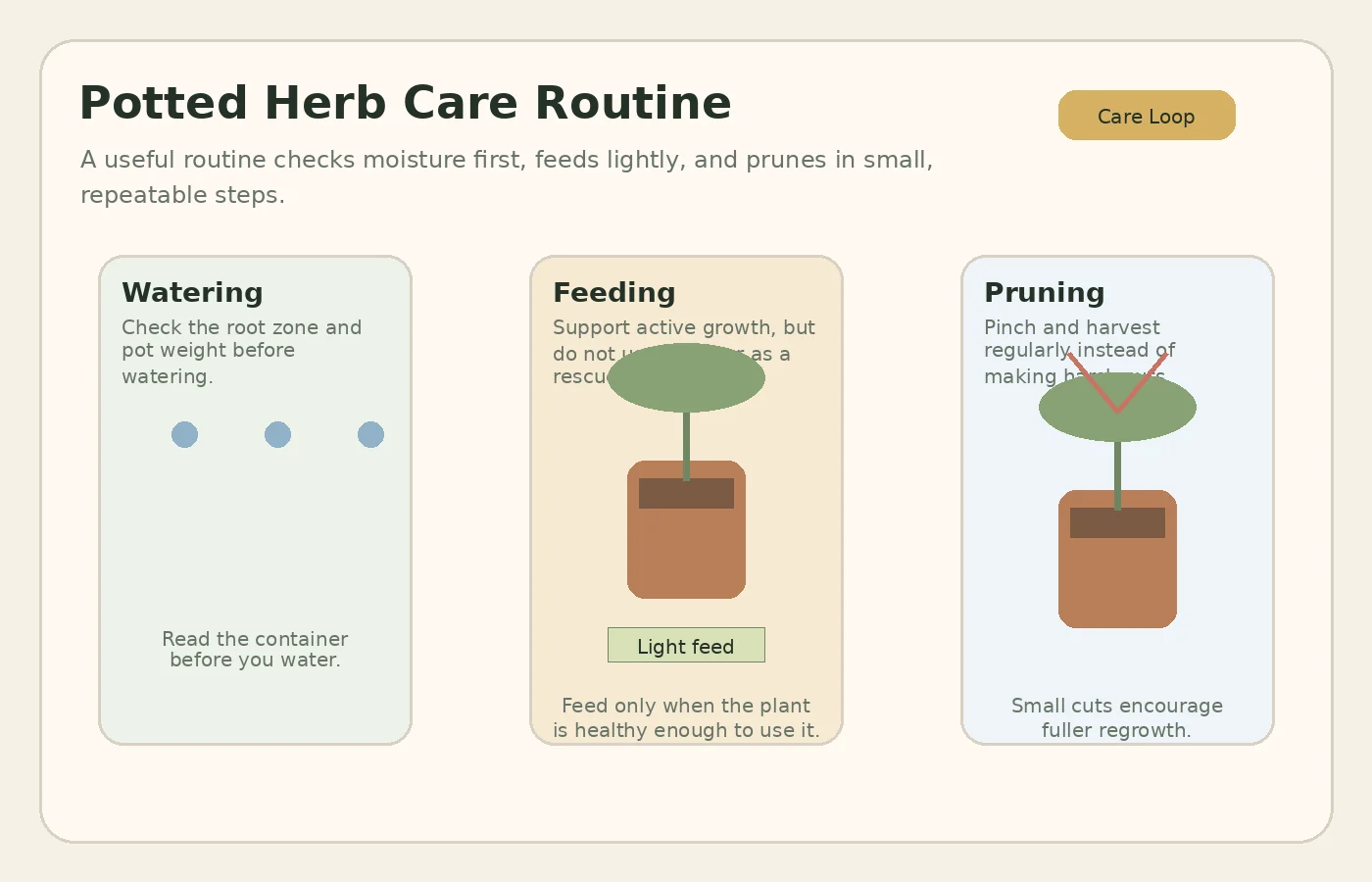
Potted herb care: watering, feeding, and pruning without guesswork
A practical guide to keeping basil, parsley, mint, thyme, and chives healthy by matching watering, feeding, and pruning to the setup.
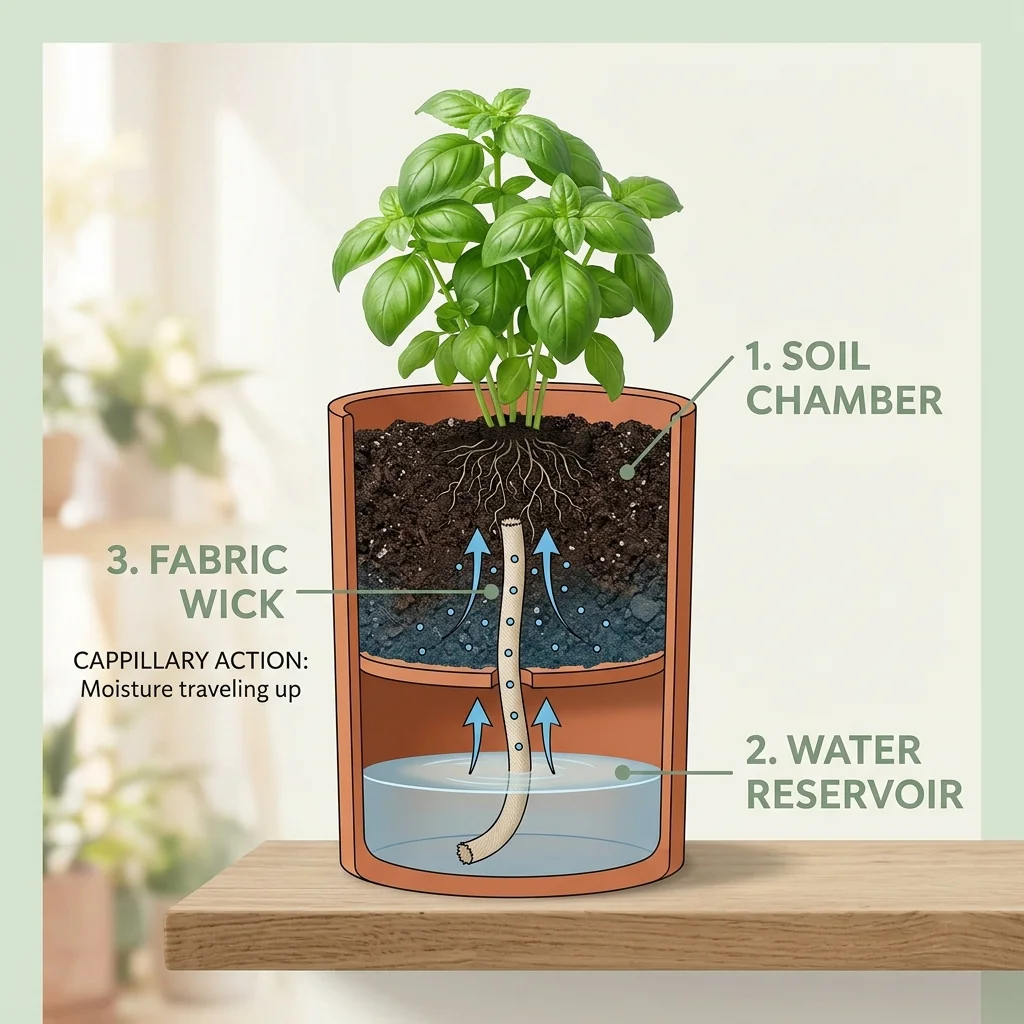
Best self-watering pots for herbs
Self-watering pots take the guesswork out of watering thirsty herbs, but they are wrong for Mediterranean herbs. Here is how to choose and who they suit.