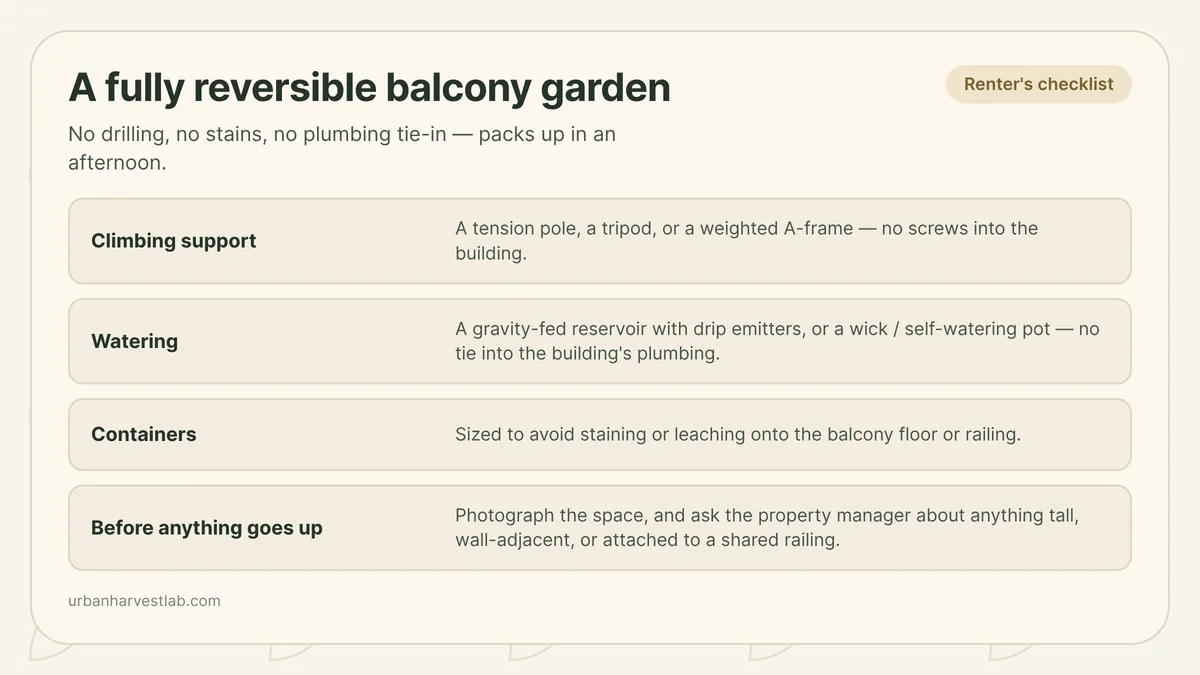
A fully reversible rental garden avoids four kinds of permanent change: holes in a wall or railing, stains or leaching from the containers themselves, a water line tied into the building’s own plumbing, and enough uncontrolled weight or wind to turn into a liability question. Solve those four and a balcony or apartment garden comes apart in an afternoon, with a security deposit intact and nothing left behind for the next tenant to explain. A beginner’s apartment vegetable garden plan already covers light, containers, crops, and routine; a rented balcony or apartment adds one more constraint on top of all of them — nothing in the setup can leave a mark, a hole, or a modification behind once the lease ends.
What “reversible” actually means to a landlord
A landlord does not experience a rental garden as pots and plants. A landlord experiences four possible outcomes instead: a mark on paint or flooring, a hole that needs patching, a plumbing or electrical change nobody approved, or a weight and wind incident that turns into an insurance conversation — and a move-out inspection checks for exactly those four, not for whether the plants themselves were well kept.
Anchoring a plant without a single screw
A climbing plant, a hanging basket, or a tall grow-light stand all want something to hold onto, and a rented balcony has no ground to sink a post into and usually no permission to drill one. Three approaches solve that without a fastener: a tension-mounted pole wedged between a floor and a real ceiling or overhang, a tripod or obelisk pushed straight into the potting mix so the pot itself becomes the anchor, and a free-standing A-frame or weighted-base panel that rests its own weight on the floor instead of the container. How to trellis a plant without drilling a single hole works through which of the three fits a given vine’s actual weight, and the same free-standing logic extends past trellising: a tiered plant stand or a wheeled shelving unit holding a grow light or a row of pots needs its own base and its own feet, not a wall bracket.
Choosing a container that doesn’t stain, leach, or disqualify a deposit
Check what is under the pot, not just what is in it. An unglazed terracotta pot wicks moisture and dissolved minerals out through its wall as it dries, which marks a wood deck or a carpet in a way a glazed ceramic or a plastic pot does not; a saucer, or a set of pot feet lifting the base an inch off the floor, catches that before it reaches anything a move-out inspection will look at. What a container is made of matters just as much when the plant growing in it is food: food-safe containers for growing vegetables and herbs covers which recycling codes and which repurposed buckets are actually safe to grow in — a question that has nothing to do with staining, and everything to do with what you’re willing to eat out of a rented balcony.
Watering without tying into the building’s plumbing
Assume there is no tap on the balcony. Running a line to an indoor tap for a whole season is its own kind of permanent change. A gravity-fed reservoir with drip emitters solves that for a full row of pots without a pump or a tap, sized from measured water use rather than a fixed rule; balcony drip irrigation: sizing your emitters and reservoir works through the arithmetic for five, ten, or twenty pots. A wick setup or a self-watering pot does the same job with less to build for a handful of containers, and either one packs into a moving box as easily as the plants themselves.
Weight and wind: the two ways a freestanding setup becomes a liability
Nothing in a fully reversible setup is bolted down, which means weight and wind have to be managed on their own terms instead of engineered away. A container garden gets heaviest the moment every pot is fully saturated, and that number needs to be checked against what a balcony’s own structure — not a general figure found online — is actually rated to carry; balcony weight limit: calculate what your container garden really weighs works through that arithmetic from your own containers. Wind works the other way: nothing anchors a free-standing trellis or a tall planter to the floor, so it has to resist tipping on its own footprint and its own ballast, which windproof balcony garden: anchoring, plant choice, and windbreaks covers for both the plants and the structures holding them up.
Protecting plants through a season without building anything permanent
Seasonal change is the part of a rented garden most likely to tempt someone into something fixed — a cold frame screwed to a railing, a greenhouse panel bolted to a wall. Neither has to happen. The Royal Horticultural Society’s advice for a tender plant left outdoors over winter is to move the pot, not build around it: place it “where they cannot be frozen, saturated by rain or allowed to become too dry,” such as “in the rain shadow of walls, in a coldframe or even in an open fronted shed,” and wrap it in bubble polythene ahead of a hard freeze. University of Illinois Extension moves the plant indoors entirely instead: sage, rosemary, and bay are commonly overwintered indoors as tender perennials, kept in a 40-60°F band with bright light until outdoor daytime temperatures are reliably above 60°F again. How to overwinter rosemary and thyme in pots and overwintering pepper plants cover the technique crop by crop; the principle behind both is the same one: move the plant, rather than modify the building around it.
Documenting the space before anything goes up
A few minutes of paperwork protects a deposit more reliably than any container choice on its own. Photograph the balcony, the railing, and the floor before the first pot arrives, including any marks or wear that already exist, so a later dispute has a clear before-and-after. Keep the same habit at move-out: photograph the empty space once everything is packed. For anything tall, anything visible from outside the unit, or anything attached to a shared railing rather than free-standing, a short written note to a property manager ahead of time costs less than an argument after the fact — a lease often has a clause on exterior alterations worth checking beforehand, and a landlord who has seen a plan in writing has less reason to treat a trellis or a planter as a surprise.
Packing it up: a move-out checklist
| Item | Reversible if… | Check before you leave |
|---|---|---|
| Vertical support | Tension-mounted, pot-set, or free-standing rather than screwed to a wall or railing | Unwedge, untie, or lift it out; patch nothing |
| Containers | Food-safe material, sitting on a saucer or pot feet, with no adhesive or hardware attaching them to a surface | Wipe down and lift away; check for a ring or stain underneath |
| Watering | Gravity-fed reservoir, wick, or self-watering pot rather than a line tapped into the building’s plumbing | Disconnect and drain the reservoir; nothing stays behind |
| Weight and wind | Placed within a checked, documented limit; ballasted rather than fastened down | Redistribute or remove the heaviest pots before a final walkthrough |
| Seasonal protection | Moved indoors or to a sheltered spot rather than built | Bring everything in before the space is handed back |
Sources
Putting the reversible pieces together
Each piece of a fully reversible setup gets its own deep dive; these cover the support, container, and watering decisions in full.
Common questions
What makes an apartment or balcony garden fully reversible for a renter?
Four things: nothing drilled or fastened into a wall, railing, or ceiling; containers that do not stain a surface or leach into the soil; a watering setup that does not tie into the building's own plumbing; and enough attention to weight and wind that nothing becomes a safety or liability problem. Solve those four and the whole setup packs into moving boxes without a mark left behind.
Do I need a landlord's permission to put pots on a balcony?
Usually not for containers sitting on the floor. A tall freestanding structure, anything visible from outside the unit, or anything attached to a shared railing is worth a short written note to a property manager beforehand, since a lease often has a clause on exterior alterations, so read yours before anything tall goes up.
Will a container garden affect my security deposit?
Only if it leaves something permanent behind: a drilled hole, a stain from an unglazed pot or a leaching container, or water damage from a system tapped into the building's plumbing. Freestanding supports, food-safe and saucer-protected containers, and a self-contained watering setup avoid all three.
Can I take my whole garden with me when I move?
Yes, as long as every piece of it is potted and freestanding rather than fixed to the building. A tension pole, a tripod, an A-frame, a reservoir-fed drip line, and the containers themselves all break down and pack the same way the plants do.
Related guides
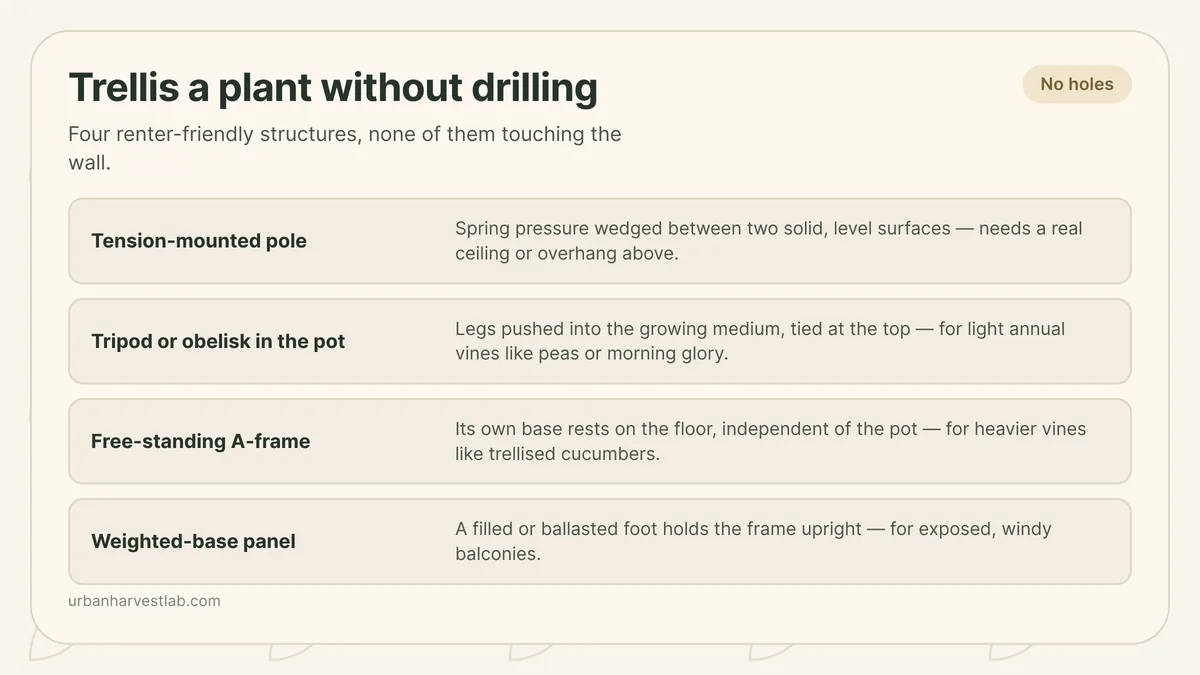
How to trellis a plant without drilling a single hole
A container has no ground to sink a post into, so a renter-friendly trellis has to get its stability from somewhere else. Four approaches do that without touching a wall, railing, or ceiling.
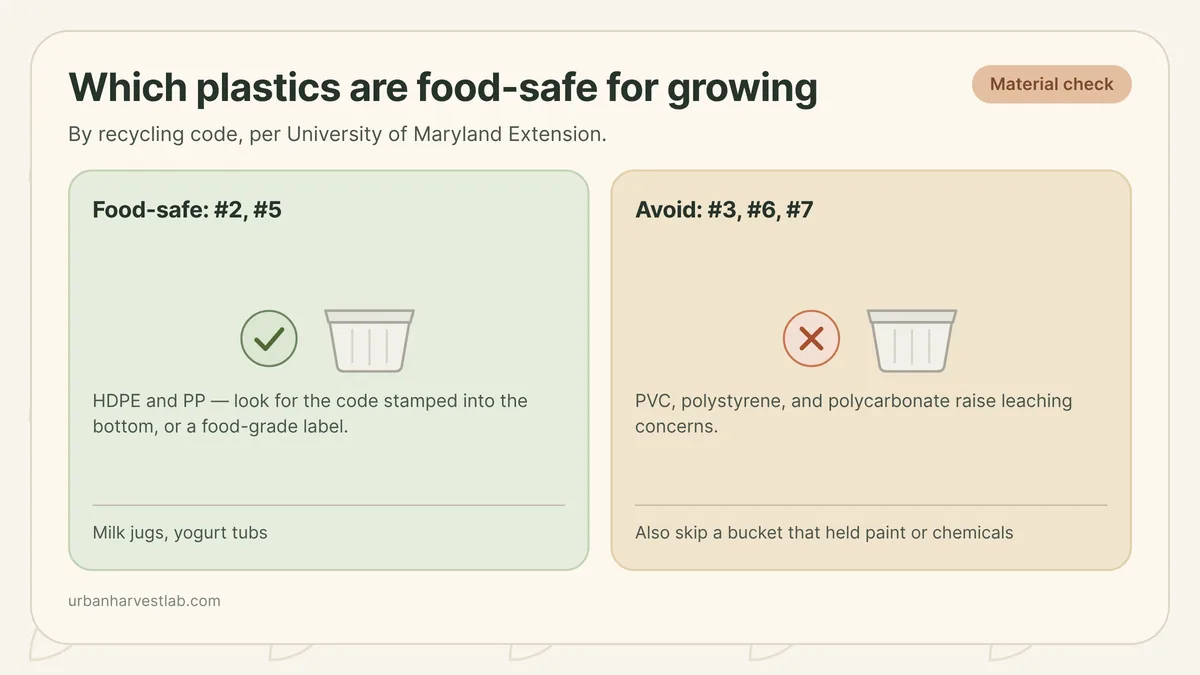
Food-safe containers for growing vegetables and herbs
A container's recycling code and its history both decide whether it's safe to grow food in -- and the two questions have different answers.
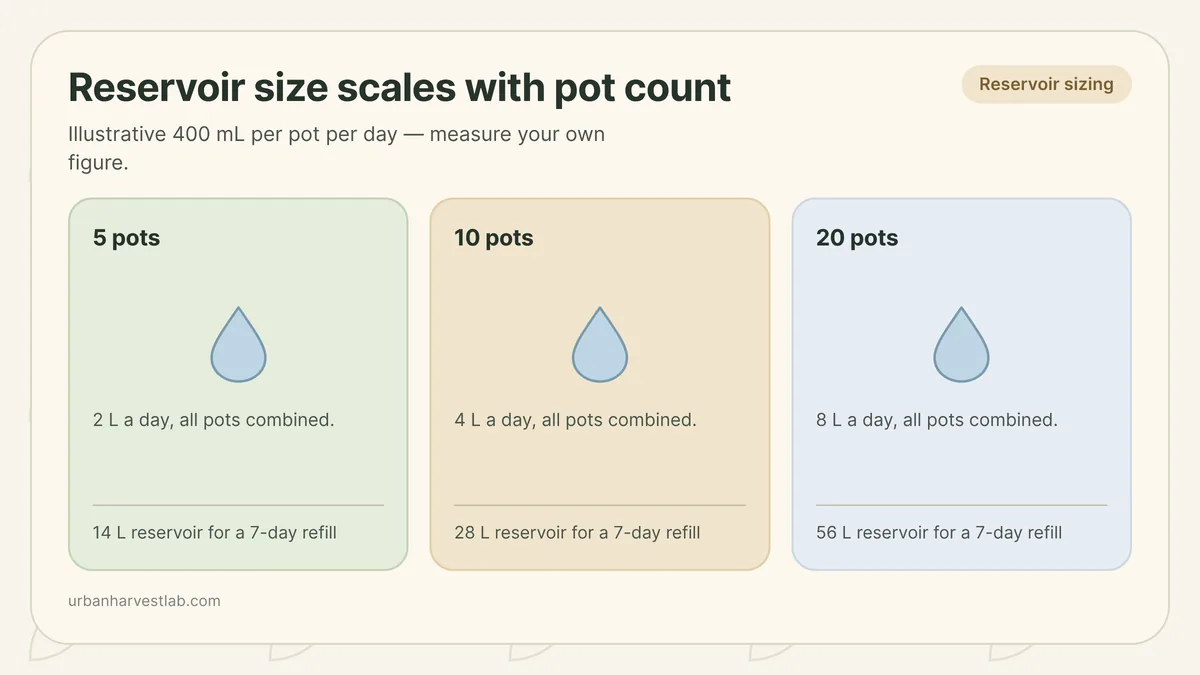
Balcony drip irrigation: sizing your emitters and reservoir
A gravity-fed drip system with its own reservoir waters a whole row of balcony pots without a hose bib. Here is how to size the emitters and the tank from your own numbers.