
Seed life in years, by extension source (properly stored)
| Crop | Illinois | Wisconsin | South Dakota State | Kansas State |
|---|---|---|---|---|
| Onion | 1 | 1 | 2 | 1 |
| Parsley | 1 | - | 2 | 1 |
| Pepper | 2 | 2 | 2 | 2 |
| Corn | 2 | 2 | 2 | 2-3 |
| Bean, pea | 3 | 3 | 3 | - |
| Carrot | 3 | 3 | 3 | 2-3 |
| Beet | 4 | 4 | 4 | 2-3 |
| Tomato | 4 | 4 | 4 | 4 |
| Spinach | 3 | 5 | 3 | 2-3 |
| Lettuce | 6 | 5 | 2 | 4-5 |
| Cucumber, radish | 5 | 5 | 5 | - |
Most vegetable seed stays good for 2 to 5 years if you keep it cool and dry, and the packet in your drawer is probably still usable. Onion, parsley and parsnip are the exceptions at about a year. The surest way to know is a germination test: 10 seeds, a damp paper towel and the days to germination printed on the packet (7 to 10 days if it gives none, per Illinois Extension).
If you are deciding what to sow this spring from last year’s leftovers, this is the check to run before you fill a tray. It also helps when you are weighing seed against buying plants for the same herbs, since a cheap packet only saves money if it comes up. Once the seed is sorted, the seed starting calculator turns your last frost date into sowing dates.
How long seeds last, crop by crop
Kansas State Extension says most garden seeds remain viable for about 3 years under cool, dark, dry conditions, with exceptions. University of Vermont Extension says most are good for an additional year or two after the packet date, and that tomato and kale are usually viable for four years while corn and pepper last two, “though that can vary”.
The table gives four extension services side by side. Where the numbers differ, that is real: the sources do not agree.
Lettuce is the widest gap. Illinois Extension lists 6 years, Wisconsin 5, Kansas State 4 to 5 and South Dakota State 2. Spinach runs from 2 to 3 years (Kansas State) up to 5 (Wisconsin). Do not pick one number and trust it. Treat the crops with a spread as “test before you rely on it”, and the crops where all sources land in the same place, such as tomato at 4 and pepper at 2, as safer bets.
The carrot family is the short-lived group. Kansas State puts carrots, parsnips and parsley at 1 to 2 years, though the same Kansas State page lists carrots at 2 to 3 years in its per-crop list, and South Dakota State calls parsnips “notoriously short-lived”. Illinois gives parsley 1 year, South Dakota State 2. Buy parsley and parsnip seed fresh each year, or test it.
Illinois Extension also lists kale, Swiss chard and eggplant at 4 years and leek at 2.
What shortens seed life
Humidity first. South Dakota State Extension says reducing humidity is the most important factor in extending seed life, and that relative humidity below 60% is best. Illinois Extension adds that the drier the seed is when you put it away, the longer it keeps.
Heat second. South Dakota State Extension says exposure to temperatures above 90°F greatly decreases viability, which is one more reason to keep packets out of a hot shed or car.
Warmth and moisture together can start the seed growing in the packet. Illinois Extension warns that seed which sprouts in storage will not grow the next year when planted.
Age lowers vigor before it lowers the germination count. Illinois Extension notes that if very few seeds from a packet germinate, the ones that do are not likely to grow strong, healthy plants. South Dakota State describes the cost: slower emergence, uneven stands and more seedling rot from old seed.
How to store seeds so they last
Use a sealed jar or a zip-top bag, and keep it somewhere cool, dry and dark.
- Temperature. Illinois Extension recommends below 45°F and says a sealed container in the refrigerator is best if you have room. Kansas State gives 40 to 50°F and says slightly lower is fine as long as it does not freeze. Vermont and Wisconsin both say about 40°F.
- Refrigerator or freezer. Kansas State prefers the refrigerator, because a freezer can be detrimental if the seed holds too much moisture.
- Condensation. Let a cold jar come to room temperature before you open it (Illinois and South Dakota State), or moisture settles on the seed. If you see condensation inside the jar, South Dakota State says you may have a problem.
- Where not to keep them. South Dakota State says to avoid sheds and garages in summer because of humidity. Illinois says a cool basement or garage that does not freeze is fine in winter.
- Not next to fruit. Wisconsin Extension advises keeping seed away from fruit and vegetables that are not fresh, because aging produce gives off ethylene, which harms germination.
- Seed you saved yourself. South Dakota State says to make sure it is thoroughly dry before storing it. Drying and collecting are covered in saving seeds from container plants.
Label each jar with the crop and the year. Packets carry a “packed for” date, but Vermont Extension points out that leftover seed does not have to go in the bin when that year ends.
The paper-towel germination test
You need 10 seeds, a paper towel, and a plastic bag or container. The steps below combine Illinois, Vermont and Wisconsin Extension.
- Dampen a paper towel. Wisconsin says very moist but not dripping; Illinois warns that if it is too wet the seeds will rot.
- Lay 10 seeds along one edge, then fold or roll the towel so every seed touches the damp surface.
- Put it in a bag. Wisconsin Extension suggests sealing the bag about 70% so a little air gets in and it does not mould; Illinois and Vermont say a closed bag.
- Write the date, the crop and the days to germination from the seed packet on the bag.
- Keep it warm. Illinois Extension says above 70°F, and Vermont Extension suggests the top of the refrigerator.
- Check every few days that the towel has not dried out (Vermont Extension), or every 2 to 3 days (Wisconsin Extension). If the packet gives no germination time, Illinois Extension says to check at 7 to 10 days.
- Count the sprouts. Each one is 10 percent: 8 sprouted is 80 percent.
What the result means
Illinois draws the buy-new line at 6 of 10, Vermont at under half and Wisconsin at under 4 of 10.
| Result (of 10) | Illinois Extension infosheet | Other sources |
|---|---|---|
| 10 | Plant as normal | |
| 7 to 9 | Sow more seeds | Illinois blog: sow thicker at 70 to 90 percent |
| 5 or 6 | Buy new seed | Wisconsin: plantable at 40 percent or more, sow extra |
| Under 5 | Buy new seed | Vermont: under half, consider new; Wisconsin: under 40 percent, get fresh |
A middling result is not wasted seed. South Dakota State suggests sowing old seed at a higher rate or mixing it with new. In a pot, that means sowing a few extra and removing the surplus later, which thinning seedlings explains. For a result near the low end, weigh the packet price against the tray space and weeks you would spend on weak plants.
Peas, beans and corn have a quicker check. Illinois Extension says to put them in a bowl of water: if they sink they are fine, and if they float, throw them out.
Sprouted seeds from the test do not need to be wasted. Illinois and Vermont both say to cut around the seed and plant it with the paper. Handle the root gently, and the seedlings will need the usual care before they go outside; the plan for that is in hardening off seedlings.
When a test is worth running
Spend the test on seed from the middle of the table, such as pepper, tomato, carrot or lettuce that is three or more years old, or on any packet that sat somewhere warm or damp. Onion, parsley and parsnip older than a year or two are better replaced than tested, given the 1 to 2 year figures above.
A good test result and an empty tray point somewhere other than the seed. The medium matters, and seed starting mix versus potting mix covers it. If you are growing microgreens and nothing is coming up, see why microgreens are not germinating.
Sources
- University of Illinois Extension: Will my seeds still grow? (infosheet)
- University of Illinois Extension: Test seed viability
- University of Wisconsin-Madison Extension: Testing seed viability
- South Dakota State University Extension: How to store leftover garden seeds
- Kansas State University: How long can garden seed be kept?
- University of Vermont Extension: Can old seeds still grow?
Start seeds well
Decide between seed and plants, time your sowing and thin the trays that come up.
Common questions
How long do seeds last?
Most vegetable seed stays usable for 2 to 5 years when stored cool and dry. Onion, parsley and parsnip are about 1 year; corn and pepper about 2; beans, peas and carrots about 3; tomato about 4; cucumber and radish about 5 (Illinois, Wisconsin and South Dakota State Extension). Kansas State suggests about 3 years as a general figure.
How do you test whether old seeds will germinate?
Put 10 seeds on a damp paper towel, fold it, seal it in a plastic bag and keep it warm. After the number of days on the seed packet, count how many sprouted. Seven to nine of 10 means sow a little thicker; six or fewer means buy new seed (Illinois Extension).
Where is the best place to store seeds?
Somewhere cool, dry and dark, in a sealed jar or bag. Illinois Extension recommends below 45°F and a refrigerator if you have room; Kansas State gives 40 to 50°F. South Dakota State warns against sheds and garages in summer because of humidity.
Can you freeze seeds?
Kansas State Extension prefers a refrigerator to a freezer, because a freezer can harm seed longevity if the seed holds too much moisture. Keep seed dry first, whichever you use.
Related guides
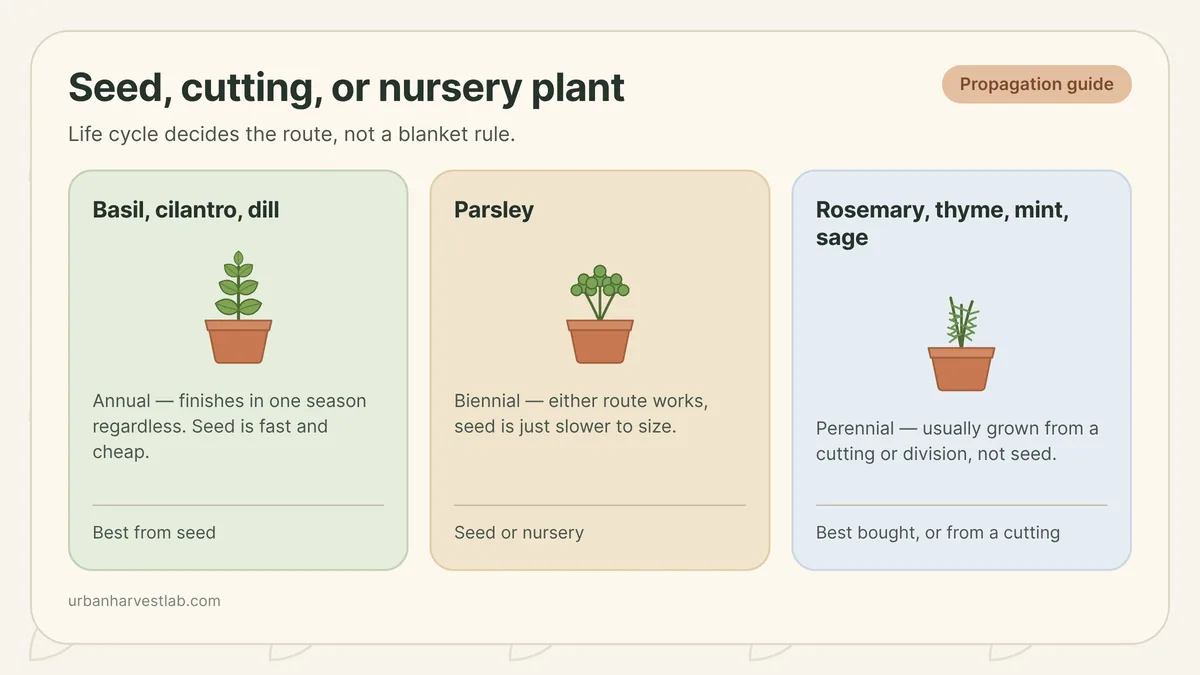
Herbs from seed or buying plants: how to decide
Some herbs finish a whole life cycle from seed in a matter of weeks; others are slow, woody, or simply propagated a different way. The life cycle of the herb, not a blanket rule, is what actually decides which route makes sense.
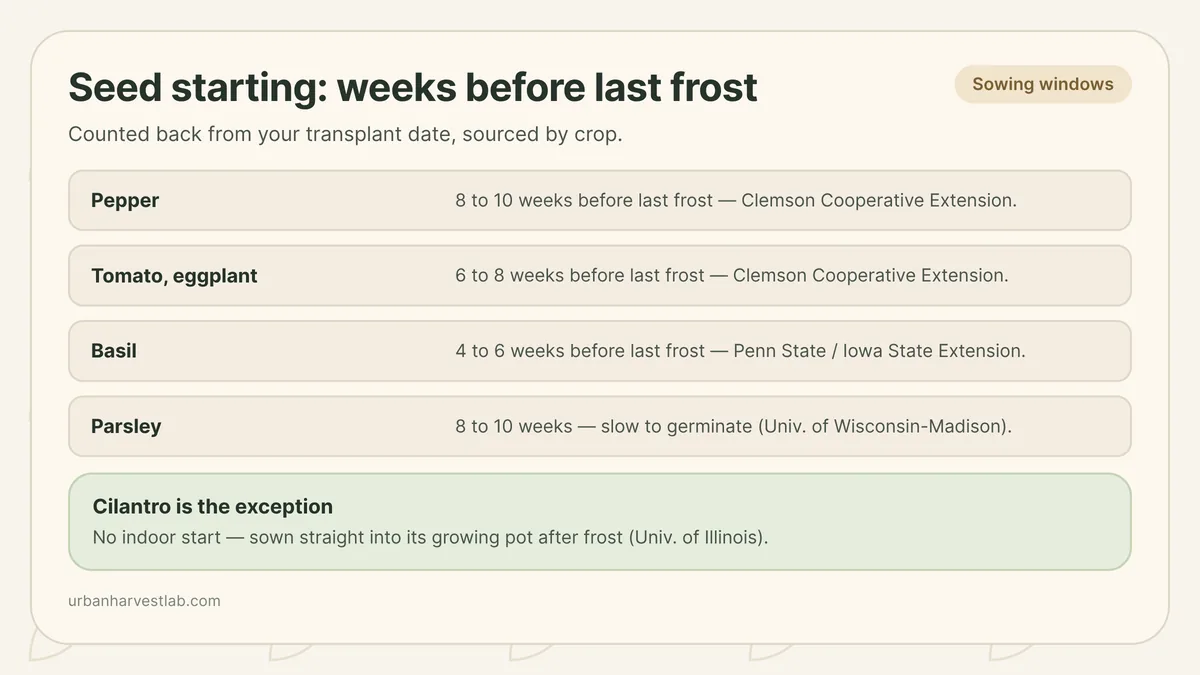
Seed starting calculator: sowing dates from your last frost date
A last frost date is only useful once you count backward from it. This works out that count crop by crop, instead of applying one week figure to everything in the seed drawer.

How to save seeds from container vegetables: tomatoes, beans and peppers
Tomatoes, peppers, beans and peas are the easiest vegetables to save seed from, as long as the variety is not an F1 hybrid. Here is how to do each one from a pot.